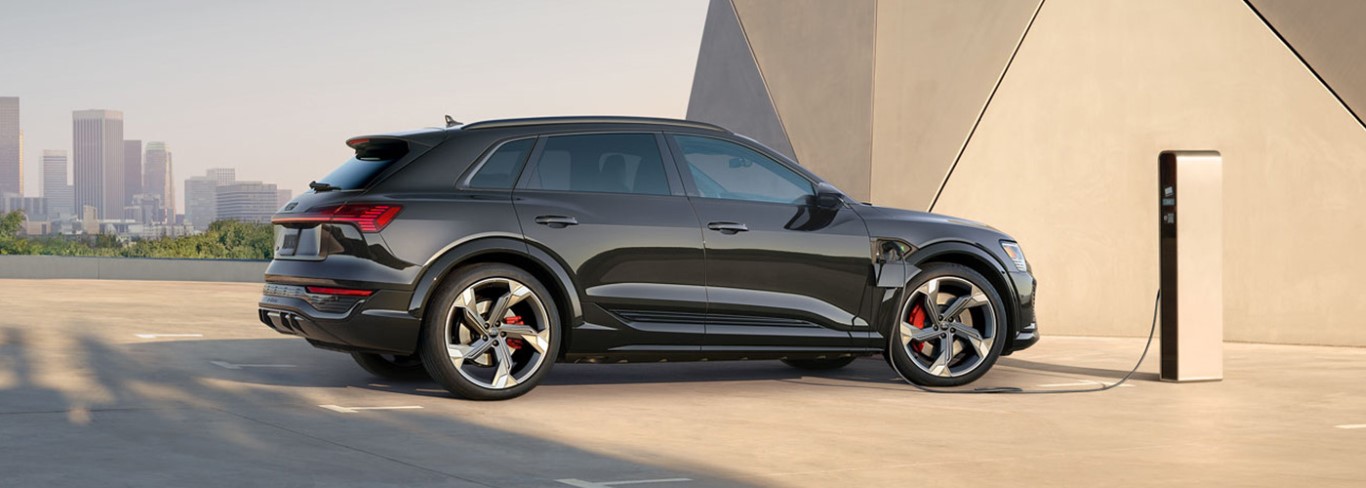
1st Generation
(2024-)
Triple-motor electricity: the vanguard of electric all-wheel drive in a high-performance, zero-emissions SUV.
Select a generation to see available versions
(2024-)
The global automotive industry is going through its most radical period of transformation in over a century, marked by the transition from internal combustion engines to electric propulsion. In this scenario, Audi, a premium subsidiary of the Volkswagen Group, has taken an avant-garde position among traditional German manufacturers. The Audi SQ8 e-tron is not just an isolated product; it represents the culmination of the first phase of this electric strategy, serving as the performance standard-bearer for the brand's family of electric SUVs.
This report is dedicated to an exhaustive analysis of the trajectory, engineering, production details, and market impact of the Audi SQ8 e-tron. The model distinguishes itself technically by being one of the few mass-production vehicles in the world to use a three-electric-motor (tri-motor) configuration, which gives it unique dynamic capabilities through electric torque vectoring.
The importance of the SQ8 e-tron lies in its ability to unite the brand's traditional luxury with the new reality of zero-emission propulsion, correcting the limitations of previous generations and establishing a technological bridge to future dedicated platforms. Throughout this document, we will explore how the model evolved from the old "Audi e-tron S", its detailed technical specifications, its reception in the global and Brazilian markets, and the challenges inherent to its production and positioning.
To understand the essence of the SQ8 e-tron, it is fundamental to analyze the evolutionary lineage that preceded it. The model is the direct result of a learning and refinement process that began with the launch of Audi's first purely electric vehicle in the modern era.
The story begins in 2018, with the launch of the model named simply "Audi e-tron". At that time, Audi opted to use "e-tron" as the model name, similar to what it did with the original "Quattro" in the 1980s, to emphasize the novelty of the technology. This SUV was built on a deep adaptation of the MLB Evo platform, an architecture originally developed for vehicles with a longitudinal combustion engine.
The decision to use an adapted platform, rather than a dedicated one (like the future PPE or MEB), allowed Audi to reach the market quickly with a product that maintained the robustness and comfort characteristics known to its customers, but imposed certain compromises in terms of spatial efficiency and weight.
In 2020, Audi expanded the range with the launch of the Audi e-tron S and the Audi e-tron S Sportback. This was the true technical genesis of the SQ8. The "e-tron S" introduced the world innovation of three-motor drive in a mass-production car. The goal was clear: to prove that electric cars could be emotionally engaging and dynamically superior to their combustion equivalents, not only in a straight line, but also in corners.
As Audi launched new electric models, such as the Q4 e-tron and the e-tron GT, the "Audi e-tron" nomenclature for the large SUV became confusing. Consumers had difficulty positioning the car in the brand's hierarchy. Was it equivalent to a Q5 or a Q7?
To resolve this ambiguity and align the portfolio, Audi took advantage of the model's mid-life update (facelift) in November 2022 to rename it. The Audi e-tron became the Audi Q8 e-tron, and its sporty "S" version was renamed as the Audi SQ8 e-tron.
This name change had a dual purpose:
The introduction of the SQ8 e-tron in the global market followed a staggered strategy, typical of premium launches:
The most striking feature of the Audi SQ8 e-tron, which differentiates it from practically all its direct competitors, is its propulsion system (powertrain). While most all-wheel-drive electric SUVs use two motors (one per axle), the SQ8 employs three.
The SQ8 e-tron is equipped with three asynchronous electric motors. The choice of asynchronous motors (as opposed to the more common permanent magnet synchronous ones) is strategic for this performance model. Asynchronous motors have the advantage of being able to be electrically deactivated without generating significant magnetic drag (coasting), which improves efficiency at cruising speeds when full power is not needed.
The distribution of the motors is configured as follows:
This complex configuration results in expressive performance numbers, especially when "Boost" mode is activated.
| Parameter | Specification (Boost Mode) | Technical Context |
|---|---|---|
| Maximum Power | 370 kW (503 hp) | Available for limited periods (usually 8-10 seconds) to protect the battery and motors. |
| Total Torque | 973 Nm (99.2 kgfm) | Torque is almost instantaneous, providing a brutal acceleration response. |
| 0-100 km/h Acceleration | 4.5 seconds | Competitive value for a vehicle weighing over 2,600 kg. |
| 0-60 mph Acceleration | 4.2 seconds | Standard measure used in the North American market. |
| Top Speed | 210 km/h (limited) | Electronically limited to preserve the single gear ratio and the battery's efficiency. |
The true engineering triumph of the SQ8 e-tron is not its straight-line acceleration, but rather its cornering behavior, made possible by electric torque vectoring. In a vehicle with a conventional differential, the force is divided mechanically. If one wheel loses traction, the system must brake that wheel (loss of energy) to transfer force to the other. In the SQ8 e-tron, Audi eliminated the mechanical rear differential.
Operating Mechanism:
The advantage of this purely electric system is its reaction speed. Audi claims that the latency (response time) is only a quarter of the time of a mechanical system, allowing for adjustments that are almost imperceptible to the driver, but vital for stability.
The transition from the "e-tron S" name to "SQ8 e-tron" brought with it a critical update in energy storage technology. Range was the "Achilles heel" of the previous generation, and Audi focused its engineering resources to mitigate this problem without altering the physical size of the battery pack.
The SQ8 e-tron uses a high-voltage battery with a gross capacity of 114 kWh and a net (usable) capacity of 106 kWh.
Audi is recognized in the industry for prioritizing the "charging curve" rather than just the "peak charge".
The range of the SQ8 e-tron varies significantly depending on the test cycle and the body configuration (SUV vs. Sportback).
| Test Cycle | Estimated Range | Observations |
|---|---|---|
| WLTP (Europe) | 440 – 470 km | Optimistic cycle. The Sportback version has a higher range due to better aerodynamics. |
| EPA (USA) | ~407 km (253 miles) | More realistic cycle, considering mixed use and highways. |
| PBEV (Brazil) | 296 – 307 km | Extremely conservative Inmetro methodology (correction factor of 30%). Real-world use in Brazil tends to exceed this number. |
The discrepancy in the Brazilian numbers is due to Inmetro's rules, which heavily penalize electric vehicles to avoid consumer frustration. In practice, Brazilian owners report ranges closer to 380 km in moderate urban use.
The design of the SQ8 e-tron was refined to communicate its new position in the brand's hierarchy and to improve aerodynamic efficiency, vital for an electric vehicle's range.
Audi offers the model in two body variants, both sharing the same mechanics and technology.
The SQ8 visually distinguishes itself from the regular versions (Q8 50 and 55) through exclusive elements:
One of the most futuristic and controversial items on the SQ8 e-tron are the virtual exterior mirrors. Replacing traditional glass mirrors with thin stalks housing cameras, the images are projected onto high-resolution OLED screens (1200x800 pixels) located on the front doors, just above the door handles.
Brazil represents a niche but strategic market for Audi's high-performance division. The launch of the SQ8 e-tron in the country was treated with priority to reinforce the brand's technological image.
The official launch in Brazil took place in January 2024, marking the first major launch in the year of Audi's 30th anniversary in the country. The version chosen to lead the offering was the Audi SQ8 Sportback e-tron, due to its stronger visual appeal.
To justify the high price, Audi do Brasil configured the SQ8 e-tron with an extremely generous equipment package ("full options").
The performance of the SQ8 e-tron in the Brazilian Vehicular Labeling Program (PBEV) reflects the strictness of local standards.
The analysis of the SQ8 e-tron's production and sales data requires an understanding of how Audi reports its financial and industrial numbers.
All global production of the Audi Q8 e-tron and SQ8 e-tron is centralized at the Audi factory in Brussels (Forest), Belgium. This manufacturing facility is historic and symbolic for the brand, as it was the first high-volume factory in the premium segment to be certified as carbon neutral.
The factory uses green energy, gigantic solar panel systems, and emissions offsetting to ensure that the vehicle's production has the lowest environmental impact possible, aligning with the car's sustainable proposition.
Audi, in its annual and quarterly reports, does not disclose the granular breakdown of sales by specific variant (e.g., how many "SQ8s" vs how many "Q8 55s" were sold). The numbers are reported in aggregate for the "Q8 e-tron" family.
The positioning of the SQ8 e-tron places it in direct confrontation with other luxury electric "super SUVs".
| Characteristic | Audi SQ8 e-tron | BMW iX M60 | Mercedes-AMG EQE 53 |
|---|---|---|---|
| Platform | Adapted (MLB Evo) | Dedicated (Aluminum/Carbon) | Dedicated (EVA2) |
| Motors | 3 (Tri-Motor) | 2 (Dual-Motor) | 2 (Dual-Motor) |
| Power | 503 hp | 619 hp | 625 hp |
| Torque | 973 Nm | 1,100 Nm | 950 Nm |
| Battery (Net) | 106 kWh | 105 kWh | 90.6 kWh |
| Differential | True Vectoring (Twin-Motor Rear) | Electronic/Brakes | Electronic/Brakes |
| Style | Traditional/Conservative | Avant-garde/Controversial | "One-Bow" (Ovoid) |
Comparative Analysis:
The Audi SQ8 e-tron occupies a unique and transitional position in the brand's history. It is the pinnacle of what was possible to achieve by adapting a combustion platform for the electric era.
Despite its qualities, the SQ8 e-tron faces imminent technological challenges.
The Audi SQ8 e-tron is a show of strength from Audi's engineering. Faced with the need to quickly electrify its fleet, the brand not only adapted an existing chassis, but radically innovated with the tri-motor propulsion system to create a driving dynamic that defies the physics of a 2.6-ton vehicle.
For the consumer, the model represents a "safe transition" choice: it offers cutting-edge electric technology (motors, batteries) wrapped in a familiar luxury package, with physical buttons, impeccable finish, and a design that does not scream "I am an electric car". In the Brazilian market, it serves as a symbol of status and performance, offering exclusivity through its price and technical specifications. Although not the most powerful or the most modern in terms of voltage architecture, the SQ8 e-tron remains the benchmark for sporty drivability and torque vectoring in the luxury electric SUV segment.