

8J
(2010 - 2014)
2.5 Turbo (5 Cylinders)
360 cv
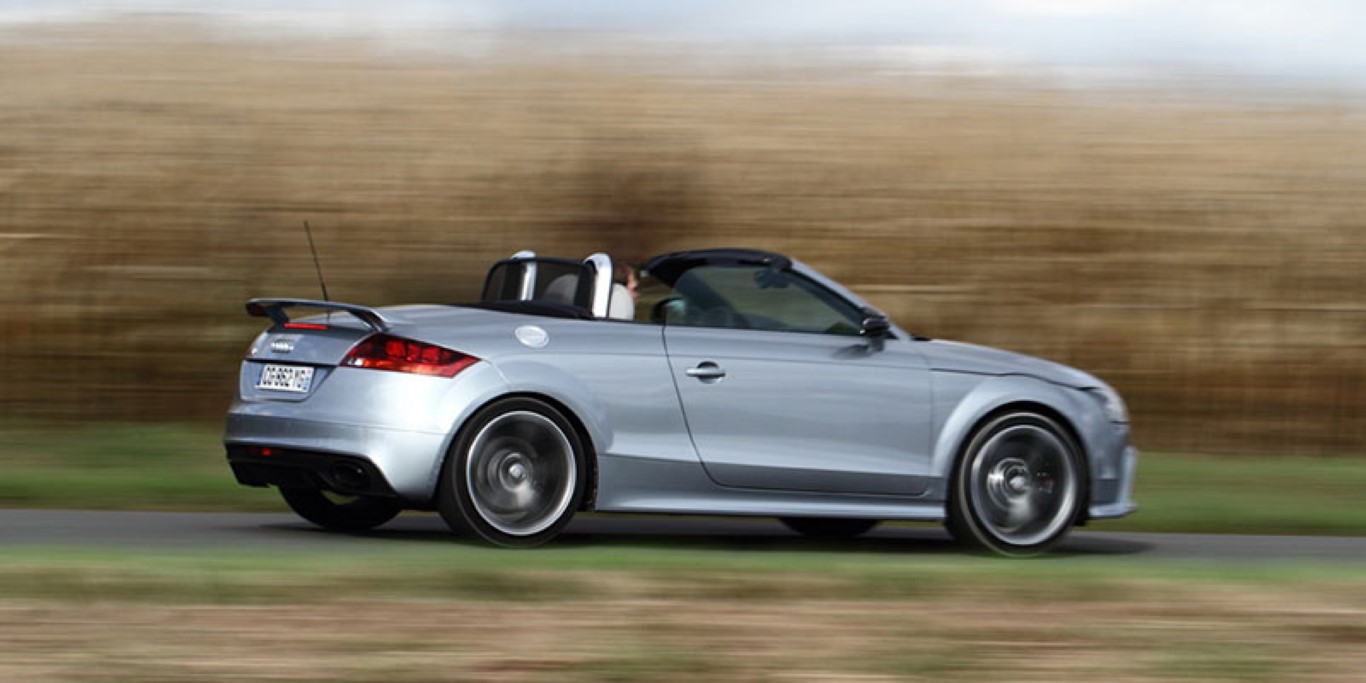
Technical specifications, versions, and history for the Audi TT RS Roadster.
Select a generation to see available versions
(2010 - 2014)

(2017 - 2019)

(2020 - 2023)
Select a powertrain to view full technical specifications
The Audi TT RS represents the apex of a lineage that began as a radical design experiment and evolved into one of the most competent and charismatic sports cars of the modern era. This report dissects the trajectory of the "RennSport" (RS) model of the TT family, covering its two generations of existence (Mk2 and Mk3), its detailed technical specifications, production volumes, and the cultural impact of its five-cylinder engine.
The history of the TT begins long before the RS version. The original concept, presented in Frankfurt in 1995, shocked the world with its "Bauhaus" aesthetics, characterized by geometric wheel arches, a low roofline, and near-perfect symmetry. When production began in 1998, the TT (Tourist Trophy) established Audi as a leader in design. However, during the first generation (Mk1), although there were potent versions like the 3.2 VR6, it lacked a true high-performance model capable of challenging rivals like the Porsche Cayman S or the BMW Z4 M.
It was only with the arrival of the second generation (8J chassis) that Audi's high-performance division, quattro GmbH (now Audi Sport GmbH), was given the green light to create a "mini R8". The result was the launch of the TT RS in 2009, marking the historic return of the turbocharged five-cylinder engine, a configuration not seen in a performance Audi since the legendary RS2 Avant of the 1990s.
The acronym RS stands for "RennSport" (Racing Sport). Unlike the "S" models (like the TTS), which are sporty versions of street cars, the RS models are developed separately with a focus on extreme performance. For the TT, this meant not just more power, but a complete re-engineering of the suspension, brakes, aerodynamics, and crucially, the adoption of an exclusive powertrain that was not shared with the standard Volkswagen Golf or Audi A3.
To understand the Audi TT RS, one must dissect its most vital component: the engine. The decision to use an inline five-cylinder engine was not merely technical, but emotional and strategic.
The 2.5-liter TFSI (Turbo Fuel Stratified Injection) engine is what defines the car's character. Unlike four-cylinder engines (common and sometimes harsh) or V6s (smooth but complex to package transversely), the five-cylinder offers a unique compromise.
Although the displacement and configuration remained the same, the engine underwent a radical change between the Mk2 and Mk3 generations.
| Characteristic | CEPA/CEPB Engine (Mk2) | DAZA/DNWA Engine (Mk3) |
|---|---|---|
| Block Material | Compacted Graphite Iron | Aluminum Alloy |
| Engine Weight | ~183 kg | ~157 kg (26 kg lighter) |
| Cooling | Traditional mechanical water pump | Intelligent thermal management (electric pump) |
| Injection | Direct only | Dual (Direct + Indirect in the manifold) |
| Base Power | 340 hp (335 hp) | 400 hp (394 hp) |
The switch to aluminum in the Mk3 was crucial not only to increase power but to reduce weight over the car's nose, drastically improving cornering dynamics and reducing the tendency to push wide (understeer).
The second generation of the TT RS was presented at the 2009 Geneva Motor Show. It was the car that proved the TT platform could handle supercar power.
The Mk2 TT RS distinguished itself visually by its huge front air intakes, necessary to feed the intercooler and cool the brakes. The gloss black "Singleframe" grille with a diamond pattern and the TT RS logo were exclusive. At the rear, a prominent diffuser housed two large oval exhaust outlets (an RS line signature).
A point of controversy and choice for buyers was the rear spoiler. From the factory, the car came with a raised fixed wing, designed to generate real downforce. However, Audi offered as an option (at no cost in some markets) the substitution for the automatic retractable wing of the standard model, for those who preferred a more discreet ("sleeper") look.
A fascinating peculiarity of the Mk2's history is its introduction in North America. Audi initially did not plan to sell the TT RS in the US. Following an online campaign by enthusiasts, the brand relented and imported the model only for the 2012 and 2013 model years.
US Exclusivity: All units imported to the US were exclusively manuals. While Europe migrated to the faster S tronic gearbox, the US received the most purist configuration possible. This makes the American TT RS Mk2 one of the most collectible modern Audis, with only about 1,200 to 1,400 units sold in total.
To conclude the production of the Mk2 generation with a flourish, Audi launched the "Plus" version.
For anyone looking to acquire a Mk2 today, it's important to note:
Launched in 2016 (as a 2017/2018 model), the Mk3 represented the technological maturation of the concept. Based on the MQB platform, it brought significant advances in torsional rigidity and weight reduction.
The most drastic change in the Mk3 was the elimination of the central infotainment screen. Everything was integrated into the Audi Virtual Cockpit, a 12.3-inch TFT screen in front of the driver. In the TT RS, this screen gained an exclusive "RS Screen" configuration, highlighting the tachometer in the center, as well as providing G-force, tire pressure, instant torque, and lap time data. The air conditioning controls were ingeniously integrated into the air vents themselves, cleaning up the button panel.
In 2019, the TT RS received a visual and technical update.
| Metric | Mk2 TT RS (Manual) | Mk2 TT RS (S tronic) | Mk3 TT RS (S tronic) |
|---|---|---|---|
| 0-100 km/h | 4.6 s | 4.3 s | 3.7 s |
| 0-200 km/h | ~15.9 s | ~15.3 s | ~13.4 s |
| Weight (DIN) | 1,450 kg | 1,475 kg | 1,440 kg |
| Max. Speed | 250 (280 opt) | 250 (280 opt) | 250 (280 opt) |
Note: Independent tests frequently record the Mk3 doing 0-100 km/h in 3.4 to 3.6 seconds, beating Audi's official data.
Audi launched several special editions, especially towards the end of the Mk3's life, to maintain interest and honor the model's history.
An ultra-exclusive edition for the German market.
Farewell to the North American market.
Celebration of design in Europe.
The final package for one of the largest TT markets.
Audi produced a total of 662,762 units of all versions of the TT (Mk1, Mk2, Mk3) between 1998 and November 2023. However, the TT RS represents a minuscule fraction of that total, which guarantees its future rarity.
Because Audi does not publicly disclose the exact production breakdown by sub-model in global annual reports, we rely on registration and import data:
The last Audi TT produced in Győr, Hungary, on November 10, 2023, was not an RS, but rather a TTS Coupe in Chronos Gray. This event marked the end of 25 years of continuous production.
The TT RS uses an electro-hydraulic multi-plate clutch (Haldex) based system, typical of transverse engines.
Many TT RSs left the factory with Audi Magnetic Ride suspension. The shock absorbers contain a fluid with microscopic magnetic particles. When an electric current is applied, the particles align, increasing the fluid's viscosity and stiffening the suspension in milliseconds. This allows the car to be comfortable in the city and stiff on the track.
For those interested in acquiring a used TT RS, attention to detail is paramount.
The Audi TT RS occupies a unique place in automotive history. It democratized supercar performance, offering 0-100 km/h acceleration in the 3-second range for a fraction of the price of a Lamborghini or Porsche 911 Turbo.
More than numbers, the TT RS saved the five-cylinder engine from extinction. In an era of soulless downsized four-cylinder engines, Audi insisted on maintaining an exotic architecture that directly linked the car to the Group B Rally heroes of the 80s.
With the end of production in 2023 and Audi's move towards total electrification, it's unlikely we'll see another car like the TT RS: small, relatively light, with an iconic design and an engine with one of the world's most distinct soundtracks. It exits the stage not for lack of competence, but because it no longer fits into a zero-emissions world, guaranteeing its instant status as a future classic.
Images of the Audi TT RS Roadster