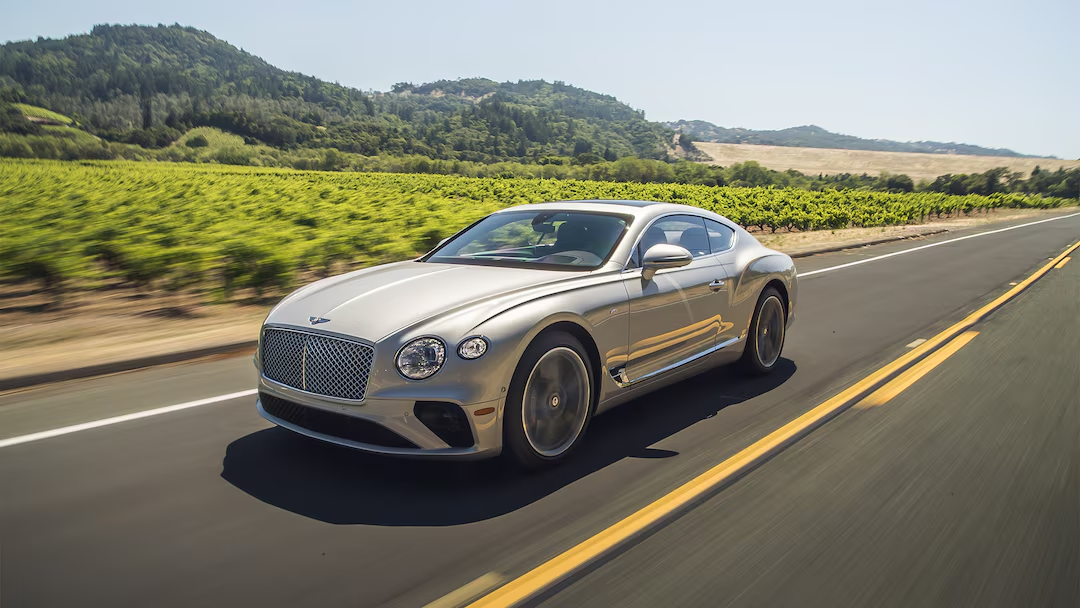
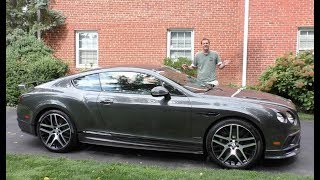
The first generation of the Continental GT marked the beginning of a new era, not only for Bentley
but for the entire luxury car segment. It was a car that combined, with unprecedented success, brute force
with handcrafted elegance.
The Launch (2003): A New Era Begins
Presented to the world in 2003, the Continental GT was an automotive sculpture. Designed under the leadership
of Dirk van Braeckel and Raul Pires, its design was simultaneously modern and reverent to the brand's
history. The muscular lines, especially the "powerline" that flowed from the twin headlights to the wide
rear haunches, were a clear homage to the iconic 1952 R-Type Continental, establishing a visual continuity
with the past. The use of the Volkswagen Group's D1 platform was a fundamental pillar that made the project
viable in record time.
The heart of this new machine was its engine, an engineering centerpiece that would become legendary: a
6.0-liter twin-turbo W12. Its unique configuration, essentially two compact VR6 engines sharing a single
crankshaft, allowed it to be exceptionally short, improving weight distribution, while simultaneously
providing immense smoothness and torque. In its initial version, it delivered an impressive 560 PS (552 bhp)
of power and 650 Nm of torque, available from very low revs. These numbers translated into stunning
performance for a luxury car weighing over 2,300 kg: acceleration from 0 to 100 km/h in just 4.8 seconds and
a top speed of 318 km/h. To manage this power, the GT was equipped with a 6-speed ZF automatic gearbox and,
crucially, a permanent all-wheel-drive system with a Torsen center differential, ensuring that the
performance was usable and safe in all weather conditions.
The interior redefined expectations of luxury and personalization. From launch, customers could choose from a
wide range of options, initially including six exterior colors, eight leather colors, and five types of wood
veneers. Every detail was meticulously handcrafted in Crewe, from the leather stitching to the polishing of
the wood veneers. One detail that became iconic was the analog clock in the center of the dashboard,
manufactured by the prestigious Swiss brand Breitling, a symbol of the attention to detail and the
partnership between two luxury brands.
Expanding the Family: Versions and Special Editions
Mulliner Driving Specification (from 2004)
Introduced in 2004, this optional package quickly became an almost mandatory choice for customers
desiring an extra touch of sportiness and personalization. It included 20-inch wheels with a 7-spoke design,
drilled alloy sports foot pedals, and a gear lever finished in knurled metal and leather. However, its most
distinctive element, which would become a brand signature, was the diamond-quilted leather upholstery,
applied to the seats, doors, and rear quarter panels.
Continental GTC (2006): The Sky is the Limit
The convertible version, the GTC, was unveiled in 2005 and hit the market in 2006. Its creation was
not in Bentley's original plans, but the enormous demand from customers who fell in love with the coupe's
design led the brand to develop the open-top variant, demonstrating a newfound agility and responsiveness to
the market. The fabric roof, manufactured by specialist Karmann, was a work of engineering art. Composed of
seven structural bows and three layers of material, it guaranteed exceptional thermal and acoustic
insulation, making the GTC almost as quiet as the coupe when closed. The additional weight of the structural
reinforcement and the roof mechanism slightly affected performance: the 0 to 100 km/h acceleration rose to
5.1 seconds, and the top speed was 314 km/h with the roof closed and 305 km/h with it open.
Continental GT Speed (2007): The Quest for Speed
In 2007, Bentley resurrected the legendary "Speed" name, inspired by its high-performance models from
the 1920s, to create a more focused version of the Continental GT. The W12 engine was uprated to deliver 610
PS (602 bhp) and 750 Nm of torque. With this extra power, the GT Speed was capable of accelerating from 0 to
100 km/h in 4.5 seconds and reaching a top speed of 326 km/h, making it the first production Bentley to
break the 200 mph barrier. The improvements went beyond the engine: the suspension was lowered and
stiffened, the anti-roll bars were uprated, and exclusive 20-inch wheels with high-performance Pirelli
P-Zero tires were fitted. Visually, the Speed was distinguished by its front grille and lower air intakes
with a dark-tinted chrome finish, giving it a more aggressive appearance.
Continental Supersports (2009): The Radical Athlete
The Supersports, launched in 2009, represented the pinnacle of the first generation's performance. It
was designed to be the fastest and most powerful Bentley ever up to that date, a true supercar with the
comfort of a GT. The power of the W12 engine was raised to a new level of 630 PS (621 bhp) and 800 Nm of
torque, allowing acceleration from 0 to 100 km/h in just 3.9 seconds and a top speed of 329 km/h.
The focus on performance led to a drastic measure for a Bentley: weight reduction. The Supersports
was 110 kg lighter than the GT Speed, a diet achieved by removing the rear seats, which were replaced by an
elegant carbon fiber-reinforced storage deck, and installing carbon fiber racing front seats, although
maintaining heating and the expected luxury. The Supersports was also a technological pioneer, being the
first Bentley capable of running on E85 biofuel. As standard, it came equipped with carbon-ceramic brakes,
which at the time were the largest brake discs fitted to any production car, ensuring braking capability to
match its performance.
Continental GT Series 51 (2009): The Celebration of Design
Launched in the same year as the Supersports, the Series 51 was a special edition celebrating
Bentley's design legacy, paying homage to the year 1951, when the brand's first official styling studio was
established. This version did not focus on performance, but rather on exclusive personalization. It offered
three-tone exterior color and interior trim combinations, carefully selected by the design team and inspired
by classic models. It was distinguished by "51" badges on the front fenders, 20-inch 14-spoke polished
wheels, and unique interior finishes, such as Amboyna wood veneer.
Production Numbers and Market Impact
The success of the Continental GT was resounding and immediate. Bentley's total sales skyrocketed
from 1,017 units in 2003 to 6,576 in 2004, peaking at 10,014 units in 2007, a nearly tenfold increase in
just four years. This model alone transformed Bentley from a niche manufacturer into a protagonist in the
global luxury market. The most exclusive editions, like the Supersports, had limited production, with 1,207
coupe units and 583 convertibles, which increases their rarity and value today.
With the first generation, Bentley didn't just launch a car; it created an ecosystem of products. The
base GT established the market. The GTC captured a new segment of customers who valued the open-air
experience. The Speed appealed to those who desired more performance without sacrificing everyday luxury.
The Supersports served as a "halo car," an image car that reinforced the performance credentials of the
entire range, attracting the most hardcore enthusiasts. Together with the infinite personalization
possibilities of Mulliner and special editions like the Series 51, Bentley created a "value ladder." This
strategy allowed customers to spend progressively more to get more performance, exclusivity, or
personalization, maximizing profitability and solidifying the brand's image as the undisputed leader in
performance and luxury.
| Model (Year) |
Engine |
Power (hp) |
Torque (Nm) |
Acceleration 0-100 km/h (s) |
Top Speed (km/h) |
| Continental GT (2003) |
6.0 W12 Twin-Turbo |
560 |
650 |
4.8 |
318 |
| Continental GTC (2006) |
6.0 W12 Twin-Turbo |
560 |
650 |
5.1 |
314 |
| Continental GT Speed (2007) |
6.0 W12 Twin-Turbo |
610 |
750 |
4.5 |
326 |
| Continental Supersports (2009) |
6.0 W12 Twin-Turbo |
630 |
800 |
3.9 |
329 |