


The Rebirth of an Icon
The launch of the Bentley Continental Flying Spur in 2005 was not an isolated event, but rather a calculated and crucial move in Bentley's rebirth strategy under the aegis of the Volkswagen Group. Following the resounding success of the 2003 Continental GT, the Flying Spur was designed to capitalize on that momentum, extending the brand's appeal to a new segment: the ultra-luxury, high-performance sedan. It was conceived to be the "four-door sibling" of the GT, sharing not only the engineering but also the spirit of a Grand Tourer capable of crossing continents with incomparable speed and comfort.
From its inception, the car was defined by a fundamental duality: the ability to offer the performance of a supercar for the driver and, simultaneously, the comfort and refinement of a limousine for the passengers. This philosophy would become the guiding thread of its entire evolution, a delicate balance between the thrill behind the wheel and serene opulence.
The choice of the name "Flying Spur" was no accident. It was a deliberate revival of one of the most revered names in Bentley's history, associated with the iconic 1957 S1 Continental Flying Spur sedans, built by coachbuilder H.J. Mulliner. This act of naming connected the new car to a lineage of elegance and power, giving it instant historical legitimacy and signaling to the market that this was not just another luxury sedan, but the continuation of a legend.
The First Generation (2005-2013) – The Continental Legacy
The Link with the Continental GT: A Solid Foundation
The 2005 Continental Flying Spur was the result of a simultaneous development process with the acclaimed Continental GT. Both vehicles were designed by the same design team, under the leadership of Dirk van Braeckel and Head of Exterior Design, Raul Pires, ensuring visual and engineering cohesion that defined the new face of Bentley. The foundation for this new family of models was the Volkswagen Group's robust D1 platform, an advanced engineering architecture that also underpinned the Volkswagen Phaeton and the Audi A8. This technology sharing was a pragmatic decision that allowed Bentley, with its more limited resources at the time, to launch a technologically sophisticated product efficiently. However, it also presented the challenge of clearly differentiating the Bentley's British pedigree from its German relatives, something the brand overcame through distinct exterior design and unparalleled interior craftsmanship.
The design alterations to transform the coupe into a sedan were substantial and focused on providing a truly luxurious rear space. The wheelbase was lengthened by 320 mm, the roof was raised, and the total length of the vehicle reached almost 5.3 meters. Instead of the pronounced musculature over the rear wheels of the GT, the Flying Spur adopted an elegant and continuous waistline, giving it a more formal and imposing presence, without sacrificing the evident family resemblance at the front, with its dominant hood and the distinctive Bentley matrix grille.
The Standard W12: Strength and Majesty (2005-2013)
The heart of the launch model was the monumental 6.0-liter W12 engine, twin-turbocharged, with 48 valves. This masterpiece of engineering produced 560 PS (552 bhp) and an overwhelming torque of 650 Nm (479 lb-ft) available from a mere 1,600 rpm. The 'W' configuration made the engine incredibly compact for a 12-cylinder, benefiting weight distribution.
Coupled with a 6-speed ZF automatic transmission and a permanent all-wheel-drive system with a Torsen center differential, this engine was capable of propelling the nearly 2.5-ton sedan from 0 to 100 km/h in approximately 5.2 seconds, reaching a top speed of 312 km/h (194 mph). At the time of its launch, these numbers enshrined it as the fastest and most powerful production sedan in the world, a remarkable feat that immediately established the Flying Spur as a leader in its segment.
The interior was the brand's true sanctuary, a demonstration of Crewe's craftsmanship. Utilizing the finest leathers and wood veneers, each cabin was hand-assembled to create an atmosphere of absolute luxury and supreme comfort. Standard equipment, such as four-zone climate control, power seats with heating, ventilation, and memory, a navigation system, and an iconic Breitling clock on the dashboard, ensured that both driver and passengers were enveloped in opulence and cutting-edge technology.
The Arrival of the 'Speed' Version: Breaking the 200 mph Barrier (2008-2013)
The introduction of the Continental Flying Spur Speed in 2008 was Bentley's response to the growing demand for even more visceral performance, solidifying the model's reputation as a true "sports sedan." The W12 engine was meticulously recalibrated to produce 610 PS (602 bhp) and 750 Nm (553 lb-ft) of torque, representing a 9% increase in power and a 15% increase in torque over the standard model.
This increase in power had a direct and impressive impact on performance. The 0 to 100 km/h acceleration time was reduced to 4.8 seconds, and the top speed was raised to 322 km/h (200 mph). This number was not just a technical datum; it was a symbolic milestone, making the Flying Spur Speed one of the first luxury sedans to officially break the 200 miles per hour barrier, a territory previously reserved for exotic supercars.
The improvements, however, went far beyond the engine. The chassis received special attention to ensure that the handling matched the extra power. The suspension was lowered by 10 mm, and stiffer bushings and thicker anti-roll bars were installed. High-performance Pirelli P-Zero tires on 20-inch wheels completed the package, resulting in sharper handling, greater steering response, and superior body control in corners. Visually, the Speed distinguished itself with subtle but significant details, such as the radiator grille and air intakes in dark tinted chrome, exclusively designed wheels, and "rifled" exhaust tailpipes, which hinted at its dynamic potential. Inside, the sporty character was reinforced by diamond-quilted upholstery and drilled alloy pedals.
Touches of Exclusivity: Mulliner and Series 51
For customers desiring an even higher level of personalization and sportiness, Bentley offered the Mulliner Driving Specification package. This optional package added elements that enhanced the car's dynamic character, such as 20-inch sports wheels, drilled alloy pedals, a knurled gear lever finished in chrome and leather, and the iconic diamond-quilted leather upholstery, which would become a brand signature.
In contrast, the Series 51 version focused primarily on the expression of design. Launched as a celebration of Bentley's design studio, this special series allowed an almost unlimited level of personalization. Its most notable feature was the introduction, for the first time, of a three-tone interior, offering exclusive color and trim combinations that transformed each car into a unique piece of automotive art.
Legacy and Production Numbers
The success of the Continental GT created the perfect platform for the launch of the Flying Spur. Bentley knew how to capitalize on the coupe's image and engineering to introduce a sedan that was born with a reputation for performance and luxury. Sharing the D1 platform was a pragmatic decision that allowed Bentley, with limited resources at the time, to launch a technologically advanced product quickly and efficiently. The result was a resounding commercial success, with more than 4,500 units delivered in its first full year of production, a number that solidified Bentley's position in the global luxury market. Initial demand was so high that, to avoid long waiting lists, 1,358 units destined for markets outside the UK and US were assembled at Volkswagen's "Transparent Factory" in Dresden, Germany, until 2007, when all production was consolidated in Crewe.
The introduction of the Speed model in 2008 was more than a simple quest for more power; it was the first clear sign that the Flying Spur was beginning to forge its own identity, distinct from the GT. While the GT consolidated itself as the Grand Tourer par excellence, the Speed positioned the sedan as the "Performance Limousine," a car that was not just meant to be chauffeured, but to be driven with enthusiasm. This strategic move foreshadowed the eventual separation of the names in the next generation, establishing the Flying Spur's performance credentials independently.
| Year | Units Produced |
|---|---|
| 2005 | 4,271 |
| 2006 | 4,042 |
| 2007 | 2,270 |
| 2008 | 1,813 |
| 2009 | 1,358 |
| 2010 | 1,914 |
| 2011 | 2,354 |
| 2012 | 1,764 |
The Second Generation (2013-2019) – Forging an Independent Identity
Goodbye 'Continental': A New Strategic Direction
The launch of the second generation at the 2013 Geneva Motor Show marked a fundamental turning point in the model's history. Bentley made the strategic decision to drop the "Continental" prefix from the name, renaming the car simply the "Flying Spur". This change was a clear declaration of intent: to distance the sedan from the image of being merely a coupe derivative and establish it as an independent model line, with an even greater focus on opulence and presence. This marketing maneuver allowed the Flying Spur to be positioned as a more premium product, creating a clear step in the brand hierarchy, just below the Mulsanne, and competing more directly with rivals like the Rolls-Royce Ghost.
The design followed this new philosophy. Although still based on the D1 platform, the new Flying Spur exhibited a significantly more sporty and muscular look. The body lines became sharper and more defined, the front grille adopted a more upright and imposing stance, and the headlights were redesigned to be larger and more prominent. The interior was almost completely reimagined, with an obsessive focus on luxury and technology, so that only minor components, such as the sun visors and door handles, carried over from the previous generation.
A Tale of Two Engines: The Power of the W12 and the Agility of the V8
The biggest technical novelty of the second generation was the diversification of the engine range, drastically broadening the car's appeal.
The Flying Spur W12 continued as the flagship, with its 6.0-liter engine upgraded to deliver 625 PS (616 bhp) and 800 Nm (590 lb-ft) of torque. Now mated to a more modern and efficient 8-speed ZF automatic transmission, performance was elevated to a new level: acceleration from 0 to 100 km/h dropped to 4.6 seconds, and the top speed reached 322 km/h (200 mph).
The big news, however, was the introduction of the Flying Spur V8 in 2014. For the first time, a V8 engine was offered in the model. The 4.0-liter twin-turbo V8, a proven engineering unit from the VW Group, produced 507 PS (500 bhp) and 660 Nm (487 lb-ft) of torque. With it, the car accelerated from 0 to 100 km/h in 5.2 seconds and reached a top speed of 295 km/h (183 mph). The V8 model was not just an entry-level option; it fundamentally changed the character of the car. The lighter engine on the front axle gave the Flying Spur noticeably greater agility and a more visceral exhaust note, attracting a younger audience focused on the driving experience. Visually, the V8 was distinguished by the red Bentley "B" badge and the figure-eight shaped dual exhaust tailpipes.
The 'S' Factor: Performance at its Peak
To cater to customers seeking ultimate performance, Bentley introduced "S" versions for both engines.
The Flying Spur V8 S, launched in 2016, bumped the V8 engine's output to 528 PS (521 bhp) and 680 Nm of torque. With a top speed of 306 km/h (190 mph), it offered an even more engaging driving experience. The exterior reflected this sportiness with Beluga gloss black details on the grille and rear diffuser, plus dark-tinted headlights and taillights.
The Flying Spur W12 S was the pinnacle of the range and a milestone in Bentley's history. With the W12 engine tuned to 635 PS (626 bhp) and 820 Nm (605 lb-ft) of torque, it became the first four-door Bentley sedan to officially exceed the 200 mph mark, with a top speed of 325 km/h (202 mph). The chassis was recalibrated for even more responsive handling, and the design adopted a more aggressive aesthetic with extensive dark-tinted detailing, cementing its status as the definitive performance luxury sedan.
A Leap in Refinement and Technology
Bentley dedicated itself to addressing criticisms regarding the refinement of the first generation. The new model was designed to be one of the quietest sedans in the world. This was achieved through a stiffer body, the addition of more acoustic insulation material, the use of acoustic glass on all windows, and a revised exhaust system that minimized noise at cruising speed.
On-board technology also took a significant leap. The cabin was equipped with a new infotainment system and, most notably, the introduction of a Touch Screen Remote. This wireless device, housed in the rear center console, allowed passengers to control functions such as the climate control system, seat adjustments (including massage and ventilation), and the entertainment system, reinforcing the car's focus on occupant comfort.
| Year | Units Produced |
|---|---|
| 2013 | 3,960 |
| 2014 | 4,556 |
| 2015 | 3,660 |
| 2016 | 1,731 |
| 2017 | 2,295 |
| 2018 | 1,627 |
The Third Generation (2019-Present) – The Technological Tour de Force
A New Foundation: The MSB Platform Revolution
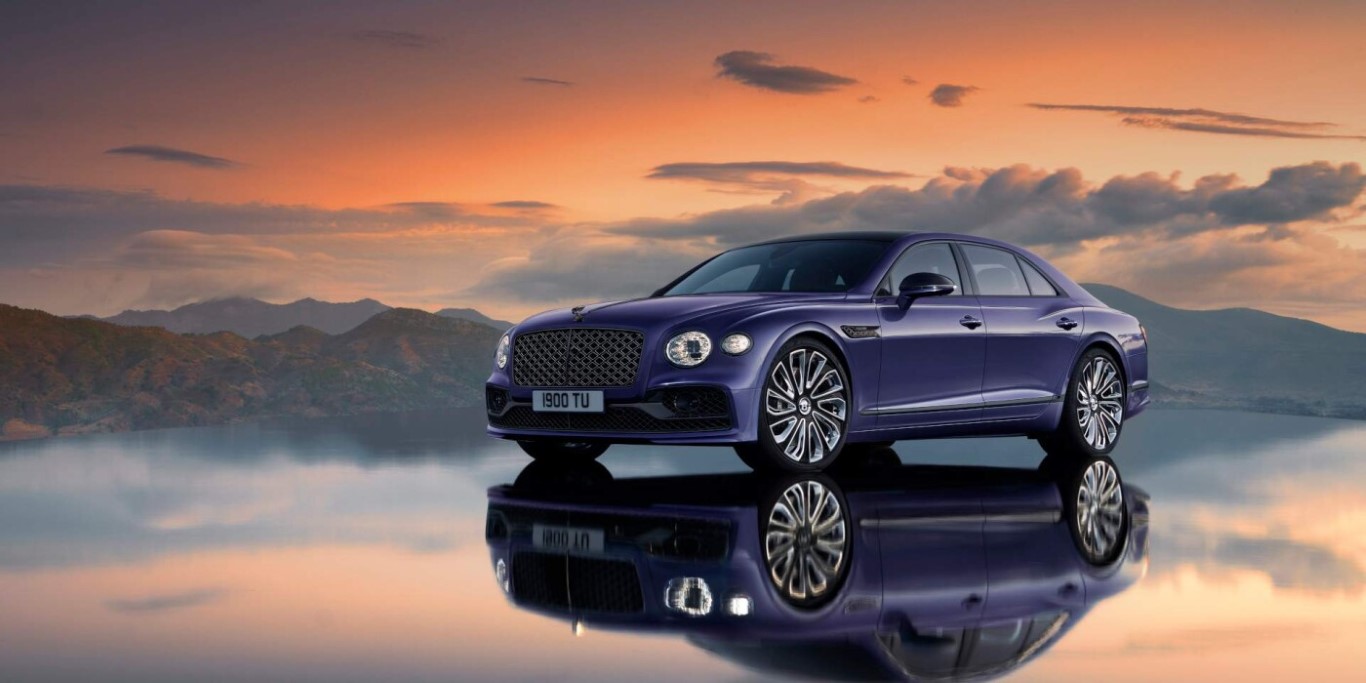
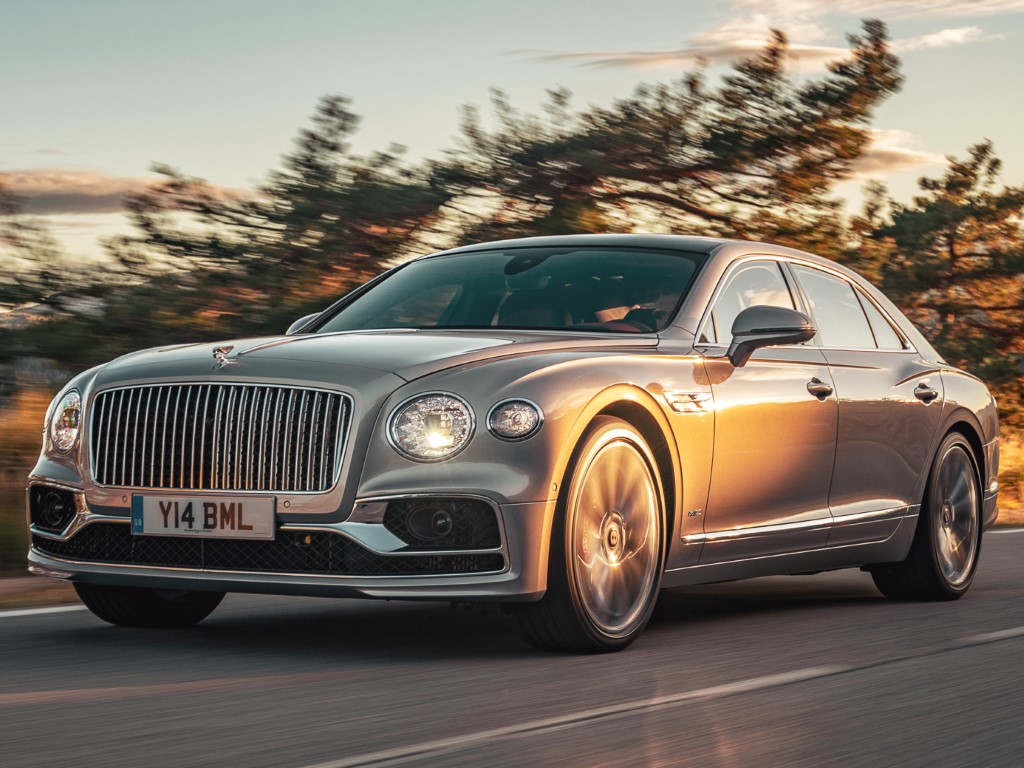
Launched in 2019 as a 2020 model, the third Flying Spur represented a quantum leap in engineering and dynamics. It abandoned the old D1 platform and adopted the modern and highly flexible MSB (Modularer Standardantriebskasten) platform from the Volkswagen Group, an architecture shared with the Porsche Panamera and the third-generation Continental GT. This new foundation was the most transformative event in the model's history, as it finally resolved the inherent contradiction of previous generations: how to make a 2.5-ton car genuinely agile.
With a 130 mm longer wheelbase, the new platform allowed for a complete transformation in driving dynamics. For the first time, the Flying Spur was equipped with electronic all-wheel steering, which drastically improves agility at low speeds and stability at high speeds; active all-wheel drive, which operates primarily as a rear-wheel-drive vehicle for a sportier feel but sends torque to the front axle instantly when needed; and Bentley Dynamic Ride, a sophisticated 48V active anti-roll bar system that combats body roll in corners, keeping the car incredibly flat and composed. These technologies, many shared with Porsche, allowed the Flying Spur to defy its mass and dimensions, offering a duality of character — from comfortable limousine to sports sedan — that was once a compromise but has now become an uncompromised reality.
From the Peak of the W12 to the Hybrid Era
The third generation marked both the pinnacle of Bentley's internal combustion engine and the beginning of its transition to electrification.
W12 (2019-2024): The launch model came with an enhanced version of the 6.0L W12 TSI engine, now mated to a fast 8-speed dual-clutch transmission. With 635 PS (626 bhp) and 900 Nm (664 lb-ft) of torque, it allowed for an acceleration from 0 to 100 km/h in an impressive 3.8 seconds and a top speed of 333 km/h (207 mph). Production of the iconic W12 engine, a hallmark of modern Bentley, ended in April 2024, making these models the last of their lineage.
V8 (2020-Present): A version with the 4.0-liter V8 engine and 550 PS (542 bhp) was introduced in 2020, continuing to offer a more agile driving experience and a more visceral exhaust note.
Hybrid (2021-Present): Bentley embraced the future with the introduction of hybrid powertrains. The first was a 2.9-liter V6 combined with an electric motor, producing a total of 544 PS. More recently, the range evolved to the High Performance Hybrid and Ultra Performance Hybrid systems, which combine a V8 engine with a powerful electric motor. These systems can generate up to 782 PS (771 bhp) and 1,000 Nm of torque, offering extreme performance alongside the capability for purely electric driving for significant distances. This generation, therefore, serves as the bridge between Bentley's glorious 12-cylinder past and its electrified future.
A Showcase of Design and Innovation
The exterior design became even more sculpted and imposing, with an unmistakable presence on the road. The most striking feature was the reintroduction of the "Flying B" mascot on the hood. For the first time on a modern Bentley, the ornament is retractable and illuminated, designed to retract automatically in the event of an impact to meet strict pedestrian safety requirements. LED headlights with an intricate cut-crystal effect and taillights incorporating the "B" motif became new brand design signatures.
Inside, the most spectacular innovation was the debut of the Bentley Rotating Display. With the touch of a button, a section of the center fascia rotates to reveal one of three faces: a 12.3-inch high-resolution infotainment screen; three classic analog dials (thermometer, compass, and chronometer); or a seamless wood veneer panel that integrates perfectly with the rest of the cabin's trim. This piece of engineering, comprising over 150 components and with alignment tolerances of +/-0.3 mm, is a metaphor for the car itself: a perfect fusion of cutting-edge technology and traditional craftsmanship.
The Modern Range: Azure, Speed, and Mulliner
With the third generation, Bentley restructured its model lineup to cater to different facets of the luxury experience. The Azure version was created with a focus on comfort and well-being, optimizing ride smoothness and cabin silence. The Speed continues the tradition of being the ultimate performance variant, with chassis and engine tuning focused on driving dynamics. And the Mulliner represents the pinnacle of bespoke personalization and craftsmanship, offering exclusive trim and material options for the most demanding customers.
| Year | Units Produced |
|---|---|
| 2019 | 102 |
| 2020 | 3,381 |
| 2021 | 3,947 |
| 2022 | 4,226 |
| 2023 | 3,178 |
Three Generations of Unwavering Excellence
The journey of the Bentley Flying Spur since 2005 is a fascinating chronicle of automotive evolution. What began as an elegant, yet derivative, "four-door Continental" has transformed over three distinct generations into a standalone icon and, with the discontinuation of the Mulsanne, Bentley's definitive flagship sedan.
Throughout its history, the Flying Spur has consistently perfected the delicate balance between handcrafted luxury designed for supreme passenger comfort and thrilling performance engineered for driver enjoyment. Each generation has adapted to, and often set, trends in the ultra-luxury segment, from introducing the first production sedan to break the 200 mph barrier to integrating physics-defying chassis technologies.
The third generation, with its advanced platform and the transition to high-performance hybrid powertrains, represents not just the pinnacle of the Flying Spur to date. It lays the foundation for Bentley's electrified future, ensuring that the spirit of the four-door Grand Tourer — an unmatched combination of speed, style, and luxury — will continue to thrive and set the standard of excellence for years to come.