


The Genesis of the i4: From Concept to Reality
Project "i" and BMW's Vision of the Future
The journey of the BMW i4 did not begin with the car itself, but with a philosophy. In the early 2010s, BMW launched its "i" sub-brand as a laboratory for the future of mobility. The first fruits of this project, the i3 urban compact and the i8 hybrid supercar, were revolutionary vehicles. They introduced exotic materials like carbon fiber into mass production and explored new frontiers of design and electrical engineering. However, they were niche products, conceived to be distinct and even disruptive compared to BMW's mainstream lineup.
This initial phase was crucial for accumulating technical knowledge, but BMW's leadership understood that for electrification to become a central pillar of the brand, it needed to step out of the niche and into the heart of its portfolio. Electrification needed to be associated with the models that had defined BMW's reputation for decades: the sporty sedans and coupes that epitomized "Sheer Driving Pleasure". A vehicle was needed that combined the innovation of the "i" sub-brand with the core values of the BMW brand, making the transition to electric a natural choice for its loyal customers.
The BMW i Vision Dynamics (2017): The Statement of Intent
The response to this strategic challenge was spectacularly unveiled at the 2017 Frankfurt Motor Show (IAA): the BMW i Vision Dynamics concept. This was not just another concept car; it was a public and unequivocal statement of BMW's future direction. Positioned as a four-door Gran Coupé, it was designed to bridge the gap between the urban i3 and the exotic i8, electrifying the mid-size segment, the true heart of the brand.
The design of the i Vision Dynamics was a masterclass in how to modernize BMW's identity for the electric age. It maintained the brand's classic proportions — a long wheelbase, flowing roofline, and short overhangs — that historically created a profile of elegance and dynamism. The bodywork, with its large surfaces and nearly invisible joints, looked as if it were sculpted from a single block, conveying modernity and aerodynamic efficiency.
However, the most discussed change was the reinterpretation of the iconic kidney grille. Since electric vehicles have much lower cooling needs, the grille was closed off and transformed into an "intelligence surface". Instead of feeding air to a combustion engine, it now housed an array of sensors for the driver assistance systems, showing how a historical design element could be adapted with a new function in the digital age.
The specifications promised by the concept were equally ambitious and signaled BMW's intent to compete at the top of the performance EV market. The brand announced a range of 600 km, a top speed of over 200 km/h, and an acceleration from 0 to 100 km/h in an impressive 4.0 seconds. These numbers weren't just to impress; they were a promise that BMW's electric future would not sacrifice the performance its customers expected. The i Vision Dynamics was the materialization of a fundamental strategic pivot: the transition from electric experimentation to the total integration of electrification into the brand's DNA.
The First Generation (G26): Launch and Technical Architecture
Global Launch and Production Design
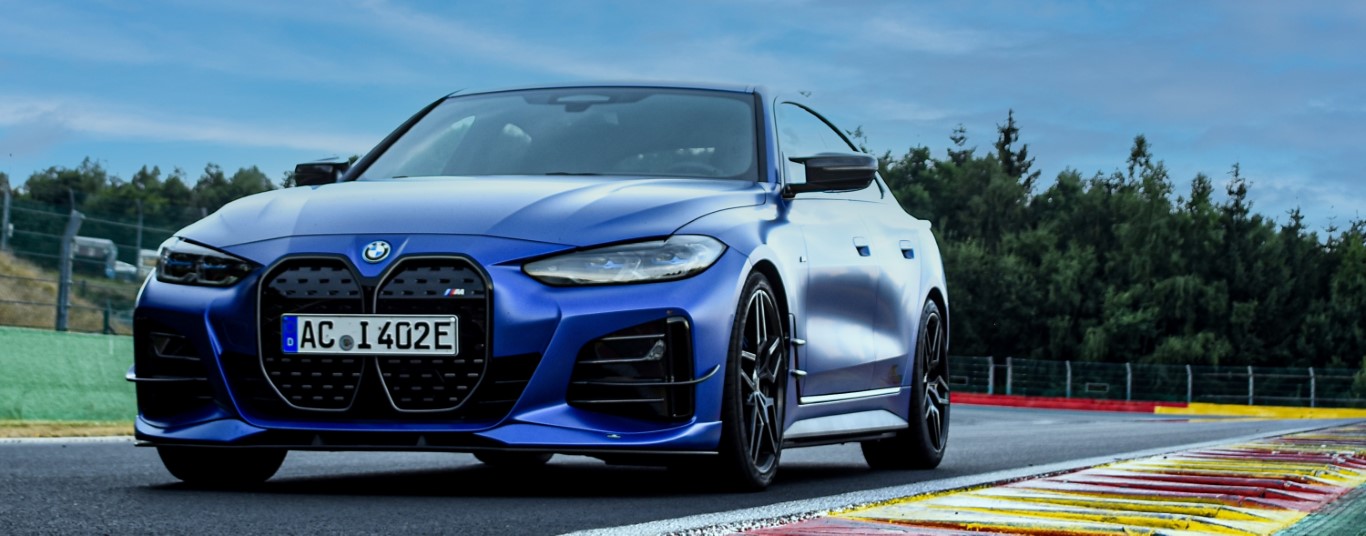
Fulfilling the promise of the concept, the production version of the BMW i4 (model code G26) was officially revealed in March 2021, with global sales starting in November of the same year, already as a 2022 model. The final design remained remarkably faithful to the i Vision Dynamics, solidating the elegant and sporty aesthetic.
Technically, the i4 is a five-door liftback, marketed as a four-door Gran Coupé. A crucial design decision was to base its body on the 4 Series Gran Coupé (G26), rather than the 3 Series sedan. This choice allowed for the combination of a lower, more flowing silhouette typical of a coupe, with the practicality of a large tailgate, which provides access to a versatile trunk with a capacity of 470 liters, expandable up to 1,290 liters.
The CLAR Platform and Flexible Production Strategy
One of the most important and strategic decisions in the development of the i4 was its architectural foundation. Instead of creating a dedicated EV-only platform — an expensive and high-risk path followed by some competitors — BMW chose to use its modular CLAR (Cluster Architecture) platform. This architecture was designed from the ground up to be flexible, capable of accommodating combustion engines, plug-in hybrid systems, and fully electric powertrains.
This approach represented a brilliant, albeit conservative, strategic move. It allowed BMW to integrate i4 production directly into the existing assembly line at its historic Munich plant, right alongside the 3 Series, 4 Series, and M3. The investment to adapt the factory was around 200 million euros, a fraction of the cost of building a new facility from scratch. This manufacturing flexibility gave BMW the ability to shift production between electric and combustion models according to market demand, minimizing financial risks and optimizing efficiency during a transitional period for the automotive industry.
Technological Innovations: 5th Generation eDrive
The heart of the i4 is the fifth generation of BMW eDrive technology. One of its main innovations is the integration of the electric motor, single-speed transmission, and power electronics into a single, compact component. This solution not only saves space but also significantly increases energy conversion efficiency. Furthermore, BMW focused on reducing the use of rare-earth metals in the motors, aligning the project with sustainability goals.
The high-voltage battery was also a focus of innovation. With cells just 110 mm high, the pack is extremely thin and was positioned in the vehicle's floor. This location resulted in a center of gravity up to 53 mm lower than that of the 3 Series sedan, a critical factor that drastically improves the car's stability and dynamic handling, preserving the agility for which BMW is famous. To handle the additional weight of the battery and ensure comfort, the i4 was equipped with a MacPherson strut front suspension and a multi-link rear suspension, with an air suspension system on the rear axle as standard on all versions.
The Interior: The Arrival of the BMW Curved Display
The interior of the i4 marked the debut of one of the most significant evolutions in BMW's human-machine interface: the BMW Curved Display. This is a single, continuous, curved piece of glass that unites the 12.3-inch digital instrument cluster and the 14.9-inch central infotainment screen.
Along with the new hardware came BMW Operating System 8 (also known as iDrive 8.0). This system represented a major shift towards a more touch and voice-command focused interface, featuring modern graphics and a widget-based menu structure. Despite the emphasis on touch control, BMW retained the iconic physical iDrive controller on the center console, offering drivers a tactile and familiar alternative to navigate the system's functions, acknowledging the importance of usability while driving.
Versions and Technical Specifications (2021–2024)
Since its launch, the BMW i4 has been offered in multiple variants, each designed to cater to a different customer profile, from those who prioritize range to those seeking maximum performance.
i4 eDrive40
The i4 eDrive40 was one of the launch models and positioned itself as the core of the range. Focused on an ideal balance between performance and range, it featured a single electric motor mounted on the rear axle, maintaining BMW's classic rear-wheel drive. This configuration was designed to offer the highest possible range within the lineup, making it the ideal choice for daily use and longer trips.
i4 M50 xDrive
The i4 M50 xDrive was not just a more powerful version; it was a historic milestone. This was the first fully electric vehicle to receive the full treatment from BMW's performance division, M GmbH. Equipped with two electric motors (one on each axle), the M50 offers all-wheel drive (xDrive) and an absolute focus on dynamic performance. The goal was clear: to prove that the emotion and adrenaline associated with the letter "M" could be translated into the electric era, with instantaneous acceleration and enhanced cornering behavior thanks to technologies like the adaptive M suspension.
i4 eDrive35
Introduced later to broaden the model's market reach (arriving in Brazil in May 2023), the i4 eDrive35 became the new entry point for the i4 family. With a slightly less powerful motor and a lower-capacity battery, it offered a more accessible price point, making the electric Gran Coupé a viable option for a wider audience without sacrificing the model's premium design and build quality.
The following table details the technical specifications of the initial BMW i4 range.
| Specification | i4 eDrive35 | i4 eDrive40 | i4 M50 xDrive |
|---|---|---|---|
| Power | 286 hp (210 kW) | 340 hp (250 kW) | 544 hp (400 kW) |
| Torque | 400 Nm | 430 Nm | 795 Nm |
| Acceleration (0-100 km/h) | 6.0 s | 5.7 s | 3.9 s |
| Top Speed | 190 km/h | 190 km/h | 225 km/h |
| Battery (Gross / Usable) | 70.2 kWh / 68.7 kWh | 83.9 kWh / 81.3 kWh | 83.9 kWh / 81.3 kWh |
| Range (WLTP) | Up to 483 km | Up to 590 km | Up to 521 km |
| Range (Inmetro - Brazil) | Up to 339 km | Up to 422 km | Up to 335 km |
| Drivetrain | Rear-wheel | Rear-wheel | All-wheel (xDrive) |
| Max. DC Charging Power | 180 kW | 205 kW | 205 kW |
The Mid-Cycle Update (LCI - 2025)
As is tradition at BMW, roughly halfway through its life cycle, the i4 lineup received an update, known as LCI (Life Cycle Impulse), for the 2025 model year. This update focused on refining aesthetics and technology while maintaining the mechanical foundation that was already successful.
Subtle but Striking Aesthetic Evolution
The visual changes of the LCI were subtle, but effective in modernizing the car's appearance. At the front, the headlights were redesigned for a slimmer profile, featuring a new vertical arrow-shaped LED daytime running light signature. The surround of the kidney grille now has a matte chrome finish, and the internal pattern of the grille was updated with a honeycomb design on some models.
The most impressive update, however, is at the rear. The 2025 i4 now offers optional taillights with Laserlight technology, a feature inherited directly from the exclusive M4 CSL. These taillights use laser beams to illuminate fiberglass bundles, creating an intricate, three-dimensional light graphic that gives the car a unique and highly technological appearance. New colors, such as Cape York Green and Fire Red (Vegas Red in other markets), along with new alloy wheel designs, completed the exterior update.
Interior Refinements and Technology
Inside, the acclaimed BMW Curved Display was retained, but the environment was enhanced with new details. The main change was the introduction of a new flat-bottomed steering wheel design for models with the M Sport package, which also received a "12 o'clock" marker to reinforce sportiness. New interior trim and upholstery options, such as M Performtex (a sustainable, velvet-like material), were added to increase the sense of luxury and personalization.
In the software realm, the infotainment system was updated to BMW Operating System 8.5. The main novelty was the introduction of the "QuickSelect" feature, which redesigned the home screen with customizable, quick-access shortcuts to the most used functions, like navigation and media. This change aimed to simplify the menu structure and make interaction more intuitive, responding to some of the criticisms regarding the complexity of version 8.0. The absence of changes to the powertrain highlights BMW's confidence in its 5th generation eDrive hardware. The update's focus on software and lighting technology reflects a broader trend in the automotive industry, where user experience and aesthetic differentiation have become battlegrounds as important as mechanical performance.
The Updated Range and Its Specifications (Post-2025)
The mid-cycle update also brought a strategic restructuring to the i4 model lineup, optimizing the offering to better meet market demands.
Restructuring of the Model Lineup
The most notable change for the 2025 model year was the discontinuation of the entry-level eDrive35 version in key markets, such as the United States, simplifying the base of the range. In its place, and to fill an important gap in the portfolio, BMW introduced the new i4 xDrive40 version.
This new model was designed for the customer who wants the added safety and traction of all-wheel drive (xDrive) but does not need the extreme performance — and higher cost — of the M50 version. With a dual-motor configuration, the xDrive40 offers a significant power increase over the rear-wheel-drive eDrive40, resulting in faster acceleration and greater confidence in low-grip conditions, making it an ideal sweet spot in the i4 lineup.
The following table presents the technical data for the updated BMW i4 range.
| Specification | i4 eDrive40 | i4 xDrive40 | i4 M50 xDrive |
|---|---|---|---|
| Power | 340 hp (250 kW) | 396 hp (291 kW) | 544 hp (400 kW) |
| Torque | 430 Nm | 600 Nm | 795 Nm |
| Acceleration (0-100 km/h) | 5.5 s | 4.9 s | 3.7 s |
| Top Speed | 190 km/h | 200 km/h | 225 km/h |
| Battery (Gross / Usable) | 83.9 kWh / 81.3 kWh | 83.9 kWh / 81.3 kWh | 83.9 kWh / 81.3 kWh |
| Range (WLTP) | Up to 600 km | Up to 548 km | Up to 520 km |
| Range (Inmetro - Brazil) | Up to 399 km | N/A (not yet launched) | Up to 405 km |
| Drivetrain | Rear-wheel | All-wheel (xDrive) | All-wheel (xDrive) |
| Max. DC Charging Power | 205 kW | 205 kW | 205 kW |
The BMW i4 in the Brazilian Market
Brazil has been an important market for BMW's electrification strategy, and the i4 plays a central role in this plan.
Launch Timeline in Brazil
The introduction of the i4 to the Brazilian market occurred in phases, aligning with the brand's global strategy:
- November 2022: The BMW i4 was officially launched in Brazil. The initial versions available were the eDrive40, focused on range, and the top-of-the-line M50, focused on performance.
- May 2023: BMW Brazil expanded the range with the arrival of the entry-level i4 eDrive35 M Sport version. This version made the model more accessible, combining a more efficient powertrain with the sporty look of the M Sport package.
- April 2025: The facelifted model (LCI) arrived in the country. The launch of the 2025 lineup began with the updated eDrive40 M Sport and M50 versions, bringing the new design and technological updates to the Brazilian consumer.
Versions and Official Range (Inmetro)
For the Brazilian consumer, the most relevant range figures are those measured by the Brazilian Vehicular Labeling Program (PBEV), coordinated by Inmetro. These values tend to be more conservative than the European WLTP cycle and reflect usage conditions in the country more realistically.
- i4 eDrive35 (pre-LCI): Range of up to 339 km.
- i4 eDrive40 (pre-LCI): Range of up to 422 km.
- i4 M50 (pre-LCI): Range of up to 335 km.
- i4 eDrive40 (LCI 2025): Range of up to 399 km.
- i4 M50 (LCI 2025): Range of up to 405 km.
Production and Market Performance
The Heart of Production: The Munich Plant
All global production of the BMW i4 is centralized in a location of great symbolic and operational importance for the brand: the BMW Group's main plant in Munich, Germany. This is not just any factory; it is the historical heart of BMW, which underwent a significant transformation to adapt to the era of electric mobility.
The facility was modernized to operate with a single, fully integrated assembly line capable of producing vehicles with different types of powertrains. On the very same day, the 3 Series sedan (combustion and hybrid), the sporty M3, and the fully electric i4 roll off the line. This flexible production capacity is a testament to BMW's engineering and manufacturing prowess and a key piece of its strategy to navigate the energy transition efficiently and profitably.
Sales Performance: Answering the "Amount Produced"
Although BMW does not disclose cumulative production numbers by specific model, sales data and market reports paint a clear picture of the i4's commercial success. Since its launch, the model has consistently been cited as the best-selling electric vehicle of the BMW brand worldwide.
The success of the i4 is one of the main drivers behind the electrification milestones achieved by the BMW Group, such as the sale of 1 million and, subsequently, 3 million electrified vehicles (including plug-in hybrids). Specific data from key markets reinforce this trend: in the United States, for example, 11,603 units of the i4 were sold in the first half of 2024 alone, easily surpassing other electric models from the brand. In Europe, i4 sales also recorded robust growth, helping BMW outpace direct competitors in the electric segment.
However, the most notable achievement and the one that best illustrates the i4's impact is within BMW itself. In 2024, the BMW i4 M50 became the best-selling model of the entire BMW M division. This means that an electric car, based on a shared platform and weighing over 2.2 tons, outsold combustion icons like the M3 and M4. This is not just a sales success; it is a paradigm shift. It demonstrates that the immense credibility and appeal of the "M" brand, built over five decades with gasoline engines, were successfully transferred to an electric product. Market acceptance was so strong that it validated BMW's strategy, silenced many skeptics, and proved that the appeal of the M division lies in delivering a high-performance driving experience, regardless of the propulsion technology.
Conclusion: The Strategic Positioning of the i4
Summary: The Bridge to BMW's Electric Future
The story of the BMW i4 is the story of a successful transition. It served as a crucial bridge, transporting the electric technology of BMW's future into the present, packaged in a familiar, desirable form deeply rooted in the brand's DNA. By fulfilling the promise of the i Vision Dynamics concept, the i4 brought electrification to the heart of what BMW represents: the mid-size sports sedan.
It proved that you didn't have to reinvent the wheel (or the whole car) to create an attractive EV. By focusing on the fundamentals — exceptional driving dynamics, premium build quality, and a design that balances elegance and sportiness — BMW created a product that made the switch to electric a logical and exciting step for its loyal customer base.
The i4 in the Competitive Landscape
In the market, the BMW i4 positions itself uniquely against its main competitors, such as the Tesla Model 3 and the Polestar 2. While Tesla bets on disruption, minimalism, and a closed technological ecosystem, and Polestar explores an avant-garde, Scandinavian design, the i4 plays to its own strengths.
The i4's value proposition is not to be the most futuristic EV or the most efficient in raw numbers. Its strength lies in being, first and foremost, an excellent BMW that happens to be electric. It offers a balance between ride comfort and agility that few competitors can match, an interior with high-quality materials and finish, and a driving experience that, while silent, still communicates "Sheer Driving Pleasure". For many consumers, this combination of premium tradition with cutting-edge technology is precisely the formula that makes electric mobility not just acceptable, but truly desirable.