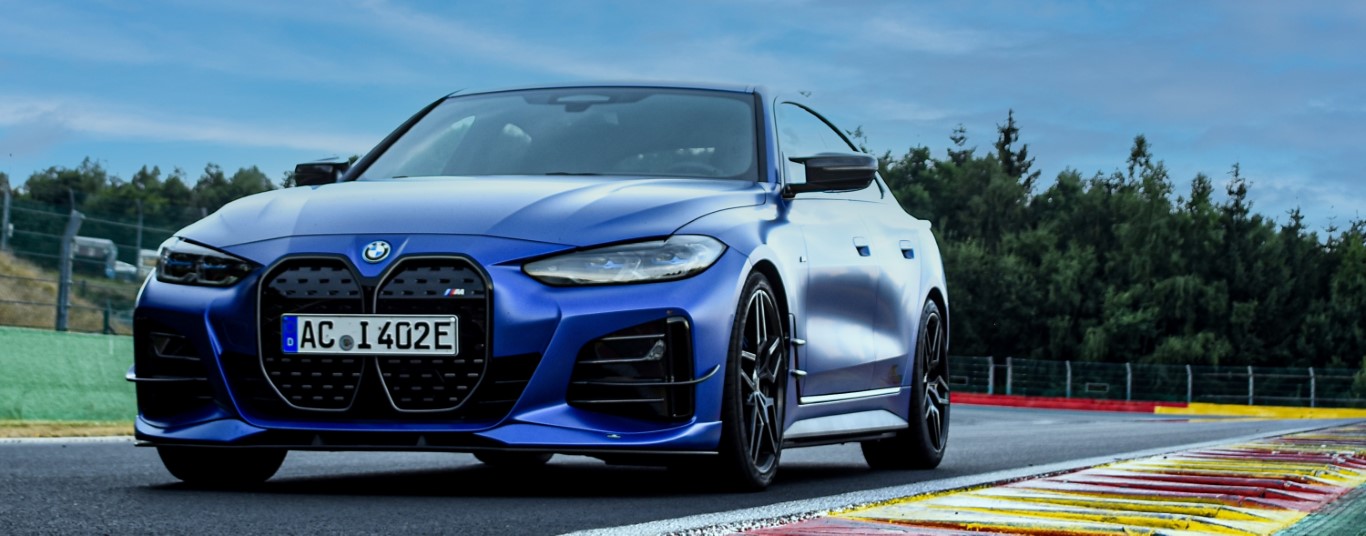
Global Launch and Production Design
Fulfilling the promise of the concept, the production version of the BMW i4 (model code G26) was officially
revealed in March 2021, with global sales starting in November of the same year, already as a 2022 model.
The final design remained remarkably faithful to the i Vision Dynamics, solidating the elegant and sporty
aesthetic.
Technically, the i4 is a five-door liftback, marketed as a four-door Gran Coupé. A crucial design
decision was to base its body on the 4 Series Gran Coupé (G26), rather than the 3 Series sedan. This choice
allowed for the combination of a lower, more flowing silhouette typical of a coupe, with the practicality of
a large tailgate, which provides access to a versatile trunk with a capacity of 470 liters, expandable up to
1,290 liters.
The CLAR Platform and Flexible Production Strategy
One of the most important and strategic decisions in the development of the i4 was its architectural
foundation. Instead of creating a dedicated EV-only platform — an expensive and high-risk path followed by
some competitors — BMW chose to use its modular CLAR (Cluster Architecture) platform. This architecture was
designed from the ground up to be flexible, capable of accommodating combustion engines, plug-in hybrid
systems, and fully electric powertrains.
This approach represented a brilliant, albeit conservative, strategic move. It allowed BMW to
integrate i4 production directly into the existing assembly line at its historic Munich plant, right
alongside the 3 Series, 4 Series, and M3. The investment to adapt the factory was around 200 million euros,
a fraction of the cost of building a new facility from scratch. This manufacturing flexibility gave BMW the
ability to shift production between electric and combustion models according to market demand, minimizing
financial risks and optimizing efficiency during a transitional period for the automotive industry.
Technological Innovations: 5th Generation eDrive
The heart of the i4 is the fifth generation of BMW eDrive technology. One of its main innovations is
the integration of the electric motor, single-speed transmission, and power electronics into a single,
compact component. This solution not only saves space but also significantly increases energy conversion
efficiency. Furthermore, BMW focused on reducing the use of rare-earth metals in the motors, aligning the
project with sustainability goals.
The high-voltage battery was also a focus of innovation. With cells just 110 mm high, the pack is
extremely thin and was positioned in the vehicle's floor. This location resulted in a center of gravity up
to 53 mm lower than that of the 3 Series sedan, a critical factor that drastically improves the car's
stability and dynamic handling, preserving the agility for which BMW is famous. To handle the additional
weight of the battery and ensure comfort, the i4 was equipped with a MacPherson strut front suspension and a
multi-link rear suspension, with an air suspension system on the rear axle as standard on all versions.
The Interior: The Arrival of the BMW Curved Display
The interior of the i4 marked the debut of one of the most significant evolutions in BMW's human-machine
interface: the BMW Curved Display. This is a single, continuous, curved piece of glass that unites the
12.3-inch digital instrument cluster and the 14.9-inch central infotainment screen.
Along with the new hardware came BMW Operating System 8 (also known as iDrive 8.0). This system
represented a major shift towards a more touch and voice-command focused interface, featuring modern
graphics and a widget-based menu structure. Despite the emphasis on touch control, BMW retained the iconic
physical iDrive controller on the center console, offering drivers a tactile and familiar alternative to
navigate the system's functions, acknowledging the importance of usability while driving.