

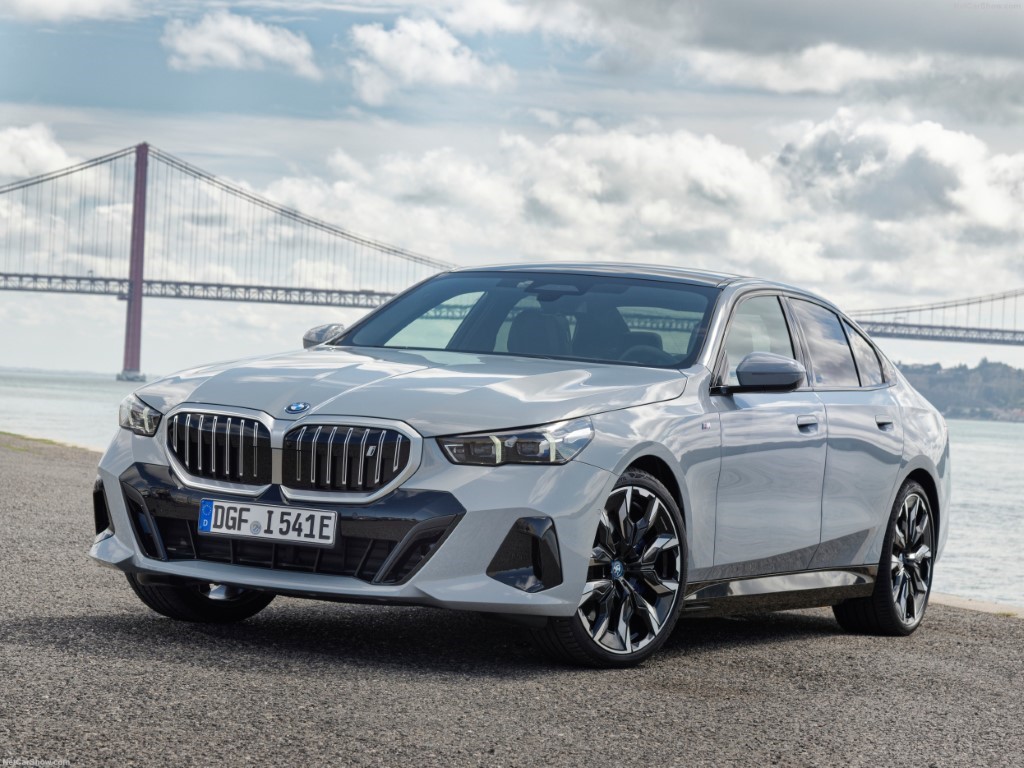
The Electrification of the 5 Series: Context and Strategy of the G60 Generation
The BMW i5 represents a decisive moment in the history of one of the Bavarian brand's pillars. It is not an isolated model, but rather the 100% electric variant of the eighth and latest generation of the BMW 5 Series, internally known by the codename G60. Its launch, with production starting in 2023, marks the first time in nearly 50 years of history that the iconic executive sedan is offered with a purely battery-powered powertrain, a fundamental step in the company's electrification strategy.
The conception of the i5 is rooted in the BMW Group's strategy called "Power of Choice". Instead of developing an exclusive platform for electric vehicles (EVs), as some direct competitors did, BMW opted for a more flexible approach. The i5 is built on the modular CLAR (Cluster Architecture) architecture, a versatile platform designed to accommodate different types of powertrains: internal combustion, plug-in hybrid (PHEV), and fully electric.
This strategic decision has profound implications. The CLAR platform allows the BMW i5, the combustion 5 Series, and the plug-in hybrid versions to be manufactured on the same assembly line. This production flexibility is a crucial competitive advantage in a global market where the pace of electric vehicle adoption varies significantly between regions. While a dedicated EV platform can optimize certain design aspects, such as a completely flat floor, it represents a massive and inflexible investment. BMW's approach, on the other hand, allows it to adjust production in real time to match market demand, whether for electric or combustion models. As a brand executive explained, the company follows the market, and it is customer needs that determine the powertrain mix. In this way, the i5 materializes a pragmatic and calculated-risk approach to the electrification of one of its best-selling and most important models.
From the Assembly Line to the Market: The Start of Production in Dingolfing
Production of the BMW i5 officially began in July 2023 at the BMW Group plant in Dingolfing, Germany. The choice of this location is laden with symbolism and strategic significance. Dingolfing is the historic birthplace of the 5 Series; over 50 years of operation, the plant has produced approximately 8 million units of the model, which corresponds to two-thirds of all 5 Series ever manufactured in the world.
By integrating the i5 into this historic production line, BMW sends a clear message: the i5 is not an experiment or a niche model, but the natural and legitimate evolution of the 5 Series. This association with Dingolfing's heritage and reputation for quality gives the i5 instant pedigree, reassuring the traditional customer base that an electric 5 Series maintains the essence and quality that define the model.
Adapting the factory for this new era required an investment of over one billion euros, allowing the flexible integration of the i5 alongside the iX and i7 models. The i5 was the third 100% electric model to enter production in Dingolfing in just two years, a testament to BMW's rapid transformation capability. The goals are ambitious: the company projects that, as early as 2024, more than 40% of the Dingolfing plant's total production will be fully electric vehicles, boosting the plant's total volume to well over 300,000 vehicles per year.
The BMW i5 Sedan (G60): Complete Analysis of the Versions
One of the most important design decisions for the eighth generation of the 5 Series was the visual unification between the different powertrains. The BMW i5 Sedan is, externally, almost identical to its combustion sibling, a deliberate choice to present a cohesive and familiar lineup to customers, smoothing the transition to electric mobility. The range was structured to offer options ranging from maximum efficiency to high-caliber performance.
i5 eDrive40: The Efficient Starting Point
The i5 eDrive40 represents the entry point to the 5 Series electric range. This version is equipped with a single electric motor mounted on the rear axle, providing a rear-wheel-drive (RWD) configuration that is a hallmark of the BMW driving experience. The engine delivers a power output of 340 hp (250 kW) and a torque of 430 Nm, allowing an acceleration from 0 to 100 km/h in 6.0 seconds.
The main focus of the eDrive40 is the balance between performance and range. Equipped with an 81.2 kWh usable battery, this version offers the longest range in the lineup, capable of reaching up to 582 km in the WLTP cycle. It is the ideal choice for customers looking for the luxury, comfort, and advanced technology of the new 5 Series in a highly efficient electric package, perfectly suited for both daily use and longer trips.
i5 xDrive40: The Balance of All-Wheel Drive
Introduced for the 2025 model year, the i5 xDrive40 fills an important gap in the lineup, offering the safety and performance of BMW's xDrive all-wheel drive. This version adds a second electric motor to the front axle, resulting in an all-wheel-drive (AWD) configuration. Combined power rises to 389 hp, significantly improving acceleration — the 0 to 100 km/h time is reduced to about 5.2 seconds — and optimizing traction in low-grip conditions, such as rain or snow.
The range is slightly lower than the rear-wheel-drive model due to the additional motor, but remains robust for most needs. The i5 xDrive40 positions itself as the perfect intermediate option for those who want a performance boost and the added safety of all-wheel drive, without the need to jump to the cost and extreme power of the M60 version.
i5 M60 xDrive: The Ultimate Expression of Performance
At the top of the range is the i5 M60 xDrive, a model that redefines the performance hierarchy within the 5 Series lineup itself. At its launch, the M60 was not only the most powerful i5 but the most powerful 5 Series of the entire G60 range. This is the first time in the model's history that the highest-performance variant at launch is electric, a strategic move by BMW to transfer its "M" performance legacy into the electric era.
Equipped with two electric motors (one on each axle), the M60 xDrive offers all-wheel drive and impressive numbers: maximum power reaches 601 hp (442 kW) and torque can hit 820 Nm with the M Sport Boost or M Launch Control functions activated. With this configuration, the executive sedan accelerates from 0 to 100 km/h in just 3.8 seconds, a time comparable to many supercars.
However, the M60 is more than just straight-line acceleration. It incorporates a suite of M Performance components that transform its dynamics. Adaptive Suspension Professional, high-performance M Sport brakes, and Integral Active Steering (which includes rear-wheel steering for greater agility and stability) are standard. This suite of technologies makes the i5 M60 xDrive BMW's answer for the enthusiast customer looking for an electric luxury sedan with the dynamics and excitement of a true sports car.
| Feature | i5 eDrive40 | i5 xDrive40 | i5 M60 xDrive |
|---|---|---|---|
| Drive | Rear (RWD) | All-Wheel (AWD) | All-Wheel (AWD) |
| Power | 340 hp / 250 kW | 389 hp | 601 hp / 442 kW |
| Torque | 430 Nm | N/A | 820 Nm (with Boost) |
| Battery (usable) | 81.2 kWh | 81.2 kWh | 81.2 kWh |
| Acceleration 0–100 km/h | 6.0 s | 5.2 s | 3.8 s |
| Top Speed | 193 km/h | N/A | 230 km/h |
| Range (WLTP) | 497–582 km | up to 428 km (est.) | 455–516 km |
| DC Charging Power | 205 kW | 205 kW | 205 kW |
The BMW i5 Touring (G61): Unprecedented Practicality and Performance
A Pioneer in the Segment: The First Luxury Electric Wagon
With the launch of the i5 Touring (codename G61), BMW not only expanded the 5 Series lineup but also created a new market niche. At the time of its introduction, the BMW i5 Touring positioned itself as the first and only fully electric wagon (or estate) in the luxury executive segment. This strategic move gave the brand a unique competitive advantage, attracting a customer profile that values the versatility and cargo space of a wagon, but does not want to give up the sophistication, technology, and propulsion of a modern electric vehicle.
This initiative is particularly astute in markets like Europe, where premium wagons have a long tradition and a loyal customer base. By being the first to electrify this body style, BMW not only captured the entirety of this initial market niche but also forced historic competitors, such as Audi with its Avant line and Mercedes-Benz with its Estate models, into a reactive position. This move reinforces BMW's image as an innovative brand that is electrifying its full lineup, not just the highest-volume models.
Version Analysis and Practicality Differentiators
The i5 Touring's powertrain range mirrors that of the sedan, offering the eDrive40 (rear-wheel drive), xDrive40 (all-wheel drive), and the top-of-the-line M60 xDrive (high-performance all-wheel drive) versions. The big differentiator, naturally, is in the practicality.
The i5 Touring's trunk offers a capacity of 570 liters, an 80-liter increase over the sedan's 490 liters. With the rear seats folded down, the cargo space expands to an impressive 1,700 liters, transforming the i5 Touring into an extremely versatile vehicle for families, trips, and transporting bulky items.
Despite the increase in size and functionality, BMW managed to keep the driving dynamics very close to those of the sedan. The additional weight of the Touring body is only 50 kg, a minimal difference that has little impact on the vehicle's behavior. The range is slightly lower than the corresponding sedan versions due to differences in aerodynamics, but the figures remain highly competitive, with the eDrive40 Touring version reaching up to 560 km in the WLTP cycle.
| Feature | i5 eDrive40 Touring | i5 xDrive40 Touring | i5 M60 xDrive Touring |
|---|---|---|---|
| Drive | Rear (RWD) | All-Wheel (AWD) | All-Wheel (AWD) |
| Power | 340 hp / 250 kW | 394 hp | 601 hp / 442 kW |
| Torque | 430 Nm | N/A | 820 Nm (with Boost) |
| Battery (usable) | 81.2 kWh | 81.2 kWh | 81.2 kWh |
| Acceleration 0–100 km/h | 6.1 s | 5.5 s | 3.9 s |
| Trunk Capacity | 570 L | 570 L | 570 L |
| Max. Capacity | 1,700 L | 1,700 L | 1,700 L |
Technical X-Ray: Powertrain, Battery, and Design
Electric Heart: Battery and Charging Technology
The BMW i5's performance is based on the fifth generation of BMW eDrive technology, a highly integrated and efficient propulsion system. The heart of the system is a lithium-ion battery pack with a flat design, mounted under the vehicle floor to optimize the center of gravity. The battery has a gross capacity of 84.3 kWh and a usable capacity of 81.2 kWh.
The charging system was designed to be fast and convenient. On alternating current (AC), like at residential wallboxes, the i5 accepts a standard 11 kW, with an optional upgrade to 22 kW, which reduces a full charge time to about 4.25 hours. The system's true capability is revealed in direct current (DC) fast charging. The i5 supports a maximum power of up to 205 kW, allowing the battery to be recharged from 10% to 80% in approximately 30 minutes, ideal for stops on long journeys.
Beyond speed, the i5 introduces smart features to optimize the charging experience. The "Plug & Charge" function allows the vehicle to automatically authenticate at compatible public charging stations, eliminating the need to use apps or cards. Additionally, the "MAX RANGE" mode can be activated to extend range by up to 25% in critical situations, by limiting engine power and deactivating non-essential comfort functions.
The Art of Drivability: Chassis, Suspension, and Dynamics
Maintaining BMW's reputation for "sheer driving pleasure" in a heavy electric vehicle was one of the main engineering challenges. Despite its weight, the i5 is consistently praised for its balance, comfort, and agility. The foundation for this performance is a rigid chassis with near-ideal 50/50 weight distribution.
The suspension plays a crucial role. The i5 M60 xDrive comes standard with Adaptive Suspension Professional, which is optional on other versions. This advanced system uses electronically controlled dampers that adjust in real time to road conditions and driving style. It can also include active roll stabilization, which uses electric motors to counteract body lean in corners, keeping the car exceptionally flat and stable.
Another key technology, especially in the M60 model, is Integral Active Steering. This system allows the rear wheels to steer slightly. At low speeds, they turn in the opposite direction to the front wheels, reducing the turning circle and making the car, which is over 5 meters long, surprisingly maneuverable in cities and parking lots. At high speeds, the rear wheels turn in the same direction as the front ones, increasing stability and smoothness during lane changes.
Design and Aerodynamics: The Fusion of Tradition and Efficiency
The design of the BMW i5 (and the entire G60 generation) represents a deliberate choice for an evolutionary and "clean" aesthetic, avoiding the polarizing front grilles seen in other recent brand launches, like the 7 Series or the iX. This more conservative approach aims not to alienate the loyal and traditional 5 Series customer base, making the transition to electric a less radical change. The visual similarity between the i5 and the combustion 5 Series reinforces the idea that it is a single model with different powertrain options. One of the visual highlights is the "Iconic Glow" front grille, an option that illuminates the contours of the grille, giving the car a distinct light signature at night. Aerodynamic efficiency was a priority, resulting in an excellent drag coefficient (Cd) of just 0.23 for the sedan, which directly contributes to greater range.
Inside, the philosophy is minimalism and digitalization. The number of physical buttons has been drastically reduced, with most controls integrated into the digital system. The centerpiece of the cabin is the impressive BMW Curved Display, a single curved piece of glass that unites the 12.3-inch digital instrument cluster and the 14.9-inch central infotainment screen. Another innovative element is the "Interaction Bar", a crystalline ambient light strip that runs across the dashboard and doors, changing color and animation according to the driving mode or system alerts. In line with sustainability trends, the i5 is the first BMW to offer a fully vegan interior as standard, using a high-quality material called "Veganza".
The Onboard Experience: Technology and Driver Assistance
The Digital Brain: BMW Operating System 8.5
The BMW i5 was one of the first models to debut BMW Operating System 8.5, a significant evolution of the iDrive system. The main new feature of this version is the "QuickSelect" interface, which restructures the home screen with a vertical layout of quick access icons and customizable widgets. The goal is to simplify navigation and reduce the number of steps required to access the most used functions, creating a more intuitive, smartphone-like experience.
The system can be operated by touch on the central screen, through the traditional iDrive controller on the center console, or by natural voice commands with the BMW Intelligent Personal Assistant. Connectivity is comprehensive, with wireless integration for Apple CarPlay and Android Auto as standard. The onboard experience is highly customizable through "My Modes", which adjust not only throttle and steering response, but also the ambient lighting of the Interaction Bar, the sound of the electric motor (IconicSounds Electric), and the screen layout. For waiting times, such as during charging, the system offers onboard entertainment, including video streaming and the AirConsole gaming platform, which turns the passenger's smartphone into a controller.
The Smart Co-pilot: Driving Assistant Professional
The i5 takes driver assistance to a new level with the optional Driving Assistant Professional package, offering Level 2 semi-autonomous driving features. The main highlight is the Highway Assistant, a system that allows fully "hands-free" driving on highways with physically separated lanes, at speeds of up to 130 km/h. An attention camera constantly monitors the driver to ensure they remain focused on the road.
The most notable innovation, a world premiere on the i5, is the Active Lane Change with eye activation. When the system detects a safe opportunity for an overtaking maneuver, it suggests the lane change on the instrument cluster. The driver can then confirm the maneuver simply by looking into the corresponding exterior rearview mirror. The car then executes the lane change autonomously, smoothly, and safely. This technology represents a breakthrough in human-machine interaction, making assisted driving more intuitive and natural. Modern luxury manifests itself not only in materials, but in the sophistication and simplicity of technology, and this function is a perfect example of this, serving as a strong market differentiator.
The package also includes features like adaptive cruise control with Stop & Go function for heavy traffic, lane keeping assist, rear cross-traffic alert, and blind spot detection.
The i5 in the Real World: Production, Sales, and Market Analysis
Although BMW does not release specific production or sales numbers for the i5 model in isolation, group reports provide a clear context about its strategic role. Data is generally aggregated by powertrain type (BEV - Battery Electric Vehicle) or by model line (5 Series). The launch of the i5 was crucial for BMW to hit its electrification goals, such as achieving 15% of total sales from BEVs in 2023.
Growth in the brand's electric vehicle sales has been robust. In the first quarter of 2024, the BMW Group delivered 82,700 fully electric vehicles, an increase of over 27.9% compared to the same period the previous year. The i5, alongside the i7, played a key role in rounding out the offering of electric models in the important executive and luxury segments, confirming the attractiveness of the brand's electric portfolio.
Competitive Analysis: The i5 Against Rivals
The BMW i5 enters a competitive market, facing established rivals like the Mercedes-Benz EQE, Genesis Electrified G80, and Tesla Model S. Comparative analysis reveals distinct strengths and weaknesses for the BMW model.
In terms of charging, the i5 stands out with its 205 kW DC capacity, beating the 170 kW of the Mercedes-Benz EQE, which translates to slightly faster charging times. Regarding interior space, the i5 offers more front shoulder room and more rear legroom than the EQE, the G80, and the Model S. Its 490-liter trunk is also superior to the EQE (430 L) and the G80 EV (303 L).
| Feature | BMW i5 eDrive40 | Mercedes-Benz EQE 350+ | Genesis Electrified G80 | Tesla Model S |
|---|---|---|---|---|
| Power | 340 hp | 292 hp | 370 hp | 670 hp |
| Battery (usable) | 81.2 kWh | 90.6 kWh | 82.5 kWh | ~95 kWh |
| DC Recharge | 205 kW | 170 kW | ~187 kW | 250 kW |
| Trunk | 490 L | 430 L | 303 L | 745 L |
| Tech Highlight | Eye-activated Lane Change | Hyperscreen (opt.) | V2L Charging | Supercharger Network |
The Critics' View: Consolidated Reviews
The reception of the BMW i5 by the specialized press has been largely positive, with consistent praise for various aspects of the vehicle. One of the most highlighted points is how the i5 manages to balance ride comfort with the sportiness expected of a BMW. The interior is frequently described as luxurious, well-built, and technologically advanced, although some critics find the iDrive 8.5 infotainment system complex and with a learning curve.
Performance, especially in the M60 xDrive version, is universally acclaimed as "impressive" and "dizzying". Many analysts consider it a strong point that the driving experience is extremely refined, quiet, and very similar to that of a combustion 5 Series, which eases the transition for the brand's customers.
Conclusion: The Legacy and the Future of the BMW i5
The BMW i5 is much more than just a new model in the brand's portfolio; it is a strategic milestone that redefines one of its most iconic lineages for the electric era. Its arrival represents the successful fusion between the nearly five-decade heritage of the 5 Series — synonymous with luxury, performance, and driving pleasure — and the cutting-edge technology that will define the future of mobility.
Through a pragmatic and customer-centric approach, utilizing a flexible platform, BMW has managed to create a vehicle that does not force a disruptive choice, but rather offers one. The i5 preserves the familiarity and build quality of the 5 Series, while simultaneously introducing avant-garde innovations, such as "hands-free" driving with eye-activated lane changes.
With a diverse range spanning from the efficient eDrive40 to the potent M60 xDrive, and with the pioneering addition of the practical Touring body style, the i5 demonstrates BMW's ability to electrify its core lineup without compromising its identity. It not only solidifies the brand's position at the forefront of the competitive electric luxury segment but also serves as a crucial bridge, preparing both the company and its customers for the next generation of vehicles, the "Neue Klasse", and a fully electric future.