E82
(2011-2012)
3.0 L6 Twin-turbo
340 cv
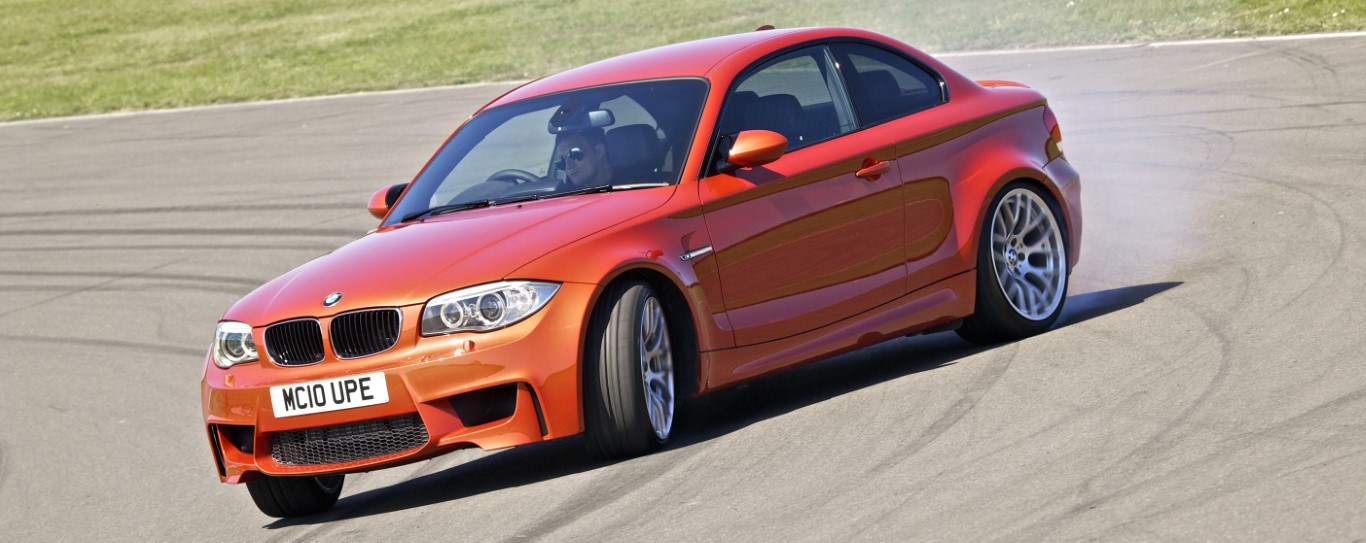
The analog hero: the limited-edition pocket rocket that reclaimed the pure, mechanical essence of the BMW M division.
Select a generation to see available versions
(2011-2012)
At the end of the first decade of the 21st century, BMW's M division, revered for creating some of the purest sports cars in the world, faced an identity crisis. Its models, such as the iconic M3, were growing in size, weight, complexity, and, consequently, price. To many enthusiasts, the soul of the classic models — the compact agility and visceral connection of the original BMW M3 E30 — seemed to be diluting amidst larger V8 engines and a growing list of technologies. This scenario created a vacuum at the heart of the M lineup, a gap felt by purists who yearned for a smaller, lighter car focused exclusively on the driving experience. BMW M GmbH recognized this opportunity not only to satisfy its traditional fanbase but also to attract a younger audience by offering a more accessible entry point to the exclusive M world. It was in this context that the idea for one of the brand's most memorable and unexpected projects was born: the BMW 1 Series M Coupé.
Unlike the long and formal development cycle of most M models, the 1 Series M Coupé — or simply 1M, as it became affectionately known — emerged from a "quasi-secret" project, often described as a skunkworks operation. The legend surrounding its creation tells that a small, passionate team of engineers from the M Division initiated the project on their own, driven by the desire to build the ultimate track car in a compact package, without the full knowledge of BMW's top management in its early stages.
The pace of development was extraordinarily fast. Initiated in October 2009, the project received official approval in December of the same year, and in just one year, the car was already being tested, finalized, and prepared for launch. This accelerated schedule, unthinkable by automotive industry standards, was only possible thanks to a pragmatic and ingenious engineering philosophy.
To make the project viable and keep development costs under control, the engineers adopted an approach that would become the key to the 1M's unique character: the use of existing high-performance components from BMW's vast catalog. Far from being a demerit, this "parts-bin" strategy was a masterstroke.
Crucial components for the vehicle's dynamics were "borrowed" directly from its larger and more revered sibling, the E92 generation BMW M3. This included the entire five-link rear suspension assembly, the robust variable M limited-slip differential, and the powerful high-performance compound braking system. By transplanting the soul of an M3 into the shorter and lighter chassis of the 1 Series Coupé, the team created a mechanical "Frankenstein" that combined the best of both worlds, resulting in a completely new and exciting driving personality.
Perhaps the most controversial and debated decision at the time was the choice of engine. Historically, M Division cars were equipped with "S" designated engines (for Motorsport), high-revving units developed specifically for extreme performance. The 1M, however, broke this tradition by adopting a specially tuned version of the N54 engine, a 3.0-liter twin-turbo inline-six that already powered "non-M" models of the brand, such as the Z4 sDrive35is.
Immediately, purists and critics questioned the 1M's legitimacy as a "true M", arguing that the absence of an "S" engine compromised its lineage. However, this choice proved to be brilliant. The N54 engine was known for its massive torque delivery at low RPMs, a direct contrast to the S65 V8 of the M3 E92, which needed high revs to deliver its peak power. This characteristic gave the 1M a distinct personality: a car with immediate response and brute force available at any time, making it explosive and visceral in a way the M3 was not.
The origin of the 1M is, therefore, a story of passion and pragmatism. Born out of the need to rescue the essence of the early M cars, the project bypassed bureaucratic and financial barriers through smart engineering solutions. The strategy of using existing parts was not just a cost-cutting measure; it was the catalyst that allowed the creation of a car that otherwise would never have been approved. This unconventional and "rebellious" origin is a fundamental part of its enduring appeal and the cult status it achieved.
The explosive personality and unforgettable driving experience of the BMW 1M Coupé are not the result of chance, but rather the result of a precise combination of mechanical components that define it. Every element, from the engine to the transmission and chassis, was chosen and tuned to create a cohesive package focused on pure driving pleasure.
At the center of it all is the N54B30T0 engine, a 3.0-liter inline-six unit equipped with M TwinPower Turbo technology — which, in this case, refers to two low-inertia turbochargers — and high-precision direct injection. This engine was tuned by the M Division to produce a maximum power of 340 hp (250 kW) at 5,900 rpm.
However, the real highlight of the N54 is its torque. It delivers an impressive 450 Nm almost instantaneously, in a flat curve that goes from a mere 1,500 rpm up to 4,500 rpm. For moments of maximum acceleration, an overboost function kicked in, temporarily increasing torque to 500 Nm, providing a surge of power that pushed the driver back into the seat.
Although the N54 block was shared with other BMW models, the M Division did not limit itself to a simple remap. Revisions were made to the exhaust system to create a sportier sound, to the ECU software for a more aggressive response, and even to the piston rings to ensure durability under the demanding conditions of an M car. Additionally, the "M" button on the steering wheel altered the throttle mapping, making the engine's response even more immediate and sharp.
In a decision that solidified its status as a purist icon, the BMW 1M was offered with a single transmission option: a six-speed manual gearbox. At a time when automated dual-clutch transmissions were becoming the norm in high-performance cars, BMW M deliberately opted for an analog approach, prioritizing maximum driver involvement and control. This choice was not just a nod to tradition, but a statement of intent: the 1M was designed to be, above all, a car for those who love to drive.
The genius of the 1M lies in the way it combines its "torquey" engine with a chassis inherited from a larger and more sophisticated car. The use of the front and rear five-link suspension, the high-performance compound brakes, and the variable M limited-slip differential from the E92 M3 gave the 1M a robust and track-proven mechanical foundation.
This foundation was combined with the compact dimensions of the 1 Series Coupé. With a short wheelbase of 2,660 mm and tracks significantly widened to 1,542 mm both front and rear, the 1M acquired a "square" stance and phenomenal agility. The result is a unique dynamic behavior: the car is incredibly nimble, changes direction with dizzying speed, but can also be twitchy and demanding at the limit. Enthusiasts and journalists frequently describe its behavior as "edgy," "playful," and "challenging," a car that demands respect and skill from the driver.
To complete the sensory package, the 1M was one of the last M Division cars to be equipped with a hydraulic power steering system. In a world rapidly migrating to electric assistance, the 1M's steering offers a level of feedback and communication with the road that has become legendary. Every nuance of the surface and the behavior of the front tires is transmitted directly to the driver's hands, creating a pure, unfiltered connection that many enthusiasts miss in modern cars.
This combination of an engine with massive low-end torque, a short wheelbase, and a rear-wheel-drive system with a highly effective M differential created a "perfect storm" of driving dynamics. The instant torque of the N54 engine, available at just 1,500 rpm, contrasted sharply with the high-revving nature of the M3's V8. In a short, agile chassis, this meant that a slightly overenthusiastic throttle application in a corner could easily destabilize the rear, inducing oversteer. Far from being a flaw, this characteristic became the core of its appeal. The 1M gained a reputation for being a "tricky" and "boisterous" car, a vehicle that felt alive, communicative, and that "wanted to be driven," rewarding the skilled driver with a visceral and unforgettable driving experience.
| Characteristic | Specification |
|---|---|
| Engine | N54B30T0, Inline 6-cylinder, 2,979 cm³, M TwinPower Turbo |
| Power | 340 hp (250 kW) @ 5,900 rpm |
| Torque | 450 Nm @ 1,500-4,500 rpm (500 Nm with Overboost) |
| Transmission | 6-speed manual, rear-wheel drive |
| Acceleration (0-100 km/h) | 4.9 seconds |
| Acceleration (0-200 km/h) | 17.3 seconds |
| Top Speed | 250 km/h (electronically limited) |
| Dimensions (L x W x H) | 4,380 mm x 1,803 mm x 1,420 mm |
| Wheelbase | 2,660 mm |
| Weight (DIN) | Approx. 1,495 kg |
| Wheels and Tires | Front: 245/35 R19; Rear: 265/35 R19 |
The design of the BMW 1M Coupé is a physical manifestation of its engineering philosophy. Its muscular and aggressive appearance is not a mere styling exercise, but the direct and honest consequence of the mechanical decisions made to maximize performance. The car visibly "wears" its engineering, and this authenticity is one of the keys to its timeless visual appeal.
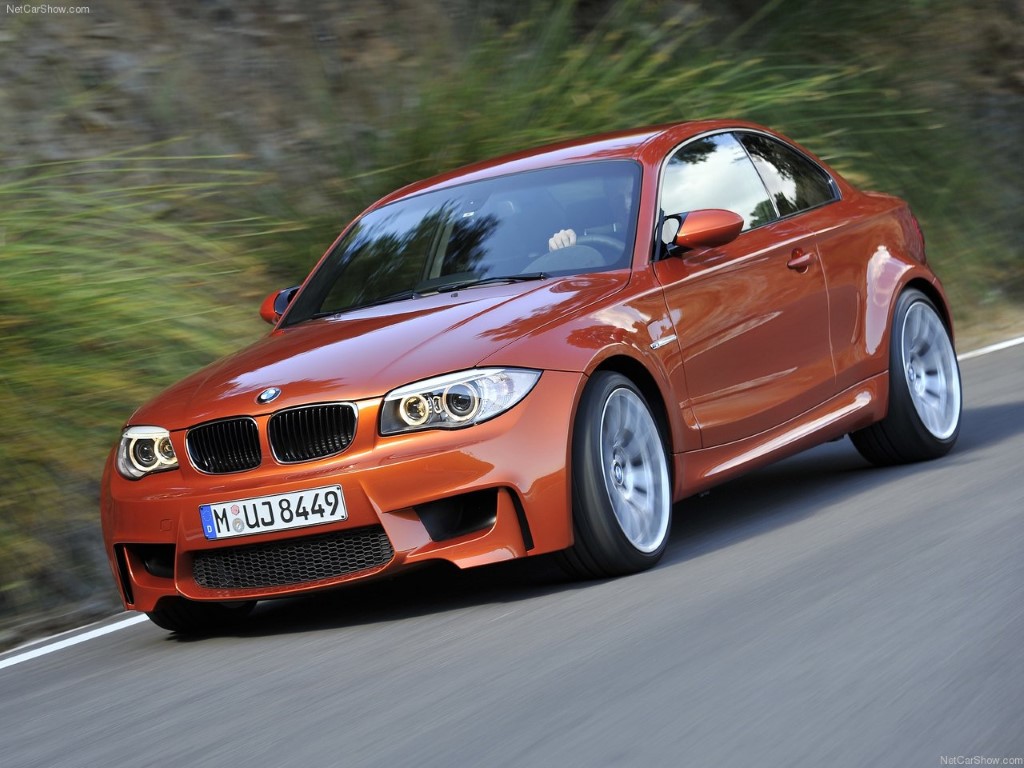
The most striking and defining visual characteristic of the 1M is its widened fenders. To accommodate the significantly wider tracks inherited from the E92 M3, designers had to drastically widen the body, creating "box-style flares" that give the car a low, wide, and extremely aggressive stance. This robust appearance earned it nicknames like "bulldog" and descriptions like "pugnacious", perfectly reflecting its dynamic character.
The design, however, goes beyond aesthetics. Form follows function in every detail. The front bumper was sculpted with three large air intakes, essential for cooling the engine and the high-performance braking system. At the outer edges of the bumper, the 1M introduced an aerodynamic innovation for the time: "Air Curtains". This system channels airflow through vertical openings and directs it at high speed across the outer face of the front wheels, creating a "curtain" of air that reduces turbulence in the wheel wells and improves stability at high speeds.
Other M details reinforce its sporty lineage. The aerodynamic rearview mirrors were inherited from the M3, M side air vents (known as "gills") adorn the front fenders, a discreet spoiler on the trunk lid improves downforce, and at the rear, a quad-tailpipe exhaust system — an unmistakable signature of M cars — completes the look. The car came factory-equipped with the beautiful and lightweight 19-inch "Y-spoke" style wheels (Style 359M), the same as the M3 Competition Package, perfectly filling the widened wheel arches.
To reinforce its special, limited-production character, BMW offered the 1M in an extremely restricted color palette, with only three options available:
The 1M's interior was designed to be a functional, driver-focused cockpit, eliminating distractions and prioritizing the driving experience. The overall design was intended to reduce glare and keep the pilot's attention on the road.
The standard trim was black Boston leather, but what truly defined the cabin were the contrasting vibrant orange stitching, present on the seats, steering wheel, and shifter boot. The extensive use of Alcantara — a synthetic suede-like material associated with race cars — on the instrument panel, door panels, and handbrake, also with orange stitching, added a touch of sportiness and refinement, elevating the perceived quality of the cabin.
Specific M Division details were everywhere: the thick-rimmed leather steering wheel was the same as the M3's, the door sills displayed the "M" logo, an aluminum M footrest was positioned for the driver, and the M emblem was embossed into the headrests of the sports seats. The instrument cluster also had an exclusive M design, featuring a grey background, red needles, and white backlighting, ensuring excellent legibility and a sporty look.
The beauty of the 1M's design lies in its honesty. It does not try to hide its nature. The need to use the M3's mechanical setup dictated the consequence of widening the bodywork. This engineering solution, in turn, created the car's most memorable aesthetic. The 1M's form is a symbol of its function, a characteristic highly appreciated in classic cars and one that contributes enormously to its cult status. It is a car that is not afraid to show, through its lines, exactly what it is: a compact and powerful performance machine.
Rarity is one of the pillars supporting the legendary status of the BMW 1M Coupé. Its remarkably short production cycle and the final numbers, although higher than planned, still position it as one of the most exclusive M models ever made, a crucial factor for its high appreciation and desirability in the collector's market.
The BMW 1 Series M Coupé had a very brief lifespan. Its production began in early 2011 and ended in mid-2012, completing a cycle of approximately 18 months. This production window is one of the shortest in the entire history of BMW M, which in itself guaranteed a degree of exclusivity from its launch.
BMW M's original plan was to manufacture the 1M as a strictly limited series, with a production target of just 2,700 units worldwide. The intention was to create a collector's item, a spiritual "homologation special" for the road.
However, the reception from specialized critics was overwhelming. Publications all over the world hailed the 1M as a return to form for BMW, one of the best enthusiast cars in years. This acclaim, combined with word-of-mouth among consumers, generated much higher-than-expected demand. The car sold out in most markets before it even physically arrived at dealerships, with waiting lists forming rapidly.
Faced with this resounding success, BMW made the decision to increase production to meet part of the pent-up demand. By the end of the cycle, the total number of units produced globally stood between 6,309 and 6,331, depending on the source — more than double the originally planned volume. Despite the increase, the final number is still low by industry standards, solidifying its status as a rarity.
The table below details the production distribution of the BMW 1M Coupé in some of the key markets, illustrating how exclusivity varies regionally and reinforcing why it is such a coveted item in certain parts of the world.
| Region/Country | Number of Units Produced |
|---|---|
| Total Global Production | ~6,309 - 6,331 |
| North America | |
| United States | 740 |
| Canada | 220 |
| Europe | |
| Germany | 1,204 |
| United Kingdom | 450 (right-hand drive) |
The impact of the BMW 1M Coupé transcends its production numbers or technical specifications. It became a milestone in BMW's history, a modern classic revered by enthusiasts, and a benchmark for driving pleasure. Its legacy lies not only in the car itself but in the influence it exerted on the M Division itself and the creation of its spiritual successor.
Despite initial skepticism from some purists regarding its non-"S" engine, the 1M was received with almost universal acclaim by the automotive press. It was praised as a triumphant return to BMW's roots, a car that captured the essence of what made M models so special: agility, involvement, and pure fun. It quickly transcended the status of "just a good car" to become a cult object, an instant icon.
One of the greatest testaments to its legacy is its performance in the used car market. Years after the end of its production, the value of a well-maintained 1M has not only remained stable but frequently surpassed its original retail price. This remarkable appreciation is a direct reflection of its combination of rarity, critical acclaim, and a driving experience that has become increasingly hard to find.
Much of the 1M's enduring appeal lies in its "analog" character. Launched on the threshold of a new automotive era dominated by electronics, the 1M is often celebrated as the "last of the analog M cars". Its recipe is simple and effective: communicative hydraulic steering, a manual gearbox as the only option, and electronic assistance systems that could be dialed back to a permissive mode (MDM) or completely turned off, handing total control over to the driver.
This pure, raw, and unfiltered driving experience has become a treasure in a world of increasingly digitized, isolated, and complex performance cars. The 1M demands skill, attention, and respect, but it rewards the driver with a visceral connection to the machine and the road, something that defines the great cars of history.
The resounding success of the 1M was an undeniable proof of concept. It demonstrated that there was an eager market for a compact, agile, and driver-focused M coupe. This success directly paved the way for the creation of its spiritual successor: the BMW M2. The M2, launched in 2015, followed the same basic formula: a turbocharged inline-six engine, rear-wheel drive, and a dynamic, compact chassis.
However, there are crucial philosophical and execution differences between the two:
Development Philosophy: The 1M was a "happy accident", a skunkworks project pieced together with parts from other cars and a limited budget. The M2, on the other hand, was a planned product from the start, developed with a full budget and the benefit of the experience gained from the 1M. It was more refined, more polished, and, in a sense, less "rebellious".
Driving Feel: Objectively, the M2 is a faster, more capable, and more stable car on a racetrack. However, many purists still prefer the 1M experience. The 1M's hydraulic steering is universally considered more communicative and rich in feedback than the M2's electric steering. The 1M's behavior is more "wild," twitchy, and unpredictable, making it more challenging and, to some, more rewarding. The M2 is described as more "forgiving" and "polished," an easier car to drive fast, but with less of that spark of unpredictability that makes the 1M so special.
The legacy of the 1M, therefore, goes far beyond being just a great car. It effectively recalibrated the M brand's identity for the 21st century. At a time when the division was at risk of being perceived as focused solely on large, heavy, and overly technological cars, the 1M reintroduced and reaffirmed the core values that built BMW's reputation: agility, feedback, and the pursuit of pure driving pleasure. The success of the 1M gave BMW the confidence to invest in a continuous line of "baby M's," the M2 series, which became one of the brand's most popular and acclaimed models. The 1M not only created its own legacy but secured the future of an entire lineage of cars focused on the essence of the "Ultimate Driving Machine".
The BMW 1 Series M Coupé represents a singular and almost unrepeatable moment in automotive history. Born from a combination of engineering passion, pragmatic constraints, and a latent demand for purity, it became much more than the sum of its parts. It was a "happy accident" that turned into a benchmark, a car that captured the perfect balance point between the old-school analog feel and the overwhelming performance of the modern era.
Its story is that of an audacious project that proved that the essence of the "Ultimate Driving Machine" does not lie solely in high-revving engines or record lap times, but in the visceral and emotional connection between driver, machine, and road. With its exclusively manual gearbox, communicative hydraulic steering, and a chassis that danced on the edge between agility and rebellion, the 1M offered a pure, challenging, and immensely rewarding driving experience.
Today, the 1M Coupé is more than a modern classic; it is an enduring testament to a driver-focused design and engineering philosophy. Not only did it leave its own indelible mark, but it also revitalized an entire segment and ensured that the spirit of the purest M cars would continue to thrive for a new generation. For enthusiasts worldwide, it remains one of the most important, desired, and above all, fun cars ever created by BMW's legendary M Division.