
F06
(2012-2015)
4.4 V8 Twin-turbo
450 cv
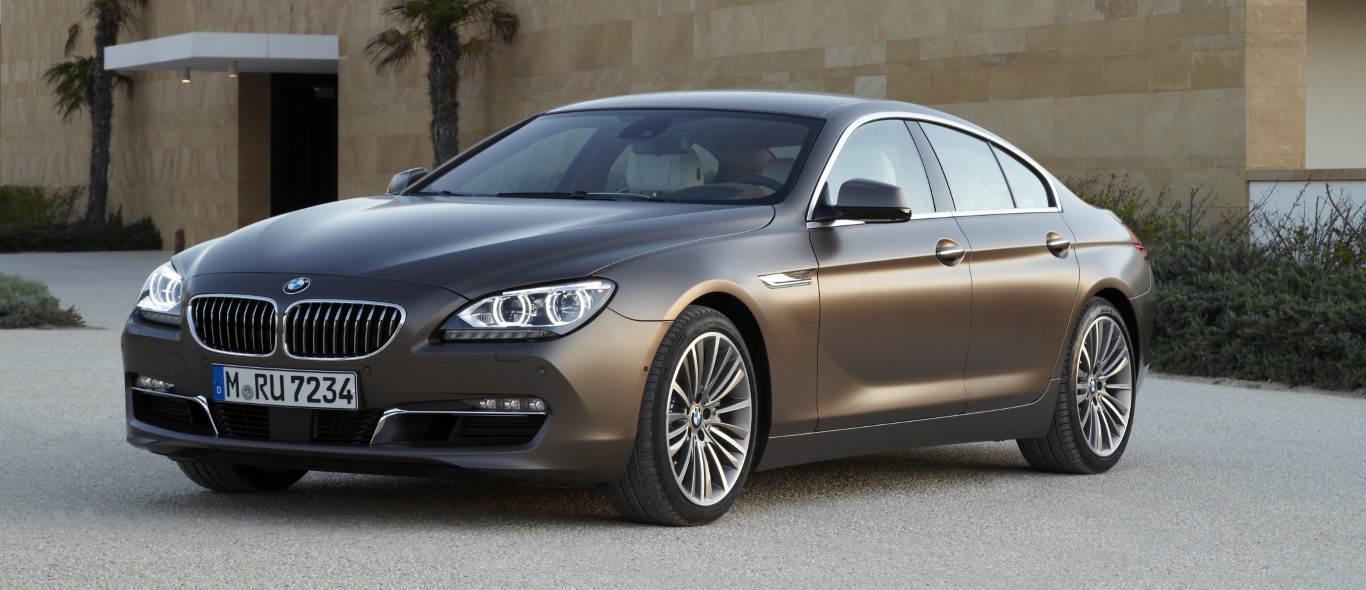
The art of seduction: the Gran Coupe that set new standards for elegance and road presence for BMW.
Select a generation to see available versions
(2012-2015)

(2016-2018)
In the early 2010s, the luxury car segment witnessed the consolidation of a new category: the "four-door coupe". Mercedes-Benz had been the pioneer with the launch of the CLS in 2004, a model that sacrificed a bit of the practicality of a traditional sedan in exchange for a dramatically more elegant and sporty silhouette. The success of the CLS inspired other brands, such as Audi with the A7 Sportback and Porsche with the Panamera, to enter this growing niche.
BMW, known for its strategic caution, observed this movement for almost eight years before introducing its own interpretation. This late entry into the market was not a sign of hesitation, but rather a calculated maneuver. The time allowed BMW to analyze the strengths and weaknesses of its competitors, understand what customers valued, and refine the formula. Instead of simply following a trend, the brand sought to redefine the segment through the lens of its core philosophy: driving pleasure. The result was the BMW 6 Series Gran Coupé, with the chassis code F06.
The design of the F06 did not emerge from a vacuum; it was the materialization of the acclaimed 2007 BMW CS Concept, a design study that signaled the brand's intention to create a luxury sedan with coupe proportions and an imposing presence. Officially unveiled at the Geneva Motor Show in March 2012, the 6 Series Gran Coupé was the first four-door coupe in BMW's history. It was positioned to combine the elegance of a 6 Series Coupé, the luxury of a 7 Series, and the driving dynamics of a 5 Series.
In Brazil, the model arrived shortly after the global launch, with the 640i version serving as the entry point to compete directly with the Mercedes-Benz CLS 350 and the Audi A7. The launch event in São Paulo, held at the Sergio Caribé Gallery, reinforced BMW's message: the Gran Coupé was not just a car, but a moving "work of art".
The BMW 6 Series Gran Coupé (F06) was universally acclaimed for its design, which many consider one of the high points of BMW aesthetics in the modern era. Its form was carefully sculpted to convey elegance, exclusivity, and dynamism.
The proportions of the F06 followed the classic playbook of a grand tourer: a long, imposing hood, short front and rear overhangs, and a flowing roofline that sloped smoothly to the rear, creating an unmistakable silhouette. The prominent wheel arches and the precise crease lines that ran along the side of the vehicle accentuated its low, wide stance. At the rear, the muscular shape over the wheels, combined with the horizontal LED taillights and the third brake light integrated into the top of the glass, gave the car an agile and powerful appearance.
Internally, the Gran Coupé maintained BMW's tradition of a strongly driver-oriented cockpit. All controls and displays were ergonomically positioned for easy access, reinforcing the connection between the driver and the machine. The environment was pure luxury, featuring exceptionally high-quality materials, such as finely structured leather (with a Nappa leather option) and fine wood or brushed aluminum trims.
One of the most distinctive features of the F06 was its "4+1" seating concept. This configuration was not a design error, but a deliberate choice that defined the character of the car. Instead of trying to be a conventional five-seater sedan, the Gran Coupé prioritized maximum comfort for four occupants. The two rear seats were individual and luxurious, separated by a center console that extended from the front, creating an atmosphere of exclusivity. The "+1", a smaller center seat functionally compromised by the transmission tunnel, was intended for short, occasional trips. With this decision, BMW communicated that the F06 was, at its core, a true coupe that offered the convenience of rear doors, and not a 5 Series with a different roof.
To accommodate the rear doors and offer more interior space, the F06 was built on an elongated version of the 6 Series Coupé (F13) platform. Its wheelbase was 117 mm longer, totaling 2,968 mm, identical to that of the 5 Series sedan (F10) from the same era. With a total length of 5,007 mm, the Gran Coupé was significantly larger than its two-door sibling, which translated into notably superior legroom for rear passengers. The trunk offered a capacity of 460 liters, a respectable volume for the category.
At its launch, the BMW 6 Series Gran Coupé offered a range of powerful and efficient engines, all equipped with BMW TwinPower Turbo technology and mated to the acclaimed 8-speed Steptronic automatic transmission. In 2012, the xDrive all-wheel-drive system became available as an option, increasing the model's versatility and safety in different grip conditions.
The main versions available in the initial period were:
The table below summarizes the technical specifications of the pre-facelift models.
| Model | Engine | Displacement (cc) | Power (hp @ rpm) | Torque (Nm @ rpm) | Acceleration 0-100 km/h (s) | Drive |
|---|---|---|---|---|---|---|
| 640i | N55 I6 Turbo | 2,979 | 320 @ 5,800-6,000 | 450 @ 1,300-4,500 | 5.4 | Rear |
| 640i xDrive | N55 I6 Turbo | 2,979 | 320 @ 5,800-6,000 | 450 @ 1,300-4,500 | 5.3 | All-Wheel |
| 650i | N63 V8 Twin-Turbo | 4,395 | 407 @ 5,500-6,400 | 600 @ 1,750-4,500 | 4.7 | Rear |
| 650i xDrive | N63 V8 Twin-Turbo | 4,395 | 407 @ 5,500-6,400 | 600 @ 1,750-4,500 | 4.5 | All-Wheel |
| 640d | N57 I6 Twin-Turbo Diesel | 2,993 | 313 @ 4,400 | 630 @ 1,500-2,500 | 5.4 | Rear |
| 640d xDrive | N57 I6 Twin-Turbo Diesel | 2,993 | 313 @ 4,400 | 630 @ 1,500-2,500 | 5.2 | All-Wheel |
In 2015, BMW introduced the Life Cycle Impulse (LCI), a mid-cycle update for the entire 6 Series line. The changes were subtle but effective, aiming to refine the Gran Coupé's design and technology while keeping it competitive in the market.
Visually, the "kidney" grille was redesigned, now featuring nine vertical bars on each side instead of the previous ten, a detail that enthusiasts noticed. The front and rear bumpers received a new design to accentuate the car's width and sportiness, and Full-LED headlights became standard equipment, providing a more modern and sophisticated visual signature. New color options and 20-inch alloy wheels were also added to the catalog.
The most significant technical change occurred in the 650i's engine. It received the N63TU update, which, among other improvements, added the Valvetronic system. With this, power jumped to 450 hp and torque to 650 Nm, resulting in a notable improvement in performance. Inside, new trims and customization packages were introduced, such as "Design Pure Experience" and "Design Pure Excellence," which allowed customers to highlight the sportier or more luxurious side of the vehicle. Another important novelty was the inclusion of a sports exhaust system with adjustable flaps as standard equipment on gasoline models, providing a more engaging and dramatic engine sound.
The table below details the specifications of the models after the 2015 update.
| Model | Engine | Displacement (cc) | Power (hp @ rpm) | Torque (Nm @ rpm) | Acceleration 0-100 km/h (s) | Drive |
|---|---|---|---|---|---|---|
| 640i | N55 I6 Turbo | 2,979 | 320 @ 5,800-6,000 | 450 @ 1,300-4,500 | 5.4 | Rear |
| 640i xDrive | N55 I6 Turbo | 2,979 | 320 @ 5,800-6,000 | 450 @ 1,300-4,500 | 5.3 | All-Wheel |
| 650i | N63TU V8 Twin-Turbo | 4,395 | 450 @ 5,500-6,000 | 650 @ 2,000-4,500 | 4.6 | Rear |
| 650i xDrive | N63TU V8 Twin-Turbo | 4,395 | 450 @ 5,500-6,000 | 650 @ 2,000-4,500 | 4.4 | All-Wheel |
| 640d | N57 I6 Twin-Turbo Diesel | 2,993 | 313 @ 4,400 | 630 @ 1,500-2,500 | 5.4 | Rear |
| 640d xDrive | N57 I6 Twin-Turbo Diesel | 2,993 | 313 @ 4,400 | 630 @ 1,500-2,500 | 5.2 | All-Wheel |
In 2013, BMW's high-performance division, BMW M GmbH, introduced the M6 Gran Coupé. This model represented the pinnacle of engineering and performance for the F06 line, being the first M to be offered in this body style. It was designed to combine the performance of a supercar with the luxury and practicality of a four-door coupe, creating a unique vehicle in its segment.
The heart of the M6 Gran Coupé was the S63B44TÜ engine, a 4.4-liter V8 with M TwinPower Turbo technology, capable of high revs. In its standard configuration, this engine produced an impressive 560 hp and 680 Nm of torque, available in an extremely wide rev range (from 1,500 to 5,750 rpm), ensuring brutal acceleration in any situation. Mated to a 7-speed M double-clutch transmission (M-DCT) with Drivelogic, the M6 Gran Coupé accelerated from 0 to 100 km/h in just 4.2 seconds.
For the most demanding drivers, BMW offered the Competition Package. Initially, this package raised power to 575 hp. With the 2015 update, the numbers became even more extreme: 600 hp and 700 Nm of torque. This extra power, combined with chassis tweaks and exclusive 20-inch wheels, allowed the M6 Competition Gran Coupé to break the four-second barrier, reaching 100 km/h in just 3.9 seconds.
Unlike many competitors who opted for all-wheel drive, the M6 Gran Coupé stayed true to BMW tradition with rear-wheel drive. To manage all the power, it came standard with the Active M Differential, an electronic system that optimally distributed torque between the rear wheels, maximizing traction and stability in corners. Top speed was electronically limited to 250 km/h, but the optional M Driver's Package raised this limit to 305 km/h.
| Version | Engine | Power (hp) | Torque (Nm) | Acceleration 0-100 km/h (s) | Top Speed (km/h) |
|---|---|---|---|---|---|
| M6 Gran Coupé | S63 Twin-Turbo V8 | 560 | 680 | 4.2 | 250 (305 with M Driver's Package) |
| M6 Comp. (pre-LCI) | S63 Twin-Turbo V8 | 575 | 680 | 4.1 | 250 (305 with M Driver's Package) |
| M6 Comp. (LCI) | S63 Twin-Turbo V8 | 600 | 700 | 3.9 | 250 (305 with M Driver's Package) |
Although BMW does not release specific production numbers for each body style, the aggregate data for the third-generation 6 Series (F06, F12, and F13) offers a clear view of the Gran Coupé's impact. Total production for the generation between 2011 and 2017 was 129,678 units. In 2011, before the launch of the Gran Coupé, annual 6 Series production was 9,396 units. In 2012, with the arrival of the F06, this number jumped to 23,193 and peaked in 2013 with 27,687 units.
This dramatic increase in sales following the introduction of the F06 strongly suggests that the four-door variant became the sales pillar of the lineup. By adding a level of practicality that the two-door models could not offer, the Gran Coupé attracted a wider audience, validating BMW's strategy and proving there was a robust market for a four-door coupe with the brand's DNA.
In the market, the 6 Series Gran Coupé was received with acclaim for its stunning design and rewarding driving experience, true to BMW's reputation. The powerful and smooth engines, along with a well-balanced chassis, were frequently praised points. Criticisms, when they existed, focused on compromises inherent to its design: access to the rear seats and headroom were limited by the roofline, and its price was generally higher than that of its direct competitors.
The main rivals of the F06 were:
Among the three Germans, the BMW 6 Series Gran Coupé firmly positioned itself as the enthusiast's choice, the car for those who valued driving dynamics as much as style.
Production of the BMW 6 Series Gran Coupé (F06) ended in September 2018, marking the end of a successful generation. The "6 Series" name was then repurposed for the 6 Series Gran Turismo (G32), a five-door model with a proposition more focused on comfort and practicality, distancing itself from the original coupe concept.
The decision to discontinue the 6 Series Coupé and Gran Coupé was strategic. BMW chose to replace the line with the new 8 Series (G15), a move to reposition its flagship in an even more exclusive and profitable luxury segment. This change was part of a "luxury offensive" by the brand, aiming to increase its market share and margins at the top end of the market, competing more directly with brands like Porsche.
This transition, however, was not just a name swap. It reflected a trend of polarization in the luxury market. The 6 Series Gran Coupé occupied a middle ground: more stylish than a 5 Series, but more accessible than a 7 Series. By launching the 8 Series Gran Coupé with a clearly superior price and positioning, BMW aimed at the top of the pyramid. Simultaneously, models like the 4 Series Gran Coupé began to meet the demand for a four-door coupe at a more accessible price point.
The legacy of the F06 is therefore twofold. It not only successfully established a new and important body type for BMW but also served as a market "laboratory". Its success proved the concept and taught the company that the formula could be even more profitable if it were split and elevated to a new level. The F06 solidified the idea of the Gran Coupé within the BMW portfolio, influencing the design of subsequent models and paving the way for its spiritual successor, the 8 Series Gran Coupé.
Today, the BMW 6 Series Gran Coupé (F06) is remembered as a milestone in the brand's history: the first Gran Coupé, a design icon that masterfully combined timeless aesthetics with the driving dynamics that define a BMW. Even out of production, it remains a coveted model in the used market, valued for its beauty and its unique balance of sportiness and elegance.