1st Generation
(2023-2025, 2026-)
Eletric (Two motors)
615 cv
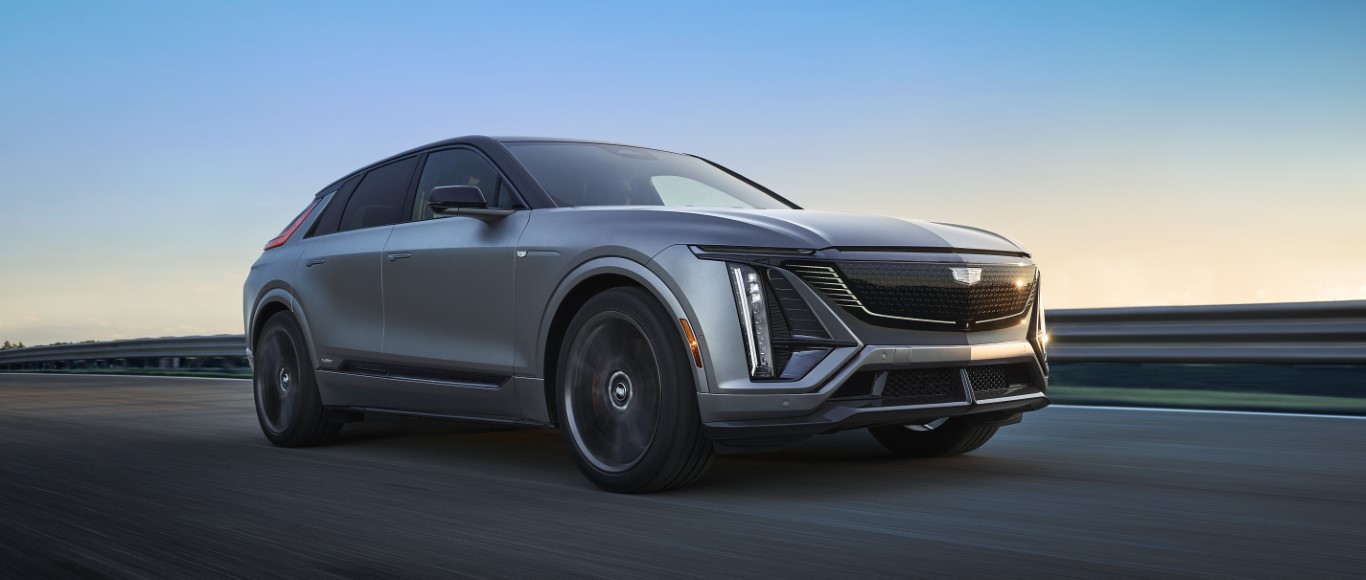
The new era of brilliance: the electric SUV merging artistic lighting with the world's most advanced battery technology.
Select a generation to see available versions
(2023-2025, 2026-)
The global automotive industry is going through its most radical transformation in over a century, migrating from internal combustion to full electrification. Within this scenario, few brands carry a historical weight as significant as Cadillac. Known for defining the "standard of the world" for luxury in the 20th century, the brand has faced, in recent decades, the challenge of rejuvenating its image and competing with the precision of German engineering and the disruptive innovation of Tesla. The Cadillac Lyriq is not just a new model in General Motors' (GM) portfolio; it represents ground zero for an irrevocable strategy. As announced by the corporation, the launch of the Lyriq signaled the end of the development of new internal combustion engines for the brand, establishing the commitment to a 100% electric portfolio by 2030.
This report exhaustively analyzes the trajectory of the Lyriq, from its conception as a concept car to its consolidation as GM's best-selling luxury electric SUV and its imminent expansion to emerging markets like Brazil. The analysis covers the engineering of the Ultium platform, the detailed year-by-year evolution of the trims (2023–2026), the manufacturing challenges, and the global market response.
The public history of the Lyriq began in August 2020, when Cadillac revealed the "show car" that would give rise to the production model. Unlike previous eras, where concept cars were design exercises far removed from reality, the Lyriq concept was, according to brand executives, about 85% faithful to the final vehicle. The goal was to establish a new design language that abandoned the angular aggressiveness of the "Art & Science" era in favor of more fluid lines, clean surfaces, and a more organic digital interaction, symbolizing the silent and smooth nature of electric propulsion.
A crucial aspect of the Lyriq's development was speed. Pressured by the competition, GM needed to get the vehicle to market quickly. To do this, Cadillac's engineering relied extensively on virtual testing and digital validation. Simulation tools allowed them to evaluate aerodynamics, cabin comfort (aeroacoustics), and structural integrity even before building the first physical prototypes. This methodology allowed them to move the launch schedule forward by nine months, a notable feat in the traditional automotive industry.
The Lyriq was the first Cadillac vehicle to utilize General Motors' modular Ultium architecture. Unlike adapted platforms that accommodate both combustion and electric engines, Ultium (BEV3) was designed exclusively for electric vehicles.
Ultium technology utilizes large, flat "pouch" style battery cells, developed in partnership with LG Energy Solution. The cathode chemistry is of the NCMA (nickel-cobalt-manganese-aluminum) type, an innovation that allowed for a reduction in the use of cobalt — an expensive and complex-to-mine material — by about 70% compared to GM's previous batteries (such as those in the Chevrolet Bolt).
The battery pack is not just a fuel tank; it is a structural component of the chassis. Integrated into the floorpan, it increases the vehicle's torsional rigidity, which is fundamental for drivability and onboard silence, in addition to lowering the center of gravity, improving stability in corners.
All Lyriq models produced up to the 2026 model year use a battery module with an energy capacity of 102 kWh. The system is managed by wireless software (wBMS - wireless Battery Management System), which reduces the pack's internal wiring by up to 90%, decreasing weight and potential points of failure, as well as facilitating production scalability.
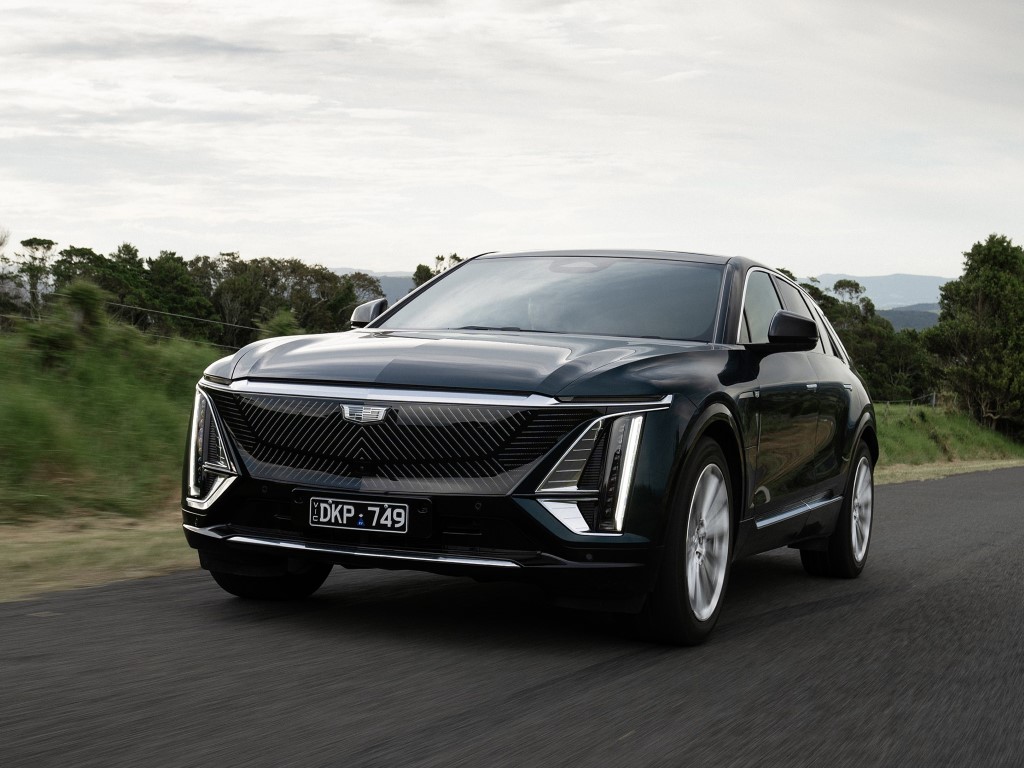
The Lyriq's design introduced the "face" of the electric Cadillac. The traditional front grille, necessary for cooling combustion engines, was replaced by the "Black Crystal Shield". This polycarbonate piece features laser-etched textures on the back and is illuminated by LEDs. When the driver approaches the vehicle with the key, the car performs a complex light choreography, which starts at the center emblem, spreads across the grille, and moves up to the vertical daytime running lights, creating a digital greeting that emphasizes the car's technology.
Conventional door handles were eliminated in favor of electronic buttons disguised in the window moldings or bodywork, which, when pressed, open the door slightly, allowing the passenger to pull it by an integrated "fin". This improves aerodynamics, contributing to energy efficiency.
The focal point of the interior is the 33-inch diagonal curved LED screen. Unlike competitors that use two separate screens (one for instruments and another for multimedia), the Lyriq uses a single continuous glass surface.
The center console is of the "cantilever" (floating) type, projecting from the armrest without connecting to the front dashboard, creating a sense of space and allowing for additional storage on the flat floor.
The Lyriq's commercial trajectory is marked by rapid evolution, moving from a limited edition to a full lineup with high-performance variants.
The 2023 model year was the initial launch, focused exclusively on getting the car on the streets and validating production.
In 2024, Cadillac normalized production and introduced the brand's global trim structure, known as the "Y" strategy, which divides models into two pillars: Luxury and Sport. In addition, the highly anticipated all-wheel drive was introduced.
The lineup was divided into three main levels, each with sublevels (1, 2, 3) that indicate the amount of equipment.
| Trim Level | Focus and Main Features |
|---|---|
| Tech | Entry-level model. Keeps the 33" screen, glass roof, and basic safety package (Cadillac Smart System). Finished in Inteluxe synthetic material. |
| Luxury (1, 2, 3) | Focus on classic luxury. Exterior with many satin chrome accents (Galvano Chrome). Illuminated front grille with geometric pattern. Elegantly designed wheels. |
| Sport (1, 2, 3) | Focus on aggressive aesthetics. Replaces chrome with dark finishes (Obsidian Chrome). Front grille with dark mesh pattern. Sporty wheel design and, inside, an exclusive steering wheel and pedals. |
The big technical news for 2024 was the availability of the AWD system.
The 2025 model focused on quality fixes, software stability, and standardization of equipment that was previously optional.
The 2026 model year represents the largest mechanical update since launch, with power increases across the line and the debut of the "V-Series" performance sub-brand.
Even the regular versions received engine and efficiency improvements:
For the first time, Cadillac applied the "V" badge — historically reserved for its "BMW M killer" sedans with supercharged V8 engines — to an electric SUV.
The table below summarizes the technical evolution of the available powertrains throughout the model years.
| Specification | 2023 Lyriq (Debut) | 2024/2025 Lyriq (RWD) | 2024/2025 Lyriq (AWD) | 2026 Lyriq (RWD) | 2026 Lyriq (AWD) | 2026 Lyriq-V |
|---|---|---|---|---|---|---|
| Drivetrain | Rear-Wheel | Rear-Wheel | All-Wheel | Rear-Wheel | All-Wheel | All-Wheel (Performance) |
| Power (hp) | 340 | 340 | 500 | 365 | 515 | 615 |
| Torque (lb-ft) | 325 | 325 | 450 | 325 | 450 | 650 |
| 0-60 mph (s) | ~6.0 | ~6.0 | ~4.8 | ~5.8 | ~4.6 | 3.3 |
| Battery (kWh) | 102 | 102 | 102 | 102 | 102 | 102 |
| Range (mi) | 312 | 314 | 307 | 326 | 319 | 285 |
| DC Charging | 190 kW | 190 kW | 190 kW | 190 kW | 190 kW | 190 kW |
Note: Data based on EPA specifications and Cadillac press information.
The production of the Lyriq is centralized at the Spring Hill, Tennessee plant (former home of the Saturn brand), which received a $2 billion investment to become an electric vehicle hub. Another production line operates in Jinqiao, Shanghai, to serve the Chinese market.
The start of production (2022/2023) was extremely troubled. GM faced difficulties in assembling the Ultium battery modules due to problems with automation equipment suppliers. This resulted in an initial "artisanal production", where very few units were delivered per month, generating frustration among customers who had reserved the car.
Sales data reveal that these production bottlenecks were overcome. From an almost symbolic start in 2022, the Lyriq exploded in volume in 2024.
| Calendar Year | US Sales | China Sales | Canada Sales | Trend Analysis |
|---|---|---|---|---|
| 2022 | 122 | 2,358 | — | Limited production. Focus on initial quality and Chinese market. |
| 2023 | 9,154 | 2,945 | 917 | Slow acceleration. Battery bottlenecks still present. |
| 2024 | 28,402 | 1,394 | 3,556 | Explosion in the US. Resolution of bottlenecks. Drop in China due to the local price war. |
| 2025 (Est.) | ~20,971* | ~1,225* | ~2,237* | Consolidation as luxury segment leader in the US. (*Projected partial data) |
Market Insight: In the third quarter of 2024 (Q3), the Lyriq recorded a 139.4% sales increase compared to the same period in 2023. This performance allowed it to surpass direct competitors like the BMW iX and the Audi Q8 e-tron in the North American market, making it the best-selling mid-size luxury electric SUV in the US, behind only Tesla's models.
On the other hand, performance in China (see table) shows a downward trend, explained by the fierce competition from local brands (NIO, Li Auto, XPeng) that offer aggressive technologies at lower prices, forcing Cadillac to adjust its strategy in that market.
The Lyriq democratized access to Super Cruise, GM's driver assistance technology. Unlike camera-only based systems (like basic Autopilot), Super Cruise uses high-precision LiDAR maps, GPS, and cameras. This allows the driver to take their hands off the steering wheel on over 400,000 miles (640,000 km) of compatible highways in North America, as long as they keep their eyes on the road. The system monitors the driver's attention through infrared cameras on the steering column and alerts if the gaze is diverted for too long.
A crucial point in the Lyriq's recent history is the "plug war".
General Motors' strategy for Brazil took a turn with electrification. After years focused on the Chevrolet brand, the company confirmed Cadillac's official return to the country.
GM used the Brazilian stage of the World Endurance Championship (WEC) at Interlagos, São Paulo, to publicly display the Lyriq and the Optiq, confirming launch intentions.
The Brazilian luxury electric market is dominated by German brands and Volvo.
The Lyriq's advantage in Brazil will be its distinct design and superior range (over 500 km in the WLTP/EPA cycle, which should translate to robust numbers in Inmetro's PBEV cycle), in addition to a GM dealership network that, although it needs adaptation for luxury, is widespread.
The Cadillac Lyriq is the physical proof of General Motors' transformation. More than a product, it is a manifesto of survival and reinvention. After overcoming initial production and software challenges in 2023, the model reached maturity in 2024, delivering a combination of expressive design, superior ride comfort, and competitive technology that propelled it to sales leadership in its segment in the US.
With the arrival of the 2026 lineup and the introduction of the V-Series variant, Cadillac corrects the main initial criticism (the lack of sporty emotion) and completes the range. For Brazil, the Lyriq will arrive as a mature and tested product, ready to challenge German hegemony with a modern, silent, and digital American luxury proposition.