1st Generation
(2011-)
6.2 V8 LSA Supercharged
564 cv
Technical specifications, versions, and history for the Cadillac CTS Coupé.
Select a generation to see available versions
(2011-)

(2012 - 2015)
Select a powertrain to view full technical specifications
The history of the Cadillac CTS Coupe is inseparable from the rebirth movement of the Cadillac brand at the beginning of the 21st century. After decades of losing relevance to European and Japanese rivals, General Motors initiated a design and engineering revolution under the banner of the "Art and Science" philosophy. The original Cadillac CTS (sedan), launched in 2003, was the first vector of this change, replacing the Cadillac Catera and introducing a visual language based on sharp lines, vertical edges, and bold geometric shapes.
However, it was only with the second generation of the CTS family, based on the Sigma II platform, that Cadillac decided to expand the lineup beyond the traditional sedan. In January 2008, at the Detroit Auto Show (North American International Auto Show), General Motors revealed the CTS Coupe concept. The vehicle shocked the public and the specialized press due to its dramatic proportions and visual aggressiveness. Unlike many concepts that are "softened" before reaching dealerships, the production version of the CTS Coupe, confirmed in November 2009 and started in the spring of 2010 as a 2011 model, remained incredibly faithful to the prototype.
This launch marked Cadillac's return to the luxury coupe segment, filling a void left by the discontinuation of the legendary Cadillac Eldorado in 2002. Unlike the Eldorado, which prioritized traditional American comfort, the CTS Coupe was positioned as a direct competitor to German precision machines, such as the BMW 3 Series Coupe and the Mercedes-Benz E-Class Coupe, targeting a younger audience focused on design and performance.
The launch of the CTS Coupe occurred at a critical moment, right after the 2008 global financial crisis that deeply shook General Motors' economy. The decision to proceed with a niche vehicle, focused on style and emotion, demonstrated the resilience of the brand's strategy to rejuvenate its image. The car was designed to be an accessible "Halo Car", attracting attention to dealerships and validating Cadillac as a manufacturer capable of producing world-class avant-garde designs.
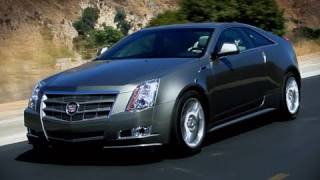
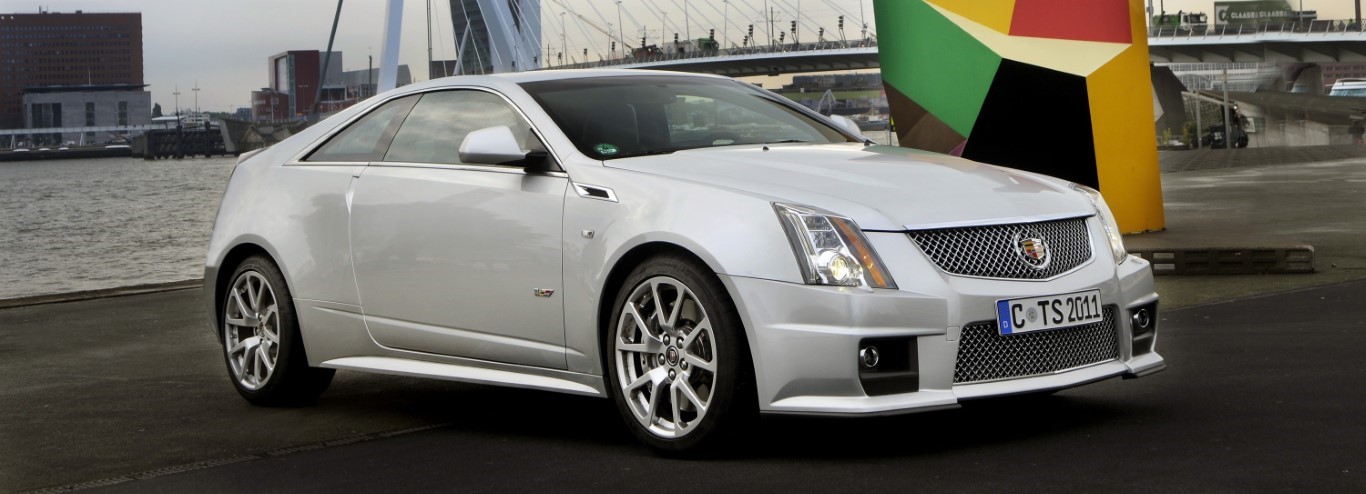
The design of the CTS Coupe is frequently described as "fractal geometric". Cadillac's design team adopted a radical approach, sharing very few body panels with the CTS sedan. Although the 2,880 mm (113.4 inches) wheelbase was kept the same as the sedan to preserve interior space and stability, the external proportions were drastically altered.
The coupe is about 50 mm (2 inches) lower and 50 mm (2 inches) shorter in overall length than the sedan. The roofline has a classic "fastback" profile, sloping smoothly to the rear in an almost continuous arc, without the clear definition of a traditional third volume (trunk). The windshield was raked at a sharper (faster) angle to improve aerodynamics and sporty aesthetics.
One of the most distinctive visual elements is the C-pillar (the rear part of the roof), which is wide and solid, giving an appearance of robustness and privacy to the rear occupants, although this resulted in significant rear visibility challenges, which the brand tried to mitigate with parking assistance technology.
To keep the car's side lines clean and uninterrupted, Cadillac's designers eliminated traditional door handles. The CTS Coupe utilizes a "hidden" or electronic door handle system.
Technical Operation:
The rear of the CTS Coupe is perhaps its most controversial and memorable angle. The car features a dual center exhaust (especially notable on V-Series versions and with performance packages), molded into geometric shapes that mirror the bumper's design. The vertical taillights use LED technology and "light pipes" to create an unmistakable nighttime signature, paying homage to the classic fins of 1950s Cadillacs, but with a futuristic execution. The third brake light also functions as an aerodynamic spoiler integrated into the trunk lid.
Internally, the CTS Coupe adopts a strict 2+2 seating configuration. This means that, unlike the sedan which can accommodate three people in the back, the coupe has two sculpted individual rear seats, separated by a fixed center console.
The materials used in the interior aimed to elevate the brand's perception of luxury. The instrument panel, console, and doors could be wrapped in hand-stitched leather (a procedure known as "cut-and-sew"). Real wood (Sapele Pommele or Midnight Sapele) and satin metal accents were standard or optional depending on the version. LED ambient lighting, hidden behind the trims, created a sophisticated atmosphere at night.
The CTS Coupe was built on the GM Sigma II platform. This rear-wheel drive (RWD) architecture was developed to compete in rigidity and dynamics with the best European platforms. Sigma II utilized high-strength steels and advanced welding techniques to ensure a rigid structure, essential for both acoustic isolation and suspension precision.
The rear track (distance between the wheels on the same axle) of the coupe was widened compared to the sedan to improve lateral stability and fill the wider wheel wells, contributing to the car's "planted" stance on the asphalt.
During its production cycle (2011-2014), the standard version of the CTS Coupe exclusively used V6 engines, but there was an important technical evolution between the first and second years of production.
In its debut year, the CTS Coupe came equipped with the 3.6L Direct Injection V6 engine (LLT code).
Starting with the 2012 model, Cadillac replaced the LLT engine with the new 3.6L V6 (LFX code). Although the displacement was the same, the LFX brought significant engineering improvements.
The CTS Coupe offered flexibility in the choice of transmission and traction system, something rare in its segment.
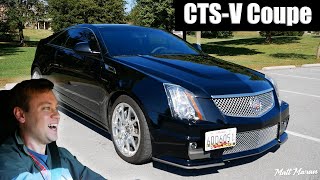
Launched simultaneously with the base model in 2010 (as a 2011 model), the CTS-V Coupe represented the pinnacle of Cadillac's engineering. It was designed to humiliate dedicated sports cars on racetracks.
The heart of the CTS-V is the legendary LSA 6.2-liter Supercharged V8 engine. This engine is a variation of the LS9 engine used in the Chevrolet Corvette ZR1 of the time.
To handle the V8's brutal torque, the CTS-V did not use the same transmissions as the V6 model.
The CTS-V came standard with Magnetic Ride Control (MRC) suspension.
To stop the vehicle, Cadillac partnered with Brembo.
For the V6 model (non-V), Cadillac offered three main "Collections" or trim levels.
Despite being the entry-level range, it was well-equipped.
The mid-level, focused on technology and comfort.
The luxury top-of-the-line.
Cadillac launched several limited editions to maintain interest in the model and offer exclusivity to collectors.
This special edition was available for the CTS-V and focused on a revolutionary paint job.
One of the rarest and most technically interesting editions.
An edition focused on discreet elegance.
The CTS Coupe's production numbers reveal its niche nature, especially in the high-performance versions.
Total production of the second-generation CTS-V (V2) was split between Sedan, Coupe, and Wagon.
One of the most important factors for collectors today is the transmission. It is estimated that the adoption rate of the manual transmission in the CTS-V Coupe was low, hovering around 15% to 20% of total production. This makes the manual examples ("3-pedal cars") extremely valued and rare in today's market.
Annual sales data for the CTS family show a peak in 2005 (before the coupe's launch), followed by a stabilization. The launch of the coupe in 2010/2011 helped sustain CTS family sales at around 50,000 to 55,000 units annually in the US during the post-crisis years, attracting an audience that would have otherwise migrated to German brands.
Below, we present the detailed evolution of the model by manufacturing year:
| Model Year | Main Details and Changes |
|---|---|
| 2011 | Launch: Debut of the CTS Coupe and CTS-V Coupe. Standard 3.6L LLT V6 engine (304 hp). Introduction of the Black Diamond color late in the year. |
| 2012 | New Engine: Replacement of the LLT V6 with the LFX V6 (318 hp). Aesthetics: New front grille with a more refined mesh design and new Cadillac logo (still with the laurel wreath). Technology: Addition of blind spot detection (Side Blind Zone Alert). Touring Package introduced for the V6. |
| 2013 | Special Editions: Launch of the limited Silver Frost (matte) and Stealth Blue editions. Subtle changes to the CTS-V brakes (two-piece rotors for weight reduction in some configurations). |
| 2014 | Last Year of the V6: The "standard" CTS Coupe enters its final year. Simplified colors and trim options. The CTS Sedan moves to the new generation (Gen 3), but the Coupe remains on the old platform (Gen 2) for one more year. |
| 2015 | Final V-Series: The V6 CTS Coupe is discontinued. Only the CTS-V Coupe is produced as a 2015 model in a limited run (about 500 units) to celebrate the end of the generation. Introduction of the new Cadillac emblem (without the laurel wreath) and exclusive Ebony interior trim with red stitching for this farewell. |
The Cadillac CTS Coupe was discontinued after the 2014 model year (with the special extension of the V until 2015). Its removal from the lineup was due to a complete restructuring of Cadillac's product line. The brand introduced the Cadillac ATS, a smaller and more agile car, which gained its own coupe version (ATS Coupe) to occupy the "entry-level sports coupe" space. The CTS Sedan grew in size in its third generation to compete with the BMW 5 Series, and Cadillac opted not to develop a coupe version for this new larger car, focusing later on the Cadillac ELR (electric) and the future CT5 and CT4 models.
The Cadillac CTS Coupe remains an American design and engineering landmark. It proved that Cadillac could create a vehicle that not only competed in numbers with European rivals, but that surpassed them in visual audacity. Today, the model is celebrated for its design that has aged surprisingly well, still looking futuristic years after its discontinuation, and for the raw performance and reliable mechanics of the V-Series versions, which represent the pinnacle of the era of large supercharged V8 engines with a manual gearbox option.
Images of the Cadillac CTS Coupé