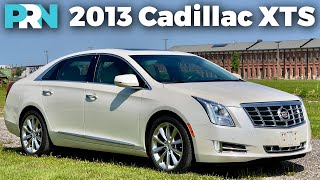
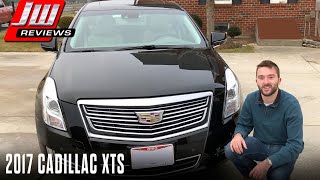
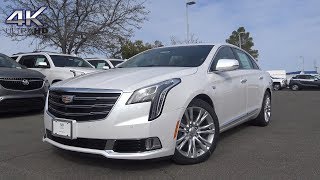
1st Generation
(2013 - 2017)
3.6 V6 Twin-Turbo DI (LF3)
416 cv

Technical specifications, versions, and history for the Cadillac XTS.
Select a generation to see available versions
(2013 - 2017)

(2018 - 2019)
Select a powertrain to view full technical specifications
At the dawn of the 2010s, Cadillac found itself at an existential crossroads. The brand, General Motors' supreme luxury division, was struggling to redefine its identity in a global market dominated by German rivals focused on sporty performance. The brand's portfolio was fragmented between two distinct philosophies. On one hand, there was the Cadillac DTS (DeVille Touring Sedan), a front-wheel-drive giant, soft and traditional, beloved by conservative customers and the executive transport industry. On the other, the Cadillac STS (Seville Touring Sedan), a rear-wheel-drive sports sedan attempt that, while dynamically competent, failed to capture significant sales volume due to a cramped interior and high price.
The 2008 financial crisis and the subsequent restructuring of General Motors forced a consolidation of resources. Cadillac lacked the capital to develop direct and independent successors for the DTS and STS simultaneously. The strategic solution was to create a single vehicle that could serve as a bridge between these two worlds: the Cadillac XTS.
Launched in 2012 as a 2013 model, the XTS (acronym for X-Series Touring Sedan) was conceived to replace both the DTS and the STS. To make the project economically viable, GM chose not to use a dedicated rear-wheel-drive platform (like the CTS's Sigma), but rather a highly modified global front-wheel-drive architecture: the Super Epsilon II platform.
This decision was controversial, but calculated. The Epsilon II platform (shared with the tenth-generation Chevrolet Impala and the Buick LaCrosse) allowed the engine to be mounted transversely. Without the need for a long transmission tunnel to send power to the rear wheels in the base versions, engineers were able to maximize the cabin's interior space. The result was a car with manageable exterior dimensions, but with rear-seat legroom and a trunk volume that surpassed most rear-wheel-drive competitors, such as the BMW 5 Series and the Mercedes-Benz E-Class.
The XTS was not designed to be a "corner-carver" at Nürburgring, but rather to dominate urban and highway asphalt with supreme comfort, cutting-edge technology, and an imposing aesthetic. It took on the role of the brand's "flagship" until the arrival of the CT6 years later, serving as the guardian of traditional American luxury while the ATS and CTS models pursued European sportiness.
The design of the XTS was led by Tim Kozub, with the interior handled by Christine Park. The vehicle represented a mature evolution of Cadillac's "Art and Science" design language, characterized by angular forms, high beltlines, and vertical lighting.
Unlike previous models, which were extremely "boxy", the XTS introduced more sculpted and fluid surfaces. The car's silhouette attempted to disguise the typical proportions of a front-wheel-drive vehicle (long front overhang) through a C-pillar (the rear roof pillar) that extended smoothly to the trunk lid, creating an almost fastback profile.
Lighting was a focal point of development. The XTS used vertical headlights that became the brand's signature.
The interior of the XTS was revolutionary for GM at the time. Christine Park focused on eliminating the "cheap plastic" feel that plagued previous models.
Rear space was the great asset, with 40 inches (1,016 mm) of legroom, allowing tall passengers to cross their legs comfortably, a critical requirement for the Chinese market and the limousine sector.
The great engineering challenge of the XTS was making a large front-wheel-drive car behave like a world-class luxury vehicle. To achieve this, GM applied an arsenal of suspension technologies.
The traditional MacPherson suspension, common in front-wheel-drive cars, suffers from "torque steer" — the tendency of the steering wheel to pull to one side under hard acceleration.
To combat this, the XTS adopted the HiPer Strut (High Performance Strut) suspension.
At the rear, the XTS used an "H-Arm" independent suspension with an automatic leveling air spring (air bag) system.
Perhaps the most important technology of the XTS was Magnetic Ride Control, standard on most versions.
To stop this nearly 2-ton sedan, Cadillac equipped the XTS with Italian-brand Brembo brakes on the front axle as standard equipment. The four-piston brakes ensured consistent and fade-resistant braking, an important safety differentiator for a vehicle of this size.
The XTS was offered with three main engine options throughout its life, varying by market and version.
This was the "heart" engine of the lineup, present in most XTS models sold in North America.
Introduced in 2014, this engine transformed the XTS into a respectable performance sedan, competing with rivals' V8 versions.
Due to Chinese taxation based on engine displacement, the V6 was unviable for mass sales in Asia.
All engines were mated to a 6-speed automatic transmission (Hydra-Matic 6T70 for the naturally aspirated and reinforced 6T75 for the Turbo).
Critical Analysis: The choice to keep the 6-speed gearbox until the end of production (2019), while competitors were already using 8, 9, or 10 speeds, was a frequent point of criticism, as it limited highway fuel economy and smoothness at low speeds.
The optional AWD system utilized fourth and later fifth-generation Haldex technology.
The XTS served as a launchpad for many of the technologies that would define Cadillac in the decade.
The XTS debuted the CUE infotainment system.
The Premium and Platinum versions came with a fully digital 12.3-inch instrument cluster. The driver could choose between four distinct layouts ("Balanced", "Performance", "Enhanced", "Simple"), prioritizing information such as speed, navigation, or engine data.
The XTS pioneered the use of the Safety Alert Seat. Instead of just beeping, the driver's seat vibrated on the left or right side to warn of hazards (such as a car in the blind spot or involuntary lane departure).
The car featured an arsenal of sensors:
Despite being technically a single generation, the XTS received constant improvements.
While in the US the XTS was seen as a traditional car, in China it was a symbol of executive modernity.
Produced by the SAIC-GM joint venture in Shanghai, the Chinese XTS had specific trims.
The XTS sold massively in China, surpassing the American market. In 2017 and 2018, Chinese sales were more than double the American sales. The car was considered a viable (and more spacious) alternative to the Audi A6L and BMW 5 Series Li, even without having an artificially stretched wheelbase, as its chassis was already naturally long.
| Year | US Sales | China Sales |
|---|---|---|
| 2017 | 16,275 | 41,645 |
| 2018 | 17,727 | 65,010 |
| 2019 | 11,304 | 42,234 |
The XTS was the official heir to the Lincoln Town Car and the Cadillac DTS in the professional services sector (Limousines, Hearses, and Executive Transport). GM created specific chassis codes for these applications, sold through the Cadillac Master Coachbuilder (CMC) program.
Aimed at hotels and private driver services ("Black Car").
An incomplete or reinforced vehicle intended to be cut and stretched.
This market was crucial to the model's longevity, ensuring steady orders even as retail sales declined.
The XTS was a quiet commercial success. Although it lacked the prestige of the Escalade, it sold consistently.
Consolidated Sales Table (US):
| Year | Sales (Units) |
|---|---|
| 2012 | 15,049 |
| 2013 | 32,559 (US Peak) |
| 2014 | 24,335 |
| 2015 | 23,112 |
| 2016 | 22,171 |
| 2017 | 16,275 |
| 2018 | 17,727 (Slight post-facelift recovery) |
| 2019 | 11,304 |
| 2020 | 1,199 (Final inventory) |
| US Total | ~163,731 |
Adding the sales in China (estimated at over 200,000 units during the period), the XTS surpassed the 350,000 to 400,000 global units mark, a significant number for a large luxury sedan in the era of SUVs.
XTS production ended in October 2019. Several factors contributed:
The Cadillac XTS occupies a unique place in automotive history. It was the "last of the Mohicans" of an era when a Cadillac was defined by space, softness, and imposing presence, rather than by race track lap times.
Although built on a platform shared with cheaper models (Impala), Cadillac's engineering — through Magnetic Ride Control, superior acoustic insulation, and handcrafted interiors — elevated the XTS to a legitimate level of luxury. It accomplished its mission with flying colors: it kept the traditional customer base loyal to the brand, dominated the professional services market, and paved the way in China for Cadillac to become a global powerhouse.
For those looking for a used sedan today, the XTS (especially the 2018-2019 models or the V-Sport version) represents one of the best value-for-money propositions in the luxury market: a vehicle with presidential presence, modern technology, and unmatched comfort, the result of engineering focused on occupant well-being.
Images of the Cadillac XTS