
1st Generation
(2024-)
Eletric (Two motors)
623 cv
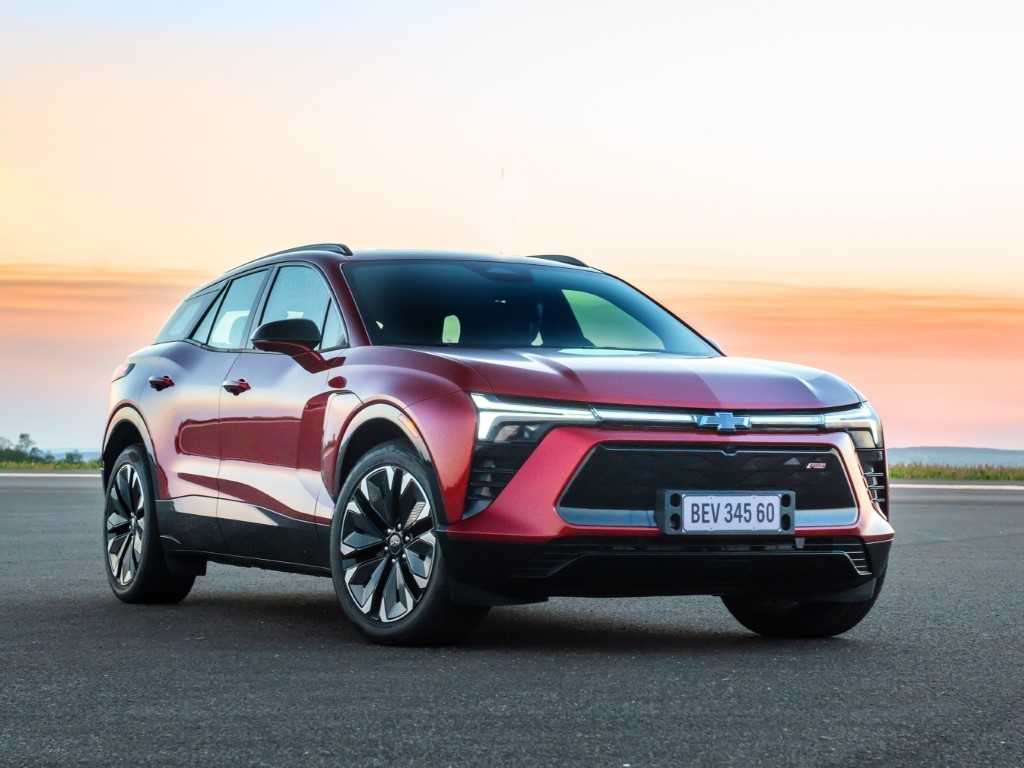
An icon reinvented: the SUV merging Chevrolet’s sporty heritage with the intelligence of the Ultium platform.
Select a generation to see available versions
(2024-)
The trajectory of the Chevrolet Blazer represents one of the most fascinating case studies on the adaptation of a product to industrial, regulatory, and consumer transformations over the course of more than five decades. To understand the strategic positioning and engineering complexity of the current Chevrolet Blazer EV, it is strictly necessary to examine the roots of the original model and the metamorphoses the nomenclature underwent until culminating in the current battery electric propulsion platform.
The development of the original Blazer began in the second half of the 1960s, a period marked by the emergence of a new niche in the North American automotive market: that of recreational and off-road utility vehicles. At that time, the competition had already established its territorial bases with the launch of the International Harvester Scout in 1961 and the first-generation Ford Bronco in 1965, vehicles that sought inspiration from the military robustness of the Jeep CJ (Civilian Jeep) and adapted them for civilian use.
General Motors, instead of rushing the development of an entirely new chassis to compete directly on the narrowest trails, adopted an approach guided by cost efficiency and the maximization of comfort. Chevrolet engineers analyzed competing vehicles and identified a gap: the lack of comfort and interior space for daily use. The solution found was to use the existing platform of the brand's full-size pickup truck line (K10 series), shortening the chassis to create a significantly more spacious utility vehicle. The result was the launch of the K5 Blazer in 1969.
The dimensions of the first Blazer demonstrated this philosophy: with up to 180 inches (4,572 mm) in length and 79 inches (2,006 mm) in width, it vastly exceeded the Ford Bronco, which was only 151 inches (3,835 mm) long and 68.5 inches (1,740 mm) wide. Although its substantial size compromised agility on extreme off-road trails, the superior drivability and stability on highways attracted a much broader audience. At the time, the term "SUV" (Sport Utility Vehicle) did not even exist in the commercial vocabulary, leading Chevrolet to peculiarly advertise the model as a "car/truck combination".
A historical detail that underlines the evolution of vehicle comfort is that the first Blazer was conceived under a strictly utilitarian and minimalist perspective. The focus on financial accessibility was so pressing that, in several entry-level configurations, the driver's seat was the only standard equipment inside the vehicle; the front passenger seat, the rear seats, and even the hardtop were sold as optional items paid separately. This strategy allowed the masses to gain access to the utility vehicle, cementing Chevrolet's legacy in the segment. The model went through several generations, shrinking in size and adopting the S-10 Blazer nomenclature, until it was discontinued in the United States in the year 2006, closing the first major chapter of its history.
After a productive hiatus of thirteen years, Chevrolet resurrected the Blazer nomenclature for the 2019 model year. However, the new vehicle completely abandoned the body-on-frame architecture and any off-road pretensions. The model returned to the market as a mid-size crossover SUV, built on a unibody structure, with primarily front-wheel drive and an aggressive urban design, whose aesthetic lines were heavily inspired by the Chevrolet Camaro sports car.
The commercial success of this internal combustion engine (ICE) iteration was immediate, reaching a peak of 94,599 units registered in the United States in the year 2020. However, as the decade progressed and the industry accelerated its transition toward sustainable mobility, sales of the combustion Blazer began to show a sharp decline. Industry records indicate that North American sales fell to just 52,576 units in 2024, representing a contraction of almost 20% compared to previous years. In the Canadian market, the scenario was similar, with the sale of only 3,983 units in 2024.
Faced with the retraction in demand for traditional utility vehicles and the heavy investment required for the energy transition, industry reports based on internal General Motors sources confirmed a drastic portfolio alteration. Production of the combustion-powered Chevrolet Blazer will be permanently terminated following the conclusion of the 2025 model year schedule. This discontinuation will occur in parallel with the end of production for the Cadillac XT5 and XT6 SUVs, effectively eliminating the presence of gasoline-powered mid-size crossovers in these brands' dealerships in the United States. Starting in 2026, the Blazer identity will be exclusively represented by the all-new fully electric model, the Chevrolet Blazer EV, marking the lineup's definitive transition into the era of electrification.
The transition to the electric model required a complete structural rupture. The Chevrolet Blazer EV is based on General Motors' Ultium platform, a modular architecture developed from the ground up exclusively to accommodate ultra-high-performance battery packs and electric motors.
The most prominent and innovative characteristic of the Ultium platform, when applied to the Blazer EV, is its extreme versatility in terms of drivetrain configuration. The model is one of the very rare vehicles in the global market designed to support, on the exact same basic architecture, front-wheel drive (FWD), rear-wheel drive (RWD), and all-wheel drive (AWD) systems with dual motors. This adaptability allows the automaker to create completely distinct dynamic behaviors within the same assembly line, optimizing the manufacturing flow and catering to everyone from the efficiency-focused consumer to the high-performance enthusiast.
The Blazer EV's energy storage is guaranteed by Ultium family lithium-ion battery packs, which vary in volumetric capacity according to the vehicle's version and purpose. General Motors adopted two primary capacities for the civilian model:
The utility of an electric vehicle is intrinsically linked to the speed at which it can replenish its energy. The charging infrastructure onboard the Blazer EV was sized to operate in both residential environments and ultra-high-voltage public networks.
For Alternating Current (AC) charging, which encompasses domestic outlets and Level 2 (240V) wallboxes, the Blazer EV features an onboard charger with a standard capacity of 11.5 kW. This transfer rate is capable of adding approximately 25 miles (40 kilometers) of range for every hour connected, allowing for full recharges overnight. For emergency situations, the vehicle supports Level 1 (120V) charging from standard outlets, which adds about 4 miles (6.4 km) of range per hour. In certain international markets, such as Brazil, the vehicle can support AC inputs of up to 22 kW, accelerating the domestic process considerably.
When exposed to long-distance travel, the vehicle relies on Direct Current (DC) fast charging. The charge acceptance rate is dictated by the battery pack's size and chemistry. Models equipped with the 85 kWh battery are capable of supporting flows up to 150 kW at public stations. Conversely, units endowed with the 102 kWh pack raise this limit to 190 kW. Under ideal conditions and with the thermal management system properly pre-conditioned, this 190 kW capacity allows the Blazer EV to recover approximately 78 miles (126 km) of highway range in a span of just 10 minutes connected, minimizing downtime during interstate trips. In bench tests and evaluations by specialized journalism, the high-voltage system proved capable of raising the State of Charge (SoC) from 10% to 90% in exactly 57 minutes.
The elimination of traditional combustion vehicle components—such as large front engine blocks, exposed radiators, longitudinal driveshafts, and exhaust systems—granted General Motors' design team unprecedented structural freedom.
The Blazer EV is marketed as a mid-size crossover SUV, but its proportions suggest a considerably athletic stance. The expansion of the wheelbase not only accommodates the wide battery plates in the floor but also stabilizes the vehicle's center of gravity and maximizes interior space for the occupants.
The physical architecture of the model presents the following standardized metrics:
| Structural Specification | Measurement |
|---|---|
| Wheelbase | 121.8 inches (3,094 mm) |
| Overall Length | 192.2 inches (4,882 mm) |
| Body Width | 78.0 inches (1,981 mm) |
| Overall Height | 65.0 inches (1,651 mm) |
| Passenger Volume (Front / Rear) | 61 cubic feet / 50 cubic feet |
| Trunk Cargo Volume (Seats in use) | 26 cubic feet (736 liters) |
| Maximum Cargo Volume (Rear seats folded down) | 60 to 64.2 cubic feet (1,818 liters) |
| Approximate Curb Weight | 5,227 pounds (2,371 kg) - Varies by version |
The long wheelbase in combination with the flat floor (resulting from the absence of the central transmission tunnel) provides generous legroom for rear-seat passengers, a crucial attribute for acceptance in family-oriented markets.
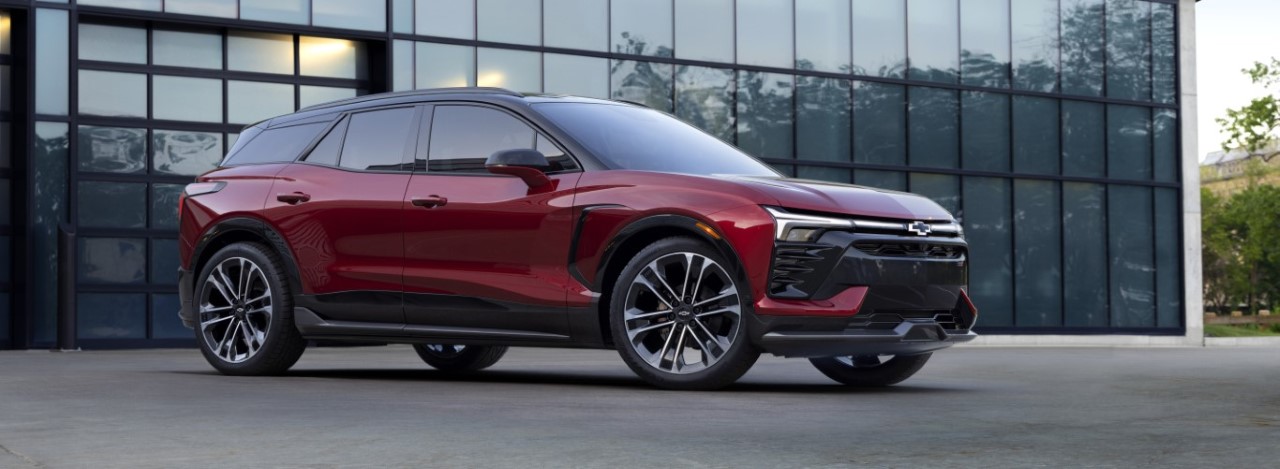
The exterior design of the Blazer EV departs from the traditional language of heavy utility vehicles and seeks direct inspiration from Chevrolet's sports car portfolio. The absence of a conventional cooling grille allowed for the development of a closed front fascia, which optimizes aerodynamic flow.
Designers integrated aggressive elements, such as motorsport-inspired vents and extractors installed on the front fenders. The lighting system is composed entirely of LED technology, featuring sharp daytime running lights and "T" shaped taillights that emphasize the vehicle's width. In the higher trim versions (RS and SS), the visual identity is enhanced by a choreographed lighting sequence on the front light bar and the illuminated Chevrolet logo, which interacts with the user when the vehicle is locked, unlocked, or plugged in to charge. The two-tone roof, painted in gloss black, is standard equipment on these upper versions, accentuating the floating roofline, while a two-dimensional white roof is offered as an option on the entry versions. Engineering also found a utilitarian design solution by integrating the charging port door just behind the left front wheel in a motorized fashion.
In the cabin, Chevrolet promoted a massive digitization of the controls. The most radical change in the driving routine is the total elimination of the traditional Start/Stop button. The system adopts a philosophy of "continuous readiness": the vehicle detects the approach of the proximity smart key, unlocks the doors, and, as soon as the driver occupies the seat and presses the brake pedal, the high-voltage systems are immediately activated and the SUV is ready to be put into gear. Shutting down follows the same passive logic, cutting power as soon as the driver exits and closes the door.
The epicenter of the dashboard is a massive multimedia center with a 17.7-inch touchscreen, arranged contiguously and under a cohesive bezel with a secondary fully configurable 11-inch digital instrument cluster for the driver. In addition to these interfaces, the vehicle can be equipped with an advanced windshield information projection system (Heads-Up Display). Despite the transition to digital touchscreen commands for various functions, Chevrolet strategically maintained the presence of tactile physical controls (buttons and knobs) for adjusting the climate control system (air conditioning) and for volume control of the premium Bose audio system, preventing the frequent dissatisfaction that consumers express with fully integrated screens. However, peculiarly, the headlight operation was moved entirely to the central screen menu, eliminating the lighting dial on the dashboard to the left of the steering wheel.
The Blazer EV marked the official debut of the automaker's global software operating system, dubbed "Ultifi". The core of this platform is the Android Automotive OS system, providing users with a "Google Built-in" experience, featuring native navigation via Google Maps, voice assistance via Google Assistant, and the downloading of applications directly through the Google Play Store onto the 17.7-inch screen.
However, to implement this autonomous ecosystem, General Motors' presidency made one of the most polarizing decisions in the contemporary industry: the complete abolition of support for the Apple CarPlay and Android Auto smartphone projection systems, features considered indispensable by the vast majority of drivers. GM's corporate communication defended the maneuver by arguing in favor of traffic safety, claiming that mirroring systems caused distractions and required the driver to handle the phone. Furthermore, engineering argued that a native navigation system deeply interconnected with the car's sensors was the only way to automatically thermally pre-condition the batteries whenever the driver entered a DC fast-charging station as a geographic destination.
Analysts and consumers, meanwhile, perceived the decision as an aggressive data control and secondary monetization tactic. Without the free mirroring of cell phones, GM now dominates the primary user interface, opening up room for the future charging of data connectivity subscriptions and cloud-based premium services. The reaction from consumers was immediately and strongly negative. Reports on owner communication channels indicated that the lack of CarPlay was the biggest complaint among customers coming from the older Chevrolet Bolt EV model, to the point of driving potential buyers away to rival automakers (like Honda) that preserved the functionality. Practical arguments from users emphasized that the Apple ecosystem offers greater data privacy, message reading without diverting attention, and the absence of navigation monthly fees after the vehicle's trial period ends.
The clamor for smartphone mirroring generated an opportunity for the secondary market. An automotive technology company called White Automotive & Media Services developed, in late 2023, a complex retrofit package designed specifically to bypass the software block and restore the full functionality of wireless Apple CarPlay and Android Auto on the screens of the Blazer EV and other Ultium platform vehicles. The system was sophisticated enough to integrate the projections into the driver's digital instrument cluster and the steering wheel voice controls.
The installation required deep technical knowledge and could only be performed by the service departments of authorized dealerships, with LaFontaine Chevrolet in Michigan being the pioneer in offering the service. As soon as General Motors became aware of the modification through its telemetry networks, corporate intervention was immediate. The manufacturer sent formal notifications demanding the halt of the installations, under the official pretext that third-party hardware could create instability on the data bus, affect critical vehicle functions, and corrupt the Over-The-Air (OTA) remote software update packages planned for the car's lifespan. Deprived of access to dealership systems, the independent company was forced to cancel the project, solidifying GM's software barrier.
The software controversies worsened substantially shortly after the start of the first deliveries of the Blazer EV to consumers and the specialized press. In late 2023, automotive journalists from renowned publications such as Edmunds and InsideEVs reported critical episodes in which the vehicles suffered total blackouts of the dashboard screens and a collapse in communication during attempts to use public DC fast-charging stations, leaving reviewers physically stranded on the road. Early owners corroborated the failures, reporting error windows, losses of traction, and the unavailability of the infotainment system.
The severity level and the accumulation of systemic instabilities within the Ultifi ecosystem forced General Motors' management to issue, just before a long holiday weekend at the end of 2023, a strict "Stop-Sale" order (halting sales and deliveries) covering all Blazer EV units spread across the dealership networks. This is one of the most damaging procedures for an automaker's reputation and cash flow amidst a global launch. GM confirmed that only "a limited number of customers" had been affected, as the company had managed to deliver fewer than 500 units before the total block was instated.
To solve the crisis, the automaker mobilized software engineering teams working non-stop (24/7 basis) for weeks to rewrite and debug the internal communication protocols of the Android Automotive system and the charging module.
The Stop-Sale was formally lifted and sales were resumed only in early March 2024, after a massive software update had been installed in all affected vehicles and the stalled inventory. To reignite demand and repair the distrust generated by the stoppage, Chevrolet executed a drastic cut in the Manufacturer's Suggested Retail Prices (MSRP) of all Blazer EV trims in the United States. The entry-level LT AWD version suffered the largest cut, having its sticker price reduced from $56,715 to $50,195. Adding in the $7,500 US federal government tax credit (for which the vehicle re-qualified after adjustments to battery component sourcing), the base price plummeted to an attractive $42,695. Higher trims, such as the RS AWD, had their prices adjusted from $60,215 to $54,595 before subsidies. These price cuts proved vital to sustaining the vehicle's sales flow in subsequent quarters.
The trim structure for the Blazer EV was designed to attract a diverse range of budgets and driving needs. Originally, the automaker planned a spartan version called 1LT, focused on fleet customers and the lowest possible price point; however, this version was canceled before launch to prioritize trim levels with higher profit margins, restructuring the lineup to begin with the model initially designated as 2LT (now simply called LT).
The Blazer EV LT serves as the access point to the brand's electric universe. This configuration prioritizes cost-benefit, ride comfort in urban settings, and the maximization of energy efficiency derived from the 85 kWh battery pack.
The Rally Sport (RS) trim is historically positioned by Chevrolet as the volume version geared towards visual and sporty appeal, combining premium aesthetic equipment with more responsive dynamic behavior. The darkened front grille, gloss black side moldings, advanced LED lighting, two-tone roof, and enormous 21-inch machined wheels ensure a strong visual presence on the roads.
The mechanical portfolio of the RS version is what underwent the biggest metamorphoses during the model's early years:
The pinnacle of engineering applied to the Blazer EV resides in the Super Sport (SS) configuration. This is the first time Chevrolet adorns a purely electric propulsion vehicle with the consecrated "SS" badges, taking on the challenge of facing formidable adversaries in the growing electric sports SUV segment, such as the Ford Mustang Mach-E GT, the Tesla Model Y Performance, and the newly launched Jeep Wagoneer S.
The Blazer EV SS was designed without mechanical compromises. Equipped exclusively with the largest 102 kWh battery module and an advanced eAWD system focused on performance (composed of permanent magnet motors on both axles), the vehicle delivers, under normal driving conditions, a substantial 515 horsepower and 450 lb-ft of torque.
However, the true technological leap is activated through the central interface: the performance launch mode dubbed Wide Open Watts (WOW). When the driver engages WOW mode, the frequency inverters and thermal management release the maximum and unrestricted flow of energy contained in the battery cells toward the rotors, unlocking a terrifying 615 horsepower and 650 lb-ft of instantaneous torque. In this maximum stress configuration, by applying heavy pressure on the brake pedal and the accelerator simultaneously for launch, the vehicle pins its occupants against the seats, catapulting its heavy 2,371 kilos from 0 to 60 mph (96 km/h) in a mere 3.4 seconds — a milestone provided by the factory, which some independent tests managed to nail down to an absurd 3.3 seconds, destroying the original metric.
Automotive engineering applied severe hardware upgrades to handle such physical brutality. The braking system was redesigned in partnership with the renowned manufacturer Brembo, adopting oversized front discs to provide the stopping power vital at high speeds. In independent evaluations, braking from 70 mph requires only 190 feet for a complete stop. The sports suspension was recalibrated to withstand high lateral weight transfer, allowing the SUV to grip the asphalt and record a considerable lateral gravitational force of 0.80 g on a 300-foot circular skidpad. Directional stability is anchored by large 22-inch multi-finish wheels. As a differential geared toward extreme performance on smooth asphalt, consumers can opt for an extra package (Performance Pack, approximate cost of $395) that replaces the standard rubber with ultra-high-performance Continental Performance summer tires in the immense 275/45R-21 sizes (referring to the optional wheel wells or alternative dimensions described in tests).
Surprisingly, due to the formidable volumetric capacity of the 102 kWh Ultium battery, the sacrifice in highway driving efficiency proved negligible. The ultra-performance model still boasts an impressive EPA estimate that hovers between 302 and 303 miles (486 km) with WOW mode disengaged during routine traffic.
In addition to physical dominance of the road, the SS model is the brand's autonomous safety showcase. It is the only version in the catalog to incorporate the advanced Level 2 driver assistance package, "Super Cruise", as factory equipment, backed by an OnStar data subscription included for three years. Utilizing complex radars, ultrasonic sensors, and high-precision cameras associated with a satellite-mapped LiDAR map, Super Cruise guarantees absolutely hands-free driving on over 200,000 miles of pre-mapped and compatible highways spread across the North American continent. For the more basic configurations, the Blazer EV provides mandatory features from the "Chevy Safety Assist" suite, encompassing technologies such as autonomous emergency braking for vehicles and front pedestrians, active lane keep assist, and adaptive cruise control.
Prices for this formidable piece of engineering start from the stipulated base of around $60,600 to $60,700, potentially exceeding $62,000 with the addition of delivery fees and dealership freight in the documented tests.
Recognizing the deep interest of state governments and police departments in the adoption of zero-emission fleets with reduced mechanical maintenance costs, General Motors designed a variant specialized in high-speed interception: the Blazer EV Police Pursuit Vehicle (Package 9C1).
This government service platform has its architecture based not on the simple versions, but rather on the robust structure of the SS performance version. Receiving modular armoring in critical areas, reinforced cooling systems in the battery thermal radiators for prolonged operation under intense wear, and a front dashboard redesigned internally to allocate computer terminals, the vehicle underwent extensive technological modifications. The eAWD system recalibrated specifically for police forces dispenses with commercial artifices like WOW mode and linearly delivers an enormous power of 498 horsepower and an incredible 531 lb-ft of breakaway torque, sufficient to immobilize and quickly close off passages against most fleeing cars.
The law enforcement speedometer displays an unlocked projected Top Speed of 130 mph (209 km/h), an impressive feat considering the poor aerodynamic proportions caused by the later installation of heavy spotlights and immense, ostensible roof light bars, called aftermarket equipment. Under clean configurations without obstructive roof-mounted accessories, the certified operational range is 286 miles (approximately 460 kilometers), offering a considerable action radius for policing activities per shift.
Structured Table of Consolidated Mechanical Specifications To facilitate visual comparison among the myriad of variants available to the civilian and government public in the current life cycle, below is the tabulation of the utility vehicle's core driving parameters:
| Nomenclature | Drivetrain Layout | Battery Capacity | Measured Power | Measured Torque | EPA Range | Approximate Starting Price (USA) |
|---|---|---|---|---|---|---|
| Blazer EV LT (FWD) | Front Axle | 85 kWh | 220 horsepower | 243 lb-ft | 312 Miles / 502 km | $44,700 Blazer EV LT (AWD) All-Wheel 85 kWh 288 to 300 horsepower 355 lb-ft 283 Miles / 455 km $49,260 to $51,855 Blazer EV RS (FWD) Front Axle 85 kWh 220 horsepower 243 lb-ft 312 Miles / 502 km $50,500 |
| Blazer EV RS (RWD) | Rear Axle* | 102 kWh | 340 horsepower | 325 lb-ft | 334 Miles / 537 km | $56,170 (2024 Adjustment) Blazer EV RS (AWD) All-Wheel 85 kWh 288 to 300 horsepower 355 lb-ft 283 Miles / 455 km $50,400 to $54,595 Blazer EV SS (AWD) Perf. All-Wheel 102 kWh 615 horsepower (WOW) 650 lb-ft 302 Miles / 486 km $60,600 to $60,700 |
| Blazer PPV 9C1 (AWD) | Police All-Wheel | Not Disclosed | 498 horsepower | 531 lb-ft | 286 Miles / 460 km | Exclusive to Government Fleets |
(Observation Note: The RS RWD configuration was discontinued from the official North American portfolio of 0 km vehicles for the 2026 production transition, leaving its guidelines applied to select exports and vehicles already sold).*
The war for the consumer in the American market is waged in the continuous updating of features that keep the vehicles attractive in contrast to innovative brands like Rivian and Tesla. For the year 2026, GM's product management outlined pragmatic adjustments focused not on revolutionizing the powertrain, but on convenience and aesthetics:
Transforming a versatile platform concept like Ultium into tens of thousands of units ready for global shipping requires logistical coordination involving colossal-magnitude cross-border complexes. The global birthplace base for the Blazer EV project is found in the facilities located on Mexican soil.
The entire North American commercial operation and the worldwide export infrastructure tied to the Chevrolet Blazer family converge into a single geographical neuralgic center of metal casting and robotics: General Motors' productive complex established in Ramos Arizpe, located in the semi-arid proximities of the industrialized state of Coahuila, in Mexican territory. The regional government of Coahuila and the American corporate sphere spearheaded broad fiscal coalitions to make the area the main lung of the future of electromobility in the intercontinental free trade zone.
The decision-making process actually materialized on the corporate balance sheet in the month of April in the year 2021, a time when the automaker's management overwhelmingly injected infrastructure investments, modernizing and adapting sections of the traditional plant (which until then was the exclusive progenitor of the old forged steel variations of the ICE-powered Blazer). The figure committed for this remodeling hit the impressive mark of one billion dollars (US$ 1,000,000,000.00).
The gravity that the Ultium project took on in northern Mexico worked as a tremendous retention magnet for global accessory industries; multi-billion dollar Asian and Western corporations of the ilk of Magna and LG Electronics swiftly inaugurated annexes neighboring GM's primary factory property so as to supply in high capillarity critical parts and precision electronic modules that could not suffer setbacks in port networks during times of chip supply crisis. Composing the sustainable industrial vanguard and maintaining the formidable position of the fifth complex by volume to be converted in the region, the factory expanded its productive army of operational direct employees allocated on the shop floor to 10,000 employees. GM established a relentless operation at the site strictly divided into three exhausting shifts to satisfy the high speculative projections of the marketing offices.
Under these conveyor belts, not only the molded sheet metal and polymer silhouettes of the Blazer EV slide. To massively dilute the re-engineering expense among the holding's varied divisions, Ramos Arizpe started accommodating the continuous birth on its mixed lines of sister projects based on the exact same electric drivetrain foundation: the voluminous practical utility Chevrolet Equinox EV, the elegant high-luxury sports SUV Cadillac Optiq, the shared structures yielded to joint ventures like the Japanese market success Honda Prologue and its refined counterpart, the Acura ZDX.
The first finished bodywork of the Chevrolet Blazer EV utility vehicle designated for the export ships headed out of the plant's machinery clutches during the mild third commercial quarter of the 2023 calendar year.
The visionary schedule stipulated by the summit of CEO Mary Barra aimed in a frighteningly optimistic manner to flush through the delivery channels a consolidated level of 400,000 purely electric units to customers by the threshold of 2024, aggressively engaging capacity until dyeing the magical annual million prospected for the 2025 financial balance sheets. The intangible forces of the global macroeconomic market, however, would apply an abrupt brake on the operational guidelines in Coahuila.
The vigorous entry of the Western economy into the inflationary arc that dragged on from the second half of 2023 and spread its stagnating shadow throughout the entire backbone of 2024 caused the aggressive resurgence of the American Central Bank's base lending rates and credit instruments for family consumption. Without the leverage of mild interest rates for installments or the end of stability in environmental tax exemptions promoted by state administrations, the wealthy consumer restrained impulses in trading up for electrified technologies. The direct result of the formative base's refusal to contract liabilities of $50,000 to $60,000 mercilessly surfaced on the analytical charts formally elaborated by the Mexican Association of the Automotive Industry.
The accumulation of manufacturing volumetrics pointed out abysmal disparities within the portfolio. The assembly structures for the Chevrolet Equinox EV utility vehicle — which ostensibly attacks the buyer in the lower $35,000 to $45,000 range with a retail discount volume policy — experienced an admirable commercial traction that forced a quantitative production swell originating from the meager 61,002 copies conceived in the delayed temporal base (2024) to the robust terminal quantity reported in the shape of 75,912 rolling breeds estimated at the finished turnstiles (2025). In a mournful counterpoint to the corporate plans for the mid-size utility vehicle object of this deliberation, the heavy platforms of the Blazer EV violently sank in expectations. The daily output declined in a sharp pattern, severely bringing down the total contingent of dry kilns and inspection, retreating from the solid 33,765 units produced in the prosperous cycle of 2024 to the modest readjusted grouping of only 16,826 integral components formatted during the logistical course of the adjacent 2025 automobile academic year schedule.
The corollary of this drastic discrepancy in the inflationary profile promptly crashed upon the human capital positions in the industrial complex. The unified and partial success of sales originating from the Equinox model proved inept to counterbalance the drastic cooling as a whole of the production plates of the Blazer sporty intermediate SUV and the sudden readjustment (volume adjustments requested internally by corporate partner Honda to curb battery imports of the Prologue co-sister utility vehicle to accommodate its own demand without overcrowding its logistical yards). As an inescapable and somber directive, after months in an inglorious effort to rescue flows, General Motors issued summary operational decrees entirely canceling and shredding the allocation of its third morning productive block, ending the grueling third shift that once represented its sustainable triumph in the premises in the Mexican state. Approximately 1,900 specialized manufacturing artisans linked to the local Coahuila union were suddenly severed from their corporate contractual arrangements and compensated via summary severance payments in the national legislation solely within the reactive scope to the crumbling of North American demand; this purge being indirectly supplemented by a reported correlated amount of 800 peak stress losses generated by the intersection hiatuses of Japanese Honda in the joint pavilions. Such severe shrinkages mark deep within the corporate core the poignant risks inherent in the perilous driving through the long-spectrum migration away from the intensive use of flammable carbon-derived fuels, warning all Western directing leaderships.
Notwithstanding the oppressive panorama stemming from the factory base reconfigurations due to overestimation in the automaker's logistical chain of command at the cross-border facilities, the result in the final instances of consumer outflow — the negotiation counter at the retail point (dealerships) — portrays, under quantitative microscopes, a gradual and consistent saga of assimilation on the part of American passersby who managed, in the wake of interest rate rebates, to capitalize on the drastic amputations of the suggested retail price that occurred subsequent to the traumatic hurdles originating from the infamous "Stop-Sale" provoked by the corporation's software at the dawn of registrations.
The segmented dissection of the numbers provided by the automaker's closing commercial balance sheet on the active borders evidences robust trends, albeit diluted in light of new emerging competitive paradigms of newly manufactured SUVs from the Honda, Ford, and Hyundai corporations.
To draw an evolutionary quantitative portrait of the growth that transpired in tow of the product's recovered confidence in the continental panorama:
| Markets and Time Series Analyzed | 2023 (Restricted Launch) | 2024 (Intermediate Annual Cycle) | 2025 (Finished Cycle Global Estimates) |
|---|---|---|---|
| Exclusive USA Domestic Market Deliveries | 482 Units | 23,115 Units | 22,637 Estimated Units |
| Cross-Border Outflow Canadian Market | 36 Units | 5,810 Units | 2,139 Estimated Units |
(Note: Global compilations concerning the finished 2025 academic calendar are based on closing automotive publications, indicating a maintenance of support on American roads in severe counterpoint to the decay in the Canadian confines).
Looking with detail at the most fierce quarterly window provided by compiled internal industrial panels, corresponding to the third temporal academic closing cycle, encompassed under the denomination "Third Quarter" (Q3):
In the United States of America: In the turbulent course of Q3 2025, Chevrolet dealerships actually attested to the pragmatic effectiveness of deliveries, stipulating 8,089 transfer registrations to the SSNs (social security numbers/tax IDs) of primary civil owners. Such volumetric sum materialized a positive sustainment grounded in the diminutive house of gradual ascension, denoting a marginal growth rate equivalent to a 1.14% elevation against the reference margin of registrations in Q3 2024 (which held the fixed number of 7,998 deliveries). A longer systemic view over the aggregated count, alluding to the amounts transacted in the entirety of the current year up to that portion, reveals that the overall YTD (Year-To-Date, equivalent to the three preliminary four-month cycles together) amount catapulted admirably, marking a portentous 20,825 electronic keys granted to acquirers. In comparison with the outflow obtained in the exact same chronological steps of the past calendar encompassing only a timid 15,232 units, a forceful financial breath is noted in the house of 36.72% of consolidated increase in demand.
Even so, as an inscrutable counterpoint in the interconnected competitive slices (the Market Share of similar crossover competition), due solely to the excessive overflow of the other producers massifying portfolios in the scenario (for example, the astonishing explosion of outputs from its own sibling Equinox EV, totaling a massive finished count reported beyond the line of almost 58 thousand passersby), the amount retained with the Blazer shield shrank in the sectorial market slices from a prestigious 14% of appropriation to a paltry restricted 9% of the current competitive block at the temporal close of Q3 2025.
In the vicinities and Domains of Canada and Dependent Hemispheres (Mexico): In the bordering cold provinces, circumventing the severe icy barrier that severely harms lithium chemistry and repels consumers from unified platforms, the electric SUV witnessed a mournful bloodbath in lethal volumetric retraction. The numbers passed in the punctual analysis of what was stipulated in the finalized closing for the registered sales of the Q3 section in the seasonalized course of the Canadian autumn at year-end (2025) plummeted abysmally in slippery accounting slides, embittering revenues in scarce reports containing a meager and depressing 494 units invoiced for fleets. The overwhelming regression reported before the parallel line formerly fixed by the solid totalized transactional movements accounted for in the balance in the previous Q3 (1,596 units in 2024), means concretely and statistically disastrous losses denoting an embezzled annihilation that mercilessly corrodes alarming and deep equivalent indices in black marking by an exact negative 69.05%. Meanwhile, in the warm vicinities of the surrounding Latin industrial tropics to the epicenter at the headquarters of the furnaces in the neighboring country, Mexico, where the assembly is entirely forged, the sparse local purchasing power inhibits luxury purchases, halting local state transactions to mere inexpressive clusters of no more than modest sums of internal transfers totaling only a minuscule and rare 73 annual allocations closed through consortiums in the temporal chronological extension in the entire period accounted for by analysts.
If quantitative volatility raises reservations at an executive level in Wall Street offices, the intrinsic composition — qualitative — of the registration numbers in the accounting finance sector's ledgers of the active sales fronts shines in corporate triumph on the balance sheet for Mary Barra's investor relations in her reforming crusade with the purely electricity-powered SUV in the Crossover segment. The single most impressive variable internally pointed out by the board is its expressive parameter of the neighboring clientele evasion thermometer: that which is dubbed in strategy glossaries as the "Conquest Rate".
It became official in institutional circulars broadcast throughout operational intersections that the complex, modern, lowered sport utility vehicle with ostensive panels boasts glorious statistical records, garnering an absurd index, measured in the house of an astonishing 57% relating to customers who remove the newly issued provisional plates under their possessions. Unraveling the managerial terminology: strictly speaking, with unbeatable mathematical consistency during the interurban flows attested on the roads spread over the entire coastal geography from the districts of bustling metropolises in the congested expressways in the palm-bathed sunny south by California resplendent in the sunset, this clearly shows through, demonstrating and redefining in the surveys that much higher than the simple numerical fraction of half of the engaged and passionate drivers willing to bear the installments of the Chevrolet electric model in question, there are people who never even stepped on the inner carpet previously allocated to sedan models or passenger vehicles of the aging classic family grid of combustion or flex-fuel produced under the golden symbol on the hood of the general motors company in urban axes. A large amount migrates, directly abandoning the competing portfolios of efficient hybrid sedans of oriental breeds from Asian automakers, as well as leaving behind overestimated models from the technological hubs headed by Tesla or the perennially shrinking and outdated utility divisions operated by the former automotive compatriot Ford corporation and associates. The vehicle acts in social redoubts as a powerful demographic captor that injects into the corporate coffers previously renegade capital from strata of connected youth or early-adopting executives of computational engineering supported under base technologies.
The direction adopted under the tutelage of global institutional command massively instructed all dispersed dealerships to vehemently abort the antiquated, failed, and doomed practice of continuous persuasion in converting old conservative pragmatic holders of old "Equinoxes" based and operating in the secular use guided only by the rotary and noisy routine of archaic conventional engines fed through exhaust and carbon pollution to the limited gates in electric fueling of the new driving environmental trends on high-cost roads without ready infrastructure in the route of homes and shelters of stripped American garages from charging, seeking instead assertive ties aiming with sharp focus only at customers from the exact roll digitally engaged in the attractive consumer profile of the charging station network.
The proportions of deliveries reveal the brutality of electric competition in the United States of America in an overwhelming manner, unmasking asymmetries and anomalies in the statistics. The inexorable leadership remains petrified before the monopolistic market hegemony built over the last two decades, rooted in the super-massive grid of exclusive hyperchargers and in the brutal simplification in spartan blocks managed by independent networks without associations with automakers of old generations founded and operated by the procedure of supercomputers generated by the billionaire corporatism of the global automotive matrix giant Tesla Inc.
| Segmented and Comparative Ranking of Crossovers and Battery Congeners of 2025 (US) | Consolidated Absolute Total in Approximate Annual Outflow in the North American Territory |
|---|---|
| Hegemonic Giant (Tesla Model Y) | 317,800 Units |
| Popular Background Utility Congener (Chevrolet Equinox EV) | 57,945 Units |
| Historical Classic Sport Rival (Ford Mustang Mach-E) | 51,620 Units |
| Innovative South Korean Rival with 800V High Voltage Cubic Electric Platform (Hyundai Ioniq 5) | 47,039 Units |
| Asian Twin Competitor with Divided Production Line (Honda Prologue) | 39,194 Units |
| Luxury Sport Urban Hybrid Utility in Focus (Chevrolet Blazer EV) | 22,637 Estimated Units in the Final Balance (Consolidated Sales Base) |
It is incontrovertible to admit openly, without aesthetic mitigating accounting subterfuges or marketing jargon of analytical softening, under the irrefutable pillars outlined and erected based on careful observation regarding the astonishing indices described that GM suffers a massive loss of alignment with its main rival headquartered in California. The Tesla Model Y, even aging and desperately crying out in forums for superficial updating bodywork revisions in the undisclosed internal projects of brand readjustment behind the scenes, dispatched formidable and gigantic summed batches making up breathtaking amounts stipulated and tracked reaching the astronomical house in the stunning line of 317,800 examples unleashed on the sidewalks in the same paths of the civil operating calendar in the metropolis; a merciless annihilating blow before the modest meager arrangements of those stipulated in approximately 22 thousand transfers garnered by the new Blazer sport utility bet in question in the same accounting interim. Ford remains cohesive, holding out under siege, retaining about a vigorous 51,620 slices held by obstinate owners of the iconic rival Mustang. The most severe irony of the productive balance is concentrated on the Honda Prologue utility vehicle. Built with Ultium batteries in the same lobby and lent by the same General Motors workers, the oriental Honda managed to bill in commerce almost the exact formidable double of customers than the developer brand that grants it the patented mechanics and assembled it in the ducts of the complex from which both emanate their electric torque force in the clutches of cross-border engineering in Coahuila on neighboring South American soil.
If the situation in the Northern Hemisphere reveals deep stagnations, the predatory incursions actively orchestrated by Chinese state conglomerates armed with plump contributions on South American soil drive and expedite fleet and transfer plans in the diplomacy of port lines at the borders of the branches of global subsidiaries panicking from intercontinental threats with the premature end of the secular reign built across the vast geography. Brazil congregates the neuralgic geopolitical geographical link as the center and centralizing fulcrum of the automotive expansionist operation in the southern provinces and capitals, hosting titanic battles in the Tupiniquim dealerships for the sums coming from the ascending agricultural elites and emerging metropolitan latifundia in the large demographic concentrations with voracious appetites for pure insignias on the chassis without coupled pollution.
The managerial and logistical summit linked to the external affairs directorate tied directly to the guidelines at the North American headquarters dictated in the urgency of port dispatches the disembarkation in green-yellow lands in favor of the imperative launch under threat, of the portentous and hyper-equipped purely traction-battery Chevrolet Blazer in the coastal ports in the timely course of chronological closing of recent past weeks to combat, shielding the national dealerships, the dread established in the internal network regarding the sweeping advance of the massive cheapened shipments relentlessly flooding the entire continent originated, violently poured in massified packages from the predatory sheds installed by Chinese manufacturers in their Asian crusade for tariff annihilation driven by fierce and agile automakers in rapid expansion across the world (such undisputed global emerging giants acting with a massified base on the guidelines of the unbeatable high-ranking lithium automaker, BYD).
The internal charts of the economists at the headquarters noted the overwhelming revelation explicitly exposed indicating with gravity that the unbridled rate of eager consumption in acquiring electric locomotion machines tied to the battery in the internal automotive commercial square of the Brazilian state (the official segment of vehicles technically categorized as pure in the fleet market block without coupled block engines and classified as the restricted models based solely denominated BEV - Battery Electric Vehicles) accelerated uncontrollably doubling astonishing volumes transpired in the twelve cycles of the previous notebook of the past balance of the troubled intertemporal limit referring to the mark of the commercial calendar headed by nineteen elapsed in the closing in the fixed past retroceding to close a formidable total fiscal report consolidating robust aggregated amounts calculated spinning dangerously above and against the astonishing goal of the extremely high and unthinkable 93,927 legally stamped seal examples in the chronological course of the limits of paved roads during the entire path in twelve complete exhausting monthly rounds computed encompassing the total temporal cycle nailed for the calendar of two thousand and twenty-three that form the market expansion precepts. In addition, the projective prospects foresee sweeping volumes that destabilize statistics in the stipulated temporal course for the stunning continuation and the closing that will border the vast insane amounts floating above stratospheric stratospheric stratospheric stratospheres stipulating above astronomical transactional and accounting quotas reporting colossal figures in the overwhelming parameters of volumetry unceremoniously reaching more than one hundred and fifty thousand automobiles acquired annually.
Intimately aware through geolocated research that the massive interconnected overwhelming majority of the people who inhabit the continental plateau still hold the immeasurable pernicious deficiency linked to the weakness in the network of restricted and sparse highway charger infrastructures among the urban corners of the highway vastnesses, the strategic leadership imposed for the quotas destined for local export of the Brazilian showcases the exact and singular most unusual vehicle package formatting of the global automaker of all those listed in the workbooks: The exclusive shipment of exotic leftovers originating from the excluded and extinct productions (as elucidated previously in our report of the restructured line banned in the US capitals of two thousand and twenty-six listed going back to the parameters of the neighboring country's production schedule that barred it in the logistical offices), the formidable purist sporty intermediate Chevrolet Blazer version based with the luxurious sporty black trim seal dubbed RS devoid of the secondary front motor thus maintaining the ingenious clean force channeled focused on the rear through solely and exclusively supported by the dynamic rear thrust of the rear train, this being propelled through the robust isolated Rear-Wheel Drive (the technical naming system RWD) and bound together with the giant electric holds of the massive modular set with the long boards of the high-density expanded chemical and metallurgical pack accumulating the colossal volumetric energetic immense well of the 102 kWh.
In the specific green-yellow national scope, the formidable isolated unit rotates pushing formidable channeled spurts converted in the bushings and differentials engaging the overwhelming mechanical force corresponding to immense driving volumes generated converted in the delivery bands marking expressive numbers guided varying under measurements on the bench devices with exact or close to exorbitant amounts delivering 345 to the margins of the formidable 347 robust horsepower (hp/cv), supported on a parallel base under the contiguous gears brutally linked in the driven dynamic masses crushing the belts with astonishing metrics reaching peaks aligned to a gravitational punch pulling forces measuring the brutal amount spinning in the frightening and robust margin accounting for a massive driven rotating angular thrust reported nailing punctual markings equivalent to the exorbitant bands of the incisive bulky mounts indicating precise absolute indices with heavy formidable amounts of traction that generate massive collections delivering up to their precise vigorous stipulated breakaway equivalent strict 44.8 kilogram force meter of pure immediate torsional physical vector propulsion without gears for stalling in the mechanical guides in all clean road stops.
By cunningly combining with refinement the suppressed weight coming from the complete elision of the front tractive assistance motor to the colossal stupendous capacity encompassed by the giant cell deposits of the extended excess expanded large format lithium package that compose with singular excellence the thick matrices interconnected by the colossal architectures that the chemical batteries encompass and aggregate summed with total excellence in the impressive clean charge of the immense abyssal repository of the colossal batteries of the giant interconnected thick plates formatted for the version with its one hundred and two thousand Watts of closed electrical accumulation on demand (102 kWh), the SUV boasts insane frightening highway range numbers obliterating and destroying metrics on the charts. Leaning on the booklets of the federal agencies nailed and measured on audited benches under the cold tutelage of the rigorous bureaucratic and rigid manual of the tough Brazilian standardized national supervisory autarchy extended chancellery stamped based on the Inmetro laboratories attest to formidable stipulated performances, the model drives impressive extensions that bypass the gigantic margin surpassing and reaching without recharges extremely long continental distances nailed at the absurd kilometric mark measuring gigantic perimeters crossing 481 kilometers traveled. This metric appropriates for the North American giant the coveted untouchable crown safeguarded by specialized publications in the notebooks as being in ranking the fabulous honorable feat with unparalleled power positioning in the ranked scope of the official listing, nothing less terrifying than the formidable honorable acquisition to rise as the holder and conqueror of the majestic restricted top in the stipulated nailed hierarchy obtaining and receiving the fabulous honorable portentous majestic and fabulous title in posthumous awarding of the phenomenal and fantastic and impressive coveted coveted unquestionable isolated glory obtaining glorious titles of the spectacular coveted second longest extensive margin in clean battery range compared to any of the multiple automotive devices of present times homologated without chimneys in the documented legal legalized ranks of official commerce in the coastal vastness on the local internal national soil losing by minimal restrictive sparse residual variations, to the gigantic wealthy abysses encompassed by the colossal immense monoliths encompassed encompassed armored in the very expensive tanks in the sumptuous values contained in the megalomaniacal structures inserted of the super mega super sumptuous hypermegalomaniacal elitist and German utility vehicle in the exclusive class of the owners of the exclusive sumptuous ostensive of the aristocratic absolute top designer portfolio of the luxurious company and global European excellence super premium armored builder in the high Germanic automaker referred to in the exclusive model for plutocrats of the hypertrophied SUV in the high luxury ostentation in its extreme glory BMW in the ostensive iX series.
The formidable passed-on cost of fixed linked tax and tributes to the final counter pass-through reflects the heavy port machinery and customs taxes in its high priced elitist ceiling in the country: the enthusiast customer will need to inject massive volumes contributing heavy sums of monetary transfers reaching the summit on the roads in the astronomical inflated amount passed on from the terrifying colossal levels tabulated in the fixed absolute value of almost half entire millions equivalent to heavy stipulated very highs nailing and bleeding budgets in astronomical levels priced in fabulous exact and sumptuous inflated prices exorbitant expressive quantified accounting values priced heavy of massive colossal summed amounts R$ 480,000.00 of our punished and volatile, but circulating noisy, massive floating strong and noisy exchanged amount in local fiat nominal value priced fixed in our current bills in national local fiat circulating Real to extract it from the waxed polished salon showcase in the fronts of luxurious specialized stores with styled shiny black roofs and the package without dependencies for cell phones based on the cores in command of Google technology integrating with efficacy its initial swept flaws from the matrices. The sporty acceleration remains faithful marking the stunning force of the American claws emerging marks and tearing on the layout the limits until reaching to the extremes breaking the marks of the clean thresholds crossing to the glorious levels raised to the exact restricted summits of the spectacular fast levels reached under pressure in the massive breaks of the stopped inertia on the margin reaching and smashing from the inhibiting zeros and tearing the fronts colliding barriers to dye fast crossed thresholds until raising courses hitting the barriers with the mark of the final fixed quota in punctual marks on the needle tips up to the centennial landmarks of breaking the markings breaking the marks reaching elapsed thresholds to its robust formidable glorious 100 fractioned kilometers per hour (km/h) completing and closing distances in the chronological finish with fantastic chronometers pointing short fractioned meager tiny instants of smashing swift and short swept times nailing fast 5.8 clocked seconds crushing the backs on the backrest in the vigorous driven throw under the vertiginous acceleration in the raw and noisy silent thresholds of electricity.
The macrostructural analysis of all the manufacturing, operational, technical, and diplomatic intricacies that encompass the formatting epic and the documented managerial reports embedded from the clipboard reports on the mockups and draft drawings in the sketches outlined and drawn on the automotive design canvas that give the plastic skin shell to the colossal axles linked to the underlying driving motor that commendably compose the total and complex of the gigantic hidden corporate engineering underlyingly linked in the bowels that give base formatting in the cemented foundation in the internal structures vitally and lifelong linked attesting to the functioning of the supermodern complex of the new purified final formatting without the imposing Chevrolet Blazer EV's pollution smoke transcend in a much more complex and superior way the shallow, basic simple analytical restricted pernicious corollary solely based on the fallacious simple or basic restricted summarized deduction that lightly suggests the mistaken pitiful unfounded conception merely reporting in the puerile guesswork blindly pointing as an exclusive mere light simple peaceful simple mere ordinary supplementary superficial commercial addition of expansion in the standardized accounting catalog balances inserted annually routinely in the commercial conveyor belt of the dealerships to garner the trivial amounts from the shallow common peaceful routine American consumer's pocket in the annual showcases.
This sophisticated machinery with its thick boards based on the heavy architectures of the immense revolutionary flexible structural platform in polymer and tempered steel of the gigantic colossal robust super-powerful modular gear called and named in the base spreadsheets based under the group's patented codename in the global naming actively known before the stock markets denominated in the acronyms Ultium acts effectively without disguises in the industry exercising roles in the colossal corporate boards engaging in the functions exercising profound mandates acting as the immense harsh brutal probationary field on the severe border line, serving the directors acting in a merciless manner of a living laboratory subjected to the severe fire and friction tests on a worldwide global scale of the chains attesting to the underlying capacities of the batteries as a gigantic experimental laboratory pillar in the severe technological transition route architected and spearheaded with industrial sweat weighing in the effort by all branches in the megacorporation. The success based on the gleaming metrics of the efficient accelerations and brakings with robust recharges of the potent technical modularity undeniably linkedly associated with the high formidable capacities in overcoming transcontinental obstacles strongly linked directly and deeply tied attest in their rigorous technical evaluations the brilliant monumental effort in the adaptations of the batteries with a long radius validating with commendable firmness all the severe years focused with perennial exactness in the masterful providential courageous ingenious assertiveness executed perennially through the designers proving with an attestation with courage nailing praise appeasing with praise and unanimous validation in the booklets the commendable electrical competencies in the bold dynamic lines guided from the matrices in Coahuila overcoming the borders in the engineering adaptations with impeccable masterful dexterity in the engineering of the forged parts in the molded plastic molded plates adapted from the bodyworks and plates.
The mournful reverse of the events linked in the logistical trauma at the factory in the abrupt merciless traumatic drastic frightening dismissal in the unforeseen shocks linked in the contradictions and pains of growth expelling onto the streets without formal contracts thousands of the massive hundreds totaling frightening brutal reported gigantic laid off accounting for 1900 working families thrown to the weather without line posts evidence how the cooling with inflation tears apart with bubble fragility the aggressive projective speculations of the executives in the corporate collections based on the accelerated transit of the energy of the future driven by the insane bank invoices in the base tables of treasure prices. Without dodging the heavy flaws of the disastrous obscure lockups causing towings in the perennial failure of the panels of the systemic flaws locking chains of the ecosystem's paths blacked out in the Android networks without aids in the maps in the shameful failure of the abrupt end in erasing from the panels with stigmas of prohibitions to the practical supports of the classic CarPlay illustrate the flaws and arrogance of the directions in not aligning and imposing in a harsh dangerous manner dangerous engineerings of the pressures exerted in the locked corporate network based purely monetized of the cores in unpopular restriction without endorsement of the tests in the premature massification forcing down the throats of the fleet buyers of the restrictive agencies.
However, the massive growing wave of conversions and reports pointing to the gigantic renewed blood injection in the demographics points in the spreadsheets in the boards with formidable immeasurable pride injecting invigorating hopes appeasing and obliterating losses and failures counter to old strands of decadence consolidating stipulated guaranteed firmed with stakes the robust impenetrable strong attractive colossal majestic attested consolidated base in the formidable expressive rate garnering converting changing the redoubts transferring with imposing predatory lethal efficacy in the impressive marks verifying substantial and nailed 57% attested transferred herded conquered in the neighboring slices of the competition consolidates that, at the expense of the deaths of the old oil wells of the brand of the abandoned models in the sacrifice in the blocks in the merciless mournful slaughter sentenced finished for annihilation in two thousand and twenty-five of the polluting explosion and exhaust furnaces of the sibling utility vehicle, GM garners through blood in the production lines the firm burning forge of survival on the soil of the emerging century anchored and grounded strictly in an SUV that bears under the gleaming headlights the weight the load the honor stigmatized imposed and charged demanded in the billings nailed in the colossal weight of the Blazer brand in an ecosystem without flames on the path of progress of the sparks without noise from the roads with the promise that in the new world of corporate pressures on the clean noise-free asphalt link the technologies and supports based on electricity and ions dictate purely and isolatedly as one of the limited unique restricted and meager routes of permanence without bankruptcy in the relentless voracious violent competitive merciless relentless atrocious fierce capitalist Darwinism of automotive mobility without losses.