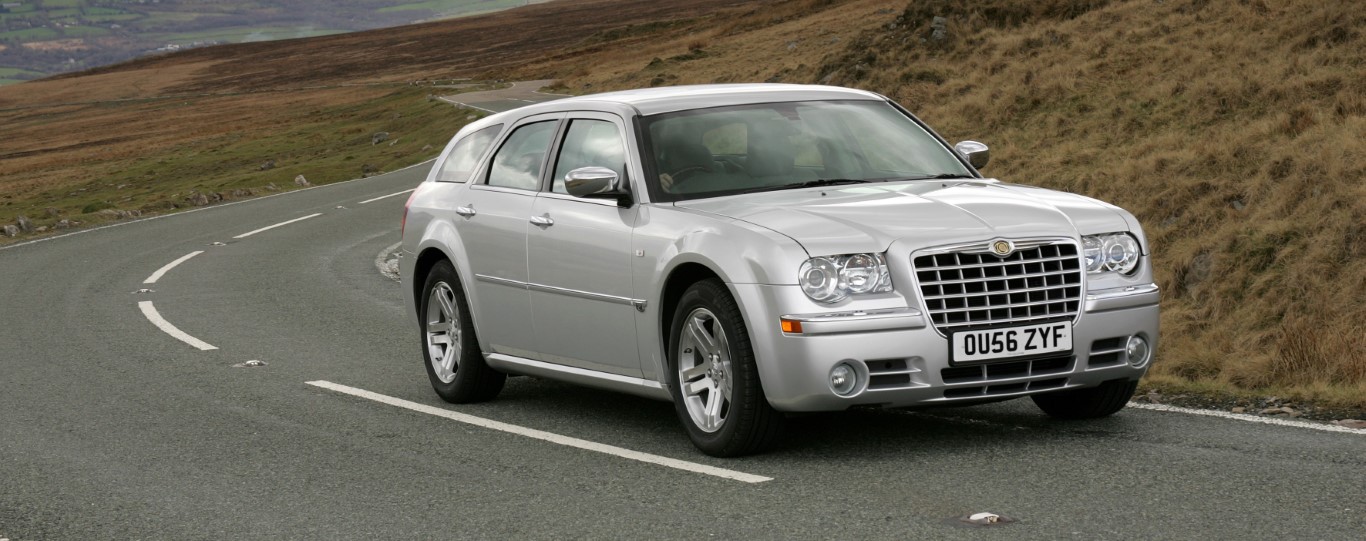
1st Generation
(2005-2007)
Raw power in a tuxedo: the American wagon that merged commanding design with the legendary punch of the HEMI engine.
Select a generation to see available versions
(2005-2007)
(2008-2010)
Select a powertrain to view full technical specifications
The history of the Chrysler 300C Touring cannot be understood without a rigorous analysis of the "Letter Series" lineage that defined the concept of high performance and luxury in North American automotive engineering. The "300" emblem was introduced by Chrysler in 1955 with the C-300 model, a vehicle that is often credited as one of the first muscle cars or, more precisely, an American "Grand Touring" designed for high-speed cruising and long distances. This original model was equipped with the revolutionary 5.4-liter (331 cubic inches) FirePower Hemi engine, capable of generating 300 horsepower, an unprecedented mark for production cars at the time. The success was immediate, with the C-300 dominating NASCAR in 1955, winning 27 out of 45 races and being the first American car to accelerate from 0 to 60 miles per hour in less than 10 seconds.
The evolution continued with the 300B in 1956, which introduced tailfins and 354-cubic-inch Hemi engines reaching up to 355 horsepower. The true nominal predecessor of the modern model, however, was the 1957 Chrysler 300C. Designed by the legendary Virgil Exner, the original 300C introduced a trapezoidal front grille, tricolor emblems, and a 392-cubic-inch Hemi engine generating 375 horsepower. The letter series continued until 1965 with the 300L, and the name "300" without a letter survived until 1979.
In the late 1990s, Chrysler revived the nameplate with the 300M (1999-2004). Although successful, with over 75,000 units sold in the first year, the 300M utilized the cab-forward design philosophy and front-wheel drive, distancing itself from its historical roots. It was only after Chrysler's merger with the German Daimler-Benz, forming DaimlerChrysler, that the scenario changed. The board decided that the successor to the 300M and the Concorde model should return to classic American proportions: longitudinal front engine, rear-wheel drive, long hood, and low roof. This guideline culminated in the creation of the LX platform and, subsequently, the modern Chrysler 300C, revealed as a concept in 2003 and launched for the 2005 model year.
While the Chrysler 300 sedan (and its top-of-the-line 300C version) was designed primarily for the North American consumer, Chrysler needed an aggressive strategy to penetrate international markets, especially in Europe, Japan, and Australia. In Europe, the executive segment (E-Segment) was dominated by long family vehicles, known as station wagons, estates, or tourings, such as the BMW 5 Series Touring, the Audi A6 Avant, and the Mercedes-Benz E-Class T-Model. Luxury station wagons represented a massive share of corporate and family sales in the old continent.
Chrysler's initial response for North America was the creation of the Dodge Magnum, a station wagon with an aggressive profile launched between 2005 and 2008. However, the Dodge brand did not possess the same luxury appeal demanded in Europe, and the Magnum's interior finish was considered inferior to the exacting standards of the European consumer. The solution was an ingenious exercise in modular engineering and internal badge engineering: Chrysler united the front end, the refined dashboard, and the superior acoustic insulation of the Chrysler 300C sedan to the rear stamping (from the C-pillar back) of the Dodge Magnum.
The result was the Chrysler 300C Touring, presented at the 2004 Geneva Motor Show. This export-exclusive model was offered in both left-hand drive (LHD) and right-hand drive (RHD), unlike the Magnum, which was restricted to left-hand drive. The nomenclature "Touring" generated some semantic confusion at the time, because in North America "Touring" referred to a trim level of the sedan with a 3.5-liter V6 engine, while in Europe and the rest of the world "Touring" specifically designated the five-door body style (station wagon).
The backbone of the Chrysler 300C Touring was the LX platform, a marvel of corporate synergy that incorporated several cutting-edge engineering components from the Mercedes-Benz W211 (E-Class) and W220 (S-Class) platforms. This infusion of German technology ensured that the heavy American bodywork could offer refined driving dynamics, moving away from the stereotype of soft and imprecise suspensions.
The front suspension used an independent short and long arm (SLA) system, while the rear employed a sophisticated five-link multi-link system entirely derived from the Mercedes-Benz E-Class. Both ends utilized high-strength coil springs. To adapt the vehicle to European tastes and the high speeds of highways like the Autobahn, Magna Steyr (the company responsible for assembly) insisted on calibrating the control bushings, springs, and shock absorbers to provide a firmer and more responsive ride than that found in models built in Canada for the American public.
The steering system adopted a rack and pinion configuration, requiring 2.75 turns lock-to-lock in most versions, 2.9 turns in all-wheel drive (AWD) versions, and 2.8 turns in the sporty SRT8. This setup delivered surprisingly agile control for a vehicle whose width exceeded 1.88 meters.
Mass control was fundamental, given that the Touring's curb weight ranged from 1,852 kg in the base version to 2,050 kg in the V8 versions with all-wheel drive. Standard civilian versions employed 345 mm (13.58 inches) ventilated disc brakes on the front axle and 320 mm (12.6 inches) solid discs on the rear. The SRT8 model, destined for high performance, required drastic improvements, receiving 360 mm (14.17 inches) ventilated rotors in the front and 350 mm (13.78 inches) in the back, accompanied by Brembo calipers.
All versions of the 300C Touring came standard with the Electronic Stability Program (ESP) and an all-speed Traction Control System. In rear-wheel drive (RWD) versions, torque delivery was continuous, while AWD models used a transfer case based on Mercedes-Benz's 4MATIC technology, actively splitting traction to ensure grip in harsh European climates.
The visual design of the Chrysler 300C Touring was conceived to command respect. The front maintained the strong visual identity, with its massive rectangular grille and expressive headlights inspired by the classics of the letter series. The incredibly high beltline reduced the glass area (the "greenhouse"), giving the model the appearance of an armored car or a factory-lowered classic hot rod.
The proportions of the Touring were massive by urban European standards, requiring spacious parking spots and care during low-speed maneuvers. The drag coefficient (Cd) achieved a notable efficiency of 0.34 in the standard gasoline and diesel versions, rising slightly to 0.36 in the SRT8 and 0.37 in the AWD versions due to wider tires and alterations in airflow under the chassis.
| Dimension and Aerodynamics | Specification |
|---|---|
| Total Length | 501.5 cm (197.44 inches) |
| Total Width | 188.0 cm to 188.1 cm (74.06 inches) |
| Total Height | 146.2 cm (SRT8) to 150.7 cm (AWD) |
| Wheelbase | 304.8 cm to 305.0 cm (120 inches) |
| Front Track | 160.0 cm (62.99 inches) |
| Rear Track | 160.3 cm to 160.5 cm (63.11 inches) |
| Drag Coefficient (Cd) | 0.34 to 0.37 (depending on the version) |
The true functional innovation of body engineering lay in the trunk design. The liftgate of the Chrysler 300C Touring was manufactured in heavy structural steel and designed in the shape of an inverted "L". The trunk hinges were not located at the rear edge of the roof like in traditional station wagons, but set back and cut deep into the roof panel. This kinematic design allowed the door to open almost vertically and forward, totally clearing the roof over the cargo area. As a result, users did not need to bend down under the door to load long items or bulky boxes, ensuring superior ergonomics.
The storage capacity was designed for versatility. With all five seats occupied (2+3 configuration), the trunk volume offered 630 liters (22.2 cubic feet), with alternative measurements indicating up to 770 liters to the roof. By folding the rear seats, the cargo capacity skyrocketed to a vast and flat volume of 1,602 liters (56.6 cubic feet), reaching up to 2,010 liters of gross volume. The load floor included a removable tri-fold panel that weighed only 7.25 kg. When this panel was removed, the usable height of the compartment increased by 102 mm. The area also featured a roller cover, storage boxes in the side panels, tie-down rings, and a 12-volt outlet.
The 300C Touring line possessed multiple trim levels to appeal to everyone from conservative fleet managers to high-octane enthusiasts. The interior focused on traditional luxury, contrasting with the utilitarian plastics of the Dodge Magnum.
The gasoline engines offered a wide range of displacements (from 2,736 cm³ to 6,059 cm³) to navigate markets where tax laws based on engine size were strict.
Acting as the entry version, the naturally aspirated 2.7-liter engine was destined for rental companies, taxis, and buyers with strict budgets. The inherent weight of the 300C Touring's body (1,852 kg) severely compromised the dynamic performance of this small engine.
The 3.5-liter engine provided an acceptable compromise between price and adequate torque to move the station wagon. It was available with both rear-wheel drive (RWD) and all-wheel drive (AWD).
The brand's historical signature. The HEMI V8 introduced massive breath and an imposing soundtrack.
Built to annihilate high-ranking German station wagons in Europe and Australia, the SRT8 (Street and Racing Technology V8) version was the mechanical peak of the 300C Touring. It was a factory sleeper (a car with civilian looks but supercar power).
For the practical success of the Chrysler 300C Touring outside North American borders, the adoption of a diesel engine was not optional, it was mandatory. Chrysler took off the shelf of its parent company, Mercedes-Benz, one of the most revered engines of the time: the OM642. This powerplant transformed the heavy nature of the station wagon, delivering reliability, range, and brutal force at low RPMs.
The fiscal impact of this engine can be observed from the perspective of vehicle import and regulation in Portugal (used here as a case study for European emissions laws for 2026). The diesel engine suffers heavily under annual circulation taxes, with an ISV of €7,233 and IUC around €749 (for a 2008 vehicle). Nevertheless, the taxes applicable to the V8 5.7 and 6.1 SRT8 versions would easily surpass the €12,000 barrier in regularization, making any corporate success for gasoline unviable in European fleets.
To mitigate logistical costs, bypass strict import tariffs, and ensure build quality in line with European perceived quality expectations, DaimlerChrysler made the strategic decision not to export the finished Chrysler 300C Touring from the Brampton, Canada plant (where the Magnum and the 300 sedan were assembled).
In October 2004, the group announced the agreement to assemble the 300C Touring at the Magna Steyr plant in Graz, Austria. Production began in the second quarter of 2005. Magna Steyr has one of the most prestigious contract manufacturing histories in the world, operating super flexible lines that, at the same time, assembled icons like the Mercedes-Benz G-Class, the BMW X3, and the Jeep Grand Cherokee.
The Graz factory was the exclusive base for the production of all 300C Touring models destined for right-hand drive (RHD) markets and all diesel (CRD) configurations. Modular flexibility allowed the line to perfectly adapt to harsher suspension calibrations (autobahn tuning) and the installation of the Mercedes OM642 engine. The operation was so efficient that it consolidated Magna Steyr as a central pillar for Chrysler to experience its sharpest growth rate in Europe in mid-2006, celebrating over one million vehicles produced at the plant since the partnership's foundation in 1990. Production of the station wagon in Austria continued until the discontinuation of the first generation in 2010.
Table: Produced Quantities and Global Registrations (300 Series)
The aggregated data for the Chrysler 300 line (sedan and wagon) underscores the peak in 2005 and 2006 and the downfall following the 2008 financial crisis. The volume reported for Europe and Australia almost strictly mirrors the preference for the Touring version and CRD engine.
| Base Year | United States | Europe | Australia | Mexico |
|---|---|---|---|---|
| 2004 | 112,930 | 2,460 | N/A | N/A |
| 2005 | 144,068 | 5,520 | 363 | 1,001 |
| 2006 | 143,647 | 14,186 | 1,864 | 1,024 |
| 2007 | 120,636 | 13,463 | 1,645 | 660 |
| 2008 | 62,352 | 7,244 | N/A | N/A |
| 2009 | 38,606 | 3,428 | N/A | N/A |
| 2010 | 37,116 | 3,507 | N/A | N/A |
In Europe, the Chrysler 300C Touring fought directly for the "old money" and new executives who would generally opt for a BMW 5 Series (E61) or Mercedes E-Class (S211). Chrysler approached the market through its value package: unlike the competition, which based a large part of its profit on endless catalogs of options, the Touring version frequently included items like adaptive cruise control, HID xenon headlights, heated seats, and premium audio systems as standard (as in the case of the SRT-Design and Heritage packages). Despite the favorable fuel consumption in the CRD model, some buyers criticized the interior for being devoid of the microscopic refinement found in Stuttgart and Munich, citing inferior plastics in the pre-2008 generation, although they recognized that the 300C offered the best intimidating look in the class. Sales collapsed from 14,186 in 2006 to a meager 3,428 units at the height of the European crisis in 2009.
Australian automotive culture has a visceral affinity for heavy rear-wheel-drive sedans and station wagons with V8 engines (driven by historical names like Holden Commodore and Ford Falcon). The Chrysler 300C Touring hit an exposed nerve in Oceania. The introduction of the SRT8 Touring model found an eager market for fast station wagons. At the end of 2006, the 300C boasted a surprising 32% of the Australian large upper car market priced under $100,000 AUD, with almost 1,750 units sold. Impressively, the SRT8 represented over 10% of the model's total local sales, evidencing how perfectly the 431 horsepower of the 6.1 block matched the lifestyle of the Australian enthusiast.
The role of the 300C Touring in Brazil was one of pure eccentricity, positioning itself strictly as an ultra-segmented luxury good. The model arrived officially in a restricted manner, essentially highlighting the importation of the ultra-high-end Touring variant with the 5.7 Hemi V8 engine (340 hp). While the sedan quietly thrived for a long time in wedding fleets and among high-end executives due to its "Bentley face", the station wagon market was suffering a massacre in favor of the overwhelming rise of SUVs (Sport Utility Vehicles) at the end of the first decade of the 21st century. As a result, the V8 Touring became a unicorn on Brazilian streets, coveted and restricted. In November 2017, after a decade and the brief introduction of the second generation of the sedan only, Chrysler officially ended its sales and representations of new vehicles in the Brazilian market, leaving no zero-kilometer models in the country.
The drastic drop in production of the Chrysler 300C (and consequently the station wagon) was not motivated by inherent product flaws, but by the troubled divorce between Daimler and Chrysler in 2007, and by the global economic devastation of 2008. Chrysler's bankruptcy in the United States resulted in its rescue by Fiat, generating the Fiat Chrysler Automobiles (FCA) corporation.
The Italian management proceeded to substantially redesign the LX platform, creating the second generation designated by the "LD" architecture for the 2011 model year onwards. The LD generation modernized the front grille, adopted the new and advanced Pentastar 3.6-liter V6 gasoline engine family (replacing the criticized 2.7 and 3.5), introduced a revamped interior far superior in materials, LED daytime running lights, and refined suspension. The Hemi V8 had its displacement increased in the SRT versions to 6.4 liters (392 cubic inches), reaching 485 hp in the final farewell edition of the 300C sedan in 2023.
However, the news for station wagon fans was fatal. The board concluded that converting the new LD body panels for a wagon (and all safety approvals in crash-tests and aerodynamics for LHD and RHD) would represent unjustifiable engineering costs in a world dominated by SUVs. Furthermore, the physical basis of the wagon, the Dodge Magnum, had been summarily canceled and buried in 2008 due to low volume. Consequently, the Touring configuration was extinguished forever, and Magna Steyr's Austrian lines ended production of the 300C in 2010.
For Europe, the FCA restructuring determined that the Chrysler and Lancia networks should not compete or expend redundant funds. Thus, the new second-generation Chrysler 300 was subjected to profound badge engineering (brand substitution). In all markets of Continental Europe, except the UK and Ireland, the Canadian sedan manufactured in Brampton, Ontario, began to bear the classic Italian insignia and was baptized as the Lancia Thema.
Lancia, a brand renowned for sportiness and tactile sophistication in the 80s and 90s (including the notorious original Thema Type 834 manufactured between 1984 and 1994, which even featured an acclaimed station wagon signed by the Pininfarina studio), tried to inject transcontinental refinement into the robust American block. The exterior received subtle Italian polishes on the front grille and in the luxurious porous wood interior (offered in Gold and Platinum versions). Mechanically, the Thema abandoned the old German 3.0 V6 CRD and embraced the brand-new 3.0 V6 turbodiesel developed locally in Italy by VM Motori (in 190 hp and 239 hp variants), alongside a powerful 286 hp 3.6 V6 gasoline engine mated to the excellent ZF 8-speed automatic gearbox.
However, when attempting to revive the mystique of the nostalgic Pininfarina Thema station wagon/estate and faced with the fact that the current 300 platform (LD) had abolished the station wagon variant, the Thema operation found no resonance. European executive car clients considered the fractured identity between Detroit roots, the disappearance of the old Austrian wagon's L-shaped trunk, and a Lancia shield on the hood far too artificial. The modest goal of selling between 10,000 and 15,000 units annually never materialized, prompting the quiet withdrawal of the Thema from European showrooms in 2014. The American model, as a pure rear-wheel-drive sedan, fought behind the scenes in local fleets until the definitive and celebratory shutdown of the entire 300 line at the end of the 2023 calendar year.
The Chrysler 300C Touring, commercialized globally between 2004 and 2010, attests to an idiosyncratic era in modern automotive industry: a unique synergy between the stylistic brutality of American culture and the rigor of German dynamic architectures. The implementation of a trunk that could hold between 630 to over 1,600 liters of rectangularly shaped cargo, thanks to an intelligent roof hinge design, elevated it to the level of the best family proposals of the decade.
Unlike the Dodge Magnum, with which it shared stampings and indeed the same structural steel skeleton, the Touring cemented an opulent personality in export. The market recognized and paid for the superior acoustic effort, the refined trim levels (like the Executive or Heritage version), and the SRT-Design package, which granted the menacing air of the SRT8 V8 edition to the more pragmatic buyers of Mercedes-Benz's efficient OM642 turbodiesel engines.
Analyzing its absence in the second generation and the unsuccessful effort of the "Italianization" of its sedan replacement (the Lancia Thema), the Touring consolidates itself as a cult classic. Records attest to its position as the last genuine North American station wagon designed at the intersection with German mechanical intelligence. It represents the industry's capacity to conceive non-conformist alternatives in conservative segments; for many high-performance and robust family utility collectors — whether enthusiasts of the naturally aspirated fury of the HEMI engine in Brazil and Australia or Autobahn devourers in Europe pushed by diesel propulsion —, the 300C Touring remains an inimitable masterpiece of the golden era of DaimlerChrysler.
Images of the Chrysler 300C Touring 5.7 V8