


The Context of the Merger and the Genesis of the Project
The trajectory of the Chrysler Crossfire in the global automotive scene is one of the most emblematic examples of how corporate politics and transatlantic engineering can converge to create a highly specific niche product. Launched during the tumultuous period of the merger between Daimler-Benz and the Chrysler Corporation, the Crossfire was conceived to be the American brand's "halo car," a technological showcase that would combine bold United States design with German mechanical precision. This report details the genesis, technical development, performance variants, and industrial performance of this vehicle, which remained in production between 2003 and 2007, covering the 2004 to 2008 model years.
The birth of the Chrysler Crossfire is intrinsically linked to the creation of DaimlerChrysler in 1998. The strategy behind the union was to leverage cost synergies and the expertise of both companies to dominate the global market. In the early 2000s, Chrysler sought to renew its image, trying to distance itself from the perception of a minivan and utility vehicle manufacturer to become a luxury and performance brand. Under the design leadership of Trevor Creed and the operational direction of Wolfgang Bernhard, the idea emerged for a two-seater sports car that would use existing Mercedes-Benz components to reduce development time and investment costs.
The concept for the Crossfire was first revealed at the North American International Auto Show in Detroit in January 2001. The original design, penned by Eric Stoddard, who was just 25 years old at the time, was inspired by the Art Deco period and classic vehicles like the Bugatti Atlantic and the Talbot Lago, featuring a center line that split the car longitudinally, including the windshield. The public reception was so overwhelming that Chrysler decided to put the vehicle into production in record time, utilizing the Mercedes-Benz R170 platform, which underpinned the first generation of the Mercedes-Benz SLK.
Engineering Architecture: The R170 Base
Although the exterior design was purely Chrysler, about 80% of the Crossfire's mechanical components were of Mercedes-Benz origin. This strategic decision allowed the car to be assembled by the renowned coachbuilder Karmann in Osnabrück, Germany, instead of being manufactured at Chrysler's traditional plants in North America. The use of the R170 platform brought with it significant technological advantages and limitations for the time.
The Crossfire's chassis structure shared the same 2,400 mm wheelbase as the SLK320, as well as the front and rear track width. The engine compartment was virtually identical to the German model's, which facilitated maintenance and powertrain integration. A divergent technical point from most contemporary sports cars was the retention of the Mercedes recirculating ball steering system, rather than a more modern rack-and-pinion system, which resulted in less direct steering feedback, although very stable at high speeds.
The suspension was configured with double wishbones at the front and a five-point multi-link system at the rear, a robust architecture that provided a balance between ride comfort and maneuverability. To emphasize the sporty stance, Chrysler opted for staggered wheel sizes, being 18 inches in the front and 19 inches in the rear, a characteristic that required tires with different profiles to maintain the vehicle's dynamic balance.
Design and Aerodynamics: The Boattail Concept
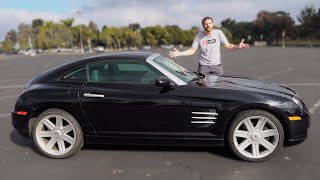
The Crossfire is visually defined by its dramatic proportions: a long hood, a set-back cabin, and a rear end that converges to a central point, an aesthetic known as "boattail." This design was not just an aesthetic choice, but a homage to the "dream cars" of the 1950s and the architecture of the Chrysler Building in New York, with the longitudinal grooves on the hood serving as a clear visual signature of the brand.
Aerodynamic efficiency was a focal point, resulting in the inclusion of an active rear spoiler. This device remained hidden in the trunk lid at low speeds, automatically raising when the vehicle reached about 96 km/h (60 mph) to increase downforce and stabilize the rear in fast corners, retracting when the speed dropped below 63 km/h.
Design Specifications and Dimensions Table
| Attribute | Measurement / Detail |
|---|---|
| Overall Length | 4,059 mm |
| Width (without mirrors) | 1,765 mm |
| Height (Coupé) | 1,308 mm |
| Height (Roadster) | 1,316 mm |
| Wheelbase | 2,400 mm |
| Average Weight (Curb Weight) | 1,388 kg to 1,470 kg |
| Drag Coefficient (Cd) | 0.37 |
Sources:
The name "Crossfire" derives from the character lines that run along the sides of the bodywork, which cross over at the door level, moving from a positive to a negative concavity. This visual element reinforced the idea of movement even when the car was stationary and highlighted the muscularity of the rear fenders.
The Heart of the Machine: Engines and Performance
The Crossfire was predominantly equipped with the Mercedes-Benz M112 E32 engine, a 3.2-liter naturally aspirated V6 powerplant that was already widely used in models such as the C-Class, E-Class, and the SLK itself. This engine was manufactured at the DaimlerChrysler engine plant in Untertürkheim, Germany, and was known for its smoothness and linear torque delivery.
Technical Details of the 3.2L V6 Engine
The M112 engine featured an aluminum block with Alusil cylinder liners, an SOHC (single overhead camshaft) valvetrain system with three valves per cylinder, and two spark plugs per cylinder (Twin Spark system). This configuration was chosen by Mercedes-Benz at the time to optimize combustion efficiency and reduce exhaust emissions.
| Engine Specification | Technical Detail |
|---|---|
| Configuration | 90-degree V6 |
| Displacement | 3,199 cc |
| Maximum Power | 215 hp (218 PS) @ 5,700 rpm |
| Maximum Torque | 310 Nm (229 lb·ft) @ 3,000 rpm |
| Compression Ratio | 10.0:1 |
| Fuel Delivery | Sequential multipoint electronic injection |
Sources:
In terms of performance, the standard Crossfire was capable of accelerating from 0 to 100 km/h in approximately 6.5 to 7 seconds, depending on the chosen transmission, with a top speed electronically limited to 250 km/h.
Transmissions and Dynamics
Buyers could choose between two transmission options sourced from Mercedes-Benz:
- 6-speed Manual (NSG370): Offered a more engaging driving experience, although the lever throw and precision were frequently compared to those of executive sedans rather than pure sports cars.
- 5-speed Automatic (NAG1 / 5G-Tronic): Equipped with the AutoStick system, it allowed for sequential manual shifts by moving the lever to the sides. Interestingly, the automatic version was often more fuel-efficient on highway cycles due to the gearing of the upper gears.
Versions and Trim Levels
Throughout its commercial life, the Crossfire was offered in three main trim levels, in addition to limited special editions.
Base (or Standard)
Introduced to make the model more accessible, the Base version simplified several finishes. Externally, the windshield surrounds were painted matte black instead of satin silver. Internally, the seats were upholstered in heavy-duty fabric and did not have the heating system. Furthermore, the fog lights were replaced by black plastic blanking plates.
Limited
The Limited model was the luxury standard of the range, offering all the features customers expected from a car in this segment. Highlights included leather seats with an 8-way power driver's adjustment and 4-way for the passenger, heated seats, an Infinity Modulus sound system with 240 watts and dual subwoofers mounted behind the seats, and heated exterior mirrors. Visually, the Limited displayed the silver windshield surround, which became a trademark of the model.
Special Edition (SE)
Available primarily for the Roadster in the 2006 and 2007 years, this version served as an aesthetic middle ground. It was characterized by the exclusive Inferno Red Crystal Pearl color, 15-spoke alloy wheels similar to those of the SRT-6 (but in a standard finish), and Dark Slate Gray fabric seats.
The Apex of Performance: Crossfire SRT-6
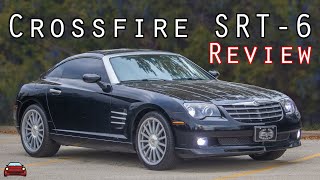
In 2005, Chrysler launched the SRT-6 high-performance variant, developed in collaboration with the AMG division of Mercedes-Benz and Chrysler's Street & Racing Technology group. This version transformed the Crossfire from an elegant GT into a respectable sports car, capable of taking on much more expensive competitors.
The SRT-6 utilized the M112 C32 engine, a supercharged version of the 3.2-liter V6 hand-assembled by AMG. A positive displacement compressor (supercharger) and an air-to-water intercooler were added, raising the power from 215 hp to an impressive 330 hp and the torque to 310 lb-ft.
Performance Comparison: Limited vs. SRT-6
| Feature | Crossfire Limited | Crossfire SRT-6 |
|---|---|---|
| Engine Aspiration | Naturally Aspirated | Supercharger (AMG) |
| Power (hp) | 215 | 330 |
| Torque (lb-ft) | 229 | 310 |
| Transmission | 6MT / 5AT | 5AT (Recalibrated by AMG) |
| 0-60 mph (97 km/h) | ~6.4 s | ~4.8 s |
| Rear Spoiler | Active (Retractable) | Fixed (Body-color) |
| Wheels | 7-spoke (Standard) | 15-spoke (SRT-style) |
Sources:
In addition to the engine, the SRT-6 received extensive modifications to the suspension, with stiffer springs and shock absorbers to reduce body roll, and an upgraded braking system with larger discs and high-performance calipers. The fixed rear spoiler was a functional necessity to handle the substantial increase in speed and guarantee constant stability.
The Crossfire Roadster: Open-Air Engineering
Introduced in the 2005 model year, the Crossfire Roadster was designed to capture the essence of European convertibles. The conversion to a Roadster required significant structural reinforcements to compensate for the loss of the hardtop, which resulted in a slight increase in the vehicle's total weight.
The fabric top was electro-hydraulically operated. The driver needed to manually unlatch a central handle on the windshield header and slightly raise the front of the top before pressing the button on the center console, which completed the stowing process under a hard tonneau cover in less than 25 seconds. The Roadster's design maintained the Art Deco theme, featuring two silver sport bars behind the seats that not only offered protection in the event of a rollover but also served as aesthetic elements integrated into the fairings of the rear decklid.
Production and Industrial Logistics at Karmann
Unlike almost all other Chrysler products at the time, the Crossfire was a genuinely German product in terms of manufacturing. Production was outsourced to Wilhelm Karmann GmbH at its Osnabrück factory. This decision was made because Karmann already had vast experience in producing low and medium volume niche vehicles and had a long-standing relationship with Daimler-Benz.
The manufacturing process involved shipping Mercedes-Benz components from its various German factories to Osnabrück, where they were integrated into the bodywork designed by Chrysler. The first production unit rolled off the line on February 3, 2003. However, the logistics of producing a car in Europe to sell it primarily in North America, combined with the appreciation of the Euro against the Dollar at the time, pressured profit margins and raised the selling price, contributing to the model's commercial difficulties.
Quantities Produced per Year and Model
Total production of the Chrysler Crossfire reached 76,014 units over five years. The following table details the distribution of this production, highlighting the sharp decline in the final years due to low demand and stock saturation.
| Model Type / Year | 2004 | 2005 | 2006 | 2007 | 2008 | Grand Total |
|---|---|---|---|---|---|---|
| Coupé (Base) | 0 | 1,807 | 770 | 434 | 0 | 3,011 |
| Limited Coupé (LHD) | 22,801 | 9,027 | 2,155 | 1,063 | 826 | 35,872 |
| Limited Coupé (RHD) | 2,322 | 983 | 591 | 128 | 0 | 4,024 |
| Roadster (Base) | 0 | 1,806 | 780 | 803 | 0 | 3,389 |
| Limited Roadster | 0 | 18,501 | 4,281 | 1,905 | 960 | 25,647 |
| SRT-6 Coupé (LHD) | 0 | 2,419 | 47 | 0 | 0 | 2,466 |
| SRT-6 Coupé (RHD) | 0 | 26 | 79 | 0 | 0 | 105 |
| SRT-6 Roadster (LHD) | 0 | 1,252 | 69 | 0 | 0 | 1,321 |
| SRT-6 Roadster (RHD) | 0 | 78 | 101 | 0 | 0 | 179 |
| Total Production | 25,123 | 35,899 | 8,873 | 4,333 | 1,786 | 76,014 |
(LHD = Left Hand Drive / RHD = Right Hand Drive)
Sources:
Year-by-Year Evolution: Changes and Discontinuation
The Crossfire's lifespan was short but marked by constant adjustments to try to maintain market interest.
- 2004: The car was launched only in the Coupé version with a single trim level (equivalent to the Limited).
- 2005: Introduction of the Roadster, the Base model, and the high-performance SRT-6 variant.
- 2006: SRT-6 production became extremely limited, being technically discontinued as a mass-production model and kept only to fulfill remaining commitments. New color packages were introduced.
- 2007: The SRT-6 was officially removed from the lineup. Safety changes included new knee airbags for the driver and passenger and the OCS (Occupant Classification System) for automatic deactivation of the passenger airbag.
- 2008: Only the Limited version remained. Physical production ended in December 2007, but vehicles continued to be sold as 2008 stock until mid-2009.
The discontinuation of the Crossfire was accelerated by the divorce between Daimler and Chrysler in 2007. Without the technological partnership, Chrysler would not have access to the platform of the second-generation SLK to develop a successor, and the sales volume did not justify the investment in a proprietary platform for a niche vehicle.
Reliability and Maintenance: What Owners Should Know
As the Crossfire is mechanically a classic-era Mercedes-Benz (late 90s and early 2000s), it shares many of the virtues and vices of products from that time.
Common Mechanical and Electrical Problems
- Relay Control Module (RCM): One of the most reported problems is the failure of solder joints inside this module, which can cause the engine to shut off suddenly or make it impossible to start.
- Locked Ignition Cylinder: The key mechanism can jam (sticky key syndrome), preventing the driver from turning the key to start the car.
- Transmission Leak: The electrical connector of the 5-speed automatic gearbox tends to leak fluid, which can infiltrate the wiring harnesses if not repaired.
- Rear Window Detachment (Roadster): The thermal rear window of the fabric top can detach due to the failure of the original adhesive, a costly repair that often requires total replacement of the top.
- Wheel and Headlight Corrosion: The alloy wheels can show corrosion under the clear coat (white powder) and the headlights are prone to internal condensation buildup.
Despite these specific flaws, the M112 engine and the 5G-Tronic transmission are considered "bulletproof" when maintained correctly, and it is common to find examples with high mileage without major internal engine problems.
The Chrysler Crossfire in Brazil
In Brazil, the Chrysler Crossfire had a very limited and exclusive presence. Officially imported by DaimlerChrysler do Brasil during the mid-2000s, the model was positioned as an extremely expensive image vehicle. Most of the imported units were of the Limited Coupé or Roadster version with an automatic transmission.
Due to its rarity and the sharing of parts with the Mercedes-Benz SLK320, the Crossfire has become a collector's item in the Brazilian used market. The maintenance of these vehicles in the country is facilitated by the fact that most mechanical and suspension parts can be found within the Mercedes-Benz parts network, although specific bodywork components, interior trim, and glass can be extremely difficult to obtain outside of direct importation.
Final Considerations and Legacy
The Chrysler Crossfire remains a fascinating industrial curiosity. It was the result of an era when manufacturers were willing to take extreme aesthetic risks through international collaboration. Although it did not reach Chrysler's sales goals, it fulfilled its role as a "halo car," drawing people into showrooms and generating heated discussions about its design.
For current enthusiasts and collectors, the Crossfire offers a unique combination: the sculptural and exotic beauty of an "Art Deco" American design with the robustness and ease of mechanical maintenance of a classic Mercedes-Benz. Whether in the form of a Coupé with its "boattail" lines or in the freedom of a Roadster, the Crossfire is a testament to a unique moment in the history of DaimlerChrysler. As time passes, the surviving units, especially the rare SRT-6 variants, are beginning to be seen as modern classics with sustained appreciation potential driven by their low production and prestigious mechanical heritage.