


The Chrysler Neon Phenomenon
The history of the Chrysler Neon is one of the most dynamic accounts of the modern North American automotive industry, symbolizing a period of technical boldness and corporate reinvention. Launched at a time when the Chrysler Corporation sought to break free from a conservative image inherited from the 1980s, the Neon was not just a compact car; it was a declaration of war against the dominance of Japanese automakers in the United States market. Between its emergence as a concept in 1991 and the end of its original production in 2005, the model went through two main generations that sold over two million units, in addition to a strategic resurrection in 2016 based on global partnerships. This analysis details each phase of this journey, from low-cost engineering to the emergence of performance icons like the SRT-4.
The Genesis and Concept: The Vision of Thomas Gale and Bob Lutz
The development of the Neon began in an environment of intense financial and strategic pressure at Chrysler. After being saved from bankruptcy in the 1980s by Lee Iacocca, the company needed products that would attract a younger audience. The starting point was the concept car presented at the Detroit Auto Show in 1991. The project was led by a team of designers who had joined Chrysler after the purchase of the American Motors Corporation (AMC) in 1987, bringing a more agile and less bureaucratic approach to vehicle development.
The original 1991 concept was radical. It featured sliding doors that opened from the center without the need for a central pillar (B-pillar), a fabric sunroof that covered almost the entire length of the vehicle, and an interior focused on sustainability, even including a trash compactor to encourage cleanliness. Although many of these features were prohibitive for mass production, the rounded lines and the car's friendly "face," created by Thomas Gale — the same designer behind the Dodge Viper and the Dodge Ram —, were kept for the final production model.
A critical factor in the birth of the Neon was the initial resistance from then-Chrysler president Lee Iacocca. He believed that small cars were not profitable and that it would be impossible to manufacture a compact in the United States competitively due to the high labor costs of the United Auto Workers (UAW). However, executives like Bob Lutz insisted that Chrysler needed a "Japanese killer" to secure the brand's future. The solution was engineering obsessively focused on cost reduction without sacrificing performance. For example, the platform team utilized the seat frames from an older generation Honda Civic to save on the development of new tooling.
First Generation (1995-1999): The Birth of a "Smiling" Icon
Officially launched in January 1994 as a 1995 model, the first-generation Neon broke paradigms. While American compacts of the time were seen as bland and slow, the Neon emerged with a vibrant personality, reinforced by the famous "Hi" marketing campaign. The "cab-forward" design pushed the wheels to the extremities of the bodywork, maximizing interior space and ensuring stability superior to the class average.
In the North American market, the car was sold as the Dodge Neon or Plymouth Neon, being virtually identical except for the badges. For the export market, including Europe, Australia, and South America, the model received the Chrysler Neon brand, positioning it as a higher value-added product.
Technical Specifications and Trim Structure
The first-generation Neon was offered in two body styles: a four-door sedan and a two-door coupe. The PL platform was designed to be lightweight, weighing around 1,100 kg, which allowed the car to be extremely agile with the offered engines.
| Attribute | First Generation Specification |
|---|---|
| Length | 4,364 mm |
| Wheelbase | 2,642 mm |
| Width | 1,714 mm |
| Height | 1,394 mm |
| Suspension | Independent on all 4 wheels (MacPherson front, Multi-link rear) |
| Brakes | Disc front / Drum rear (4-wheel disc on ACR/RT versions) |
The Neon outperformed most of its contemporary rivals in base power. While a Honda Civic DX of the time delivered about 102 hp, the simplest Neon already came with 132 hp.
First Generation Powertrains
- 2.0 L SOHC (Single Overhead Cam): The standard engine, delivering 132 hp (98 kW) and 175 Nm of torque. It was known for its economy and solid response at low RPMs.
- 2.0 L DOHC (Double Overhead Cam): Standard on Sport versions and optional on others, it yielded 150 hp (112 kW). This engine allowed the Neon to reach 100 km/h in about 7.6 seconds, beating many more expensive sports cars of the 90s.
- 1.8 L EBD (Export): A variant aimed mainly at Europe and other markets with displacement-based taxes, delivering 115 hp.
The available transmissions were a five-speed manual (NVG T-350) or a three-speed automatic (TorqueFlite 31TH). The lack of a fourth gear in the automatic transmission was one of the most common criticisms of the model in its early phase.
Special Trims and Equipment
The trim structure was designed to cater to everyone from the budget buyer to the racing enthusiast:
- Base: Stripped-down version, focused on price. In some years, it came with unpainted bumpers that better resisted minor impacts.
- Highline: The most balanced and popular version, famous for the "bubble caps" hubcaps that became a visual symbol of the car in the 90s.
- Sport: Included the 150 hp engine, a hood with an aerodynamic bulge, a rear spoiler, and alloy wheels. A curious detail of this generation was the offering of power windows only on the front doors, keeping manual cranks in the back to reduce costs.
- ACR (American Club Racer): A homologation model aimed at SCCA competitions. It was a "bare-bones" car inside (no air conditioning or radio to save weight), but it came with adjustable Koni suspension, shorter gear ratios, four-wheel disc brakes, and no 190 km/h speed limiter.
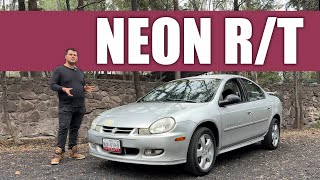
- R/T (Road/Track): Introduced in 1998, it brought the performance of the ACR but with comfort features. Visually, it was marked by dual stripes on the top of the car, nodding to the Dodge Viper GTS.
First Generation Production Data
The initial production of the Neon was massive, justifying Chrysler's investment in the new platform.
| Model Year | Dodge Units | Plymouth Units | Chrysler (Export) | Annual Total |
|---|---|---|---|---|
| 1995 | 238,447 | 204,287 | 54,976 | 497,710 |
| 1996 | 147,110 | 115,482 | 24,801 | 287,393 |
| 1997 | 133,122 | 97,107 | 25,166 | 255,395 |
| 1998 | 159,749 | 103,708 | 19,321 | 282,778 |
| 1999 | 62,595 | 43,598 | 13,605 | 119,798 |
| Total Gen 1 | 741,023 | 564,182 | 137,869 | 1,443,074 |
Second Generation (2000-2005): Refinement and the Arrival of the SRT-4
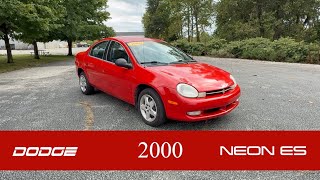
In mid-1999, Chrysler launched the second-generation Neon as a 2000 model. The focus shifted from pure charisma to maturity. The company claimed to have made over 1,000 refinements to the vehicle to improve sound insulation and perceived quality. The two-door body style was discontinued, and the sedan received doors with full frames, replacing the "frameless window" design of the first generation that was prone to wind noise at high speeds.
Although the car became larger, quieter, and more comfortable, it also became heavier. Initially, Chrysler only offered the 132 hp 2.0 SOHC engine, which caused the car to lose some of the agility that made it a success on the tracks.
Technical Evolution and Brand Changes
Starting in 2001, with the closure of the Plymouth brand, the Neon was marketed primarily as a Dodge. In Canada, between 2003 and 2005, the car was rebranded as the Dodge SX 2.0 in an attempt to refresh the model's image.
| Model Year | Main Novelty |
|---|---|
| 2000 | Launch with a more refined design and only a 4-door body style. |
| 2001 | Return of the R/T version with a 150 hp Magnum engine and an active intake manifold. |
| 2002 | Replacement of the 3-speed transmission with the 4-speed Ultradrive automatic. |
| 2003 | Major visual update (new crosshair grille) and launch of the SRT-4 version. |
| 2004 | Introduction of the limited-slip differential (LSD) on the SRT-4 version. |
| 2005 | SRT-4 Commemorative Edition and the end of global production. |
The Dodge Neon SRT-4: The Giant Killer
Shutterstock
Explorar
In 2003, Chrysler took the Neon to a new level with the launch of the SRT-4. Created by the Performance Vehicle Operations (PVO) division, the car was equipped with a 2.4-liter turbocharged engine that produced surprising numbers for the time.
Contrary to what many think, the 2.4 engine was not just a PT Cruiser engine with a turbo. It received block reinforcements, forged Mahle pistons, high-strength connecting rods, and a piston-jet oil cooling system. The exhaust system was unique: it had no muffler, utilizing only the turbo and resonators to control the sound, which resulted in an exhaust rumble and pops that became its trademark.
SRT-4 Specifications
| Technical Detail | Specification |
|---|---|
| Engine | 2.4L Turbo DOHC I4 (A853 Engine) |
| Power (2003) | 215 hp @ 5,400 rpm |
| Power (2004-05) | 230 hp @ 5,300 rpm (often underestimated by the factory) |
| Torque | 339 Nm between 2,200 and 4,400 rpm |
| Transmission | 5-speed manual (reinforced NVG T-850) |
| 0-100 km/h Acceleration | ~5.3 seconds |
| Top Speed | ~246 km/h |
The SRT-4 was an immediate cult success, selling over 25,000 units during its three years of production, far exceeding Dodge's initial expectation of 2,500 units per year. In 2005, the Commemorative Edition collector's model was launched, with only 200 units produced in white with blue stripes, and the track-focused SRT-4 ACR version, with BBS wheels and an even stiffer suspension.
Total Second Generation Sales (North America)
Despite growing competition, the Neon maintained respectable sales numbers until the end of its career.
| Calendar Year | US Sales | Canada Sales | Total |
|---|---|---|---|
| 2000 | 163,332 | N/A | 163,332 |
| 2001 | 137,353 | N/A | 137,353 |
| 2002 | 126,118 | N/A | 126,118 |
| 2003 | 120,101 | N/A | 120,101 |
| 2004 | 113,476 | 14,876 | 128,352 |
| 2005 | 113,332 | 15,064 | 128,396 |
| Total 2000-05 | 773,712 | 29,940+ | ~803,652 |
The Chrysler Neon in the Brazilian Market
Brazil was officially introduced to the Neon in 1995 when Chrysler began its formal importation. At that time, the national market was opening up to imports, and the Neon was positioned as an accessible luxury sedan, competing with the more expensive versions of the Chevrolet Vectra and the newly arrived Honda Civic and Toyota Corolla.
Unlike the American market, where it was an entry-level car, in Brazil it almost always came in the Highline trim, with the 2.0 SOHC engine, automatic transmission, and comfort features like air conditioning and a cassette radio as standard.
A striking detail of the Brazilian units was the taillights. While in the US the car had fully red lights, the official versions for Brazil had amber turn signals to comply with local signaling laws. Two-door coupe versions also arrived in the country, but often through independent importers, making them rarities today. Despite its initial acceptance, the Neon suffered in the used car market due to a reputation for expensive maintenance and difficulty finding specific trim parts after Chrysler reduced its presence in the country in the early 2000s.
Third Generation (2016-2021): The Global Partnership with Fiat
After an 11-year hiatus, the Neon name returned to the market in 2016, but with a completely different origin. As part of Fiat Chrysler Automobiles' (FCA) strategy, the new Dodge Neon was a rebadged version of the Fiat Tipo (Egea project sedan), manufactured in Turkey by Tofaş.
Sold primarily in Mexico and the Middle East, this third generation shared no mechanical components with the previous generations from the 90s. It was a more conservative sedan, focused on safety technology and fuel economy.
Technical Specifications (Mexican Model)
The main trims (SE, SXT, and SXT Plus) offered a European driving experience under the Dodge emblem.
| Component | Third Generation Specification |
|---|---|
| 1.4 FIRE Engine | 95 hp and 127 Nm of torque (6-speed Manual Transmission) |
| 1.6 E-torQ Engine | 110 hp and 152 Nm of torque (6-speed Automatic Transmission) |
| Trunk | 520 Liters |
| Safety | ABS, Stability Control, 6 Airbags, Hill Holder |
Sales in Mexico
Though modern, the "Turkish Neon" did not have the same cultural impact as the original. In Mexico, sales figures showed a steady decline after the initial launch:
| Year | Sales in Mexico |
|---|---|
| 2016 | 2,491 |
| 2017 | 5,271 |
| 2018 | 2,289 |
| 2019 | 899 |
| 2020 | 1,025 |
| 2021 | 70 |
| Total | 12,045 |
Technological and Cultural Legacy
The Chrysler Neon left an indelible mark on the automotive industry for three main reasons. First, it proved that an American automaker could develop a small car with creative engineering, maximizing interior space through the cab-forward design. Second, it democratized performance; the Neon was one of the first affordable cars to offer high-quality independent suspension on all four wheels, which made it a legend in amateur and autocross racing through the ACR versions.
Third, the SRT-4 model is today considered a modern classic. Its ability to be easily modified (with factory Mopar kits that could raise the power to over 300 hp) helped pave the way for the "sport compact" culture that dominated the early 2000s.
Although it was succeeded by the Dodge Caliber in 2006 — a vehicle that never reached the same status or sales volume —, the Neon continues to be remembered as the car that saved Chrysler in the 90s and brought a "smile" to streets all over the world. With over 2 million units sold and countless victories on racetracks, the Neon remains a testament to an era when simplicity, low cost, and pure performance walked together.