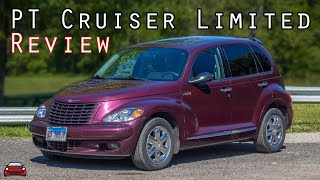
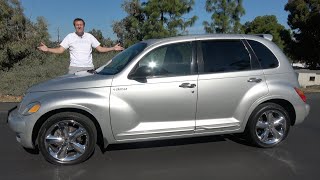
1st Generation
(2001 - 2005)
2.4 L4 16V Turbo High Output
223 cv
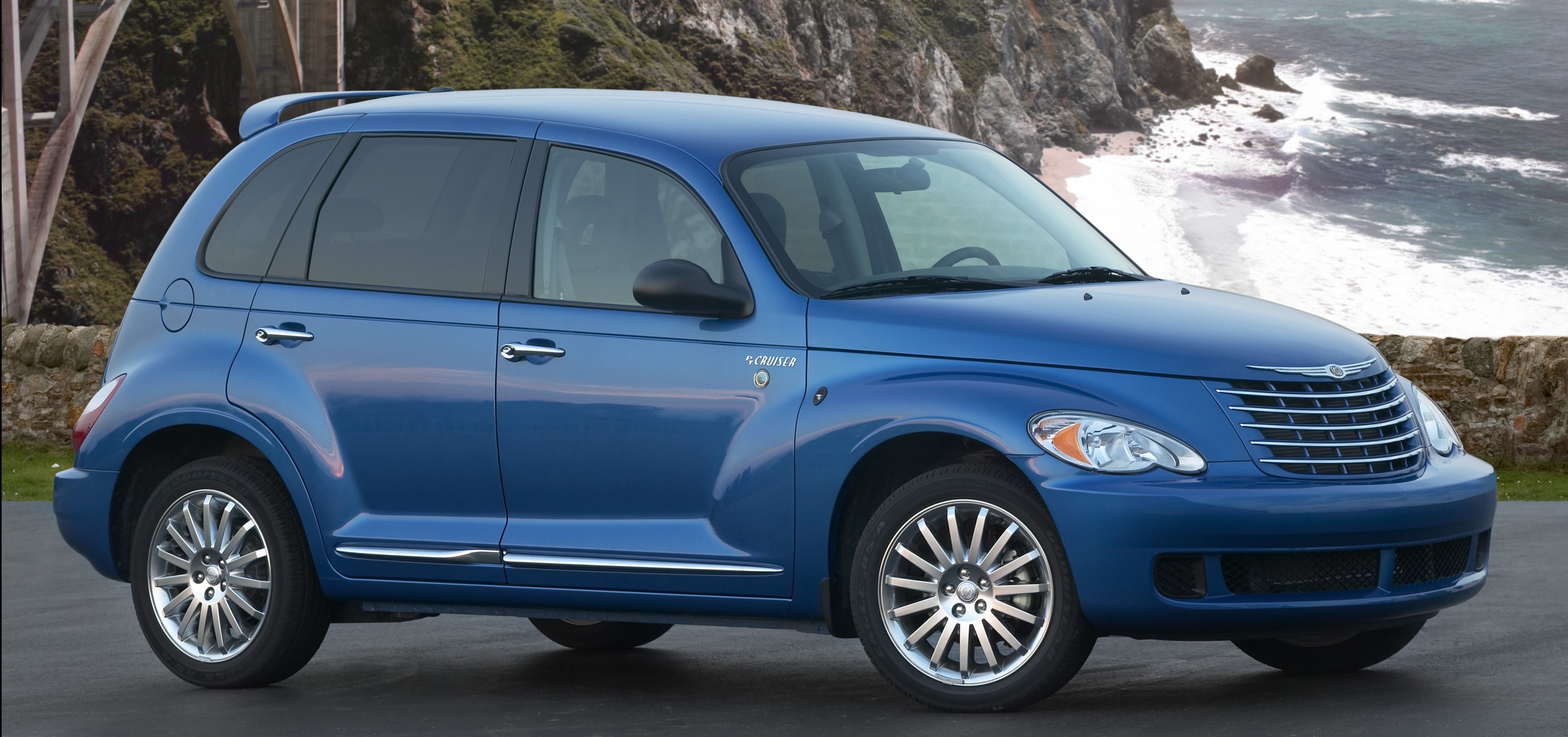
Technical specifications, versions, and history for the Chrysler PT Cruiser.
Select a generation to see available versions
(2001 - 2005)
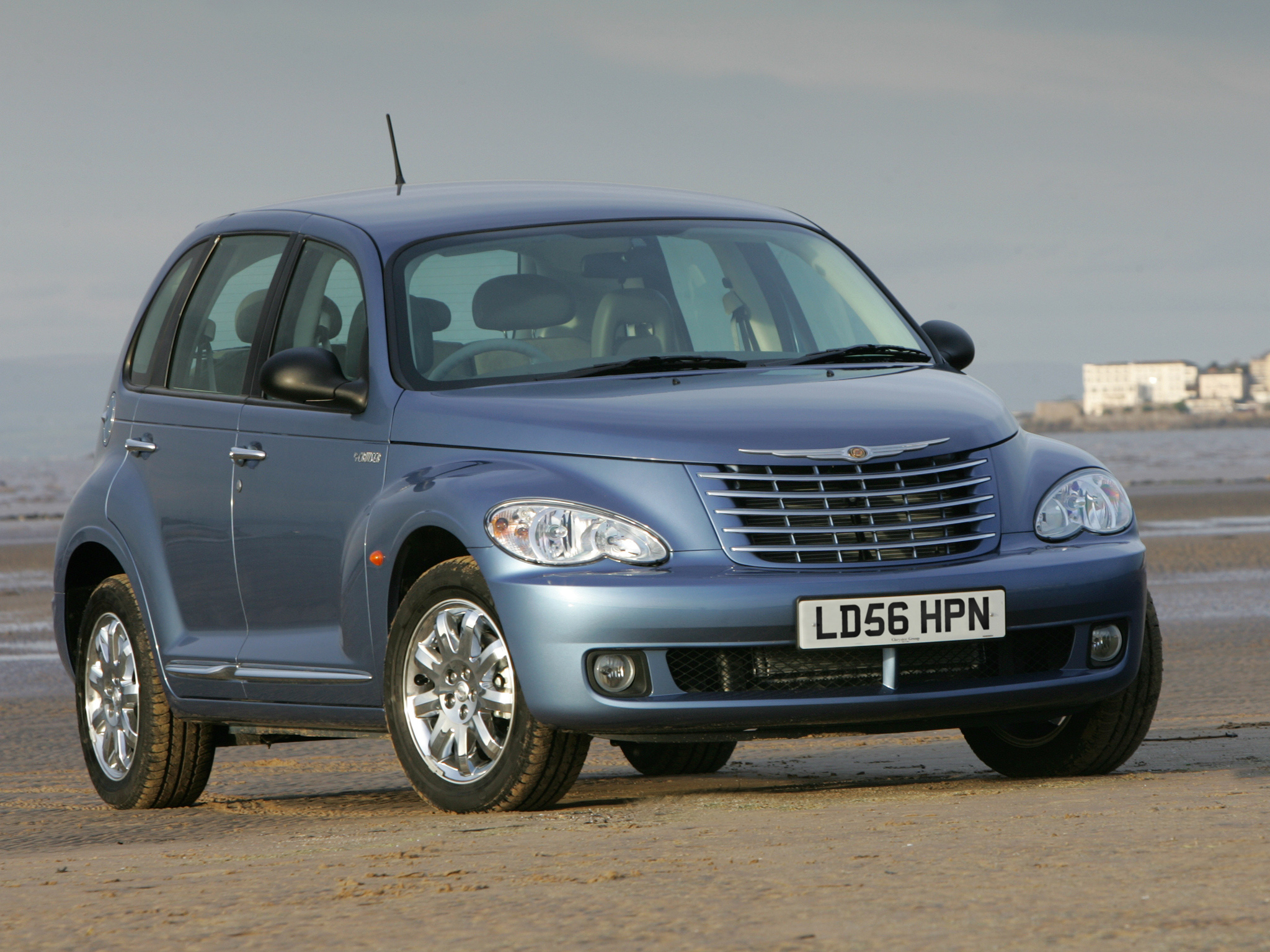
(2006 - 2010)
Select a powertrain to view full technical specifications
The Chrysler PT Cruiser represents one of the most remarkable and unique chapters in modern automotive history. Launched in the market in the year 2000, already as a 2001 model, the vehicle was not just another product launch, but rather an authentic creator of new segments, described by the manufacturer itself at the time as a model that broke the established paradigms of the industry. In a period when the global automotive market was beginning to migrate from traditional minivans to sport utility vehicles (SUVs), the PT Cruiser emerged as a bold bet. It combined the practicality and interior space of a compact minivan with a deeply nostalgic appearance, inspired by the classic station wagons derived from the Model A and the American delivery vans ("hot rods") of the 1930s and 1950s.
The initial market reception validated Chrysler's strategy immediately and very strongly. Public demand vastly exceeded the factory's production capacity in the early months. This generated waiting lists that reached almost a year, leading dealers to sell the model for amounts that, in some extreme cases, reached double the factory suggested price. This document details in a straightforward and exhaustive manner the complete trajectory of the Chrysler PT Cruiser, covering its creation, detailed technical specifications, all versions and special series launched, the production history, and the specific characteristics of its commercialization and use in Brazil.
In the mid-1990s, Chrysler was going through a phase of great renewal driven by creative designs. The success of niche vehicles, such as the Dodge Viper sports car and the Plymouth Prowler, showed that there was a considerable audience willing to buy cars with great emotional appeal and distinctive visuals. At the same time, the company had launched the Dodge and Chrysler Neon, a compact car with a more traditional shape designed for the American and international markets.
The company's management noticed two different opportunities in the global market. In Europe, taller, practical vehicles with compact proportions, known as multi-purpose vehicles or MPVs (like the Renault Mégane Scénic), were gaining a lot of popularity among families. In the United States, Chrysler dominated sales with its large pickup trucks and SUVs, but this created a serious problem with the government: the need to improve the average fuel consumption of all vehicles sold by the brand to meet the requirements of fuel economy laws (known as CAFE).
The solution Chrysler found was to develop a vehicle that was small on the outside and used less fuel than a pickup truck, but that could be classified by American laws as a van or light utility vehicle. This brilliant strategy allowed the model to help lower the average consumption of the company's utility vehicle category. This gave Chrysler the legal leeway necessary to continue selling its larger, more profitable vehicles that consumed a lot of gasoline.
The origin of the PT Cruiser's design began with the 1997 Chrysler CCV concept, a project focused on low production costs that resembled the classic French car Citroën 2CV. However, the CCV was too basic and would hardly pass the crash tests required in the United States. The true basis for the PT Cruiser's look emerged with the Plymouth Pronto concept car, also from 1997. It already featured the high roof and a versatile interior, but the front end did not completely please critics and the American public.
It became clear that the idea of a tall and practical car was correct, but it required a more striking look to capture the consumer's attention. The task was handed to Bryan Nesbitt, a 27-year-old designer recently graduated from the Art Center College of Design in Pasadena. Nesbitt then created the Plymouth Pronto Cruizer concept (spelled with a "Z") in 1999. It was a three-door car with wide fenders, a curved roof, and lines inspired by the old Chrysler and DeSoto Airflow models, as well as classic American delivery vans.
The project for mass production was already well advanced when the company's management made a drastic decision: the historic Plymouth brand would be shut down. Originally planned to be the model that would save the Plymouth brand, the car had its emblems swapped and was officially born as the Chrysler PT Cruiser for the 2001 model year. The "PT" in its name is a direct reference to the platform on which it was built (Platform T) and also served as an abbreviation for "Personal Transportation". Due to the great success of this design, designer Bryan Nesbitt was later hired by the Chevrolet brand, where he designed the HHR model, a competing car with very similar visual ideas.
The Chrysler PT Cruiser was built using Chrysler's PT platform, a front-wheel-drive structure with a transversely mounted engine. This mechanical base had many similarities to the platform used by the compact Neon sedan. This structure gave the PT Cruiser driving dynamics very similar to those of a standard passenger car, which contrasted positively with its legal classification as a utility vehicle.
One of the model's greatest engineering innovations was the excellent utilization of its interior space. The design prioritized a fairly high roof (exactly 1,600 mm high) and seats mounted in a higher position than usual. This provided an upright driving position with a good view of the road, often compared to sitting in a conventional chair.
The trunk and rear cargo area offered a lot of flexibility. The inside of the trunk lid featured a shelf with various fixing levels, which could serve as a divider to separate groceries, or even be extended outside the car to serve as a small table. The rear seats were split and could be folded forward, tumbled against the front seats, or even completely removed from the car without the use of any tools. This characteristic transformed the car, increasing cargo space to a level comparable to that of small delivery vans.
The following table consolidates the main bodywork measurements and dimensions in the standard five-door versions:
| Physical Measurement | Dimension in Millimeters (mm) | Dimension in Inches (in) |
|---|---|---|
| Wheelbase | 2,616 mm | 103.0 in |
| Overall length | 4,288 mm to 4,290 mm | 168.8 in to 168.9 in |
| Width (without mirrors) | 1,704 mm to 1,748 mm | 67.1 in |
| Height (closed model) | 1,600 mm to 1,665 mm | 63.0 in |
| Height (convertible model) | 1,539 mm | 60.6 in |
| Front track | 1,481 mm | 58.3 in |
| Rear track | 1,478 mm | 58.2 in |
| Ground clearance | 140 mm | 5.5 in |
| Fuel tank capacity | 57 liters | 15.0 gallons |
| Curb weight (base) | 1,417 kg to 1,580 kg | 3,123 pounds |
It is important to note that the weight of the vehicle (which started at 1,417 kg and reached 1,580 kg depending on the version and equipment) was considered quite high for a compact-sized car. This weight factor would have a direct impact on fuel consumption and the performance of the non-turbocharged engine versions.
To meet all the requirements of the different markets around the world (United States, Europe, Asia, and Latin America), Chrysler had to install a wide variety of engines in the PT Cruiser over its ten-year history. The engines were grouped into the following main families:
The table below details all the technical specifications of the engines applied throughout the global production:
| Capacity | Engine Code | Configuration | Valves | Power | Torque | Bore x Stroke | Compression Ratio | Main Market |
|---|---|---|---|---|---|---|---|---|
| 1.6 Liters | EJD | 4 cylinders, Gasoline | 16v SOHC | 115 hp | ~157 Nm | N/A | N/A | Export (Europe, Russia, Spain, Greece) |
| 2.0 Liters | ECC | 4 cylinders, Gasoline | 16v DOHC | 140 hp | ~188 Nm | 87.5 mm x 83.0 mm | 9.6:1 | Initial Global Export (2000-2004) |
| 2.4 Liters (Naturally Aspirated) | EDZ | 4 cylinders, Gasoline | 16v DOHC | 143 to 150 hp at 5,100 rpm | 165 lb-ft at 4,000 rpm (224 Nm) | N/A | N/A | United States, Brazil, Americas (Standard) |
| 2.4 Liters (Low Pressure Turbo) | EDV | 4 cylinders, Turbo Gasoline | 16v DOHC | 180 hp | ~210 lb-ft (285 Nm) | N/A | N/A | USA, Optional on Limited and Dream versions |
| 2.4 Liters (High Pressure Turbo) | EDT (H.O.) | 4 cylinders, Turbo Gasoline | 16v DOHC | 215 to 230 hp at 5,000 rpm | 245 lb-ft (332 Nm) | N/A | N/A | Only for the GT performance version |
| 2.2 Liters (Turbodiesel) | OM646 CRD | 4 cylinders, Diesel | 16v DOHC | 121 hp | ~300 Nm | 88.0 mm x 88.3 mm | 18.0:1 | Exclusive to the European market |
Note on the Diesel engine: The 2.2 Turbodiesel engine was not developed by Chrysler. Taking advantage of the union of companies at the time (DaimlerChrysler), the model used an engine straight off the shelves of Mercedes-Benz, the same one that equipped the German brand's luxury cars such as the C and E classes. This engine was never offered in the United States market.
The transmission gearboxes also varied greatly. The models with the simplest engines used a 5-speed manual gearbox or the optional 4-speed automatic transmission called Ultradrive (40TE and 41TE versions). In the GT versions, which had the high-power turbo engine, Chrysler used a reinforced manual gearbox made by the Getrag company (model 288) to handle the extra force of the engine. Optionally, these powerful versions offered the AutoStick automatic transmission, which allowed the driver to change gears manually by pushing the lever.
Generally, a car model gets a new generation every five or six years. However, Chrysler decided to keep the PT Cruiser in the same generation for its entire ten years of production, choosing to make only one major visual and technological update midway through its life.
The car hit stores in the spring of 2000 in the United States as a 2001 model. In the first year of sales in North America, dealers delivered 106,829 units, an excellent number that grew to a peak of over 160,000 sales the following year. At first, all cars in the United States used the non-turbo 2.4-liter engine.
In the fall of 2002 (already as the 2003 lineup), Chrysler solved the car's main problem: the lack of speed. The company launched the PT Cruiser GT model. Taking advantage of the high-performance parts from the Dodge Neon SRT-4 sports car, the brand installed a Mitsubishi turbocharger on the 2.4 engine, making the horsepower jump from 150 to up to 215 horsepower in the early years (and then to 230 horsepower in subsequent years). The GT version also received much stronger brakes, sports suspension, and larger 17-inch wheels to keep the car stable at high speeds. This fast model never had a right-hand-drive version, as the turbine occupied the space where the steering system would go for markets like England and Japan.
Also during this phase, in 2004, the factory ended the use of the 2.0-liter engine for the global market, leaving the 2.4-liter engine as the standard in most countries to simplify production, maintaining only the small 1.6-liter engine in countries with very high taxes on large engines.
For the 2006 model year, the PT Cruiser underwent its deepest update. On the outside, the designers were careful not to ruin the retro lines. They added new bumpers, headlights with scalloped lower edges, round fog lights, and a larger Chrysler logo on the front grille.
The biggest changes occurred on the inside. The original dashboard was discarded and replaced with a model featuring larger, easier-to-read dials. The air vents, which were previously spherical, became flush with the dashboard, and a classic analog clock with the Chrysler brand was added in the center. The radio was placed higher up to be closer to the driver's hands. The glove compartment door got larger and gained a smoother opening system.
The real improvement couldn't be seen, but rather heard. The engineers added a huge amount of acoustic insulation material on the wall behind the dashboard, sealing foam inside the side door pillars (A-pillar), and new weatherstripping on the windows. Thanks to these mechanical changes and adjustments to the air conditioning system, the cabin of the 2006 PT Cruiser became up to five decibels quieter than previous years, resolving many customer complaints about wind and engine noise.
In response to rumors in the automotive press at the time and requests from customers, Chrysler developed a roofless version of the PT Cruiser, called Cabrio or Convertible, which went on sale in 2004 as a 2005 model. Transforming a car with a high roof into a convertible is dangerous for the chassis's strength. To solve this without ruining the look, Chrysler installed a very thick and prominent structural bar between the front seats and the back seats. This part worked both to tie the sides of the car together and make it rigid, and to prevent the wind from bothering the rear passengers when the soft top was open.
The convertible had a short lifespan. The factory stopped producing it at the end of 2007, with the units sold in 2008 being the last to leave the dealerships in this configuration.
In its last two years of life, the PT Cruiser suffered a massive reduction in its factory options. In 2009, with the elimination of the convertible version, only the closed four-door model with a roof remained. The high-power GT sports version (230 horsepower) was also eliminated. Buyers were left to choose between three basic trim levels and two options for the 2.4 engine: the normal non-turbo version and the low-pressure turbo version (180 horsepower). The market was already demanding more modern cars, and with the severe financial crisis of the automaker that culminated in its union with the Italian Fiat, the retro look of the PT Cruiser no longer fit into the new brand's future, leading to the final decision to completely shut down production.
In global markets and especially in the United States market, the assembly line delivered the PT Cruiser in basic configurations before applying the special packages. The following table straightforwardly explains the regular trim levels and what they offered:
| Trim Level | Description and Main Standard Equipment |
|---|---|
| Base (LX after 2008) | Entry-level version, the most economical. It came with basic factory equipment, steel wheels with hubcaps, simple fabric seats. Available with a manual transmission and limited extra comfort options. |
| Touring | The intermediate and best-selling model. It included significant improvements in seat upholstery, a higher-quality stereo system, more interior courtesy lights, and factory aluminum alloy wheels. |
| Limited | The top-tier version focused on luxury. It came standard with seats covered in a mix of leather and suede, plus a heating system in the front seats. The driver's seat gained power adjustments. On the outside, larger diamond-cut or chrome wheels and various chrome pieces scattered across the bodywork gave it a shiny look. |
| GT (2003 - 2008) | A version totally focused on high speed and sportiness. It offered much stronger brakes (4-wheel disc), firmer suspension, and the exclusive turbo engine with over 215 horsepower. |
| Classic | A name widely used in Europe, and also introduced in the US at the end of production. It was a mix: it took expensive items from the Touring and Limited versions and sold them at a lower price to attract buyers in the final stretch of the car's life. |
The PT Cruiser generated immense profit margins for the automaker in its early years. To keep sales active as the car grew older, the company launched dozens of limited editions and collector's visual packages, detailed below:
To further enhance the nostalgic vibe, Chrysler launched the "Woodie" visual package, which was available between 2002 and 2004. The name refers to the classic station wagons of the 40s and 50s that had real wood panels on the doors. On the PT Cruiser, this was done by applying large vinyl decals to the four doors, the rear quarter panels, and the trunk lid. The decals imitated dark oak wood with borders that imitated a light wood (Light Ash).
Prior to this, in the year 2000, a concept car called the "Panel Cruiser" was shown at auto shows. This car was intended to be a classic-style commercial delivery van, with the rear window area covered by smooth metal and the floor lined with real wood flooring and metal strips for dragging cargo. This very unique utility vehicle was never sold commercially to the public.
This was the most famous series of limited versions, officially numbered by the factory year after year. The main rule was that all these versions came with an automatic transmission, except when specifically requested otherwise:
| Dream Cruiser Series | Year | Exclusive Specifications and Colors |
|---|---|---|
| Series 1 | 2002 | The car's first commemorative version, sold exclusively with a special metallic Gold paint job and its own emblems. |
| Series 2 | 2003 | The paint changed to a vivid Orange hue. This was the first commemorative version to receive the high-power GT Turbo engine under the hood. |
| Series 3 | 2004 | One of the most beautiful versions, it introduced two-tone paint (silver roof and hood, dark blue sides). It also used the fast engine from the GT Turbo version. |
| Series 4 | 2004 | The rarest edition of the Dream line. It was the only one made in the convertible body, painted in a deep red, and with the extremely rare combination of the GT Turbo engine and a manual transmission option. |
| Series 5 | 2009 | It returned to the closed models in the car's final years. The entire body was white, while the roof and rear spoiler received a strong black color for contrast. It was available with the non-turbo engines or with the weaker 180 horsepower turbo. |
While the Dream Cruisers focused on different equipment and colors each year, the Street Cruisers paid homage to famous places where United States car culture grew:
| Street Cruiser Edition | Year | Specifications and Visual Details |
|---|---|---|
| Route 66 Edition | 2006 | An homage to the most famous highway in the US. The car was painted in "Solar Yellow" (with a few rare black units outside the US). The front grille and even the brake calipers were painted factory yellow. It came with extra solar-tinted glass, exclusive wheels, and an instrument panel in the same yellow as the outside. It cost around 19 thousand dollars in stores. |
| Pacific Coast Highway | 2007 | Its name referred to the famous coastal highway in California. It was painted in an elegant Ocean Blue tone. Chrysler forced this version to come from the factory with expensive safety items, such as electronic traction control and 4-wheel disc brakes. It also had shiny platinum 17-inch wheels. |
| Sunset Boulevard | 2008 | A version launched in limited quantities, whose main visual characteristic was the strong reddish color combined with bright finishes and an extra items package. |
In addition to these main families, the model received other commemorative series. In 2005, the Walter P. Chrysler Signature Series was launched, which honored the company's creator and came loaded with luxury accessories and unique logos. In 2004, the Platinum Edition brought chrome parts and wheels in abundance, obligatorily paired with the 180 horsepower turbo engine. And as the lights were going out, in 2010, the elegant Couture Edition was launched, which mixed black on top and silver on the bottom, separated by a very thin painted red line, and special leather seats, in a final effort to maintain public attention before production ended. Outside the United States, there were models like the Electric Limited Edition in Europe, limited to the 2.0L engine with a manual transmission, and even the PT Touring Jukebox (2009–2010) focused on the radio and connectivity market combined with the diesel engine.
The commercial positioning of the PT Cruiser in Brazil was completely different from that applied in the United States. Abroad, it was born with the promise of being a practical, creative car, and above all, cheap for the average family and easy to maintain ("affordable"). When Chrysler began its imports to Brazil in the early 2000s, the model suffered the impact of heavy import taxes and the exchange rate of the time. The solution of the automaker's Brazilian branch was to treat the PT Cruiser not as a cheap utility vehicle, but rather as an imported car of image and status, aimed at upper-class people who wanted to stand out in urban traffic.
Due to its more luxurious positioning in Brazil, the car came equipped from the factory with everything that was charged as an expensive option in the US. The units sold here came standard with multiple airbags, modern ABS braking technology, an electronic stability system, natural and electrically adjustable leather upholstery with heating, in addition to the large aluminum wheels.
Almost the entire batch imported here was equipped with a single engine: the 2.4-liter naturally aspirated sixteen-valve four-cylinder. In the calibration sent to our country, it delivered about 143 horsepower and 21.8 kgfm of torque. This engine was obligatorily coupled to the four-speed Autostick automatic transmission, focused more on the comfort of not having jolts than on offering high speeds. The strongest version with a turbo engine (GT Turbo with over 215 horsepower) was officially brought in minuscule quantities, making it a disputed rarity among those who buy modern used cars in the country today.
In 2008, at the peak of the lineup's maturity, the official price table showed the car's distance from ordinary buyers. The entry-level version ("Classic"), which was modernized that year gaining a trip computer, cost R$ 68,900. If the customer wanted the luxury convertible version ("Cabrio"), the price skyrocketed to an extortionate R$ 94,900 at dealerships.
The exclusivity of the convertible body is demonstrated by the sales numbers in the model's entire history here: Brazil registered only 7,600 units with the retractable canvas roof, ensuring its position as a rare object.
In its final market year, 2010, Chrysler brought the Decade Edition to Brazil. It was the farewell gift that celebrated the 10th anniversary of its global launch. It cost R$ 69,900, only an R$ 4,000 difference margin over the "Limited" model at the time. For the extra value, the owner got fog lights and anti-fog mirrors, as well as commemorative chrome plaques reading "Decade Edition 2000 – 2010" attached to the rear. The most interesting part for the vehicle owner was that they received a physical certificate attesting to the authenticity and numbering of that final manufacturing run.
The perception of Brazilian owners, cataloged in clubs, repair shops, and portals, is divided. On the positive side, it is considered today a car with excellent "cost-benefit" in the used market. This is due to the high comfort and design that does not look so old, associated with the fact that cheap and compatible replacement parts can be easily imported online (from sites like eBay or Mercado Livre) straight from manufacturers in the US, as they are from the same stock as the old Dodge Neon sedan.
The biggest technical dissatisfaction documented by Brazilian owners refers relentlessly to the high gasoline consumption. The PT Cruiser was heavy for its time (the document registers almost 1,580 kg in the Brazilian versions), had a high roof (with terrible frontal wind aerodynamics), and an engine that worked with few automatic gears and dragged out long shifts. As a final result of the project, data and tests in Brazil reveal dismal averages of only 7.2 kilometers per liter driving in city traffic, and a maximum of 12 kilometers per liter traveling smoothly on the highway. Consequently, the starting power was highly impaired by the large weight of steel, with the acceleration from zero to 100 kilometers per hour taking a long 10.3 to a terrible 13.5 seconds, depending on the market configurations.
Due to the long time that this same model was on the streets, with the same platform running for over ten years, mechanic shops all over the world managed to identify what the basic design errors were and which parts suffered from great premature wear on the Chrysler PT Cruiser's platform. Although the engine block itself withstands high mileage without blowing up, the accessories around it suffer. Mechanics record ten repetitive systematic problems that the vehicle owner will invariably have to face:
The following detailed technical list of serious problems affects the daily performance of the vehicle:
The process of creating the PT Cruiser was spread across more than one facility, focused especially on a mega-factory. Almost the entirety of this vehicle's industrial history took place on Mexican soil, at the company's gigantic plant located in the city of Toluca, State of Mexico (called Toluca Car Assembly). However, in the first year, the car fever in Europe was so great that the company had to temporarily assemble the models for the region at the parallel Eurostar Automobilwerk production facility, operating in Graz, in the Austrian countryside.
Market history proves how products strictly dictated by a unique design style are victims of a lack of novelty, experiencing absurd peaks at the beginning of sales, followed by decadence year after year. The undisputed pinnacle of the entire sales process occurred in 2001, a period in which data confirms staggering sales peaking at 144,717 up to sums of 160,382 units just in the Americas network.
The absence of chassis updates, engine technology, or radical visual changes for a long five or six years violently hurt acceptance. The North American public and the global market began buying the PT Cruiser in descending volumes after the natural closure of the retro style fad windows. The following table details precisely the decline in Chrysler's commercial registrations, adding up the numbers reported in the large US market from its days of strength to the final store liquidations in its final year:
| Period Report | Computed Commercial Sales Volume |
|---|---|
| 2005 Commercial Year | 132,159 Cars Delivered |
| 2006 Commercial Year | 138,650 Cars Delivered (Growth generated by the renovation and new internal acoustics) |
| 2007 Commercial Year | 99,585 Cars Delivered (The first major drop below 100 thousand units) |
| 2008 Commercial Year | 50,910 Cars Delivered Exact 2008 Quarters: Q1: 15,604 / Q2: 17,226 |
| 2009 Commercial Year | 17,941 Cars Delivered (Beginning of the crisis and partial bankruptcy of the global
corporation) Exact 2009 Quarters: Q1: 4,798 / Q2: 3,793 |
| 2010 Commercial Year | 9,440 Cars Delivered (Definitive shutdown of factory machines in the middle of the
year) Exact 2010 Quarters: Q1: 2,066 / Q2: 2,851 |
| 2011 Commercial Year | 1,328 Cars Delivered (Only clearing out the last dead stock cars from dealerships in the country) |
Even with extremely low sales numbers free-falling in the final stretch, the company's senior management resisted ending the project. As the car's platform had already been financially paid off for many years, a lot of profit was made on the few sheet metal and iron parts that made up the last models, which store owners were already offering for low cash values to clear the lot. When the year 2010 arrived to mark the end and the final countdown at the factory, the numbers for this entire industrial odyssey proved unequivocally expressive: more than 1.35 million units of the Cruiser had hit the streets globally.
On the factory's official closing day (in the month of July on a rainy Friday), the final gates of the Toluca company saw the curtains close as the car rolled off the conveyor belt. The final vehicle recorded in the books was delivered with the factory paint completely in a solid, thick color identified in the American catalog as "Stone White". The metal line of the Toluca plant would be drastically and quickly demolished and adapted to new irons; the structure began working on a direct replacement in the classic modified style car segment, which was the also famous and newly arrived subcompact 2011 Fiat 500.
The Chrysler PT Cruiser needs to be understood and studied by automakers of the future not just as another vehicle, but rather as one of the most absolute marketing cases ever charted from the beginning of the end of the modern pure high-volume petroleum age, about what happens to the automobile company when design joins with the loosening of regulations. If in the corporate financial plan it solved a giant legal problem using government fleet loopholes regarding CAFE line utility vehicles and vans, on the streets the product overcame massive traffic jams through the strong visual mental affection for the era of "hot rods".
Bryan Nesbitt, the American executive directors commanded by the mother company under a giant arm, and a history of iconic industry characters, masterfully unraveled the desires of the average buyer, and profited millions by injecting blood into a cheap product based on the mechanical leftovers that ran the classic Neon model line. It is indisputable that, on the modern global automaker's bottom line, the creative courage seen on the clay tables in 1999 paid all the financial debts of the parts factory until the definitive turning of times in the merger with its final European partner.
Images of the Chrysler PT Cruiser