Citroen DS4

Citroen DS4

Technical specifications, versions, and history for the Citroen DS4.

Citroen DS4 Generations

Select a generation to see available versions

Citroen DS4 G1

1st Generation

(2011 - 2015)

1.6 L4 16V THP 200 cv

Technical Data and History: Citroen DS4

The Philosophy and Introduction of the DS Line

The Citroën DS4 represents one of the most significant milestones in the French automotive industry's attempt to reconquer the luxury and distinction segment at the beginning of the second decade of the 21st century. Positioned as the second model of the DS (Different Distinction) line, the DS4 was conceived to be more than just a variant of the Citroën C4; it was designed as a "hybrid" vehicle in concept, blending the silhouette of a coupe, the practicality of a hatchback, and the elevated stance of a crossover. This report exhaustively details the phase in which the model was marketed under the Citroën brand, covering everything from its conceptual development to the transition to the independent DS Automobiles brand in 2015.

Historical Context and the Philosophy of the DS Line

The DS lineage was reintroduced by Citroën in 2009 with the DS3, seeking to capitalize on the legacy of innovation and style of the original 1955 DS, designed by Flaminio Bertoni and Andre Lefebvre. While the DS3 targeted the premium compact segment, the DS4 was directed at the competitive C-segment, aiming to take on established rivals such as the Audi A3, the BMW 1 Series, and the Mercedes-Benz A-Class.

Citroën's strategy for the DS4 was based on the concept of "Avant-garde" and "Creative Technology". The goal was to offer a product that did not conform to traditional market segments. Market analysis at the time suggested that consumers were migrating from conventional hatchbacks to SUVs and crossovers, and the DS4 attempted to capture this interest through an elevated suspension and robust aesthetics, while maintaining the agility of a passenger car.

The Predecessor Concept: DS High Rider

Prior to the launch of the production version, Citroën presented the DS High Rider prototype at the 2010 Geneva Motor Show. This concept served as the aesthetic and technological basis for the DS4. At 4.26 meters long, 1.82 meters wide, and 1.48 meters high, the High Rider was a three-door coupe with a muscular stance and 19-inch wheels.

A central innovation of the High Rider was the introduction of PSA's diesel "Full Hybrid" platform, which used an HDi engine on the front axle and an electric motor on the rear axle to provide four-wheel drive and the ability to operate in zero-emission (ZEV) mode. Although the initial production DS4 did not immediately adopt this hybrid all-wheel-drive configuration, the visual elements — such as the panoramic windshield and the high beltline — were fully preserved.

Design and Architecture of the Production Model

The Citroën DS4 was officially launched in late 2010, with international sales beginning in March 2011. The design, led by Olivier Vincent, was widely acclaimed by critics, being voted the "Most Beautiful Car of the Year" at the International Automobile Festival and receiving design awards from the German magazine Auto Bild.

Dimensions and Bodywork

The DS4 utilized the PSA Group's PF2 platform, shared with the second-generation Citroën C4, but with significant modifications to the suspension and structural rigidity to support the premium proposition.

Characteristic Technical Specification Source
Length 4275 mm
Width 1810 mm
Height 1523 mm to 1535 mm
Wheelbase 2612 mm
Ground Clearance 172 mm to 195 mm
Weight (minimum) 1280 kg
Aerodynamic Drag Coefficient (Cd) 0.28

Aesthetic Innovations and Design Contradictions

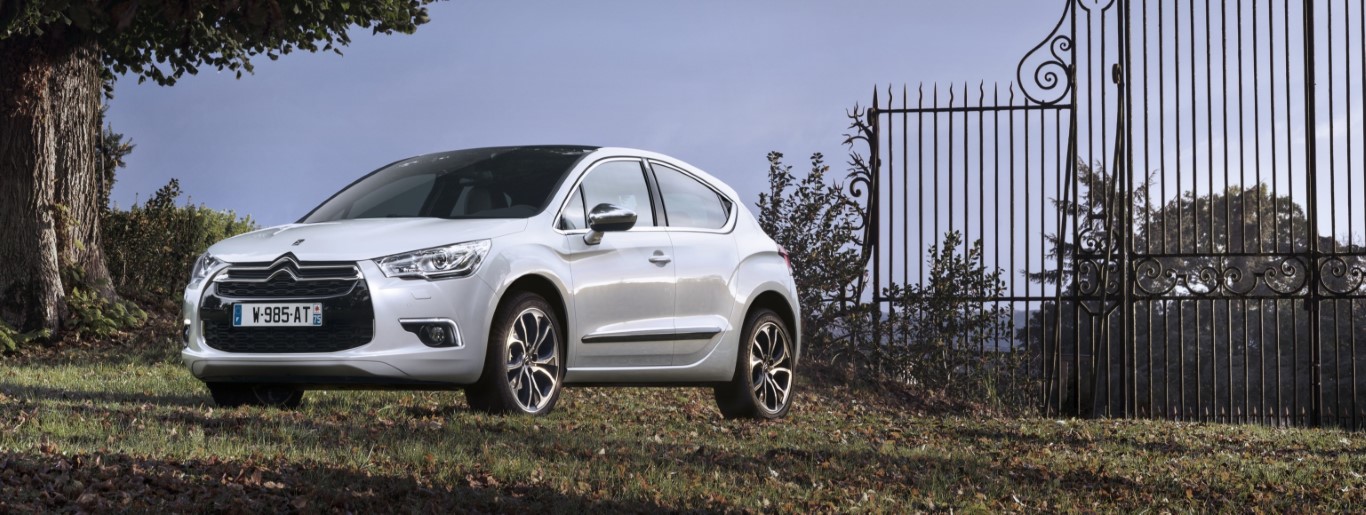
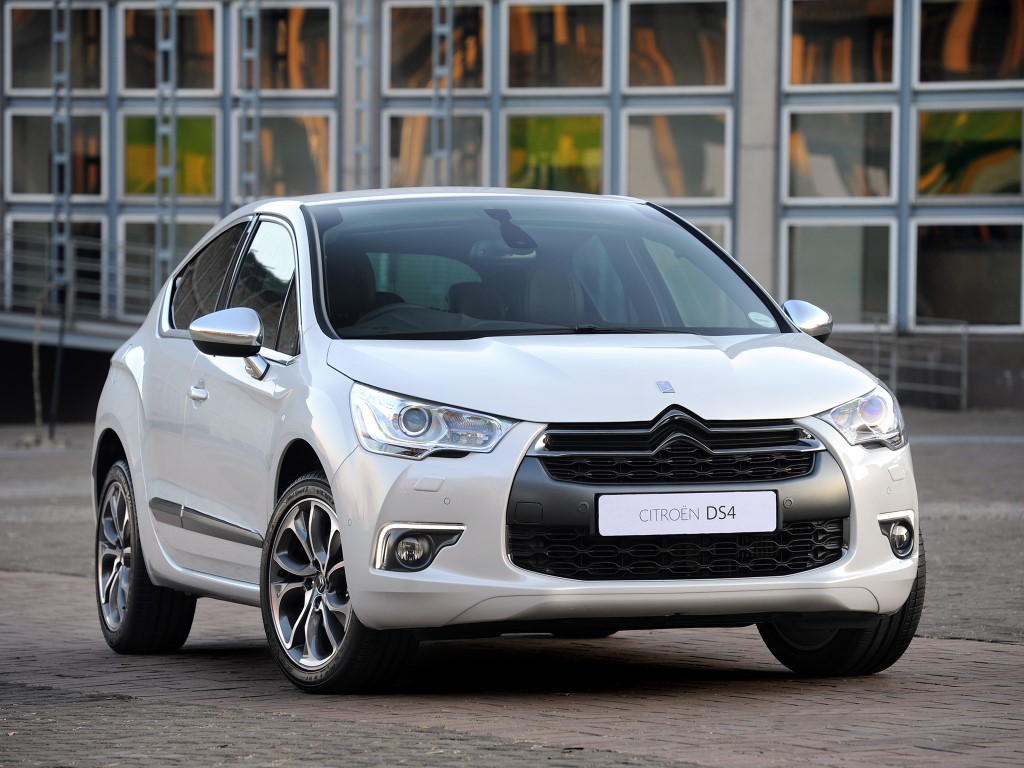
The DS4's bodywork featured design solutions that sought the illusion of a coupe. The rear door handles were camouflaged in the window frame (C-pillar), resulting in a continuous and fluid side profile. However, this aesthetic choice imposed a severe functional limitation: the rear door windows were fixed and could not be opened or rolled down.

The front of the vehicle was marked by a prominent grille with the "Double Chevron" emblem integrated into chrome trim, flanked by directional xenon headlights and boomerang-shaped LED daytime running lights (DRL). The panoramic windshield was another differentiating feature, extending over the heads of the front occupants and offering a vertical viewing angle of 45 degrees, accompanied by individual rigid sunblinds for sun protection.

Interior: Refinement and Premium Customization

The DS4's cabin was designed to exude French luxury, utilizing high-quality materials and manual finishing techniques. Citroën sought inspiration in haute couture and watchmaking for the internal details.

Finish and Materials

One of the signatures of the DS line was the semi-aniline leather seat upholstery with the "watchstrap" pattern, which required a complex and handcrafted sewing process. The instrument panel, in top-of-the-line versions, received a Nappa leather covering with hand-adjusted stitching, a process that demanded up to 15 hours of work for each unit.

Cabin Technology and Ambience

Citroën introduced the concept of sensory customization in the DS4. The driver could adjust the color of the instrument panel lighting on a scale ranging from white to deep blue. Furthermore, the sound alert system was polyphonic, allowing the choice between four distinct themes:

  • Classic: Traditional warning sounds.
  • Crystal Symphony: Sharper and more crystalline tones.
  • Jungle Fantasy: Sounds inspired by natural elements.
  • Urban Rythmik: Electronic and modern beats.

In terms of comfort, the model offered front seats with massage function and electric lumbar adjustment, as well as a Denon brand Hi-Fi sound system with a trunk-mounted subwoofer in selected versions.

Powertrain Evolution (2010-2015)

The Citroën DS4 was launched with a range of Euro 5 engines, largely developed through the partnership between PSA and the BMW Group. Over the years, the powertrains were updated to the Euro 6 standard, introducing the PureTech (gasoline) and BlueHDi (diesel) families.

Gasoline Engines (Otto Cycle)

Engine Type Displacement Maximum Power Maximum Torque Period
1.6 VTi 120 Naturally Aspirated 1598 cm³ 120 hp at 6000 rpm 160 Nm at 4250 rpm 2011-2014
1.2 PureTech 130 Turbo 1199 cm³ 131 hp at 5500 rpm 230 Nm at 1750 rpm 2014-2015
1.6 THP 155 Turbo 1598 cm³ 156 hp at 6000 rpm 240 Nm at 1400 rpm 2011-2013
1.6 THP 160 Turbo 1598 cm³ 163 hp at 6000 rpm 240 Nm at 1400 rpm 2012-2015
1.6 THP 165 Turbo 1598 cm³ 165 hp at 6000 rpm 240 Nm at 1400 rpm 2012-2015
1.6 THP 200 Turbo 1598 cm³ 200 hp at 5800 rpm 275 Nm at 1700 rpm 2011-2015

The 1.6 THP 200 engine was the high-performance version, allowing an acceleration from 0 to 100 km/h in 7.9 seconds and a top speed of 235 km/h. The 1.2 PureTech 130 engine, introduced in November 2014, replaced the 1.6 VTi, offering a 19% reduction in fuel consumption and a significant increase in low-end torque.

Diesel Engines (Diesel Cycle)

Engine Type Displacement Maximum Power Maximum Torque Period
1.6 HDi 90 Turbo 1560 cm³ 92 hp at 4000 rpm 230 Nm at 1750 rpm 2011-2015
1.6 HDi 110 Turbo 1560 cm³ 112 hp at 3600 rpm 270 Nm at 1750 rpm 2011-2013
1.6 e-HDi 115 Micro-hybrid 1560 cm³ 115 hp at 3600 rpm 270 Nm at 1750 rpm 2012-2015
1.6 BlueHDi 120 Turbo 1560 cm³ 120 hp at 3500 rpm 300 Nm at 1750 rpm 2014-2015
2.0 HDi 160 Turbo 1997 cm³ 163 hp at 3750 rpm 340 Nm at 2000 rpm 2011-2015

The e-HDi technology featured a second-generation Start&Stop system with a reversible alternator, capable of restarting the engine in 0.4 seconds. The BlueHDi engines, launched at the end of the Citroën phase, introduced SCR treatment to reduce nitrogen oxide emissions.

Transmission Systems and Driving Dynamics

Citroën offered four main types of transmissions for the DS4, reflecting the technological transition of the period:

  • Manual (5 or 6 speeds): Conventional transmissions with a dry clutch.
  • EGS6 / ETG6 (Electronic Gearbox System): Single-clutch automated manual transmissions. Although fuel-efficient, they were criticized for a lack of smoothness in shifts, requiring the driver to ease off the accelerator during changes.
  • Conventional Automatic (6 speeds - EAT6): Introduced to gradually replace the automated gearbox in higher-output engines, this torque converter gearbox provided much more linear and smoother shifts.

The DS4's chassis was tuned to be firmer than that of the standard C4, aiming to provide a more "sporty" and controlled drivability, despite the higher ground clearance. The front suspension used a MacPherson strut system and the rear featured a torsion beam axle.

The Citroën DS4 in the Brazilian Market

The official launch in Brazil occurred on February 25, 2013, positioning the model between the DS3 and the DS5. In the local context, the DS4 was imported with a specific mechanical configuration to meet the performance expectations of the Brazilian premium market.

Configuration and Price

Item Specification (Brazil) Source
Engine 1.6 THP (Gasoline)
Power 165 hp at 6000 rpm
Torque 24.5 kgfm at 1400 rpm
Transmission 6-speed Sequential Automatic
0-100 km/h Acceleration 8.6 seconds
Top Speed 212 km/h
Launch Price R$ 99,990.00

In Brazil, the model came standard with self-directional bi-xenon headlights, blind spot sensors, six airbags, electronic stability program (ESP), leather seats with massagers, and the panoramic windshield. The available colors were Gris Shark (silver), Noir Perla Negra (black), Blanc Nacré (white), and Rouge Babylon (red).

Special Editions and Factory Customization

To maintain the exclusivity of the line, Citroën launched several limited editions during the 2011-2015 period.

  • Just Mat (2012): Limited to 500 units in Europe, it offered seven matte paint finishes, 19-inch black wheels, and a full brown leather interior (Havana).
  • Pure Pearl (2012): Luxurious version with pearlescent white paint, glossy chrome details, and blue leather upholstery with contrasting stitching.
  • Faubourg Addict (2013): An edition that celebrated "Parisian luxury", with the exclusive Whisper color (black with purple reflections) and a roof decorated with the laser-engraved DS monogram.
  • Opera Blue (2014): Introduced new chromatic combinations and updates to the infotainment system prior to the brand transition.
Global Production and Sales Data

The manufacturing of the Citroën DS4 took place primarily at the Mulhouse plant in France. The production data reflect the initial positive impact and the gradual stabilization of the model in the premium market.

Year World Production (Units) World Sales (Units) Source
2010 300 200
2011 34,593 29,477
2012 30,700 33,157
2013 - 29,802
2014 - 21,643
2015 - 18,825

By the end of its phase as a Citroën, the DS4 had sold over 115,000 units globally. In Europe, the largest sales volume was concentrated in France, Germany, the United Kingdom, and Spain.

Safety and Certifications

The Citroën DS4 was subjected to Euro NCAP tests in 2011, achieving the maximum 5-star rating.

Test Category Score
Adult Occupant 90%
Child Occupant 80%
Pedestrian 43%
Safety Assist 97%

The model was praised for the inclusion of technologies such as "eTouch", an assistance system that allowed automatic emergency calls and remote monitoring of the vehicle's technical status.

Year-by-Year Evolutions (Timeline)
  • 2010: Unveiling of the DS High Rider concept and start of production of the first pre-series units of the DS4.
  • 2011: Official commercial launch in Europe with Euro 5 engines (VTi 120, THP 155, THP 200, HDi 110, HDi 160).
  • 2012: Introduction of the THP 160 variant with a conventional automatic gearbox and presentation of the "DS4 Racing" concept.
  • 2013: Launch in Brazil and Argentina. Minor updates to the multimedia center (eMyWay system).
  • 2014: Profound update of the engine range to Euro 6. Introduction of the 1.2 PureTech 130 and 1.6 BlueHDi 120 engines. Launch of two-tone roof options (color customization separate from the bodywork).
  • 2015: Announcement of the separation of the DS brand. The model receives its last update as a Citroën before losing the original brand's logos in August 2015.
Transition to the DS Automobiles Brand

In mid-2015, the PSA group decided that the DS line had enough strength to become an independent luxury brand. The DS4's transition process involved a facelift that removed the front grille with the Citroën chevron, replacing it with the "DS Wings" grille.

In this final phase of 2015, the model also gained the "Crossback" version, which visually reinforced the crossover aspect with black plastic moldings on the wheel arches and an even higher suspension. Although the car continued in production until 2018 under the new brand, the era in which it was recognized as a "Citroën" technically ended in August 2015.

Final Considerations

The Citroën DS4 (2010-2015) was a bold exercise in design and engineering. It personified Citroën's transition from a volume manufacturer to a competitor in the premium market. Despite criticisms regarding practicality — especially the issue of the fixed rear windows — the model established new internal finishing standards for French vehicles and proved that there was a demand for aesthetic alternatives to traditional German hatchbacks. The diversity of powertrains and constant technological evolution during these five years were fundamental to consolidating the DS name before its full emancipation.

Technical data based on: • Official manufacturer catalogs • EPA / WLTP documentation when available • Official press releases

Editorial content produced by Gabriel Carvalho. | Última revisão: Dezembro/2025.