
1st Generation
(2022-)
3.0 V6 Twin-turbo Phev
830 cv
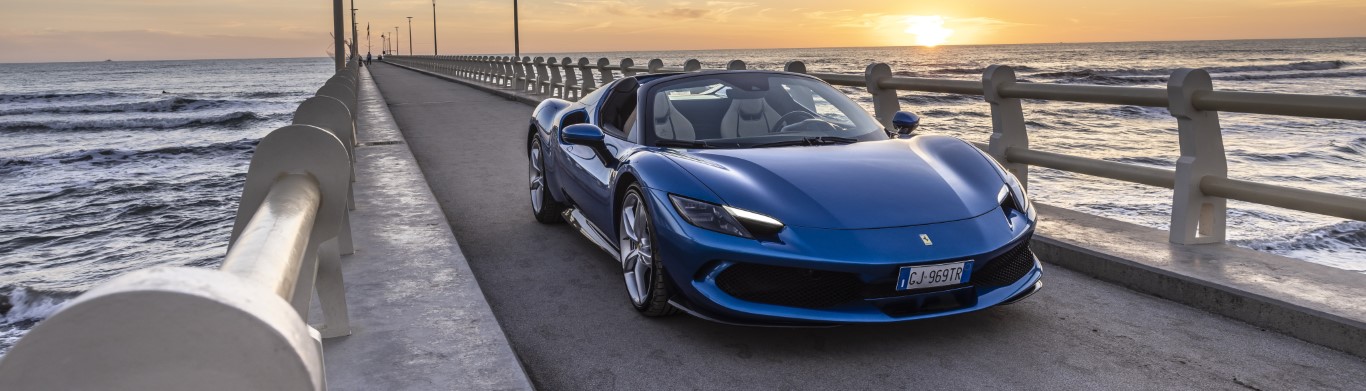
Electrifying open-air symphony: the hybrid roadster blending cutting-edge tech with the absolute freedom of the horizon.
Select a generation to see available versions
(2022-)
The Ferrari 296 GTB represents a transformative milestone in the history of the Italian manufacturer, being described as an authentic "revolution" for the house of Maranello. Launched in 2021, this two-seater berlinetta with a mid-rear engine reintroduced a 6-cylinder engine in a Ferrari road car after nearly 50 years, but in a radically new way: coupled with a plug-in hybrid system (PHEV). The core philosophy of the project, encapsulated in the motto "Defining Fun to Drive," establishes that the car was designed to deliver pure emotions not only in pursuit of maximum performance on a circuit, but also in daily driving.
Although the V6 powertrain is a novelty for the brand's modern road cars, it has a rich lineage in Ferrari's racing history. The first model of the brand to use a mid-rear V6 was the 246 SP in 1961, which won the famous Targa Florio race that year and in 1962. In the same year, Ferrari won its first constructors' title in Formula 1 with the 156 F1, also equipped with a 120-degree V6 engine.
The decision to adopt a hybrid V6 in the 296 goes beyond a simple response to growing regulatory pressures for electrification. It represents a strategic redefinition of what an entry-level Ferrari supercar is. By replacing the V8 of its predecessor, the F8 Tributo, the brand did not just change the engine, but the very identity of its main berlinetta. The obsessive emphasis on "driving fun" indicates that the goal was not just environmental compliance, but to enhance the driver's experience. By combining a smaller combustion engine with a powerful electric system, the engineers not only surpassed the power of the previous V8, but also virtually eliminated turbo lag, a common side effect in turbocharged engines. This demonstrates that Ferrari views hybridization not as a compromise, but as a tool to make performance more explosive, controllable, and, paradoxically, purer, by simulating the instant response of a naturally aspirated engine.
The powertrain of the Ferrari 296 is the centerpiece of its technological revolution, combining an innovative combustion engine with a state-of-the-art electrical system.
The combustion engine, internally coded F163, is a V6 with 2,992 cm³ of displacement and a 120-degree angle between the cylinder banks. This unusual architecture allows the two turbochargers to be housed inside the "V" of the engine, a configuration known as "hot-V". This solution offers multiple benefits: it improves thermal management, makes the assembly more compact and, crucially, lowers the car's center of gravity, improving driving dynamics. Alone, this engine generates an impressive 663 cv of power, achieving a record specific power for a production car of 221 cv per liter.
Complementing the V6 engine, there is an electric motor (MGU-K, or Motor Generator Unit - Kinetic) positioned between the combustion engine and the 8-speed dual-clutch transmission. This electric motor adds 167 cv (122 kW) to the system. Power is provided by a high-voltage lithium-ion battery with a capacity of 7.45 kWh, which allows the car a purely electric range of approximately 25 km.
Together, the two engines deliver a maximum combined power of 830 cv at 8,000 rpm and a torque of 740 Nm. During the development phase, the V6 engine earned the internal nickname of "piccolo V12" (little V12). This name is not just marketing; it is the result of a deliberate engineering goal. The shift from a V8 to a V6 could be perceived as a step backward in terms of prestige and, mainly, sound, a pillar of the Ferrari experience. To solve this emotional problem, the engineers designed the engine with a 120-degree angle and a symmetrical firing order, combined with an exhaust system that amplifies high-frequency harmonics, resulting in a sound reminiscent of a naturally aspirated V12 engine. This demonstrates that Ferrari can technologically manipulate the emotional attributes of its cars, ensuring that the transition to smaller engines does not dilute the brand's mystique.
The design of the 296 GTB redefines the identity of Ferrari's mid-rear engine berlinetta, with a compact, modern, and original line that hides immense technological complexity under an appearance of purity and elegance.
Led by Flavio Manzoni, the Ferrari Styling Centre sought a purity of forms, with clean lines and well-defined intersections that accentuate sportiness. The main inspiration came from cars of the 1960s, characterized by simplicity and functionality, with the 1963 Ferrari 250 LM being the clearest influence. Specific elements of the 250 LM were inherited, such as the vertical cut of the "B" pillar, the muscular rear fenders, and the truncated tail (known as a "Kamm tail"). The choice of the 250 LM was considered perfect due to its compact nature, similar to that of the 296. The motto that guided the design team was a quote from the sculptor Constantin Brâncuși: "simplicity is complexity resolved," reflecting the intention to create an elegant design that masks advanced engineering.
This design approach serves as a "psychological bridge" for the brand's purists. Faced with a technologically complex car, an overly futuristic design could alienate the traditional customer base. By invoking a pure and functional racing icon like the 250 LM, Ferrari anchors the 296 in its heritage, communicating that, despite cutting-edge technology, the soul of the car is still that of a classic Italian sports berlinetta.
The 296 GTB represents a reversal of Ferrari's active aerodynamic paradigm. In previous models, active devices were often used to reduce aerodynamic drag and increase top speed. In the 296, the active rear spoiler, integrated into the bodywork, is designed to do the opposite: generate additional downforce. Under normal conditions, it remains retracted, but in high-performance situations, such as hard cornering and braking, it extends to add up to 100 kg of downforce over the rear axle, improving control and stability.
The cockpit is driver-focused and built around the fully digital interface introduced in the SF90 Stradale. However, in the 296, the approach is more refined and elegant, seeking to integrate the technical content in a sophisticated way. A notable feature is the dedicated passenger display, which allows for greater participation in the driving experience, functioning almost like a co-pilot.
The combination of an agile chassis, contained weight, and advanced electronic systems allows the 296 GTB to translate its immense power into exceptional and controllable performance.
The chassis of the 296 has a wheelbase 50 mm shorter than previous Ferrari mid-rear engine berlinettas, which significantly improves its dynamic agility. The dry weight of the vehicle, when equipped with optional weight-reduction features, is 1,470 kg. This results in a weight-to-power ratio of 1.77 kg/cv, the best in its class. Weight distribution is optimized for a mid-engine car, with 40.5% at the front and 59.5% at the rear.
To manage performance, the 296 GTB debuts cutting-edge electronic systems. The "ABS evo" controller, integrated with a new 6-way chassis sensor (6w-CDS), is an absolute novelty. It allows for better exploration of the tires' grip limits, especially at the rear, ensuring shorter and more consistent braking, as well as improving performance upon entering corners. The car also features the eSSC (electronic Side Slip Control), a suite of systems that includes traction control (eTC) and an electronic differential (eDiff), which work together to make the car's power surprisingly accessible and fun.
| Characteristic | Specification (Ferrari 296 GTB) |
|---|---|
| Combustion Engine | V6 - 120° Twin-Turbo (F163) |
| Displacement | 2,992 cm3 |
| Power (Combustion) | 663 cv @ 8,000 rpm |
| Power (Electric) | 167 cv (123 kW) |
| Maximum Combined Power | 830 cv @ 8,000 rpm |
| Maximum Combined Torque | 740 Nm @ 6,250 rpm |
| Battery | 7.45 kWh (Lithium-Ion) |
| Transmission | 8-speed F1 DCT |
| Drivetrain | Rear-Wheel Drive (RWD) |
| Top Speed | > 330 km/h |
| 0-100 km/h | 2.9 s |
| 0-200 km/h | 7.3 s |
| Fiorano Lap Time | 1' 21" |
| Dry Weight (with optional equipment) | 1,470 kg |
| Weight-to-Power Ratio | 1.77 kg/cv |
| Dimensions (L x W x H) | 4565 x 1958 x 1187 mm |
| Wheelbase | 2,600 mm |
| Electric Range | ~25 km |
The 296 platform was designed to cater to different customer profiles, from those looking for a high-performance coupe to those who prefer the experience of open-top driving or racing on the track.
The 296 GTB (Gran Turismo Berlinetta) is the base model, the coupe that established the revolutionary concept of Ferrari's new hybrid V6 era.
Launched later, the 296 GTS (Gran Turismo Spider) is the convertible version, equipped with a Retractable Hard Top (RHT). To compensate for the absence of the fixed roof, the GTB's chassis was redesigned and optimized for the GTS to improve torsional and bending rigidity. The design of the GTS's rear is described as "absolutely unique" to accommodate the roof mechanism, visually differentiating it from the GTB.
Available for both the GTB and the GTS, the Assetto Fiorano is an optional package focused on maximizing track performance. Its exclusive components include Multimatic shock absorbers derived from GT racing, carbon fiber aerodynamic appendages on the front bumper for increased downforce, and the extensive use of lightweight materials, such as carbon fiber on the interior and exterior, and a Lexan® rear screen, which together reduce the car's weight by more than 12 kg. A special livery inspired by the 250 LM is also available exclusively with this package.
The 296 GT3 is the racing version, developed to compete in Gran Turismo championships around the world. A fundamental difference is that, unlike the road car, the 296 GT3 is not a hybrid, in order to comply with category regulations. Its V6 engine is tuned to generate around 600 cv. The main focus of the project was aerodynamics, generating 20% more downforce than its predecessor, the 488 GT3. Later, an "Evo" version was launched, with enhancements based on driver feedback and racing experience. The existence of a non-hybrid racing version reveals Ferrari's pragmatism: while hybridization is cutting-edge technology for road cars, the simplicity and reliability of a pure combustion engine are still preferable for customer racing, where costs and regulations are paramount.
In addition to the traditional Manettino dial on the steering wheel, which adjusts the car's dynamics (such as traction control and suspension), the 296 introduces the "eManettino," an energy management selector that allows the driver to choose how the hybrid system should operate. This transforms the 296 into multiple cars in one, drastically increasing its usability. The four modes are:
This versatility allows the owner to use the car in more scenarios, redefining the concept of a "usable" supercar. The biggest innovation of the 296 may not just be its power, but its capacity to adapt to the driver's mood and needs, making it a commercially smarter product.
The Ferrari 296 GTB and its variants represent the beginning of a new era for the brand, proving that electrification can be used not as a compromise, but as a tool to amplify emotion, performance, and usability. The car is a worthy heir to Ferrari's philosophy, combining radical innovation with a deep respect for its design and racing heritage.
As for production numbers, Ferrari maintains a policy of not disclosing official data for its series models. The 296 GTB/GTS is not a limited and numbered edition; it is a regular production model, built to order in Maranello. Based on market registration data in Europe and the United States, production is estimated at "a few thousand units per year," varying according to global demand.
This refusal to disclose numbers is a deliberate marketing tool. The Ferrari mystique is built on the idea of scarcity and desire. By keeping the numbers secret, the company prevents a model from being perceived as "common," even if its production is relatively high by the brand's standards. This strategy helps sustain resale values and the brand's prestige, demonstrating that Ferrari's production policy is as much a part of its identity as the engineering of its engines.