1st Generation
(2011-2016)
6.3 V12
660 cv
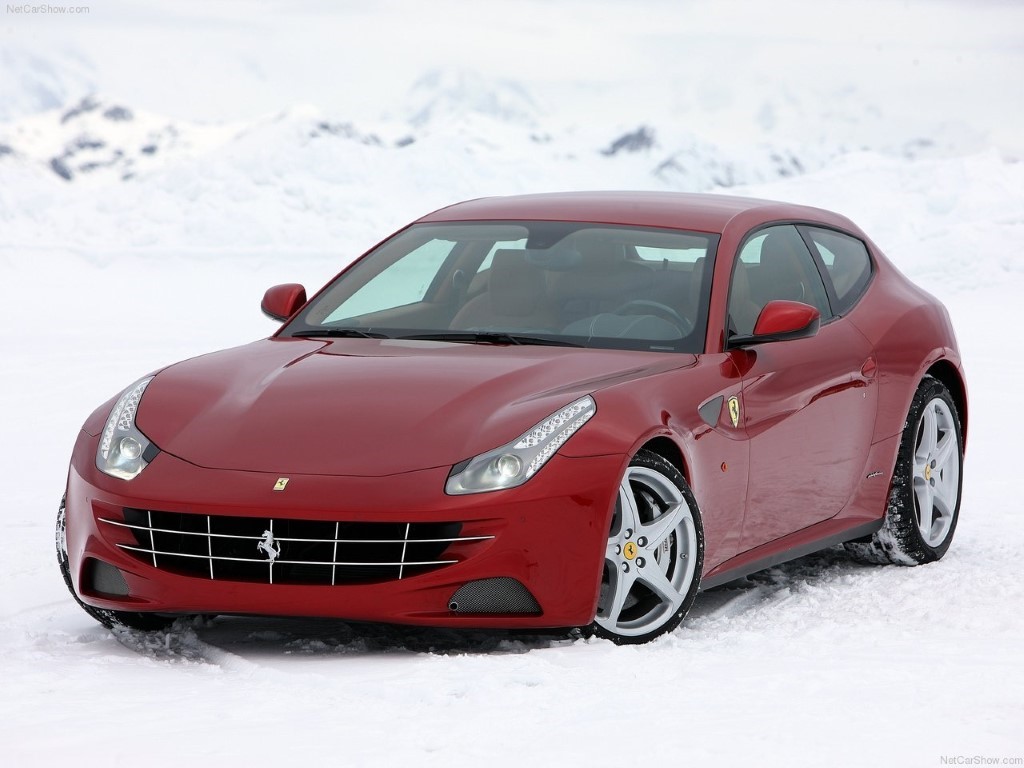
V12 power without borders: the paradigm shifter that joined extreme performance with total four-seat versatility.
Select a generation to see available versions
(2011-2016)
When the doors of the Geneva International Motor Show opened in March 2011, the world witnessed not just the launch of a new car, but the beginning of a new era for Ferrari. At the Italian brand's stand rested the Ferrari FF, a vehicle that represented a bold and, to some, controversial turning point. For the first time in its rich history, Ferrari was presenting a series production model equipped with a four-wheel-drive system, a technology previously considered an anathema to the company's purist philosophy, forged on the Formula 1 tracks and dedicated to the purity of rear-wheel drive.
The chosen name, "FF", was a concise acronym for "Ferrari Four", perfectly encapsulating the dual revolution the car brought: four genuinely comfortable seats for adults and, of course, four-wheel drive. Although developed to succeed the elegant 612 Scaglietti, the FF was far from a mere evolution. It was a complete reinterpretation of what a Maranello Gran Tourer (GT) could be, abandoning the traditional coupé silhouette for a bold and functional design.
The ambition behind the FF project was monumental: to create the most versatile car ever produced by Ferrari. The vision was of a vehicle that transcended the limits of a weekend supercar, becoming a companion for daily use, capable of facing any weather condition with the same poise as a luxury sedan, but with the soul of an Italian thoroughbred. The FF was designed to overcome the most complex driving challenges, from a day on the track to a trip to a ski resort on snow-covered roads.
This radical shift in philosophy could have alienated the brand's most traditional fans, but Ferrari anticipated this reaction with a powerful endorsement. Piero Ferrari, son of the legendary founder Enzo Ferrari, stated unequivocally: “My father would have loved this car, because it is innovative, revolutionary, and it is a true four-seater, like the Ferraris he used every day”. This quote was a masterstroke, serving to legitimize the FF and calm the purists who argued that Enzo would never approve of such a model.
At the time of its launch, the Ferrari FF was immediately positioned at the top of the automotive food chain, billed as the fastest four-seater car in the world. This title solidified its status as an "extreme grand tourer", a car that refused to compromise performance in the name of practicality. The FF was not just a GT; it was a statement that Ferrari could offer versatility without diluting its performance DNA.
This was not a decision made in a vacuum. In the late 2000s, competitors like Porsche with the Panamera, and Aston Martin with the Rapide, had already proven the existence of a lucrative market for ultra-high-performance vehicles with greater practicality. Ferrari, focused on its two-seater coupés, ran the risk of losing clients who, while desiring the thrill of driving a Maranello car, needed more space for their family or for traveling. The creation of the FF was, therefore, a calculated strategic maneuver. By introducing all-wheel drive and an innovative design, Ferrari was not only advancing technologically; it was redefining its own boundaries to capture a new market segment. In retrospect, the FF was the first concrete step in Ferrari's journey from a niche supercar manufacturer to a more comprehensive luxury and performance brand, paving the philosophical and engineering way that, a decade later, would culminate in the Purosangue.
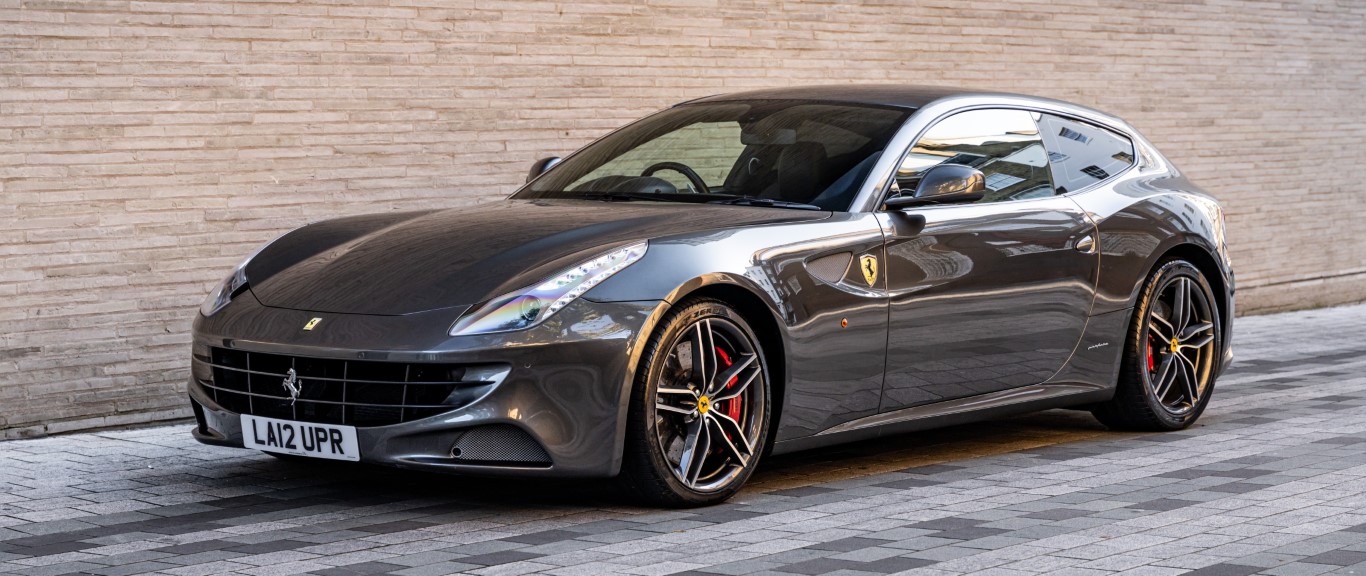
The design of the Ferrari FF was the result of a collaboration between two of the most revered names in Italian automotive design: Pininfarina, under the leadership of Lowie Vermeersch, and Ferrari's own Styling Center, directed by Flavio Manzoni. The result was a silhouette that broke all the brand's conventions. The bodywork adopted the three-door "shooting brake" format, a style historically associated with luxury coupés modified for hunting, which combines the low, flowing roofline of a coupé with the elongated, vertical rear of an estate car.
Despite its radical shape, the FF maintained a clear family visual identity. The aggressive, swept-back headlights were a clear nod to the 458 Italia, while the iconic dual circular taillights echoed the design seen on both the 458 and the 599 GTB Fiorano. Aerodynamics was a central pillar of the project. Every line and every crease was sculpted to manage airflow efficiently. A complex dual-level rear diffuser and functional side air vents worked together to generate significant downforce, ensuring stability at high speeds while minimizing drag, resulting in a drag coefficient (Cd) of 0.329.
If the exterior was a statement of functionality, the interior was its confirmation. The cabin was designed to be a driver-focused cockpit, like in every Ferrari, but with a level of comfort and passenger space never seen before. The car housed four individual seats, sculpted in high-quality leather with high backrests, designed to offer lateral support in corners and supreme comfort on long journeys. Unlike the symbolic "2+2" seats of other Ferrari GTs, the rear space of the FF was genuinely for adults, a true rarity.
Practicality was undoubtedly one of the main selling points. The trunk offered a capacity of 450 liters, an already respectable volume for a supercar. With the rear seats folded down, this space expanded to an impressive 800 liters, a volume comparable to that of a family hatchback, capable of accommodating luggage, ski equipment, or groceries with ease. The finish, as expected, was impeccable, using a rich mix of fine materials such as leather, carbon fiber, and machined metal accents. The infotainment system, centered on a 6.5-inch screen, offered modern connectivity with Bluetooth and USB ports.
The choice of the "shooting brake" design was a deliberate decision where function dictated form. Ferrari faced a fundamental challenge: how to create a truly practical Ferrari for four people and their luggage? A traditional 2+2 coupé, like the 612 Scaglietti it replaced, was simply inadequate. On the other hand, a four-door sedan would have been too radical a break, risking diluting the brand's sporty image. The "shooting brake" format emerged as the perfect engineering solution, maintaining a two-door silhouette (technically three) and a low profile, while freeing up the necessary internal volume. The criticism that arose regarding the aesthetics of the rear was predictable, but Ferrari prioritized the strategic goal of versatility over aesthetic conformity. This courageous decision established a new archetype for the brand, one that was validated by the functional success of the concept and subsequently refined in its successor.
Despite all its practicality and innovation, the Ferrari FF needed to prove that, at its heart, it was still a Maranello thoroughbred. The irrefutable proof lay under its long hood: a monumental naturally aspirated 6,262 cc (6.3-liter) V12 engine, bearing the internal code F140 EB. Mounted in a front-mid position, meaning set back behind the front axle, it optimized weight distribution and the center of gravity. This was no ordinary engine; it was the first Ferrari V12 to incorporate high-pressure (200 bar) Gasoline Direct Injection (GDI) technology, an advancement that allowed for a significant increase in power and combustion efficiency.
The performance numbers were overwhelming. The engine produced a maximum power of 660 hp at 8,000 rpm and a robust torque of 683 Nm (504 lb-ft) at 6,000 rpm. Even more impressive was its flexibility: over 500 Nm of torque was available from just 1,000 rpm, ensuring instantaneous throttle response and massive pulling power at any engine speed.
To manage this colossal force, Ferrari employed its acclaimed 7-speed dual-clutch transmission (F1 DCT). In a transaxle configuration, the gearbox was mounted at the rear of the car, an engineering solution that contributed to the FF's near-perfect weight distribution: 47% over the front axle and 53% over the rear, ideal for balanced and agile dynamic handling.
The result of this engine and transmission combination was supercar performance. The FF was capable of accelerating from 0 to 100 km/h in just 3.7 seconds and reaching a top speed of 335 km/h. These numbers not only placed it in the pantheon of the fastest cars of its time, but also crowned it as the fastest four-seater vehicle in the world.
The powertrain was complemented by an advanced aluminum chassis, lighter and with greater torsional rigidity than its predecessor's. To ensure the FF could be safely controlled, it came standard with Brembo carbon-ceramic brakes and state-of-the-art suspension with magnetic (magnetorheological) dampers, capable of adjusting their stiffness in milliseconds. Furthermore, the FF introduced the HELE (High Emotions-Low Emissions) system, which included a Stop&Start function, helping to reduce fuel consumption and CO2 emissions by up to 25% compared to the brand's previous V12 engines, a nod to growing environmental awareness without sacrificing emotion.
The V12 engine was not just a mechanical component; it was the anchor that secured the FF's credibility as a "true Ferrari". The introduction of all-wheel drive and an "estate" body were risky concepts that could be interpreted as a "softening" of the brand. To counteract this perception, Ferrari equipped the FF with one of its most charismatic and powerful engines. The decision to keep a large, naturally aspirated V12, rather than opting for a smaller or turbocharged unit, was deliberate to preserve the "soul" of Ferrari. The unmistakable sound, immediate throttle response, and linear, surging power delivery are intrinsic characteristics of the brand's V12 GTs. In doing so, Ferrari created a car of fascinating duality: practical and usable, yet with the heart and performance of a purebred supercar.
The decision to equip the FF with four-wheel drive was its most revolutionary aspect, but also the greatest engineering challenge. Ferrari categorically rejected the conventional all-wheel-drive systems available on the market. The reason was simple: they were too heavy, complex, and bulky. The addition of a traditional central differential and front driveshafts would fatally compromise the ideal weight distribution, raise the center of gravity, and ultimately "contaminate" the pure, rear-focused driving feel that defines a Ferrari. The solution had to be light, compact, and intelligent. The result was the 4RM system, patented by Ferrari, which weighed approximately 50% less than a conventional system.
The 4RM system (an abbreviation for the Italian Quattro Ruote Motrici, or Four-Wheel Drive) is a work of engineering genius. Instead of a central differential, it uses a second, much smaller and simpler gearbox called the Power Transfer Unit (PTU), connected directly to the front end of the V12 engine's crankshaft. This PTU is remarkably simple, having only two forward gears and one reverse gear.
Its operation is synchronized with the main seven-speed gearbox at the rear. The first gear of the PTU is geared to cover the first and second gears of the rear transmission. The second gear of the PTU, in turn, covers the third and fourth gears of the rear transmission. A crucial characteristic of the system is that it is "part-time": the front-wheel drive only operates when the main transmission is between first and fourth gear. Above that, at higher speeds, the FF operates exclusively in rear-wheel drive, as Ferrari determined that rear grip would be sufficient and that disengaging the front system would reduce mechanical losses and improve efficiency.
The 4RM system is predictive and reactive. It constantly monitors grip levels and, when it detects that the rear wheels are about to slip, the PTU springs into action, sending up to 20% of the engine's total torque to the front wheels. The torque distribution to each of the front wheels is independently controlled by a pair of multi-plate wet clutches. This not only allows for precise power transfer but also creates a torque vectoring effect, which can help pull the car into the corner and improve agility.
This ingenious approach allowed Ferrari to keep the V12 engine in a low and set-back position in the chassis, preserving the ideal 47/53 weight distribution and a low center of gravity. Although it seemed like technology from the future, its roots trace back to a 1987 experimental prototype, the Ferrari 408 4RM, which tested similar all-wheel-drive concepts.
The 4RM system is the purest expression of Ferrari's engineering philosophy. The challenge was not simply to "add four-wheel drive", but to do it "the Ferrari way". This meant that the system had to be light, not interfere with the car's dynamics, preserve the feel of a rear-wheel-drive vehicle, and act only when strictly necessary. The PTU meets all these requirements. It transforms the FF not into a permanent all-wheel-drive car, but into a rear-wheel-drive GT with an on-demand front-wheel-drive capability. This subtle distinction is the key to understanding why the FF, despite its revolutionary technology, still handles and feels like a traditional Ferrari.
The Ferrari FF had a five-year production cycle, with manufacturing taking place between 2011 and 2016 at the historic Maranello factory. During this period, a total of 2,291 units were produced and delivered to clients worldwide. Although not a strictly limited edition, this relatively low production number makes it a significantly rarer car than many other regular production Ferrari models, guaranteeing a certain degree of exclusivity in the used car market.
Throughout its life, the Ferrari FF existed as a single generation. The model did not receive significant mid-cycle updates (known as "Modificato" in Ferrari nomenclature) nor did it have distinct performance versions, such as a "Speciale" or "Pista" variant. The FF was produced with a single engine and powertrain configuration, being directly replaced by the GTC4Lusso in 2016, which represented the next evolutionary step of the concept.
The only notable variant based on the FF platform is the Ferrari SP FFX, a one-off model created in 2014 by Ferrari's coveted Special Projects division for an anonymous and wealthy client in Japan. This program allows the brand's most loyal customers to commission fully customized cars, with exclusive bodies built on existing mechanical platforms.
Mechanically, the SP FFX is identical to the standard FF. It retains the same 660 hp V12 engine and the innovative 4RM all-wheel-drive system. The great and dramatic difference lies in the bodywork. The client who commissioned the car desired the engineering of the FF, but with a more traditional aesthetic. Thus, the "shooting brake" design was completely discarded in favor of a coupé-style rear, with a descending roofline and a conventional trunk. This transformation fundamentally altered the car's character, converting it from a practical four-seater into a strict two-seater. The exterior and interior design were fully customized, featuring a provocative red and white color combination with black accents, and an interior that blended black, red, and blue leathers.
The existence of the SP FFX serves as physical evidence of the main controversy surrounding the FF: its design. It demonstrates that one client loved the FF's mechanical platform so much – the front-mid V12 and the 4RM system – that they were willing to invest a multimillion-dollar sum to dress it in a more classic body. This car is, in essence, the answer to the question: "What if the FF was a coupé?". This reveals two important things. First, that the FF's engineering was so exceptional that it justified an investment of this magnitude. Second, that Ferrari itself recognized (and capitalized on) the division of opinions regarding the original styling, offering an exclusive alternative to those who could afford it. The SP FFX remains a fascinating "what if" that became reality.
Upon its launch, the Ferrari FF was met with almost universal acclaim by specialized critics. Automotive journalists around the world praised Ferrari for its courage in breaking its own rules and for delivering a product that fulfilled its promises brilliantly. The unprecedented combination of supercar performance, luxury GT comfort, and everyday practicality was the most celebrated point.
The positive points highlighted were consistent across all reviews: the driving dynamics, which remained true to a Ferrari despite the all-wheel drive; the comfort of the suspension and interior, considered atypical for a car with such performance; the power and glorious sound of the V12 engine; and, above all, the versatility that made it unique. Automobile Magazine summed up the general sentiment with a revealing sentence: "The most telling thing about a Ferrari FF is that every second you’re behind the wheel, you want to drive the car further". The only points that generated some division were the rear design, which some loved and others criticized, and, over the years, the infotainment system, which began to look dated compared to more modern systems.
The success of the FF validated the concept, and in 2016, Ferrari presented its successor and direct evolution: the GTC4Lusso. The name was a homage to classic models like the 330 GTC. The GTC4Lusso maintained the core formula of the FF – front-mounted V12 engine, four seats, all-wheel drive, and "shooting brake" body – but refined and improved every aspect.
The key evolutions were significant. The design was subtly redesigned to be more elegant and aerodynamic, with a rear end that was better received by the public. The 6.3-liter V12 engine was tuned to produce 690 hp, a 30 hp increase. The biggest technological innovation was the introduction of four-wheel steering, which, integrated with the all-wheel-drive system (now called 4RM-S), provided even sharper agility and steering response. The interior received a major modernization, highlighted by a new, wide 10.25-inch infotainment screen.
Furthermore, Ferrari expanded the lineup with the introduction of the GTC4Lusso T. This new version was equipped with the brand's acclaimed 3.9-liter twin-turbo V8 engine, producing 610 hp, and, crucially, featured only rear-wheel drive. The goal was to attract an audience that might be looking for a more traditional driving experience of a rear-wheel-drive GT, with a slightly more accessible entry point into the lineup.
The table below directly illustrates the technical evolution from the FF to the two versions of its successor.
| Characteristic | Ferrari FF | Ferrari GTC4Lusso (V12) | Ferrari GTC4Lusso T (V8) |
|---|---|---|---|
| Period | 2011–2016 | 2016–2020 | 2017–2020 |
| Engine | 6.3L V12 Naturally Aspirated | 6.3L V12 Naturally Aspirated | 3.9L V8 Twin-Turbo |
| Power | 660 hp @ 8,000 rpm | 690 hp @ 8,000 rpm | 610 hp @ 7,500 rpm |
| Torque | 683 Nm @ 6,000 rpm | 697 Nm @ 5,750 rpm | 760 Nm @ 3,000-5,250 rpm |
| Drive | All-Wheel (4RM) | All-Wheel (4RM Evo) | Rear-Wheel |
| Accel. 0-100 km/h | 3.7 s | 3.4 s | 3.5 s |
| Top Speed | 335 km/h | 335 km/h | > 320 km/h |
| Key Innovation | 4RM drive system | Four-wheel steering (4RM-S) | First V8 in a 4-seater GT |
The legacy of the Ferrari FF is profound and lasting. It was the successful "proof of concept" that not only gave rise to a more refined successor but also normalized the idea of a practical, all-weather Ferrari. Before the FF, the idea of a Ferrari with four-wheel drive and an 800-liter trunk was unthinkable. The FF met skepticism with brilliant engineering and proved that the concept not only worked but also created a new and desirable market niche for the brand. For nearly a decade, the FF and GTC4Lusso duo accustomed the market to the idea that a Ferrari did not need to be limited to a two-seater coupé with rear-wheel drive. They built the bridge that allowed Ferrari, years later, to take the final step towards maximum practicality with the Purosangue, which can be seen as the spiritual grandson of the FF. Without the courage and success of the FF, Ferrari's first four-door vehicle would have been a much harder pill to swallow for the market and the brand's purists.