

1st Generation
(2000 - 2005)
3.6 V8
400 cv
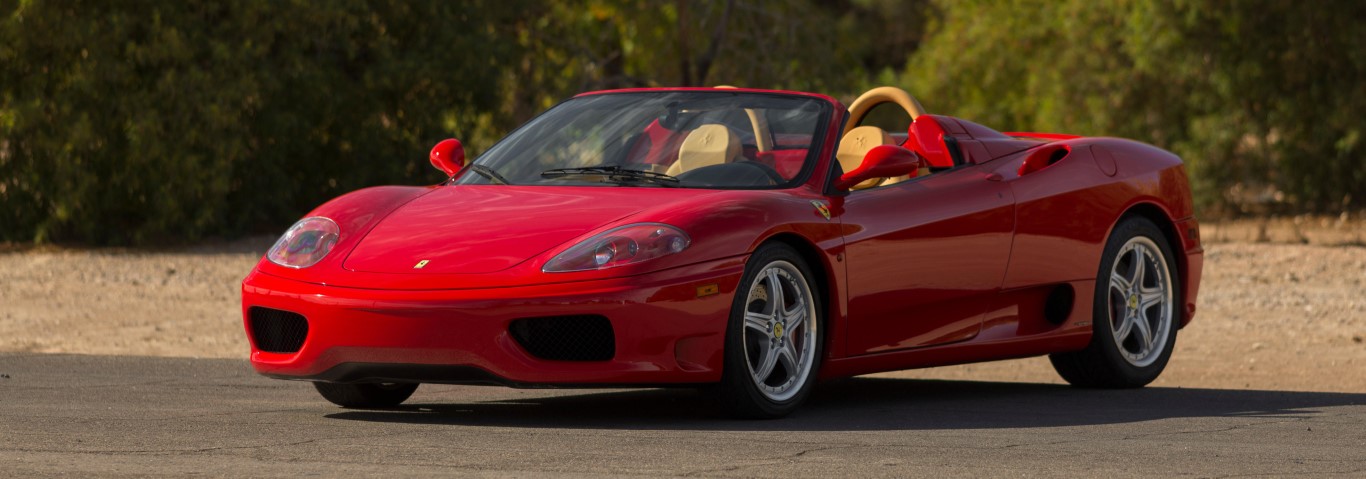
Technical specifications, versions, and history for the Ferrari 360 Spider.
Select a generation to see available versions
(2000 - 2005)
The Ferrari 360, introduced at the turn of the millennium, represents much more than the simple successor to the acclaimed F355. It was a transformative milestone, a turning point that redefined the design and engineering philosophy of Ferrari's mid-engine V8 sports cars for the following decade. Launched in 1999, the 360 was a deliberate break with traditions, introducing technologies that not only improved performance but also usability, establishing a new standard for supercars of its time.
This report details the complete history of the Ferrari 360 family, exploring the innovations that made it an icon. The three pillars that support its legacy are: the revolutionary all-aluminum chassis, which provided a quantum leap in rigidity and lightness; Pininfarina's aerodynamic design, which abandoned aesthetic conventions in favor of function; and the powerful evolution of the F131 V8 engine.
The 360 lineage consists of a family of distinct variants, each with a clear purpose. The journey begins with the 360 Modena berlinetta, the pillar of the range, followed by the 360 Spider convertible, which offered an open-air experience with minimal compromise. At the pinnacle of street performance lies the Challenge Stradale, a track-focused but street-legal version. Completing the family are the purebred competition models: Challenge, GT, and GTC, which took the 360 name to the most famous race tracks in the world.
The design of the Ferrari 360, conceived by the Pininfarina studio under the direction of Lorenzo Ramaciotti, marked a radical departure from the angular lines and pop-up headlights that defined its predecessors, such as the F355. The new design philosophy embraced more curvilinear and fluid shapes, where every line was dictated by aerodynamic function, the result of more than 5,400 hours of wind tunnel testing.
One of the most notable changes was the elimination of the traditional "egg-crate" front grille, a historical characteristic of the brand. In its place, two large and aggressive air intakes were positioned on the car's nose. These intakes not only fed the radiators but also channeled air to a completely flat underbody, which ended in aerodynamic extractors at the rear. This approach, directly inspired by Formula 1, allowed the 360 to generate significant downforce without the need for large wings or spoilers, a remarkable feat for a production car of the time.
Iconic design details reinforced this new identity. The side air intakes, mounted on the rear fenders, evoked classics like the 250 LM and the Dino, while the engine cover, made of glass, proudly displayed the V8 as a centerpiece of design, transforming mechanics into art. The shift to fixed headlights under acrylic covers was not just a stylistic choice; it was a functional decision driven by the need for cleaner airflow over the bodywork and by new safety regulations, signaling that aerodynamic efficiency now took precedence over design elements of the past.
The true technological leap of the 360 was under its skin. In a strategic partnership with Alcoa, Ferrari developed its first space-frame chassis for a production car made entirely of aluminum. This innovation provided impressive technical advantages: the 360's chassis was 40% stiffer and 28% lighter than the F355's steel structure, even with the car being dimensionally 10% larger.
The construction used aluminum extrusions of varying sections, welded together via twelve cast aluminum nodes, an advanced technique that optimized strength where it was needed and saved weight in other areas. The decision to use aluminum was not just an engineering choice to reduce weight; it was the cornerstone that allowed a complete revolution in the car's design and usability. The superior rigidity and lower weight allowed the car to grow in dimensions, resulting in a more spacious and comfortable cabin, with space behind the seats even for a set of golf clubs. This made the 360 a more practical and "livable" supercar than any of its predecessors, redefining expectations for an "entry-level" Ferrari model.
The 360's engine, bearing the type code F131B, was a refined evolution of the acclaimed F355 V8. With displacement increased to 3.6 liters (3586 cm3), the engine maintained the sophisticated five-valve-per-cylinder architecture and titanium connecting rods, but with revised bore and stroke to 85 mm x 79 mm, respectively.
This 90-degree V8, mounted in a longitudinal mid-rear position, produced 400 hp at 8,500 rpm and 373 Nm of torque at 4,750 rpm. This resulted in an impressive specific output of 112 hp per liter. The engine was packed with modern technology, including a dry-sump lubrication system, Bosch Motronic ME 7.3 electronic injection with a "drive-by-wire" electronic throttle, and a variable back-pressure exhaust system, which optimized gas flow and engine sound at different engine speeds.
The Ferrari 360 offered two transmission options, representing a crossroads between tradition and the technological vanguard of the time.
The 360 Modena, named in honor of Enzo Ferrari's hometown, was the model that started the lineage. Launched at the 1999 Geneva Motor Show, it set a new standard for performance and usability. With its 400 hp engine, the Modena was capable of accelerating from 0 to 100 km/h in 4.5 seconds and reaching a top speed of over 295 km/h.
The interior represented a significant advancement in comfort and ergonomics compared to the F355. The design combined traditional luxury leather with exposed aluminum panels on the center console, lower door panels, and instrument cluster, a constant reminder of the car's lightweight and technological construction.
Introduced a year after the coupe, the 360 Spider was the 20th street convertible in Ferrari's history and quickly became a sales success. A fundamental change in its engineering was that the 360 platform was designed from the outset to accommodate a convertible version, ensuring that structural integrity was not an afterthought.
To compensate for the absence of the roof, Ferrari engineers implemented significant reinforcements to the aluminum chassis. The side sills were strengthened, the front section of the floorpan was stiffened, and the windshield frame was redesigned to act as a protective structure. Occupant safety was guaranteed by two robust tubular steel roll bars, elegantly integrated behind the seats. The electrically operated soft top folded compactly into its own compartment in about 30 seconds, preserving the car's fluid lines when open.
The weight gain was only 60 kg compared to the Modena, a remarkable feat for the time. The impact on performance was minimal: 0 to 100 km/h acceleration increased slightly to 4.6 seconds, but the top speed remained impressive at over 290 km/h.
| Specification | Ferrari 360 Modena | Ferrari 360 Spider |
|---|---|---|
| Engine | 3.6L V8 (F131) | 3.6L V8 (F131) |
| Power | 400 hp @ 8500 rpm | 400 hp @ 8500 rpm |
| Torque | 373 Nm @ 4750 rpm | 373 Nm @ 4750 rpm |
| Weight (dry) | 1290 kg | 1350 kg |
| Weight (curb) | 1390 kg | 1450 kg |
| Acceleration 0-100 km/h | 4.5 s | 4.6 s |
| Top Speed | > 295 km/h | > 290 km/h |
| Drag Coefficient (Cd) | 0.335 | 0.36 |
| Height | 1214 mm | 1235 mm |
The Ferrari Challenge Stradale (CS), launched in 2003, was the embodiment of the "race car for the streets" philosophy. It was designed to transfer the technology and visceral experience of the Ferrari Challenge one-make racing program to a street-legal vehicle. The result was a drastically lighter, more powerful, and more focused car, capable of completing a lap at the Fiorano test track 3.5 seconds faster than the 360 Modena.
The development of the Challenge Stradale followed a mantra of relentless optimization in all areas:
The Challenge Stradale was exclusively available with the F1 gearbox, whose software was reprogrammed for even faster and more aggressive gear changes. The driver could choose between "Sport" and "Race" modes, which adjusted gearbox response, traction control, and damper stiffness. The decision to offer the CS only with the F1 gearbox was a bold statement from Ferrari, reinforcing the message that, for maximum performance, automated technology was the way forward.
The valved exhaust system was a centerpiece of the experience. In "Race" mode, the valves opened, allowing exhaust gases to bypass the main silencer. The result was a high-pitched, raw, and extremely loud sound, widely considered by enthusiasts to be one of the best and most thrilling V8 engine sounds ever produced.
The Challenge Stradale was not just a faster version of the 360; it established the winning formula that Ferrari would follow for all its future V8 "Special Series", such as the 430 Scuderia and the 458 Speciale. This formula – radical weight reduction, modest power increase, cutting-edge technology from flagship models, and a total focus on the driver experience – proved to be a critical and commercial success, validating a business strategy that endures to this day.
The 360 Challenge (or 360MC) was the car developed for Ferrari's one-make racing series, the Ferrari Challenge. A crucial change from its predecessor, the F355 Challenge, was that the 360MC was a factory-built race car from the ground up, not a conversion kit for a street car.
The interior was completely stripped out, featuring a single OMP racing seat, a full roll cage, fire suppression system, and a Magneti Marelli digital instrument cluster. All comfort items, such as air conditioning and sound deadening, were removed. The 3.6-liter V8 engine was slightly modified with a free-flowing exhaust and a racing clutch, raising power to around 410 hp. With the weight reduction, the car weighed approximately 1170 kg with fluids, allowing for a 0 to 100 km/h acceleration in 4.0 seconds.
Responding to demand from clients wishing to compete in international championships, Ferrari, in collaboration with the renowned tuner Michelotto Automobili, developed the 360 GT. Designed to compete in the highly competitive N-GT class of the FIA GT championship, the 360 GT was a significant evolution of the Challenge version.
The car went on a further diet, losing another 91 kg compared to the 360MC, thanks to the use of carbon fiber body panels. The engine was tuned to produce over 430 hp, and the aerodynamics were enhanced with the addition of a rear wing. The success was immediate: with factory support, the JMB Competition team won the teams' and drivers' titles in the 2001 FIA N-GT World Championship, overcoming stiff competition from Porsche.
The 360 GTC, launched in 2004, was the final evolution of the 360 racing platform, also developed in partnership with Michelotto. The main focus was aerodynamic optimization. Extensive wind tunnel testing led to a new rear wing positioning and other bodywork modifications, resulting in a significant increase in downforce.
The V8 engine was tuned to produce 450 hp at 8,750 rpm, mated to a six-speed sequential transmission. The weight was kept at the regulatory minimum of 1100 kg. At the 24 Hours of Le Mans, the best result for a Ferrari 360 was achieved in 2004, when a 360 GTC from the Cirtek Motorsport team finished in 19th place overall.
The Ferrari 360 was a commercial success for the brand, with over 17,000 street units produced over its life cycle. The exact numbers and the split between transmissions are of great interest to collectors, as they define the rarity and, consequently, the value of each variant.
| Version | Production Period | Manual Gearbox | F1 Gearbox | Total Produced |
|---|---|---|---|---|
| 360 Modena | 1999–2004 | 2,630 | 6,170 | 8,800 |
| 360 Spider | 2000–2004 | 2,119 | 5,446 | 7,565 |
| Challenge Stradale | 2003–2004 | 0 (F1 only) | 1,288 | 1,288 |
| Total (Road) | 4,749 | 12,904 | 17,653 |
In addition to the series production models, the 360 lineage includes a unique piece of great historical value: the 2000 360 Barchetta. This one-off car was commissioned by Gianni Agnelli, the legendary head of Fiat, as a wedding gift for Luca Cordero di Montezemolo, then president of Ferrari. Based on the 360 Spider, the Barchetta has no conventional soft top or windshield, replaced by a small wind deflector, and features an exclusive engine cover, creating a pure and radical roadster.
The legacy of the 360 is multifaceted. It served as the technical foundation for its successor, the F430, which retained the aluminum chassis and overall proportions, albeit with an evolved design and an all-new engine. The 360 proved the viability and advantages of aluminum, a concept that the F430 refined.
In the classic car market, the 360 occupies a fascinating position. Versions equipped with the F1 gearbox are often seen as the most accessible entry point into the world of modern Ferrari ownership, offering extraordinary performance for a relatively contained value. In contrast, the huge value difference between manual and F1 models highlights a strong market demand for a more analog driving experience. A manual Modena can easily be worth almost double that of an F1, a direct reflection of its rarity and collectors' desire for the iconic metal gated shifter. The Challenge Stradale, in turn, exists in a category of its own, being treated as a "blue-chip" collector's item with values that far exceed those of the standard models.
The 360 also marked a turning point in maintenance. Unlike the F355, which required engine removal for timing belt replacement, the 360 was designed to allow this crucial service to be performed with the engine in place. This drastically reduced maintenance costs and time, breaking the stigma of prohibitive costs and making Ferrari ownership more viable for a wider audience. This "usability", combined with its higher overall reliability, solidified its reputation as one of the most highly recommended models for first-time owners of the brand.
The Ferrari 360 was not just another model in Maranello's long and illustrious history; it was a watershed moment. It pioneered the large-scale use of the aluminum chassis, a technology that would become standard for future generations. It redefined supercar design, where aerodynamics dictated form in a way never before seen on a street car from the brand. With the Challenge Stradale, it created the formula for the acclaimed V8 "Special Series", which became a pillar of Ferrari's identity.
More than that, the 360 balanced, like no other before it, the performance of a purebred supercar with a level of usability, comfort, and maintenance that made it a commercial success and an enduring modern classic. It was not just a car that succeeded the F355; it was the platform that laid the technological and philosophical foundations for the F430, the 458 Italia, and beyond, securing its place as an essential milestone in the evolution of the Prancing Horse.