1st Generation
(2015 - 2021)
3.9 V8 Twin-turbo
720 cv
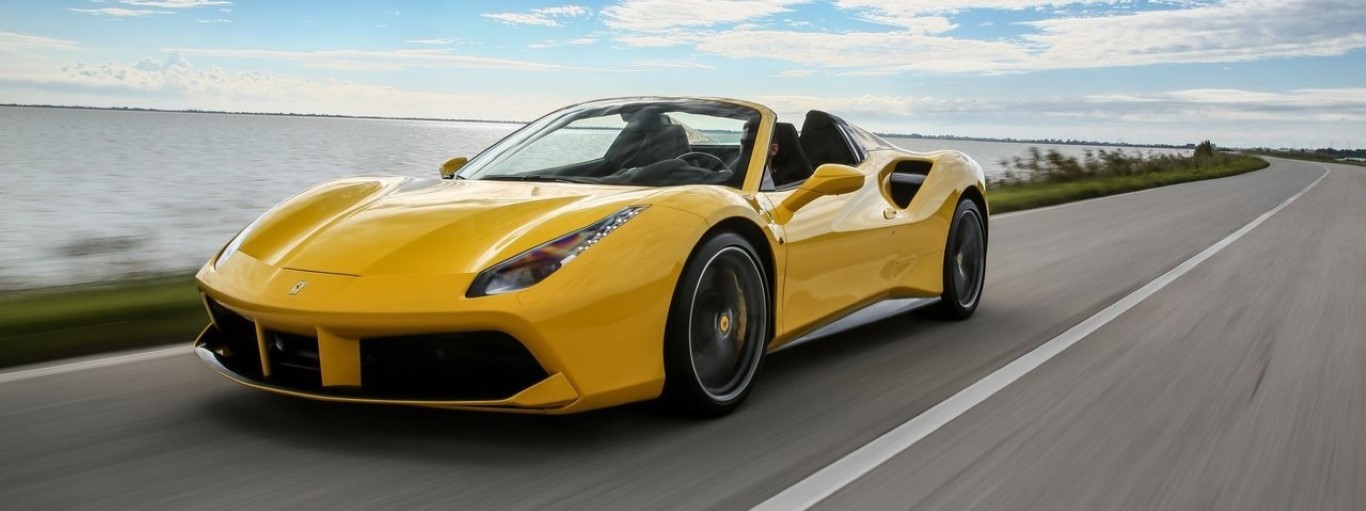
Technical specifications, versions, and history for the Ferrari 488 Spider.
Select a generation to see available versions
(2015 - 2021)
Select a powertrain to view full technical specifications
The Ferrari 488, launched in 2015, represents one of the most significant moments in the modern history of the brand. It arrived with the monumental task of succeeding the Ferrari 458 Italia, a model universally acclaimed for its stunning design and, above all, for its naturally aspirated 4.5-liter V8 engine, capable of revving to an impressive 9,000 rpm, a true sonic and engineering masterpiece. At that time, the competition, represented by models like the McLaren 650S and the Lamborghini Huracán, was raising the performance bar in the supercar segment, forcing Ferrari to make a bold response.
Maranello's response was the 488, which marked the return to a turbocharged V8 engine in a mid-rear engine car, something not seen since the legendary F40. This decision was not just technical, but a profound philosophical change, driven by the need to drastically increase power and torque levels, while seeking greater efficiency to meet increasingly strict emissions regulations. The name "488" signaled a return to classic Ferrari nomenclature, indicating the unitary displacement of each of the eight cylinders (approximately 488 cm3), while "GTB" stands for Gran Turismo Berlinetta.
Officially unveiled on February 3, 2015, ahead of its world premiere at the Geneva International Motor Show, the 488 GTB was received with a mix of admiration for its overwhelming performance figures and a certain skepticism regarding the potential loss of the iconic sound of the 458's naturally aspirated engine. Aware of this challenge, Ferrari invested heavily in engineering so that the new twin-turbo V8 engine, from the F154 family, delivered its power with "zero turbo lag" and a unique and seductive soundtrack, crucial factors for the model's acceptance by the brand's purists.
This transition from the 458 to the 488 was more than a simple model update; it was a fundamental realignment in Ferrari's engineering philosophy. The 458 represented the pinnacle of naturally aspirated engine technology, a pillar of the brand's identity. However, to remain competitive in raw performance against rivals already using turbocharging, the change was inevitable. The 488, therefore, is not just the successor to the 458, but the vehicle that signaled Ferrari's acceptance that the era of performance via turbocharging was here to stay, paving the way for future models like the F8 Tributo and the subsequent hybrid era.
The 488 lineup was introduced with two main variants that formed the foundation of its success: the GTB berlinetta (coupe) and the convertible Spider. Both share the same mechanical DNA but were designed to offer distinct driving experiences.
The core of the 488 GTB is the F154 CB engine, a 3,902 cm3 V8 with a dry sump and two parallel ball-bearing twin-scroll turbochargers. This powerplant delivers an output of 670 cv (or 661 hp) at 8,000 rpm and a massive 760 Nm of torque available at just 3,000 rpm. These numbers translate into explosive performance: acceleration from 0 to 100 km/h in exactly 3.0 seconds, 0 to 200 km/h in just 8.3 seconds, and a declared top speed exceeding 330 km/h. To manage this power, Ferrari used a 7-speed dual-clutch transmission, manufactured by Getrag, with gear ratios optimized for the turbocharged engine's torque profile.
The design, conceived by the Ferrari Styling Centre under the leadership of Flavio Manzoni, is a masterclass in functional aerodynamics. Although the aluminum chassis is an evolution of the one used in the 458, the bodywork was completely redesigned. The main goal was to increase downforce by 50% compared to the 458, while reducing drag. Elements such as the double front spoiler, the huge sculpted side air intakes (which feed both the engine and the intercoolers), and an innovative "blown spoiler" at the rear are proof of this philosophy. The latter channels air from the base of the rear window through the bodywork and out just above the license plate, creating downforce without the need for a raised wing, an elegant and efficient solution.
Drivability was enhanced with carbon-ceramic brakes derived from the LaFerrari, which reduce braking distances by 9%, and with refined electronic systems, such as Side Slip Control 2 (SSC2). This system allows drivers of different skill levels to explore the car's limits with more confidence and control.
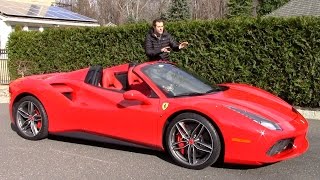
Unveiled at the Frankfurt Motor Show in September 2015, the 488 Spider brought the GTB's performance to the convertible format. Its main highlight is the retention of the Retractable Hard Top (RHT), an engineering solution that folds into two parts and elegantly stows away over the engine in just 14 seconds. This approach offers better acoustic and thermal insulation than a traditional soft top, besides being lighter.
The biggest challenge in any convertible is maintaining structural rigidity. Ferrari masterfully overcame this by using a spaceframe chassis built with 11 different aluminum alloys and noble metals like magnesium. The result is a torsional rigidity identical to the GTB coupe, a remarkable feat that ensures drivability is not compromised. The Spider weighs only 50 kg more than the GTB and is 10 kg lighter than its predecessor, the 458 Spider.
With the same 670 cv engine and 760 Nm of torque as the GTB, the Spider's performance is practically indistinguishable under normal driving conditions. The 0 to 100 km/h acceleration is identical, at 3.0 seconds. The 200 km/h mark is reached in 8.7 seconds (just 0.4 seconds slower than the coupe), and the top speed is 325 km/h. The 488 Spider was designed to be the most powerful and innovative convertible Ferrari ever built up to that point, combining the prowess of the V8 with the sensory experience of open-top driving.
If the 488 GTB was Ferrari's affirmation in the turbo era, the "Pista" lineup was its consecration. Launched in 2018, it represents the direct transfer of technology and philosophy from the racing department to a road car.
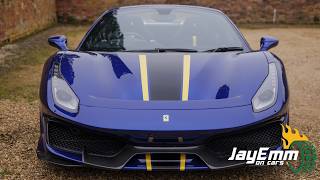
Presented at the 2018 Geneva Motor Show, the 488 Pista is the high-performance version of the 488, focused on track use. Its development incorporated lessons learned directly from the 488 GTE and 488 Challenge race cars, and the name "Pista" (track, in Italian) leaves no doubt about its vocation. The 3.9-liter V8 engine was extensively reworked to produce 720 cv at 8,000 rpm and 770 Nm of torque, making it, at the time, the most powerful V8 engine ever fitted to a Ferrari road car.
The pursuit of performance was obsessive. The Pista is 91 kg lighter than the GTB, thanks to the extensive use of carbon fiber on the hood, bumpers, rear spoiler, and various internal components. Aerodynamics were radically improved. The most visible innovation is the "S-Duct" at the front, an aerodynamic duct derived from Formula 1 that channels air from the bumper, through the hood, and expels it upwards. This creates enormous downforce on the front axle, increasing grip and precision in high-speed corners. In total, the downforce of the Pista is 20% higher than that of the 488 GTB.
The result is breathtaking performance: 0 to 100 km/h in 2.85 seconds, 0 to 200 km/h in 7.6 seconds, and a top speed of 340 km/h. While the 488 GTB was an extremely fast and competent supercar, the Pista was designed to be visceral. It answered the few critics who missed the "soul" of the 458 Speciale, delivering a driving experience so connected and brutal that it silenced most of the skepticism about Ferrari's ability to create emotion in the turbo era.
Launched shortly after the coupe, the 488 Pista Spider was a milestone, being celebrated as the 50th convertible model in Ferrari's rich history. It combines the extreme performance of the Pista with the sensory experience of an open car, without compromising performance. The dry weight is slightly higher than the coupe, but its power-to-weight ratio of 1.92 kg/cv set a new record for a Ferrari Spider, highlighting the focus on lightness and power. Retaining the same 720 cv engine and 770 Nm of torque, the performance is virtually identical to the Pista coupe, solidifying its status as the highest-performing convertible Ferrari ever created up to that point.
| Feature | 488 GTB | 488 Spider | 488 Pista | 488 Pista Spider |
|---|---|---|---|---|
| Engine | 3.9L Twin-Turbo V8 | 3.9L Twin-Turbo V8 | 3.9L Twin-Turbo V8 | 3.9L Twin-Turbo V8 |
| Power | 670 cv @ 8,000 rpm | 670 cv @ 8,000 rpm | 720 cv @ 8,000 rpm | 720 cv @ 8,000 rpm |
| Torque | 760 Nm @ 3,000 rpm | 760 Nm @ 3,000 rpm | 770 Nm @ 3,000 rpm | 770 Nm @ 3,000 rpm |
| Dry Weight | 1,370 kg | 1,420 kg | 1,280 kg | 1,380 kg |
| 0-100 km/h | 3.0 s | 3.0 s | 2.85 s | 2.85 s |
| 0-200 km/h | 8.3 s | 8.7 s | 7.6 s | 8.0 s |
| Top Speed | > 330 km/h | 325 km/h | 340 km/h | 340 km/h |
The 488 platform proved to be so versatile that it gave rise to a series of limited-production models and unique creations, solidifying Ferrari's "Special Projects" program as a vital part of its business model. These cars are not just a service for wealthy clients, but also function as a low-risk design laboratory to test new ideas and as an ultra-high-margin profit center that reinforces the brand's image of exclusivity.
This is a special edition of the 488 Pista, created by Ferrari's "Tailor Made" personalization program. Its sale was restricted to clients who actively participate in the brand's racing programs, as a tribute to Ferrari's victory in the 2017 FIA World Endurance Championship (WEC). The design is inspired by the #51 race car of the AF Corse team, featuring a livery with the colors of the Italian flag. Each car could be personalized with the client's racing number on the doors. Officially, production was limited to just 40 units, making it an instant collector's item. However, there are discussions in the collector community that the real number might be higher, a tactic to maintain the perception of extreme rarity.
To celebrate 50 years of Ferrari's official presence in Japan, the brand created the J50 in 2016. Production was strictly limited to 10 units, all sold exclusively to long-time Japanese clients. Based on the 488 Spider, the J50 features a completely new "targa" style bodywork, evoking classic Ferraris from the 70s and 80s. Its design includes a "helmet effect" on the windshield and a black dividing line that pays homage to iconic models like the GTO, F40, and F50. The V8 engine was tuned to produce 690 cv, a slight 20 cv increase over the standard 488 Spider.
The 488 platform served as the basis for several unique creations, where a client collaborates directly with the Ferrari Styling Centre to create a car that exists nowhere else in the world.
The success of the Ferrari 488 was not limited to the streets. Its platform gave rise to a family of race cars that dominated competitions around the world, demonstrating a virtuous cycle of development where technology flows from the streets to the tracks and vice-versa.
Developed for Ferrari's one-make championship, the Ferrari Challenge, this car is the entry point into the brand's racing world. Based on the road model, it uses the same 670 cv V8 engine as the GTB, but with modifications for the track, such as improved aerodynamics and a stripped-out interior. The "Evo" version, launched later, introduced an aerodynamic package that increased downforce by 50% compared to the original model, making the car faster and more stable in corners.
These are the racing versions developed to compete in the most prestigious Grand Touring categories in the world, such as the World Endurance Championship (WEC) and the IMSA SportsCar Championship. Engine power is restricted by the Balance of Performance (BoP) rules of each category, generally sitting around 550 to 600 cv to ensure competitiveness among different brands. The success was resounding: the 488 GT3 became the most successful race car in Ferrari's history, accumulating over 530 wins and 119 championships. The 488 GTE was also dominant, securing victories at the 24 Hours of Le Mans and multiple world titles.
Launched in 2020 in a very limited series, the GT Modificata is the ultimate expression of the 488 platform's performance. It was designed exclusively for track days and Ferrari Club Competizioni GT events. The car combines the best elements of the 488 GT3 and the 488 GTE, but crucially, it is free from BoP restrictions. This allowed engineers to unleash the V8 engine's potential to around 700 cv and optimize the aerodynamics to generate over 1,000 kg of downforce at 230 km/h. The result is a track car that can be up to five seconds faster per lap on a high-speed circuit like Monza compared to the already fast 488 GT3.
| Model | Base | Power (Approx. cv) | Primary Purpose | Production (Approx.) |
|---|---|---|---|---|
| 488 Challenge/Evo | 488 GTB | 670 | Racing (One-make) | Undisclosed |
| 488 GT3 | 488 GTB | ~600 (BoP) | Racing (GT3) | Undisclosed |
| 488 GTE | 488 GTB | ~600 (BoP) | Racing (GTE) | Undisclosed |
| 488 GT Modificata | 488 GT3/GTE | ~700 | Track Day (no rules) | ~25 units |
| 488 Pista Piloti | 488 Pista | 720 | Road (Special Ed.) | 40 units |
| J50 | 488 Spider | 690 | Road (Special Ed.) | 10 units |
| SP38 Deborah | 488 GTB | 670 | Road (One-Off) | 1 unit |
| P80/C | 488 GT3 | Undisclosed | Track (One-Off) | 1 unit |
| KC23 | 488 GT3 Evo | Undisclosed | Track (One-Off) | 1 unit |
Ferrari rarely discloses exact production numbers for its series models, a tactic that helps maintain an air of exclusivity. However, industry estimates provide a good picture of the scale of the 488 family. Total production of all road-going variants (GTB, Spider, Pista, and Pista Spider) is estimated to be between 11,000 and 15,000 units globally.
This production structure reveals a deliberate strategy of "managed scarcity." Ferrari produces a relatively high volume of base models to ensure profitability, while creating multiple tiers of special and limited editions to boost brand value, reward customer loyalty, and fuel demand in the secondary market. This pyramidal structure, ranging from thousands of GTBs to single-unit one-offs, ensures there is always a next level of exclusivity to aspire to, keeping customers engaged with the brand.
The Ferrari 488 will be remembered as the model that bravely and successfully led the brand into the modern turbo era in its most crucial segment. It not only surpassed the performance of its legendary naturally aspirated predecessor, the 458 Italia, but also proved that overwhelming performance and driving emotion could coexist with forced induction technology.
The greatest legacy of the 488, however, is the versatility and success of its platform. It gave rise to an acclaimed road supercar (GTB/Spider), a track version that became an icon (Pista), the most victorious race car in Ferrari's long history (GT3/GTE), and a series of one-off projects that took automotive personalization to a new level. By setting a new performance standard for turbocharged V8s, the 488 paved the way for its successor, the F8 Tributo, and gave Ferrari the technological foundation and confidence to move towards electrification, solidifying its place as a fundamental chapter in the history of the Prancing Horse.
Images of the Ferrari 488 Spider