

1st Generation
(1996 - 2002)
5.5 V12
485 cv
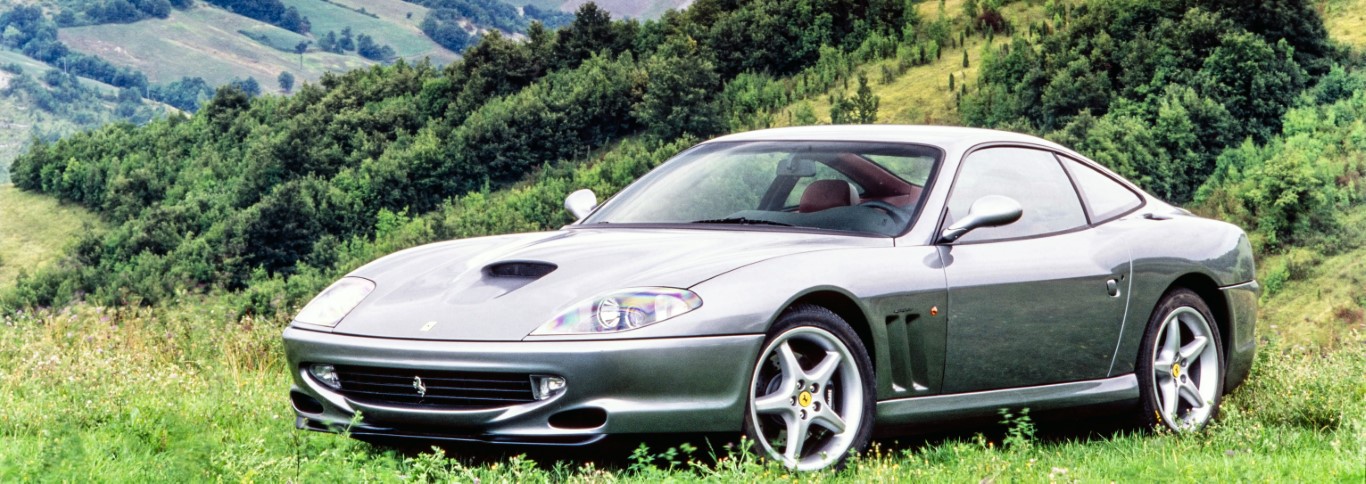
Technical specifications, versions, and history for the Ferrari 550 Maranello.
Select a generation to see available versions
(1996 - 2002)
In the mid-1990s, Ferrari found itself at a turning point. For over two decades, the image of its flagship supercar was defined by a mid-rear engine architecture, a lineage that began with the Berlinetta Boxer in 1973 and reached cultural icon status with the Testarossa and its successor, the F512M. This configuration was synonymous with exotic performance and aggressive design. However, in 1996, the Maranello brand shocked the automotive world by abandoning this successful formula. The launch of the Ferrari 550 Maranello marked the end of a 23-year hiatus, bringing back the front-mounted V12 engine configuration for its flagship two-seater model, a tradition that seemed to have ended with the legendary 365 GTB/4 "Daytona".
This change was not a natural evolution, but a strategic and philosophical course correction, deliberately implemented by Ferrari's then-president, Luca Cordero di Montezemolo. He realized that mid-engine supercars, while spectacular, had become "too showy" and impractical, resulting in extremely low annual mileage by their owners. Montezemolo's vision was clear: to create an ultra-high-performance car that could be used more frequently, on long trips, rescuing the true spirit of Gran Turismo (GT). The 550 Maranello was the materialization of this vision, a car designed to be more versatile without sacrificing emotion.
This return to its origins was also a tribute to the philosophy of the brand's own founder. The phrase frequently attributed to Enzo Ferrari, "The horse pulls the cart," summarized his historical preference for the front-engine configuration. Thus, the 550 was not just a new product, but a realignment of the brand with its deepest heritage. To underline the confidence in the new model, its launch was a grand event at the Nürburgring circuit in Germany in July 1996. Drivers from the Formula 1 team at the time, such as Michael Schumacher and Eddie Irvine, put the car to the test on the track, demonstrating from day one that the 550 Maranello was not just a comfortable GT, but a machine of unquestionable performance.
The design of the Ferrari 550 Maranello was a masterpiece of balance, a task entrusted to the legendary Pininfarina studio, under the leadership of Lorenzo Ramaciotti, with Elvio D'Aprile signing the exterior design and Goran Popović the interior. The result was a car that communicated its performance through sophisticated and muscular lines, rather than aggressive aerodynamic appendages. The approach was intentionally subtle and refined, a direct counterpoint to the extravagant styling of its predecessor, the F512M, aligning perfectly with the new philosophy of greater usability.
The bodywork of the 550 is a masterclass in how to merge heritage and modernity. Design elements harken back to some of Ferrari's greatest classics, serving as a clear visual signal that the car belonged to the lineage of the brand's great GTs. The two air vents on the front fenders are a direct homage to the iconic 250 GTO and the 275 GTB of the 60s, while the four round taillights evoke the 365 GTB/4 "Daytona". The overall silhouette, with its long hood and short, tucked-in rear, follows the classic Gran Turismo formula.
However, the design was not just nostalgic; it was extremely functional. The shape of the car was meticulously sculpted in a wind tunnel to optimize performance at high speeds. The result was an excellent drag coefficient (Cd) of 0.33, but more importantly, the generation of constant downforce on both axles, ensuring exceptional stability without the need for large airfoils. The front end, with its wide and low air intake, not only gave the car a "hungry shark" appearance, but also played a crucial role in aerodynamics and cooling. The design was so restrained that, in a color other than the traditional Rosso Corsa, the car could go unnoticed by laypeople, reinforcing the idea of a "discreet supercar", made for the pleasure of the connoisseur.
Inside, the 550 Maranello reinforced its vocation for long journeys. The cockpit was luxurious and driver-focused, fully trimmed in high-quality leather as standard. The electrically adjustable seats, air conditioning, and a generous 185-liter luggage platform behind the seats made it much more practical than any of its mid-engine predecessors, fulfilling the promise of being a Ferrari to be driven, and not just admired.
The engineering brilliance of the 550 Maranello lies in the masterful integration of proven technologies to fulfill an audacious promise: to prove that a front-engine layout could outperform its mid-engine rivals, both in pure performance and in everyday usability. The car was, in fact, faster than its predecessor, the F512M, and the key to this success lay in the holistic architecture of the project.
The heart of the car was the "Tipo F133A" V12 engine. At 5.5 liters (5474 cm³), it was an evolution of the engine found in the Ferrari 456 GT, but with significant enhancements. This 65° V12 featured 48 valves (four per cylinder), double overhead camshafts (DOHC), and a dry-sump lubrication system, which allowed the engine to be mounted lower, improving the center of gravity. A sophisticated variable-length intake system optimized torque delivery across the entire rev range. The result was an output of 485 hp at 7,000 rpm and 58 kgfm (569 Nm) of torque at 5,000 rpm.
The crucial element for the car's dynamic behavior was the transaxle layout. The iconic 6-speed manual gearbox, with its exposed metal grille, was not mated to the engine, but rather mounted on the rear axle along with the limited-slip differential. This configuration shifted a significant portion of the weight to the rear, allowing the 550 to achieve near-perfect weight distribution, replicating the primary advantage of a mid-engine car without its drawbacks in space and complexity.
The chassis structure was a traditional tubular steel space frame, to which the lightweight aluminum body panels were welded using a special material called Feran. The suspension was independent double wishbone on all four wheels, with electronically controlled shock absorbers and anti-roll bars. The 550 was also the first Ferrari flagship to come standard with traction control (ASR), a technological advancement that helped manage the immense power and made the car safer and more accessible.
This engineering combination resulted in spectacular performance. The top speed was 320 km/h, with an acceleration from 0 to 100 km/h in just 4.4 seconds. To publicly prove the car's capability, on October 12, 1998, in Marysville, Ohio (USA), a 550 Maranello set new world speed records for production cars, covering 100 km at an average speed of 304.1 km/h.
| Characteristic | Ferrari 550 Maranello Specification |
|---|---|
| Engine | |
| Type | F133 A, 65° V12 |
| Layout | Front, longitudinal |
| Displacement | 5474 cm³ |
| Maximum Power | 485 hp (357 kW) at 7,000 rpm |
| Maximum Torque | 569 Nm (58 kgfm) at 5,000 rpm |
| Compression Ratio | 10.8:1 |
| Fuel System | Bosch Motronic M5.2 electronic injection |
| Transmission | |
| Type | Manual, 6 speeds + reverse, transaxle layout |
| Drive | Rear-wheel drive |
| Chassis and Suspension | |
| Structure | Tubular steel space frame |
| Bodywork | Aluminum |
| Suspension | Independent, overlapping arms (double wishbone) on all 4 wheels |
| Brakes | Ventilated discs (Front: 330 mm; Rear: 310 mm) with ABS |
| Wheels | 18-inch magnesium alloy |
| Tires | Front: 255/40 ZR18; Rear: 295/35 ZR18 |
| Dimensions | |
| Length | 4550 mm |
| Width | 1935 mm |
| Height | 1277 mm |
| Wheelbase | 2500 mm |
| Weight (curb) | 1690 kg |
| Performance | |
| Top Speed | 320 km/h |
| Acceleration 0-100 km/h | 4.4 seconds |
| 0-1000 m | 22.5 seconds |
During its life cycle, the Ferrari 550 gave rise to different versions, including two limited editions that became extremely coveted. These variants were not mere aesthetic packages; they were carefully crafted expressions of the car's core identity, celebrating its design heritage and consolidating its performance credentials.
This was the standard model, the foundation of the entire lineage. Produced between 1996 and 2001, it established Ferrari's successful return to front-mounted V12 GTs. With its balance between performance, comfort, and usability, the 550 Maranello was a critical and public success. In total, 3,083 units were manufactured before being succeeded in 2002 by the 575M Maranello, an evolution (or Modificata, in Ferrari jargon) of the same project.
Launched at the Paris Motor Show in 2000, the 550 Barchetta Pininfarina was a special edition to commemorate the 70th anniversary of the design studio that conceived it. It was a true barchetta (an Italian term for "little boat," used to describe minimalist roadsters), as it did not have a conventional convertible top. Instead, it came with a temporary canvas soft top, designed only to protect from the rain at low speeds, making it unsafe to use above 113 km/h. This feature reinforced the pure and unfiltered driving experience.
Modifications relative to the coupe included a more raked windshield for better aerodynamics, roll hoops behind the seats, and exclusive 19-inch alloy wheels. Production was limited to 448 units. Interestingly, the initial plan was for 444 cars, but the number was increased due to superstitions related to the number 4 in the Japanese market. Each car featured a numbered plaque on the dashboard with Sergio Pininfarina's signature, attesting to its exclusivity.
In 1999, to celebrate the breaking of the world speed records in Ohio the previous year, Ferrari released one of the rarest special editions of its modern history: the 550 Maranello WSR. With a production of only 33 cars, this version was a tangible tribute to the 550's proven performance. The modifications were entirely focused on performance and the driving experience. Each WSR car came equipped from the factory with the coveted "Fiorano Handling Package" (which improved suspension and steering), a leather-trimmed interior roll cage, an Alcantara steering wheel, and carbon fiber racing seats with four-point seat belts. A commemorative "WSR" plaque inside further differentiated this exclusive edition.
| Characteristic | 550 Maranello | 550 Barchetta Pininfarina | 550 Maranello WSR |
|---|---|---|---|
| Quantity Produced | 3,083 | 448 | 33 |
| Years of Production | 1996–2001 | 2000–2001 | 1999 |
| Top Speed | 320 km/h | 300 km/h | 320 km/h |
| Purpose | Production Super GT | Commemorative edition (70 years of Pininfarina) | Commemorative edition (World Speed Record) |
| Key Modifications | Standard Model | No fixed roof, raked windshield, 19" wheels | Fiorano Package, roll cage, carbon seats, exclusive interior |
The history of the Ferrari 550 on the race tracks is one of the most fascinating in modern motorsport, a true "David vs. Goliath" tale. Although the 550 Maranello was designed exclusively as a street car, with no plans from the factory for a competition version, its latent potential was seen by a privateer team. The result was one of the most dominant GT racing cars of its era, created in spite of Ferrari, and not because of it.
The initiative came from the French driver and businessman Frédéric Dor, who, through his company Care Racing Development, commissioned the renowned British engineering firm Prodrive to transform the 550 into a race car for the GT1 category. Prodrive, best known for its success with Subaru in the World Rally Championship, accepted the challenge without any official support from Maranello.
The transformation was radical. Prodrive stripped street 550 cars down to the tubular chassis and rebuilt them from scratch. The V12 engine was enlarged from 5.5 to 6.0 liters, generating around 600 hp, mated to a 6-speed sequential transmission from Xtrac. The aluminum bodywork was entirely replaced by lightweight carbon fiber panels, and the aerodynamics were drastically reworked by designer Peter Stevens (famous for the McLaren F1), with the addition of a large rear wing and a diffuser. The result was a weight reduction of almost 600 kg, leaving the car at the category's minimum limit of 1,100 kg. Only 12 cars were built in total, including prototypes, of which 10 effectively competed.
The success was immediate and overwhelming. Between 2001 and 2008, the 550 GTS Prodrive amassed an impressive track record: 69 wins, 60 pole positions, and 151 podiums in 343 races entered. The highlights include:
The success of the 550 Prodrive was so overwhelming that it led Ferrari to belatedly commission a racing version of its successor, the 575M. However, the 575 GTC, even with factory support, never achieved the same level of dominance and was often outperformed by the older privateer 550 GTS cars, in a final and irrefutable validation of the fundamental superiority of the chassis and engineering of the original 550 design.
| Technical Specifications | |
|---|---|
| Engine | V12, 6.0 liters (enlarged) |
| Power | Approx. 600 hp |
| Weight | Approx. 1,100 kg |
| Body Material | Carbon Fiber |
| Transmission | 6-speed sequential (Xtrac) |
| Key Achievements (Palmarès) | |
| Le Mans Victory | 1 (2003, GTS class) |
| Spa 24h Victory | 1 (2004, overall) |
| FIA GT Titles | 2 (2003, 2004) |
| Le Mans Series Titles | 2 (2004, 2005) |
| Total Victories | 69 |
The legacy of the Ferrari 550 Maranello is that of being the hallmark of the "modern classic". It not only successfully reversed a two-decade trend at Ferrari, proving that a front-engine GT could be the pinnacle of performance, but it also perfectly bridged the gap between the analog Ferraris of the past and the digitally assisted supercars of the future.
The 550 Maranello holds a special place in history as the last flagship Ferrari V12 developed exclusively with a manual gearbox and its iconic metal gate. Its successor, the 575M, introduced the F1 transmission with paddle shifters, which quickly became the dominant option, marking the end of an era of pure mechanical engagement for the brand's V12s. At the same time, the 550 was a pioneer in incorporating modern aids such as standard traction control, making its phenomenal performance more accessible and safer than that of its predecessors. This unique combination — an analog interface with the beginning of electronic assistance — created a "best of both worlds" driving experience that cannot be replicated by older or newer models.
Its influence is undeniable. The 550 was not just a return to the past, but the model that reestablished the standard for all Ferrari V12 super GTs that followed, such as the 599 GTB Fiorano, the F12berlinetta, and the 812 Superfast. It proved that the front-engine, rear-wheel-drive formula was the ideal architecture for a car that needed to be both a devastatingly fast supercar and a comfortable companion for long distances.
Today, the 550 Maranello is one of the brand's most desired modern classics. Its timeless design, the glorious sound of its naturally aspirated V12, and the tactile experience of its manual gearbox have made it a collectible icon. Prices in the classic market reflect this status, with examples in good condition ranging from $150,000 to over $250,000, and the rare Barchetta and WSR versions reaching significantly higher values. Its legacy is not just having returned the V12 to the front, but having perfected the analog GT formula moments before the digital revolution, offering the last truly pure experience of a manual V12 Gran Turismo from Maranello.