
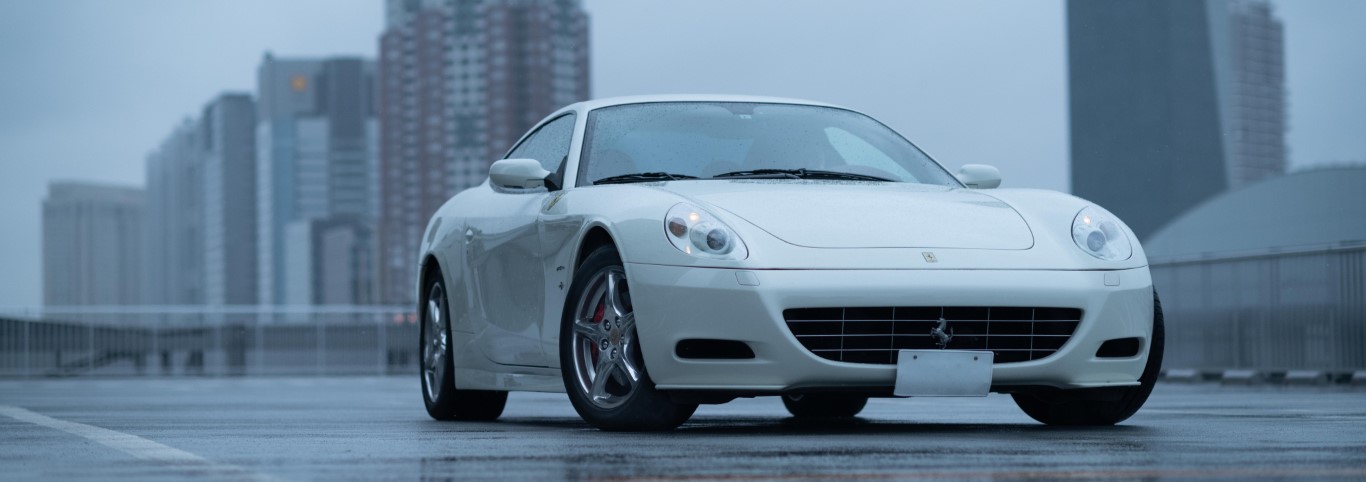

The Rebirth of the Ferrari 2+2 GT
Launched in 2004, the Ferrari 612 Scaglietti emerged to succeed the 456M, marking a fundamental turning point for the V12-engined grand tourers from the Maranello brand. The goal was clear and ambitious: to create an authentic 2+2 automobile, capable of accommodating four adults with a level of comfort and space previously unseen for the manufacturer, redefining expectations for a long-distance car that balances sporting performance with luxury and practicality.
The name "612 Scaglietti" is, in itself, a dual tribute. The number "6" refers to the engine displacement of 5,748 cm³, rounded to 6 liters, while the "12" indicates the number of cylinders of its imposing powerplant. The surname "Scaglietti" is a reverence to Sergio Scaglietti, the legendary artisan and coachbuilder from Modena, responsible for some of the most iconic and valuable Ferraris of the 1950s and 1960s. Known as the "master of aluminum," his connection with the model goes beyond a simple homage. The choice of his name, made while he was still alive – a rare and significant tribute –, was a true declaration of intent from Ferrari. By associating the new car with the greatest historical master in aluminum work, the brand signaled the project's fundamental technological shift: the transition to an advanced all-aluminum construction, creating a bridge between the company's glorious, artisanal past and its present technical innovation.
The production of the 612 Scaglietti took place between 2004 and 2011 at the historic factory in Maranello, Italy. During this period, a total of 3,025 units were manufactured, a number that positions it as a relatively exclusive model in the automotive universe.
Design and Engineering – The Fusion of Tradition and Modernity
The design of the 612 Scaglietti represents a remarkable balance between Ferrari's stylistic heritage and the application of cutting-edge engineering technologies for its time.
Exterior Styling by Pininfarina
The exterior design was conceived by the renowned Pininfarina studio, under the leadership of designer Ken Okuyama. The primary inspiration for its fluid and muscular lines came from a unique and historic model: the 1954 Ferrari 375 MM, commissioned by acclaimed film director Roberto Rossellini as a gift for his wife, actress Ingrid Bergman. The most direct homage to this iconic car are the sculpted side recesses, known as "scallops," which give the 612 a distinct profile and timeless elegance.
Despite being the longest production Ferrari of its era, the design with short overhangs and a generous wheelbase of 2,950 mm managed to maintain sporting proportions and a sense of agility. The bodywork was almost entirely constructed of aluminum, with the exception of the bumpers and some covers made of thermoplastic material.
The Luxury Cabin
The interior of the 612 Scaglietti was designed to fulfill the promise of being a true 2+2. The long wheelbase allowed the creation of a genuinely spacious cabin for four adults, a substantial improvement over its predecessor. Access to the rear seats was carefully thought out, with doors that opened to a wider angle and an electric system that moved the front seats forward to facilitate entry and exit.
The internal environment was pure luxury, with extensive use of high-quality leather and aluminum details on the dashboard, center console, and controls, reinforcing the connection with the noble material that defined the car's structure. The instrument panel combined the best of both worlds: a large analog tachometer in a central position, flanked by a speedometer on the right and a multifunctional digital screen on the left, offering a clear and intuitive reading of vital information.
The Aluminum Structure
The foundation of the 612 Scaglietti was its advanced structure. It was the second Ferrari model, after the 360 Modena, to use a fully aluminum spaceframe chassis, developed in collaboration with the American company Alcoa. Composed of aluminum extrusions and castings welded together, this structure offered torsional rigidity far superior to that of the 456M and was about 60 kg lighter, despite the significant increase in the car's dimensions.
The adoption of this technology, validated in the mid-engined 360 Modena supercar, was not just an isolated technical improvement. It represented a strategic decision to unify Ferrari's cutting-edge engineering platform, transferring the aluminum chassis technology to its line of front-engined grand tourers. This not only resulted in a dynamically superior car but also reinforced Ferrari's image as an avant-garde company across its entire product range.
To optimize driving dynamics, Ferrari implemented a front-mid engine configuration, positioning the V12 behind the front axle, and a transaxle layout, with the gearbox mounted on the rear axle alongside the differential. This complex architecture achieved an almost perfect weight distribution of 46% at the front and 54% at the rear, a crucial factor for the agility, balance, and predictability of the car's behavior on the road.
The Heart of the Machine – V12 Engine and Performance
At the center of the 612 Scaglietti experience is its magnificent V12 engine, an Italian engineering masterpiece that combines brute power with smooth and linear delivery.
F133F Engine Specifications
The 612 Scaglietti is equipped with the Tipo F133F engine, a naturally aspirated 65° V12 with 5,748 cm³ (5.7L) of displacement. This unit is a direct evolution of the engine used in the 575M Maranello and 575 Superamerica models, enhanced to deliver more power and refinement.
The engine produces a maximum power of 540 CV (397 kW) at 7,250 rpm and a maximum torque of 588 Nm (60 kgfm) at 5,250 rpm. With 48 valves (four per cylinder), double overhead camshafts, and a dry-sump lubrication system, it was designed to offer exceptional performance across all rev ranges.
Performance and Dynamics
The performance figures of the 612 Scaglietti are impressive, even by today's standards. Acceleration from 0 to 100 km/h is accomplished in a time between 4.0 and 4.2 seconds, with a top speed approaching 320 km/h (199 mph).
The suspension is independent double wishbone on all four wheels, ensuring precise body control and a high level of comfort. The original brakes were ventilated steel discs, 345 mm in diameter at the front and 330 mm at the rear. Later, carbon-ceramic brakes were introduced as part of performance packages and became standard on newer models, offering superior fade resistance and greater stopping power.
Transmissions – The Rare Choice and the Standard
The 612 Scaglietti was offered with two transmission options, which radically define the character and value of the car in today's market.
- The 6-Speed Manual Gearbox: An extreme rarity and the dream of many purists, the 612 could be equipped with a 6-speed manual transmission, featuring the iconic metal gated shifter on the center console. Only 199 units were produced with this configuration worldwide, making it one of the most coveted modern GTs by collectors. Production of manual models ended prematurely in 2006.
- The F1A Automated Transmission: The vast majority of 612s (over 93% of production) were equipped with the "F1A" 6-speed automated transmission. This system, a refined version of Ferrari's single-clutch technology, was operated by paddle shifters behind the steering wheel and offered a fully automatic mode, prioritizing comfort and ease of use on long journeys.
The extremely low adoption rate of the manual gearbox (only 6.5% of total production) provided Ferrari with unequivocal market data. The overwhelming customer preference for a luxury GT with the convenience of the F1A transmission demonstrated that the era of manual transmissions in the brand's V12 cars was coming to an end. This trend, observed in the 612, directly influenced the decision not to develop a manual option for its successors, effectively closing an important chapter in Ferrari's history.
Complete Technical Data Sheet – Ferrari 612 Scaglietti (2004-2011)
| Characteristic | Specification |
|---|---|
| Engine | 65° V12, naturally aspirated |
| Displacement | 5,748 cm³ |
| Maximum Power | 540 CV (397 kW) @ 7,250 rpm |
| Maximum Torque | 588 Nm (60 kgfm) @ 5,250 rpm |
| Transmission | 6-speed manual or 6-speed F1A automated |
| Drivetrain | Rear-wheel drive |
| 0-100 km/h | 4.0 - 4.2 seconds |
| Top Speed | Approx. 320 km/h (199 mph) |
| Chassis | Aluminum spaceframe |
| Suspension | Independent, double wishbone (front and rear) |
| Brakes | Ventilated discs (steel or carbon-ceramic) |
| Length | 4,902 mm |
| Width | 1,957 mm |
| Height | 1,344 mm |
| Wheelbase | 2,950 mm |
| Weight (curb) | Approx. 1,840 kg |
| Trunk | 240 liters |
| Fuel Tank | 105 - 110 liters |
Evolution Throughout Production (2004-2011)
The life of the 612 Scaglietti can be divided into two distinct phases, marked by important technological updates that kept it relevant and desirable throughout its seven years of production.
The Early Years (2004-2007)
Launch models came with the F1A or manual transmission options, steel brakes as standard, and an interior that did not yet feature the Manettino dial on the steering wheel. For customers seeking a more refined driving experience, Ferrari introduced two optional performance packages:
- HGTS (Handling Gran Turismo Sport): This package included a sportier suspension calibration, remapped transmission software for faster gear changes, exclusive design 19-inch modular wheels, and a sports exhaust system that intensified the V12 sound.
- HGTC (Handling Gran Turismo Competizione): Added to all the items of the HGTS package were the powerful and durable carbon-ceramic brakes (CCM), which became a highly sought-after item.
The 'One-To-One' (OTO) Era (2008-2011)
In 2008, Ferrari launched the "One-To-One" (OTO) personalization program, an initiative that transformed the buying experience and the car itself. Customers began to configure their vehicles directly at the factory, with a vast range of exclusive options. As a result, production became strictly build-to-order.
However, the OTO program was much more than just aesthetic personalization. It marked the introduction of a series of substantial technological updates that effectively created an unofficial "second generation" of the 612. This modernization was a strategic response to the need to keep the 612 competitive, especially after the launch of the technologically superior 599 GTB Fiorano in 2006. By transferring key technologies from the 599 to the 612, Ferrari not only rejuvenated the model and boosted sales but also laid the groundwork for its future "Atelier" personalization program.
The main updates of the OTO cars included:
- F1 SuperFast Transmission: The F1A gearbox was upgraded with the "SuperFast" system, inherited from the 599, which reduced the gear shift time to just 100 milliseconds (or 85 ms with the HGT2 package), providing a much faster and sportier response.
- Manettino on the Steering Wheel: Ferrari's iconic driving mode selector was finally added to the steering wheel, allowing the driver to easily adjust suspension, traction control, and transmission response settings.
- Electrochromic Roof: A panoramic glass roof with electrically adjustable opacity became a standout option, increasing the sense of space and modernity in the interior.
- Upgraded Standards: Carbon-ceramic brakes and 20-inch wheels became standard items or part of common packages on OTO cars, reflecting the model's technological evolution.
Special Editions and Unique Examples – Exclusivity in Details
In addition to production updates, the exclusivity of the 612 Scaglietti was amplified by a series of special editions and unique models, which are highly valued by collectors today.
Ferrari 612 Scaglietti Special Editions
| Edition | Year | Quantity Produced | Target Market | Key Distinguishing Features |
|---|---|---|---|---|
| 612 Sessanta | 2007 | 60 | Global | Two-tone paint, electrochromic roof, forged wheels, exclusive interior, Manettino on steering wheel |
| Cornes 30th Anniversary | 2006 | 20 | Japan | "Blu Cornes" color, standard HGTC package, carbon fiber fuel cap |
| GP Berne Edition | 2006 | 9 | Switzerland | Grey/silver paint, HGTC package, red interior, commemorative Bern circuit plaque |
612 Sessanta (2007)
Created to celebrate Ferrari's 60th anniversary, the 612 Sessanta was a limited edition of just 60 units. Available exclusively with the F1 transmission, each car featured a two-tone paint job (Grigio Scuro/Nero or Rubino Micalizzato/Nero), the electrochromic glass roof, 19-inch forged wheels, a luxurious interior in "Terra Bruciata" or "Charcoal" leather, and the addition of the Manettino and start button on the steering wheel. Each unit had a unique commemorative plaque, instantly making it a collector's item.
Cornes 30th Anniversary (2006)
To commemorate 30 years of partnership with its importer in Japan, Cornes & Co., Ferrari produced a special series of 20 units destined exclusively for this market. These cars were distinguished by the exclusive "Blu Cornes" color, the inclusion of the HGTC package as standard, a carbon fiber fuel cap, and commemorative emblems in the interior.
GP Berne Edition (2006)
Limited to just 9 units for the Swiss market, this edition celebrated Ferrari's 40th anniversary in the country. It was characterized by a two-tone dark grey paint with silver side "scallops," the HGTC package with carbon-ceramic brakes, a red leather interior with grey details, and a commemorative plaque with the layout of the historic Bern circuit.
Other Notable Versions
Other unique examples reinforce the 612's legacy, such as the 612 Kappa (2006), a one-off commissioned by collector Peter Kalikow with exclusive design details, and the GG50 (2005), a concept car created by Giorgetto Giugiaro to celebrate his 50-year career, both based on the 612 platform.
The 612 Scaglietti in Historical Context
To fully understand the legacy of the 612 Scaglietti, it is essential to position it between the model that preceded it and the one that succeeded it, analyzing the technological and conceptual evolution of Ferrari's line of V12 grand tourers.
Comparison with Predecessor – Ferrari 456M GT (1998-2003)
The 612 Scaglietti represented a quantum leap compared to the 456M GT. In terms of dimensions, the 612 was significantly larger, with a wheelbase 350 mm longer, which translated directly into superior interior space. Where the 456M used a tubular steel chassis with aluminum panels, the 612 adopted the modern, fully aluminum spaceframe structure, which was more rigid and proportionally lighter. At its heart, the 5.5L, 442 CV V12 engine of the 456M was replaced by the 5.7L, 540 CV V12 of the 612, an increase of nearly 100 CV that reduced the 0 to 100 km/h acceleration time from 5.2 to around 4.2 seconds.
Comparison with Successor – Ferrari FF (2011-2016)
If the 612 was an evolution, its successor, the Ferrari FF (Ferrari Four), was a revolution. The FF broke with the tradition of two-door coupes, introducing a bold, three-door "shooting brake" design. The most radical change, however, was the introduction of Ferrari's first four-wheel-drive system (4RM), designed to offer usability in all weather conditions. The powertrain was also completely new: a 6.3L direct-injection V12 producing 660 CV, coupled to a 7-speed dual-clutch transmission, much faster and smoother than the 612's single-clutch F1A. Performance was elevated to a new level, with acceleration from 0 to 100 km/h in just 3.7 seconds.
Generation Comparison – 456M GT vs. 612 Scaglietti vs. FF
| Characteristic | Ferrari 456M GT (1998-2003) | Ferrari 612 Scaglietti (2004-2011) | Ferrari FF (2011-2016) |
|---|---|---|---|
| Engine | 5.5L V12 | 5.7L V12 | 6.3L V12 GDI |
| Power | 442 CV | 540 CV | 660 CV |
| 0-100 km/h | 5.2 s | 4.2 s | 3.7 s |
| Top Speed | > 300 km/h | ~ 320 km/h | 335 km/h |
| Transmission | Manual 6M / Auto 4A | Manual 6M / F1A 6M | Dual Clutch 7M |
| Drivetrain | Rear | Rear | All-Wheel (4RM) |
| Chassis | Tubular steel / Aluminum | Aluminum spaceframe | Aluminum spaceframe |
| Weight (dry) | 1,690 kg | ~ 1,840 kg | 1,790 kg |
| Wheelbase | 2,600 mm | 2,950 mm | 2,990 mm |
The Legacy of the 612 Scaglietti
The Ferrari 612 Scaglietti was much more than just a grand tourer; it was a crucial transitional model in the brand's history. It introduced modern aluminum engineering to the V12 GT lineage, redefined the standard of space and usability for a four-seater Ferrari, and, remarkably, was the last of its kind to offer the purity of a traditional manual transmission.
Initially underestimated by some due to its design and considerable size, the 612 Scaglietti has been increasingly valued in the modern classic market. The extremely rare manual models command stratospheric prices, while the technologically superior OTO era cars are sought after for their combination of modernity and analog character. For many, it represents a relative value proposition in the world of Ferrari V12s, offering a combination of performance, luxury, and practicality that is unlikely to be replicated.
Its ultimate legacy is that of a car that occupies a unique place in Ferrari's timeline. The 612 Scaglietti pays homage to the brand's artisanal past – evoking the names of Scaglietti, Pininfarina, and the glamour of the 375 MM – while paving the way for the technological future, serving as the perfect bridge between the classic GT and the modern super-GT.