
1st Generation
(2018-2024)
6.5 V12
830 cv
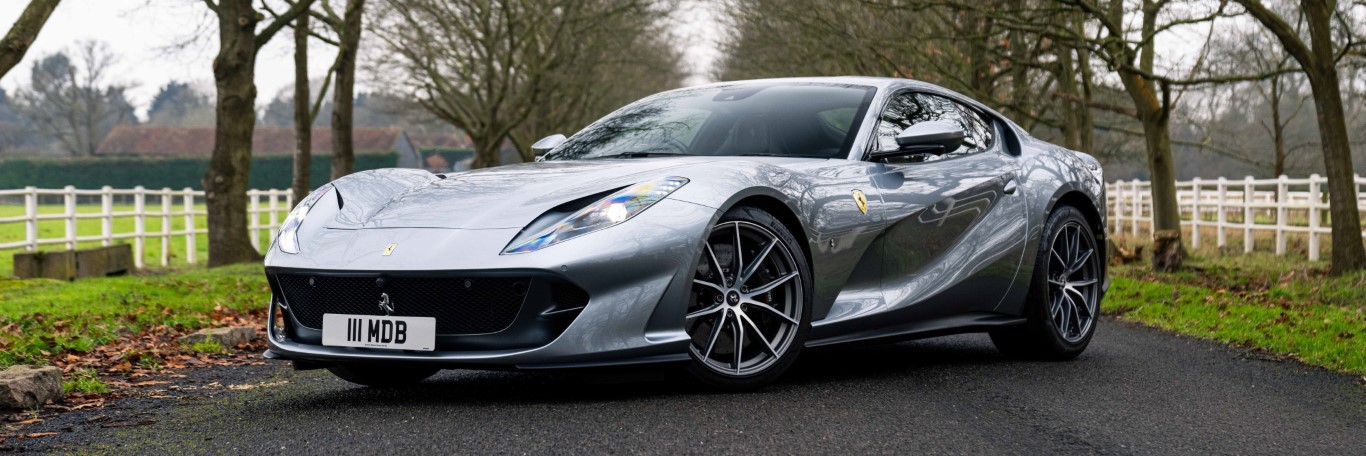
The pinnacle of the atmospheric V12: a force of nature combining 800 hp of raw power with cutting-edge technology.
Select a generation to see available versions
(2018-2024)
The history of Ferrari is, in its essence, the history of the 12-cylinder V engine (V12). Since the first car to bear the Prancing Horse, the 125 S, left the gates of Maranello in 1947, this type of engine has become the soul of the brand. Seventy years later, at the 2017 Geneva Motor Show, Ferrari celebrated this heritage with the launch of a new milestone in its lineage: the Ferrari 812 Superfast.
Positioned as the successor to the acclaimed F12berlinetta, the 812 Superfast was not a revolution, but rather a meticulous evolution of the front-mid-engine Grand Tourer (GT) formula. Its name is a statement of intent and a tribute to the past. The number "812" is a literal description of its mechanics: "8" for its 800 horsepower (cv) and "12" for the number of cylinders in the engine. The surname "Superfast" revives a nomenclature used on exclusive Ferrari models in the 1950s and 1960s, connecting it directly to the golden era of the brand's GTs.
The launch of the 812 was a strategic move that transcended the simple presentation of a new product. By connecting the most powerful car in its history (at the time) to its 70th anniversary, Ferrari wove a powerful narrative, transforming the vehicle into a historic event from day one. This strategy solidified the value and desirability of the model, positioning it not just as a performance machine, but as a crucial chapter in Ferrari's mythology. In an automotive world that was moving rapidly toward turbochargers and hybridization, the 812 Superfast and its variants represented the pinnacle and, for many, the glorious farewell to the era of the purely naturally aspirated V12 in a regular production model from the brand. Its successor, the 12Cilindri, would arrive years later to mark the definitive end of this chapter.
The 812 Superfast was designed with a clear goal: to set a new standard for front-engine sports cars, combining overwhelming performance with the ability to be a comfortable car for long journeys.
At the center of the 812 Superfast is an engineering masterpiece: the 65-degree V12 engine, code F140 GA. It is a direct evolution of the F12berlinetta's engine, with its displacement increased from 6.3 to 6.5 liters (specifically 6496 cc). The result is a maximum output of 800 hp (588 kW) delivered at 8,500 rpm and a torque of 718 Nm at 7,000 rpm. At the time of its launch, this was the most powerful naturally aspirated engine ever installed in a series-production car, a remarkable feat that dispensed with the use of turbo or hybrid technology.
The specific output of 123 hp per liter was an unprecedented figure for a front engine in a production car. However, Ferrari did not focus solely on peak numbers. To ensure that the car was usable on a daily basis, engineers made sure that 80% of the maximum torque was available at just 3,500 rpm, providing vigorous acceleration and flexibility at lower revs. The engine's ability to rev up to a maximum limit of 8,900 rpm, with a power curve that rises constantly, offers the driver a feeling of limitless acceleration.
The performance figures of the 812 Superfast are impressive: 0 to 100 km/h acceleration in 2.9 seconds, 0 to 200 km/h in 7.9 seconds, and a claimed top speed of 340 km/h. To manage this power and ensure perfect weight distribution (47% at the front and 53% at the rear), the car uses a transaxle architecture, with the engine in the front and the transmission mounted at the rear.
The 812 Superfast introduced two crucial technologies that represented a turning point for Ferrari. The first was the adoption of Electric Power Steering (EPS), a premiere for the brand. Although purists traditionally prefer hydraulic steering, Ferrari integrated the EPS into all of the vehicle's dynamic control systems to fully exploit the car's performance potential.
The second innovation was the Virtual Short Wheelbase 2.0 (PCV) system. Inherited from the experience with the F12tdf, this system combines front steering assistance with rear-wheel steering. At low speeds, the rear wheels turn in the opposite direction of the front ones, making the car more agile, as if it had a shorter wheelbase. At high speeds, they turn in the same direction, increasing stability. The introduction of these technologies was not just to make the car easier to drive, but it was framed as a tool to enhance performance, allowing a driver to explore the limits of an 800 hp car with more confidence. This solidified a new philosophy for the brand's V12s, where maximum performance is achieved through a complex symbiosis between mechanics and software.
To complete the dynamic package, the 812 Superfast was equipped with Brembo Extreme Design carbon-ceramic brakes, the same ones used on the LaFerrari, which improved braking performance from 100 to 0 km/h by 5.8% compared to the F12berlinetta.
The design of the 812 Superfast, conceived by the Ferrari Styling Centre, is a fusion of beauty and function. The aerodynamic goal was to increase downforce — the force that presses the car against the ground, improving stability — without increasing aerodynamic drag, which would hinder top speed and fuel consumption.
To achieve this, a combination of active and passive solutions was used. The front of the car was designed to channel the air and increase downforce, with ducts for cooling the brakes and to increase airflow under the car. The underbody features three pairs of curved dams that act as vortex generators, responsible for 30% of the downforce increase compared to the F12berlinetta. At the rear, the diffuser has active flaps that can open at high speeds to reduce drag.
Visually, the 812 Superfast redefines the language of Ferrari's front-mounted V12s. Its fastback silhouette, with a high and short rear, is a direct homage to the iconic 1969 365 GTB/4 "Daytona". Details like the full-LED headlights and the four circular taillights modernized the look, while maintaining the brand's identity.
The interior draws inspiration from both the F12berlinetta and the LaFerrari, with an instrument panel focused on the driver and elements that seem to "float", creating a sporty and sophisticated atmosphere.
In 2019, Ferrari revived one of its most celebrated traditions with the launch of the 812 GTS. The model marked the return of a series-production car with a front V12 engine and convertible bodywork, something that hadn't happened in 50 years, since the legendary 365 GTS/4 "Daytona Spider". The acronym GTS, which stands for "Gran Turismo Spider", is a classic nomenclature that reinforces this historical connection.
The main feature of the 812 GTS is its retractable hard top (RHT), which can be opened or closed in just 14 seconds, even with the car in motion at speeds of up to 45 km/h. The removal of the fixed roof, however, presented significant engineering challenges. The rear part of the car was completely redesigned to accommodate the roof mechanism, with the addition of two sculptural buttresses that maintain the fluidity of the design.
To compensate for the loss of structural rigidity, the chassis was reinforced. This need, combined with the roof mechanism, resulted in a weight increase of 75 kg compared to the 812 Superfast. To maintain the feeling of agility, Ferrari engineers made mechanical adjustments: the 800 hp V12 engine remained unchanged, but the seven-speed dual-clutch transmission received shorter gear ratios. This change improved throttle response, compensating for the additional weight and ensuring that the feeling of performance was preserved.
The conversion to a convertible eliminated important aerodynamic ducts that were integrated into the Superfast's roof structure and that contributed to rear downforce. For a brand focused on performance, simply losing this efficiency was unacceptable. The solution was a complete re-engineering of the rear diffuser, which incorporated a "triplane wing". This new design generates suction under the car, effectively recovering the lost downforce and ensuring that the stability and dynamic behavior of the GTS remain virtually identical to those of the coupe.
This engineering effort demonstrates a fundamental point about the elite supercar market: the emotional experience is just as valuable as raw numbers. Ferrari invested in complex solutions not to make the car faster, but to ensure that it did not get slower while becoming more thrilling.
Despite the extra weight, the performance of the 812 GTS is extraordinary and almost indistinguishable from the coupe. Acceleration from 0 to 100 km/h is accomplished in 3.0 seconds (just 0.1 seconds slower than the Superfast), and top speed remains at the same 340 km/h.
The true differentiator of the GTS, however, is not on the stopwatch, but in the sensory experience. With the roof open, the glorious sound of the naturally aspirated V12 engine invades the cabin, becoming the central element of the drive. The noise that begins as a low growl and transforms into a high-pitched scream near 9,000 rpm is an experience that the coupe, no matter how impressive it may be, cannot replicate with the same intensity.
In 2021, Ferrari presented the ultimate expression of the 812 platform: the limited Competizione series. Following the tradition of the track-focused "Versione Speciale", like the 599 GTO and the F12tdf, the Competizione was designed to offer maximum performance and driving pleasure. It was launched in two variants: the 812 Competizione, a coupe, and the 812 Competizione A (for "Aperta", or open), a version with a removable carbon fiber targa top.
The 6.5-liter V12 engine was radically reworked to reach new heights. The power was raised to 830 hp, but the most impressive change was the increase in the maximum engine speed to 9,500 rpm — the highest ever reached by a street-legal Ferrari engine until then.
To achieve this rotation reliably, Ferrari applied technologies directly derived from its Formula 1 program. Internal components were replaced with exotic materials: the steel connecting rods gave way to titanium connecting rods, 40% lighter; the piston pins received a diamond-like carbon (DLC) coating to reduce friction; and the crankshaft was lightened. These are not just improvements, but rather racing technologies that justify the existence and the price of the car, serving as a showcase for Ferrari's engineering capability.
The quest for maximum performance led to a complete aerodynamic overhaul and an obsessive weight reduction. The use of carbon fiber is extensive throughout the bodywork, including bumpers, rear spoiler, and air intakes, as well as the interior. The result is a dry weight of 1,487 kg for the Competizione, a significant reduction compared to the Superfast.
The most visible and radical innovation is the replacement of the coupe's rear window with a monolithic aluminum structure, patented by Ferrari. This single piece integrates vortex generators that improve aerodynamic efficiency, while giving the car an aggressive and unmistakable appearance, where function dictates form in an extreme way. Cooling was also improved, with a new single front air intake and "Aero" brake calipers with integrated air ducts, improving cooling efficiency by 10%.
The greatest dynamic evolution of the Competizione is the introduction of an independent four-wheel steering system. Unlike the PCV 2.0, where the rear wheels steer together, in this system the right and left actuators can move independently. This allows for a much more precise control of the car's behavior in corners, drastically increasing agility and response to steering wheel inputs.
The combination of all these improvements results in mind-blowing performance. Acceleration from 0 to 100 km/h drops to 2.85 seconds, and the lap time at the Fiorano test circuit is 1 minute and 20 seconds, 1.5 seconds faster than the 812 Superfast.
The 812 platform also served as the basis for exclusive creations from Ferrari's "Special Projects" program, where selected clients can commission unique cars (one-offs), designed in collaboration with the brand's styling center. These vehicles represent the pinnacle of customization and exclusivity, being more than just cars: they are the manifestation of the profound relationship between a client and the brand.
Based on the 812 Superfast, the Omologata was commissioned by a European client and took more than two years to be completed. Only the windshield and headlights were kept from the original car; all the aluminum bodywork was hand-crafted and is completely new. The design is futuristic, but full of references to classic Ferrari GTs, such as the 250 GTO. Details like the hammered effect paint on interior parts and the exclusive exterior color, Rosso Magma, reinforce its uniqueness.
Built on the 812 GTS platform for a Taiwanese collector, the SP51 is a pure roadster, without any kind of roof. Its design was meticulously optimized in a wind tunnel to ensure cabin comfort, even without a top. The paint, an exclusive shade called Rosso Passionale, is complemented by a blue and white stripe inspired by the legendary 1955 Ferrari 410 S. The exterior stripe theme continues into the interior of the car, creating a unique visual connection between the exterior and the cabin.
Exclusivity is a pillar of Ferrari's strategy, and the production numbers of the 812 family reflect this, especially in the limited edition versions.
| Model | Production Period | Units Produced | Notes |
|---|---|---|---|
| 812 Superfast | 2017–2024 | Not officially disclosed | Being a series-production model, it is estimated that thousands of units were manufactured. |
| 812 GTS | 2019–2022 | 5,348 (according to F-Register) | There was controversy, with early sources mentioning production limited to 500 units, possibly for a specific market or year. |
| 812 Competizione | 2021 | 999 | Limited edition, with all units sold before the official launch. |
| 812 Competizione A | 2021 | 599 | Limited edition, also sold out before launch. |
| Omologata | 2020 | 1 | Unique example from the Special Projects program. |
| SP51 | 2022 | 1 | Unique example from the Special Projects program. |
The controversy surrounding the 812 GTS numbers deserves attention. While some sources, including dealerships, cited a production limited to 500 units for the year 2022, detailed records, such as the F-Register, point to a total of 5,348 units manufactured over its production cycle. The most likely conclusion is that the mention of "500 units" was a marketing strategy or referred to a specific allocation, and not the global total, making the GTS a rare car, but not a strictly limited edition like the Competizione.
Production of the 812 family was discontinued to make way for its successor, the Ferrari 12Cilindri, presented in 2024, officially marking the end of the 812 chapter in Ferrari's long history.
The Ferrari 812 family represents the pinnacle of naturally aspirated V12 engine engineering from Maranello. It symbolizes the high point of an era, combining record-breaking power with assistance technologies that made this performance exploitable. The 812 Superfast set a new standard for Grand Tourers, the 812 GTS revived a 50-year tradition with open-air excitement, and the 812 Competizione pushed this formula to its absolute limit, bringing a street car closer to a race car like few before.
In the future, the 812 will be remembered not only for its impressive numbers, but for its soul: the sound, the response, and the emotion of one of the greatest V12 engines ever built. For many enthusiasts and collectors, it will forever be the "last great true Ferrari V12", the last of its kind to reign without the complexity of turbos or hybrid systems in a regular production model from Ferrari. Its legacy is secured as one of the most glorious chapters in the history of the Prancing Horse.