
Strategic Context and Market Philosophy
The introduction of the Ferrari California in 2008 did not represent merely the launch of a new model, but a fundamental strategic pivot in Ferrari's modern history. Internally coded as project F149, the California was conceived to fill a specific gap in Maranello's portfolio: that of a front-engine convertible Grand Tourer (GT), usable daily, which would serve as an entry point to the brand.
Historically, Ferrari maintained a clear dividing line between its mid-engine V8 sports cars (like the F430 at the time) and its V12-engine GTs (like the 612 Scaglietti and the 599 GTB). The California broke this dichotomy by introducing a fourth line of models: a front-engine V8 GT. The intention was clear: to attract a new demographic of clients — estimated at 70% new buyers to the brand — who sought the performance of the Prancing Horse, but demanded versatility, comfort, and ease of use superior to track-focused supercars.
By reviving the name "California", Ferrari invoked one of the most romantic and valuable bloodlines in its history, referring directly to the Ferrari 250 GT California Spyder of the late 1950s and the exclusive 365 California of the 1960s. However, unlike its predecessors that were derived from race cars or ultra-limited productions, the modern California was an exercise in high-technology series production, designed to be the manufacturer's highest volume model up to that point.
Ferrari California (2008–2014): The Innovation Platform
The official launch took place at the Paris Motor Show in October 2008, revealing a vehicle that, under the bodywork designed by Pininfarina, housed an unprecedented amount of technological innovations for the brand. The California was not a derivative model; it was a debut platform for technologies that would define Ferrari in the following decade.
Engineering Innovations and "Firsts"
The Ferrari California holds the title of being the Ferrari production vehicle that introduced the largest number of "firsts" in a single launch:
- First Front V8: It was the first Ferrari road car to mount a V8 engine in the front position (technically front-mid, behind the front axle).
- Dual-Clutch Transmission (DCT): It was the first to abandon the "F1" single-clutch automated transmission in favor of a 7-speed dual-clutch gearbox manufactured by Getrag.
- Gasoline Direct Injection (GDI): The F136 IB engine was the brand's first to use direct injection to improve efficiency and low-end torque.
- Multi-link Rear Suspension: Designed to offer a superior compromise between comfort and stability, replacing the traditional double wishbones in the rear.
- Retractable Hard Top (RHT): The first Ferrari convertible to use a folding metal roof, transforming the car from coupe to spyder in 14 seconds.
The F136 IB Engine: Specifications and Architecture
The heart of the first-generation California is the naturally aspirated 4,297 cc (4.3 liters) V8 engine, part of the acclaimed F136 engine family shared and developed jointly with Maserati.
F136 IB Engine Technical Data
An analysis of the specifications reveals an engine focused on linear power delivery and immediate response:
- Total Displacement: 4,297 cm³.
- Architecture: 90° V8 with a flat-plane crank, typical of Ferrari to allow high revs and the characteristic sound.
- Bore x Stroke: 94 mm x 77.4 mm. This "oversquare" configuration favors high-rpm operation.
- Compression Ratio: 12.2:1. A high ratio requiring high-octane fuel to maximize thermal efficiency.
- Maximum Power: 460 CV (338 kW / 453 hp) at 7,750 rpm.
- Maximum Torque: 485 Nm (357 lb-ft) at 5,000 rpm.
- Specific Power: Approximately 107 CV per liter, an exceptional value for a naturally aspirated engine of the time.
The use of direct injection allowed engineers to increase the compression ratio without the risk of premature detonation (engine knocking), resulting in a more complete burn and lower emissions compared to the F430's V8.
Exterior Design and Aerodynamics
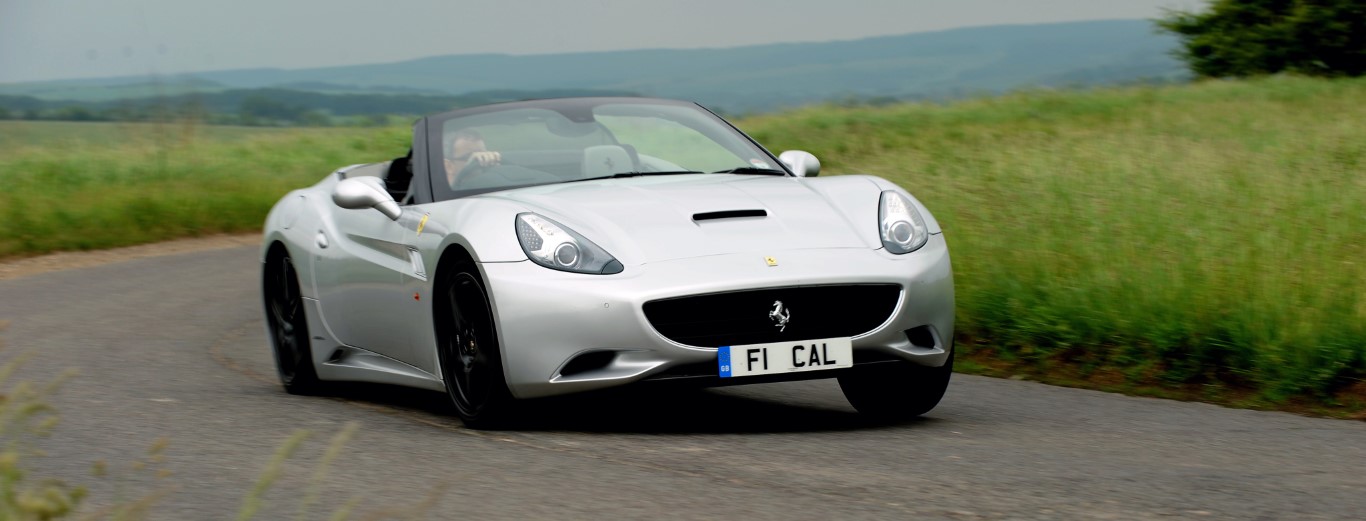
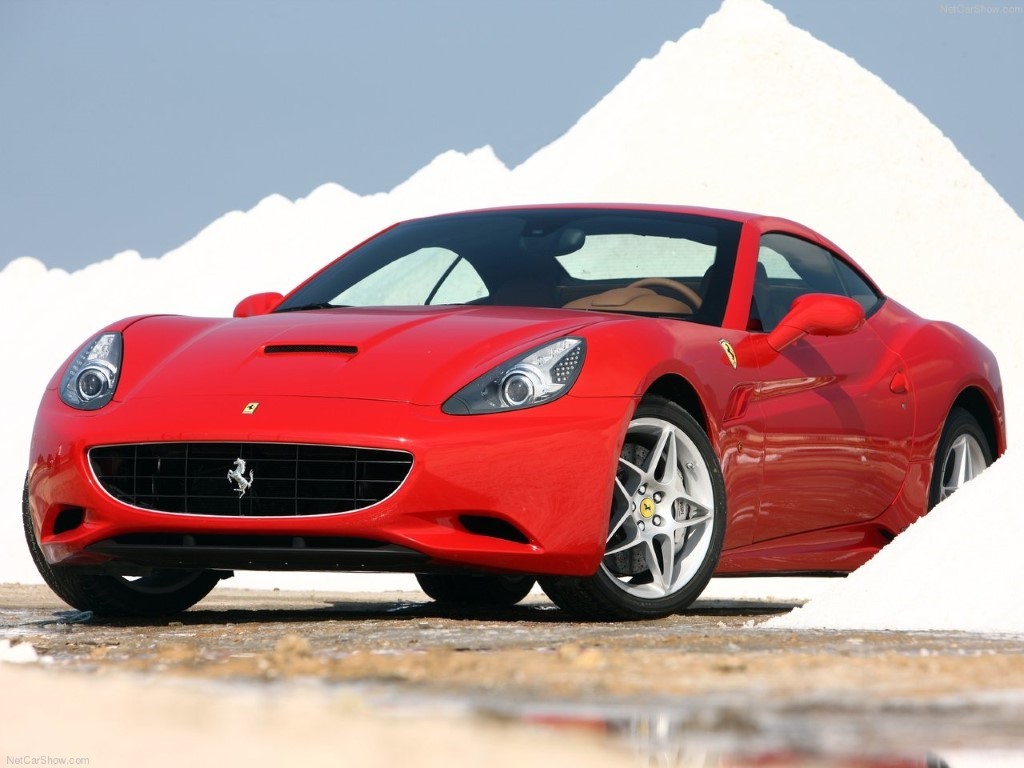
The California's design, signed by Pininfarina under the supervision of Ken Okuyama, generated immediate debates due to its proportions. The need to accommodate the folded retractable hard top required a rear ("deck") that was visibly higher and bulkier compared to traditional soft-top spyders.>
Despite the rear volume, the aerodynamic work was intense. The California's drag coefficient (Cd) is 0.32, making it the most aerodynamic production Ferrari at the time of its launch, until being surpassed by the F12berlinetta (Cd 0.299) years later.
- Dimensions: Length of 4,563 mm, width of 1,902 mm, and height of 1,308 mm.
- Chassis: Built entirely in aluminum, ensuring lightness and superior torsional rigidity compared to steel chassis, essential for a convertible.
- Seating Configuration: The car was offered in two configurations: "2+2" (with small rear seats suitable only for children or extra luggage) and "2+" (where the rear seat was replaced by a leather bench for luggage).
Chassis Dynamics and Suspension
Weight distribution was a critical point of development. Thanks to the engine placement behind the front axle (Front-Mid) and the transmission mounted on the rear axle (Transaxle), Ferrari achieved a weight distribution of 47% at the front and 53% at the rear. This rear bias is ideal for traction under hard acceleration and balance in corners.
The Multi-link rear suspension was a significant technical novelty. Unlike the double wishbone system used on the F430, the multi-link system allows a more refined separation between longitudinal forces (impact absorption comfort) and transversal forces (cornering stability), making the car more docile on uneven roads without sacrificing precision.
The standard braking system included Brembo carbon-ceramic (CCM) discs on all wheels, a feature that became standard at Ferrari during the California's production. The front discs measured 390 x 34 mm with 6-piston calipers, and the rear ones 360 x 32 mm with 4-piston calipers. This ensured 100-0 km/h braking distances in just 34 meters.
The Historical Anomaly: The Manual Transmission
One of the most intriguing chapters in the history of the Ferrari California is the existence, however brief and microscopic, of a manual transmission option. At launch, Ferrari offered, in theory, a 6-speed manual gearbox with the iconic steel gate (gated shifter) as an alternative to the new dual-clutch transmission.
This manual gearbox was a unit derived from previous models, adapted for the transaxle layout and the modern electronics of the California. However, market reality proved ruthless against the manual transmission at that time.
Production and Extreme Rarity
The demand for the manual version was statistically irrelevant. Records indicate that, between 2008 and the discontinuation of the option in 2012, only three (3) to five units were produced with a manual gearbox worldwide. Some sources, such as specialized dealers, specifically cite that only two cars were ordered, while other records suggest up to five, including one confirmed order in the UK.
Impact on the Collector Market
Absolute scarcity transformed the manual California into a "unicorn" in the collector market. While a 2012 California with a DCT gearbox can be found on the used market for values between $80,000 and $110,000, the rare manual units command prices that frequently exceed $500,000, a valuation of over 400%. This phenomenon reflects the growing nostalgia for the analog driving experience, ironically in a car that was designed to be the most technological and easy-to-drive of its era.
The Mid-Life Evolution: Ferrari California 30 (2012–2014)
In 2012, responding to criticism regarding the vehicle's weight and seeking to maintain competitiveness, Ferrari introduced a significant technical update. Although visually identical to the 2008 model, this version became known unofficially, but widely, as the California 30.
The nomenclature "30" derives from the two main engineering changes:
- A weight reduction of 30 kg.
- A power increase of 30 CV.
Weight Reduction and Power Engineering
The weight reduction to 1,600 kg (dry weight) was achieved through advances in the manufacturing processes of the aluminum chassis by the "Scaglietti Centre of Excellence". The use of new aerospace alloys and casting techniques allowed the structural mass to be decreased without compromising torsional rigidity, crucial for a convertible's dynamics.
In the engine bay, the 4.3-liter V8 received new exhaust manifolds (with lower backpressure) and a reprogrammed ECU. The result was a power jump to 490 CV (483 hp) at 7,750 rpm and a torque increase to 505 Nm (372 lb-ft) at 5,000 rpm. The torque curve was modified to be more robust across the entire rev range.
Version 30 Performance
These changes had a direct impact on the performance numbers:
- 0-100 km/h Acceleration: Reduced to 3.8 seconds (previously 4.0s).
- Maximum Speed: Marginally increased to 312 km/h.
Handling Speciale (HS) Package - First Iteration
Alongside the "30" update, Ferrari introduced the optional Handling Speciale (HS) package, aiming to silence critics who considered the California "too soft" for a Ferrari. The HS package focused exclusively on chassis dynamics and did not alter engine power.
The technical modifications of the HS package included:
- Steering: Installation of a new steering rack with a 9% faster ratio, reducing the number of lock-to-lock turns from 2.5 (standard) to 2.3 turns, providing a sharper corner entry.
- Magnetorheological Suspension (SCM): The magnetorheological dampers, which alter fluid viscosity through magnetic fields, received a new control ECU with a 50% faster response time (reduced to 5 ms).
- Springs: Springs were stiffened by 15% at the front and 11% at the rear to reduce body roll in corners.
- Aesthetics: HS models are identifiable by the front grille painted in "Grigio Ferro" (matte silver) and by the side air vents in the same color.
The Turbo Revolution: Ferrari California T (2014–2017)
The presentation of the Ferrari California T (Project 149M) in February 2014, ahead of its public debut at the Geneva Motor Show, marked the beginning of a new era for Ferrari. The "T" in the name signaled the return of forced induction to Maranello's road cars, something that had not occurred since the legendary F40.
The shift to turbocharged engines was driven by stricter global emissions and fuel efficiency regulations, forcing Ferrari to seek a solution that would reduce consumption without sacrificing — and preferably increasing — performance.
The F154 BB Engine: Engineering and "Variable Boost Management"
The new powerplant, code F154 BB, is a 3,855 cc (3.9 liters) V8 with twin-scroll turbochargers. This engine shares the basic architecture with Maserati's V8s (like in the Quattroporte GTS), but the Ferrari version is distinct, utilizing a flat-plane crank, specific cylinder heads, and complex exhaust manifolds made of three cast and welded pieces.
California T Engine Specifications
The table below illustrates the massive jump in performance compared to the naturally aspirated model:
Variable Boost Management (VBM)
The greatest technical innovation of the California T was the Variable Boost Management system. Traditional turbo engines deliver peak torque very early, creating a flat power curve that discourages high revs. To preserve the "soul" of Ferrari, which demands the driver explore the tachometer, Ferrari electronically limited torque in the lower gears (1st to 3rd), progressively increasing it in the intermediate gears. The maximum total torque of 755 Nm is only available in 7th gear. This creates a sensation of increasing acceleration, simulating the behavior of a larger displacement naturally aspirated engine.
Aesthetic and Functional Redesign
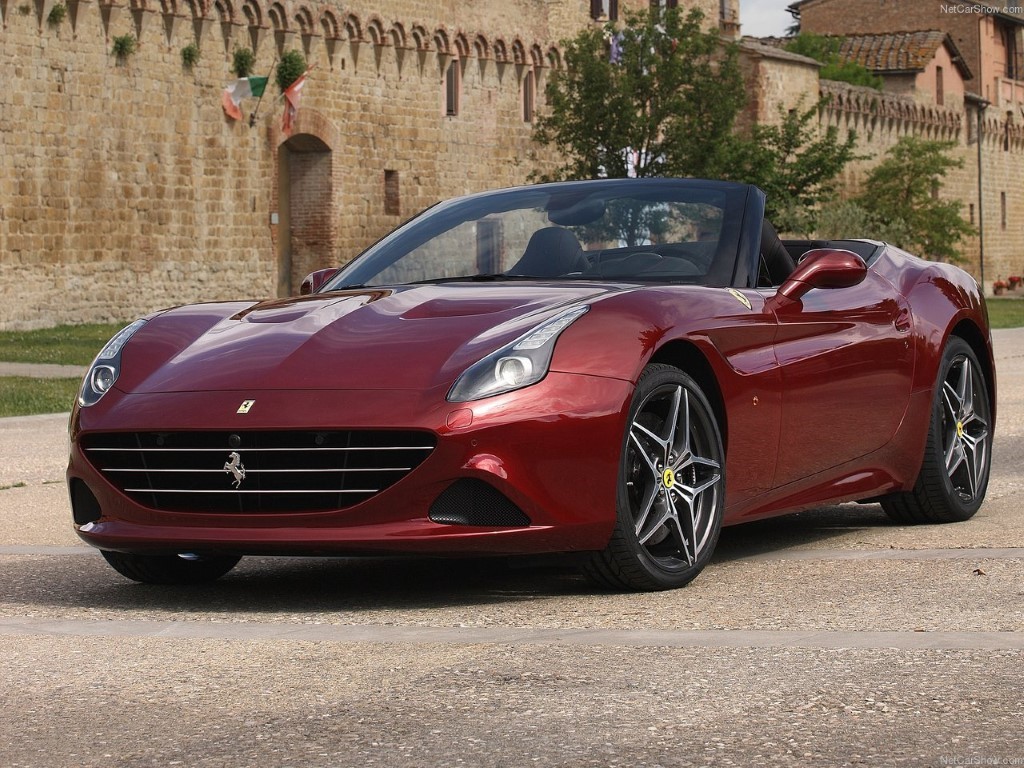
Although it maintained the central cell and retractable roof of the original model, the California T underwent a profound aesthetic overhaul. All body panels, except the roof and windows, were redesigned.
- Front: The front grille became wider and more angular, inspired by the F12berlinetta, to feed the turbo intercoolers. The hood lost the functional central air intake (a signature of the naturally aspirated model) and gained two discreet heat extractors.
- Side: The sides were sculpted taking inspiration from the famous "pontoon-fender" styling of the Ferrari 250 Testa Rossa, eliminating the sharp crease of the previous model in favor of more fluid lines that help disguise the rear's height.
- Rear: The rear was visually restructured to appear lower and wider. The trunk lid was lowered by about 12 mm (0.5 inch) at the trailing edge. The exhausts, previously stacked vertically (2+2), were repositioned horizontally, which helped visually widen the car.
Interior and Infotainment
Inside, the California T introduced the "Turbo Performance Engineer" (TPE), a digital touch-sensitive display located between the central air vents. This instrument allowed the driver to view information regarding turbo efficiency, engine response, and temperature, emphasizing the new nature of the powerplant. The infotainment system was also updated to a higher-resolution screen, although it was still criticized for feeling dated compared to contemporary rivals, with reports of buttons getting "sticky" over time, a common problem in the brand's cars of that era. Apple CarPlay support was one of the technological additions during the T's life cycle.
Refined Dynamics: The Handling Speciale Package on the California T (2016–2017)
In 2016, Ferrari launched the Handling Speciale (HS) package version adapted for the California T. Criticisms regarding the muffled sound of the turbo engine and the comfort-oriented suspension led Ferrari to develop a more aggressive package than that of the previous generation.
Turbo HS Technical Changes
The HS package for the California T focused on three pillars: suspension, sound, and transmission logic.
- Spring Stiffness: Springs were stiffened by 16% at the front and 19% at the rear. This significantly increased body control in rapid directional changes, sacrificing some ride comfort in favor of precision.
- SCM3 Dampers: The third-generation magnetorheological dampers were recalibrated to work with the stiffer springs, maintaining the impact absorption capacity but reducing roll and pitch.
- Gearbox Strategy: In "Sport" mode, the DCT transmission logic was altered to provide faster and more impactful gear shifts, simulating a more visceral mechanical engagement.
- Exhaust System: A new exhaust system was developed with revised internal geometry and modified silencers. The goal was to increase the volume and improve the tonal quality of the turbo V8, making it deeper and more present across all rev ranges.
Visually, the cars equipped with the California T HS package are distinguished by the front grille and rear diffuser in "Matte Grigio Ferro" (matte gray) and by the matte black exhaust tips.
Production Analysis and Market Statistics
The Ferrari California was an undeniable commercial success, fulfilling its volume mission. An analysis of the production numbers, although based on expert estimates (given Ferrari's confidentiality), reveals the magnitude of the project.
Production Volumes
Ferrari's total production capacity at the time was around 27 cars per day (about 7,000 to 8,000 per year for all combined models). The California occupied a significant slice of this capacity.
- Generation 1 (2008–2014): It is estimated that about 8,000 to 10,000 units of the original California (including the 30 version) were produced. Production was more intense in the early years (2009-2010) to meet pent-up demand.
- Generation 2 (California T, 2014–2017): Production of the California T was robust, benefiting from the global expansion of the luxury market. Records indicate the production of 1,645 units in 2014, rising to 2,638 in 2015 and 2,247 in 2016. The estimated total for the T series is around 15,000 units (Note: Some sources cite ~15,000 as the combined total for both generations, while others suggest 17,000 as the grand total. The most conservative and likely estimate, adding the available annual data, points to a combined total of approximately 17,300 vehicles between 2008 and 2017).
Estimated Annual Breakdown (2013-2017)
The data available for the final production years offers a granular look at the product's life cycle:
- 2013: 1,219 units (End of California 30)
- 2014: 1,645 units (Transition to California T)
- 2015: 2,638 units (Peak production of the T)
- 2016: 2,247 units (Introduction of the HS Pack)
- 2017: ~1,600 units (End of production, transition to Portofino)
Demographics and Legacy
A crucial piece of data for understanding the success of the California is that approximately 70% of the buyers were new to the Ferrari brand. This validates the strategy of the F149 as a conquest vehicle. Furthermore, the car had a utilization rate much higher than the brand's average, with owners accumulating significantly higher annual mileages than in models like the 458 Italia, proving its viability as a "daily driver".
Conclusion
The production of the Ferrari California T ended in 2017, being replaced by the Ferrari Portofino, which further refined the formula with a stiffer chassis, more power, and a more aggressive design.
The California, in all its iterations, remains an industrial milestone. It proved that Ferrari could produce in volume without diluting the brand's prestige, introduced the modern era of DCT transmissions and hardtops, and paved the way for the acceptance of turbocharged engines.
For the enthusiast or collector, the California line offers three distinct personalities:
- Original California (2008-2012): The purity of the initial concept, the classic sound of the naturally aspirated V8, and the historical importance of the innovations.
- California 30 (2012-2014): The "sweet spot" for purists of naturally aspirated driving, combining the lighter and more powerful chassis with the sharp steering of the HS package, making it today the most desired naturally aspirated version (excluding the manuals).
- California T (2014-2017): The choice for those seeking modern torque, superior interface technology, and an aesthetic more aligned with Ferrari's current design language.
The California was not just a car; it was the foundation upon which Ferrari built its financial and technological sustainability in the 21st century.