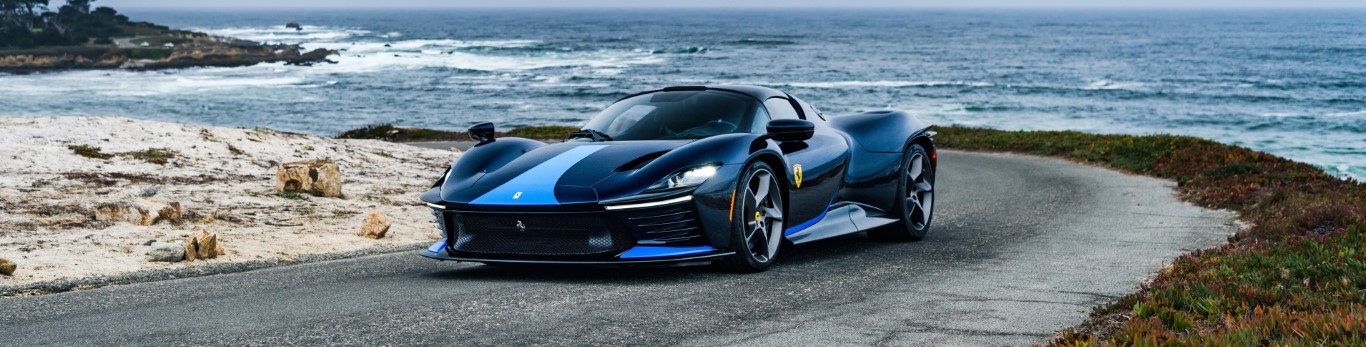
To understand the soul of the Daytona SP3, one must travel back in time to the 1960s,
a period marked by one of the fiercest rivalries in motorsport history:
Ferrari versus Ford. The conflict was sparked at the beginning of the decade when Henry Ford
II attempted to buy Ferrari, but the negotiations abruptly failed due to Enzo Ferrari's
refusal to relinquish control of his racing team. Wounded in his pride,
Ford initiated a racing program with a virtually unlimited budget with a single
goal: to defeat Ferrari on its own turf, endurance racing,
especially the 24 Hours of Le Mans.
The pinnacle of the American offensive occurred in 1966. With their powerful GT40s, Ford handed
the Scuderia a series of humiliating defeats, claiming victories at the 24 Hours of Daytona,
12 Hours of Sebring and, the most painful blow of all, a 1-2-3 finish at Le Mans.
Enzo Ferrari, deeply affected by the defeat, channeled his fury onto the drawing board
of his chief engineer, Mauro Forghieri. Given carte blanche to innovate, Forghieri
developed a new weapon for the 1967 season: the Ferrari 330 P4. This prototype was
a radical evolution of its predecessor, the P3, featuring a redesigned 4-liter V12
engine with three valves per cylinder, Lucas fuel injection, a new chassis,
and improved aerodynamics, developed in wind tunnels.
The stage for the rematch was set for the first round of the 1967 championship: the 24
Hours of Daytona, on American soil. Ferrari, with considerably more limited
resources, faced the full force of Ford, who entered multiple cars to
maximize their chances. During the race, while the robust but heavy Ford GT40s
began to suffer from reliability issues, especially in their transmissions,
the more agile and sophisticated Ferraris maintained a strong and consistent pace,
taking control of the event.
The climax of the race was an act of pure theater and strategic genius. With the victory
guaranteed, the team director, Franco Lini, instructed the drivers of the three leading
Ferrari cars to slow down and group up. In an image that
would become immortal, the 330 P3/4 (P3 chassis with P4 engine) in first place, the 330
P4 in second, and the 412 P (a customer version of the P4) in third crossed the finish
line in a perfect side-by-side formation. The photo of this iconic finish graced
newspapers around the world, symbolizing "Enzo's revenge". This victory was not
just a triumph of speed, but of strategy, reliability, and sophisticated
engineering over brute force. It is this spirit that the Ferrari Daytona SP3 seeks to evoke.
The modern car, like its 1967 ancestor, does not aim to be the fastest in
absolute numbers — the hybrid SF90 Stradale, for example, holds the lap record at
Fiorano. Instead, its goal is to offer the purest and most
emotionally resonant driving experience, a triumph of passion and purist engineering in an era
dominated by electrification.