1st Generation
(2012 - 2017)
6.3 V12
780 cv
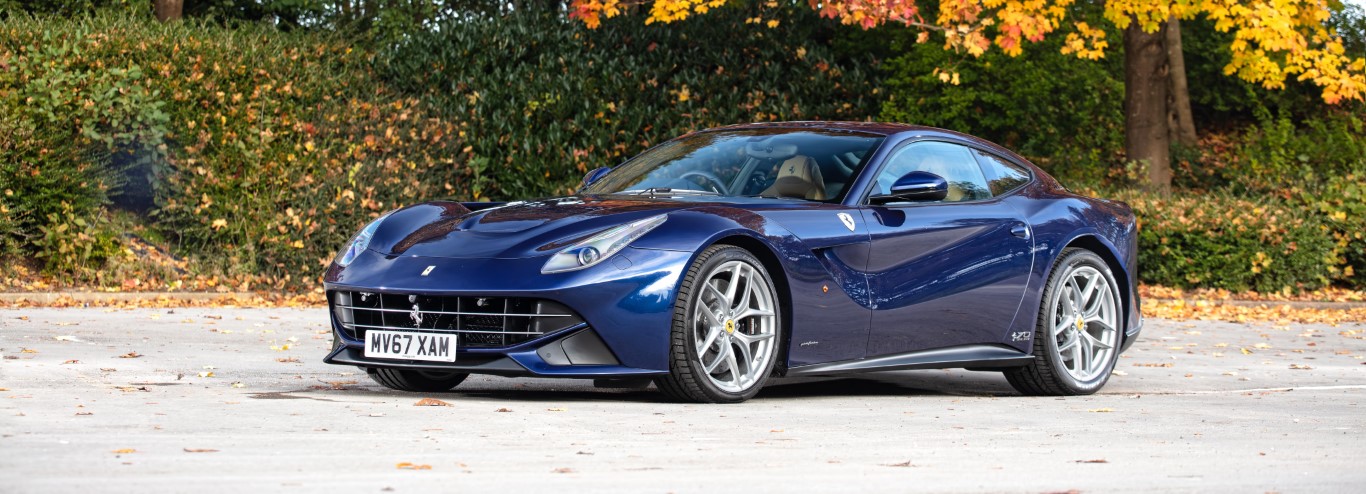
Technical specifications, versions, and history for the Ferrari F12 Berlinetta.
Select a generation to see available versions
(2012 - 2017)
Select a powertrain to view full technical specifications
The Ferrari F12berlinetta emerged in 2012 not just as a new model, but as the heir to one of the most prestigious lineages in motorsport: the front-mounted V12, rear-wheel-drive Ferrari Gran Turismos (GT). Officially unveiled at the Geneva Motor Show, it arrived with the monumental task of succeeding the acclaimed 599 GTB Fiorano, a pillar of the brand's identity that combines supercar performance with the ability to cross continents in comfort.
The impact of the F12berlinetta was immediate and overwhelming. At the time of its launch, it became the most powerful and fastest road car ever produced in Maranello. The model set a new record on the Fiorano test track with a time of 1 minute and 23 seconds, surpassing icons like the Ferrari Enzo and the 599 GTO, instantly positioning it as the industry's new performance benchmark.
Critical acclaim accompanied its performance. Top Gear magazine named it "The Supercar of the Year 2012", a recognition that solidified its reputation and generated extraordinary demand. Even before the first deliveries, Ferrari had already sold the equivalent of a full year of production, confirming that the world was witnessing the birth of a new icon.
The F12berlinetta represented a quantum leap over its predecessor. Combining a V12 engine pushed to the limits of naturally aspirated engineering, a functionally beautiful design, and exquisite chassis dynamics, it redefined expectations for a high-performance GT.
The center of the entire F12berlinetta experience is its engine, a masterpiece of engineering. The powerplant, code-named F140 FC, is a naturally aspirated 6,262 cc (6.3-liter) V12 with cylinder banks at 65°. It produces an impressive 740 cv (730 hp) at 8,250 rpm and 690 Nm of torque at 6,000 rpm, with a maximum rev limit that reaches a staggering 8,700 rpm. The specific output of 118 cv per liter was a record for an engine of this type at the time, a testament to the level of optimization achieved by Ferrari engineers.
This engine was not just an exercise in brute force, but also in efficiency and usability. Thanks to innovations like a multi-spark ignition system and a drastic reduction in internal friction, it was 30% more fuel-efficient than that of the 599 GTB Fiorano. Furthermore, 80% of the maximum torque was available at just 2,500 rpm, ensuring vigorous and immediate acceleration across any rev range. Recognition of its excellence came in 2013 when the F12's V12 engine won the "International Engine of the Year" award in the prestigious "Best Performance" and "Best Engine Above 4.0 Liters" categories. This set of characteristics solidified the F12 as the pinnacle of naturally aspirated V12 engine technology, a technological milestone before the industry's inevitable transition to turbocharging and hybridization.
The design of the F12berlinetta was the result of a collaboration between the Ferrari Styling Centre, led by Flavio Manzoni, and the legendary Pininfarina studio. This partnership resulted in the last series-production Ferrari V12 designed jointly with Pininfarina, marking the end of an iconic era. The philosophy behind the design was the total integration of form and function, where aesthetic beauty was a direct consequence of aerodynamic efficiency.
The most notable innovation was the "Aero Bridge". This is an air channel that begins on the hood, passes through the sides, and flows along the car's flanks. This ingenious solution creates downforce (downward force that presses the car against the ground) without the need for aggressive aerodynamic appendages, like large rear wings, preserving the elegant silhouette of a classic GT.
Active aerodynamics also played a crucial role. Brake cooling ducts open automatically only when the brakes reach high temperatures, remaining closed the rest of the time to reduce drag. The result of all this work was a drag coefficient (Cd) of just 0.299 and the generation of 123 kg of downforce at 200 km/h, double what the 599 GTB Fiorano could produce. The F12 demonstrated a paradigm shift at Ferrari: aerodynamics was no longer just a functional component, but an intrinsic and beautiful part of the design.
The foundation of the F12berlinetta is an advanced aluminum space frame developed in partnership with Scaglietti, utilizing 12 different aluminum alloys. This construction resulted in a 20% increase in torsional rigidity and a 70 kg reduction in weight compared to the 599. The car was shorter, lower, and narrower than its predecessor, with the engine and seats positioned lower to optimize the center of gravity.
The dry weight was stated at 1,525 kg, with a curb weight of 1,630 kg. The weight distribution was ideal for a front-engine car, with 46% at the front and 54% at the rear, contributing to agile and balanced handling. Power was sent to the rear wheels via a 7-speed dual-clutch F1 transmission, which featured shorter gear ratios to fully exploit the engine's power. The package was managed by state-of-the-art electronic systems, including carbon-ceramic brakes (CCM3), magnetorheological suspension (SCM-E), an electronic differential (E-diff 3), and F1-Trac traction control.
The performance figures of the F12berlinetta were impressive: acceleration from 0 to 100 km/h in 3.1 seconds, 0 to 200 km/h in 8.5 seconds, and a top speed exceeding 340 km/h. However, what captivated critics most was its duality. The F12 was, at the same time, a viscerally fast supercar and a surprisingly comfortable and usable everyday Grand Tourer.
Jeremy Clarkson, on the Top Gear program, perfectly captured this essence. He praised the car's stunning beauty and the majestic sound of the engine, but also noted, with his characteristic irony, that the car would be "even better if it had... a little less power" for public roads. This comment, although a compliment to the car's overwhelming performance, highlighted the wild nature of the F12 and, unknowingly, anticipated the need for the engineering solutions that would be implemented in its future track-focused version.
The Ferrari F12berlinetta was produced between 2012 and 2017. The brand never officially announced the total number of units manufactured, but the industry estimate is that around 5,000 examples were produced globally.
If the F12berlinetta was the ultimate expression of the V12 Gran Turismo, the F12tdf was its transformation into a track-focused weapon. Launched in 2015, the "tdf" was not just a more powerful version; it was a complete re-engineering, designed to offer the most extreme driving experience possible in a road car.
The following table illustrates the magnitude of the tdf version's evolution compared to the standard Berlinetta.
| Metric | F12berlinetta | F12tdf |
|---|---|---|
| Power | 740 cv @ 8,250 rpm | 780 cv @ 8,500 rpm |
| Torque | 690 Nm @ 6,000 rpm | 705 Nm @ 6,250 rpm |
| Curb Weight | 1,630 kg | 1,520 kg |
| Acceleration 0-100 km/h | 3.1 seconds | 2.9 seconds |
| Acceleration 0-200 km/h | 8.5 seconds | 7.9 seconds |
| Downforce at 200 km/h | 123 kg | 230 kg |
| Units Produced | ~5,000 (estimated) | 799 |
The name "tdf" is a direct tribute to the legendary Tour de France Automobile road race, an endurance event that Ferrari dominated in the 1950s and 1960s, primarily with the 250 GT Berlinetta model. The F12tdf was conceived to be the ultimate expression of an extreme road car, equally at home on a race track.
The same 6.3-liter V12 engine was extensively reworked to produce 780 cv at 8,500 rpm and 705 Nm of torque, with the rev limit raised to 8,900 rpm. To achieve these numbers, engineers used components derived from racing programs, such as mechanical tappets and variable-geometry intake trumpets, similar to those used in Formula 1.
The F12tdf underwent a strict diet, resulting in a 110 kg reduction compared to the Berlinetta. This was achieved through the extensive use of carbon fiber in the bodywork and a deliberately "spartan" interior, where leather was replaced by Alcantara and the door panels were reduced to a single carbon fiber shell. The bodywork was completely redesigned, with a longer and higher rear spoiler, a redesigned rear diffuser with active flaps, and a more complex front bumper. These changes resulted in an 87% increase in downforce, practically doubling the car's aerodynamic efficiency.
The F12berlinetta was known for its overwhelming power, which could be a challenge to tame at the limit. Ferrari, by further increasing the power for the tdf, needed an engineering solution to make this performance not just usable, but effective. The answer was the introduction of the "Virtual Short Wheelbase", the first rear-wheel steering system in a Ferrari car.
This innovative system allows the rear wheels to turn slightly, compensating for the tendency to oversteer caused by the wider front tires and ensuring faster steering response times. The result is a car with the agility of a short-wheelbase vehicle in tight corners, but with the stability of a long-wheelbase one at high speeds. This was not a luxury addition, but an engineering necessity that transformed the car's character, converting its wild nature into surgical precision.
With all the improvements, the F12tdf was capable of accelerating from 0 to 100 km/h in just 2.9 seconds and from 0 to 200 km/h in 7.9 seconds. On the Fiorano track, it set a time of 1 minute and 21 seconds, two seconds faster than the F12berlinetta.
Production was strictly limited to 799 units worldwide, all sold before the official announcement, making it an instant collector's item. The resounding success of the F12tdf consolidated Ferrari's "versione speciale" strategy, proving the existence of a robust market for limited-production, track-focused versions of its V12 cars. This business model was replicated with great success in later models, such as the 812 Competizione, demonstrating that the legacy of the tdf directly influenced the company's product strategy.
Beyond the series production models, the F12 platform served as the basis for some of Ferrari's rarest and most exclusive creations. Through the "Special Projects" program, selected clients can commission one-off cars, with entirely customized bodywork and designs. The F12's robust chassis and charismatic V12 engine made it the ideal canvas for these ambitious projects, resulting in a notable number of bespoke creations.
The table below summarizes the main special editions and one-offs based on the F12.
| Model Name | Year | Base | Units Produced | Main Feature |
|---|---|---|---|---|
| F12 TRS | 2014 | Berlinetta | 2 | Barchetta bodywork (roofless) inspired by the 250 Testa Rossa. |
| SP America | 2014 | Berlinetta | 1 | Coupé with Pininfarina design inspired by the 250 GTO. |
| F60 America | 2014 | Berlinetta | 10 | Roadster to celebrate 60 years of Ferrari in North America. |
| Touring Berlinetta Lusso | 2015 | Berlinetta | 5 | Handcrafted aluminum bodywork by Touring Superleggera. |
| SP275 RW Competizione | 2016 | Berlinetta/tdf | 1 | Design inspired by the 275 GTB/C with engine and gearbox from the F12tdf. |
| F12berlinetta SG50 | 2015 | Berlinetta | 1 | Unique edition to commemorate 50 years of Singapore. |
| SP3JC | 2018 | Berlinetta | 2 | Roadster with a unique design and inspiration from 50s/60s models. |
F12 TRS (2014): Commissioned by a single client who requested two units, the F12 TRS is a barchetta (roofless roadster) with a design inspired by the iconic 1957 250 Testa Rossa. It features radically redesigned bodywork, with a wraparound windshield and a glass window in the hood that displays the red covers of the V12 engine.
SP America (2014): A one-off coupé with custom bodywork by Pininfarina. Its inspiration comes from the legendary 250 GTO, evident in the three air vents on the hood and the slots on the fenders that echo the racing classic.
F60 America (2014): An edition limited to just 10 units, created to celebrate 60 years of Ferrari in North America. Based on the F12, it features roadster bodywork with a removable soft top, an asymmetrical interior design (red for the driver, black for the passenger), and a blue and white livery inspired by the NART (North American Racing Team).
Touring Berlinetta Lusso (2015): A luxury reinterpretation of the F12, created by the famous Italian design house Carrozzeria Touring Superleggera. Limited to 5 units, each car has entirely new, hand-shaped aluminum bodywork with a more classic and fluid design, while maintaining the original mechanics of the F12berlinetta.
SP275 RW Competizione (2016): This one-off is a fusion of the best of the F12 family. It uses the F12berlinetta chassis but incorporates the more powerful engine and transmission of the F12tdf. The design, inspired by the Ferrari 275 GTB/C that won its class at Le Mans in 1965, features side slots, a redesigned rear, and a yellow livery in homage to the Ecurie Francorchamps team.
The proliferation of special projects based on the F12 was no coincidence. Its classic front-engine architecture and versatile aluminum chassis made it the ideal platform for re-characterization, a perfect blank canvas for the brand's most demanding clients. The strong retro inspiration seen in almost all of these models reveals a clear trend: for Ferrari's top-tier clients, the connection to the brand's historical legacy is just as valuable as cutting-edge performance, and the F12 was the platform that allowed the perfect fusion of these two worlds.
The Ferrari F12, in all its forms, represents one of the most significant chapters in the brand's modern history. It is widely considered one of the last and greatest examples of a purely naturally aspirated V12-engined Ferrari supercar, free from hybrid assistance or turbocharging, marking the peak and the end of an era of mechanical purity. Its successor, the 812 Superfast, maintained the tradition of the aspirated V12, but the F12 captured a balance point between beauty, brutality, and technology that made it unique.
As a result of its historical importance, its overwhelming performance, and the fact that it was the last design collaboration on a series V12 with Pininfarina, the F12berlinetta is already seen as a modern classic. The F12tdf, with its strictly limited production and extreme focus, achieved legend status instantly, with market values reflecting its rarity and significance.
In short, the F12 was not just the successor to the 599; it redefined what a Ferrari V12 Gran Turismo could be. It served as an acclaimed production car, a fearsome track weapon, and the foundation for the most exclusive dreams of Ferrari clients. Its legacy is that of one of the most complete, exciting, and important chapters in the long and celebrated history of Maranello's V12 engines.
Images of the Ferrari F12 Berlinetta