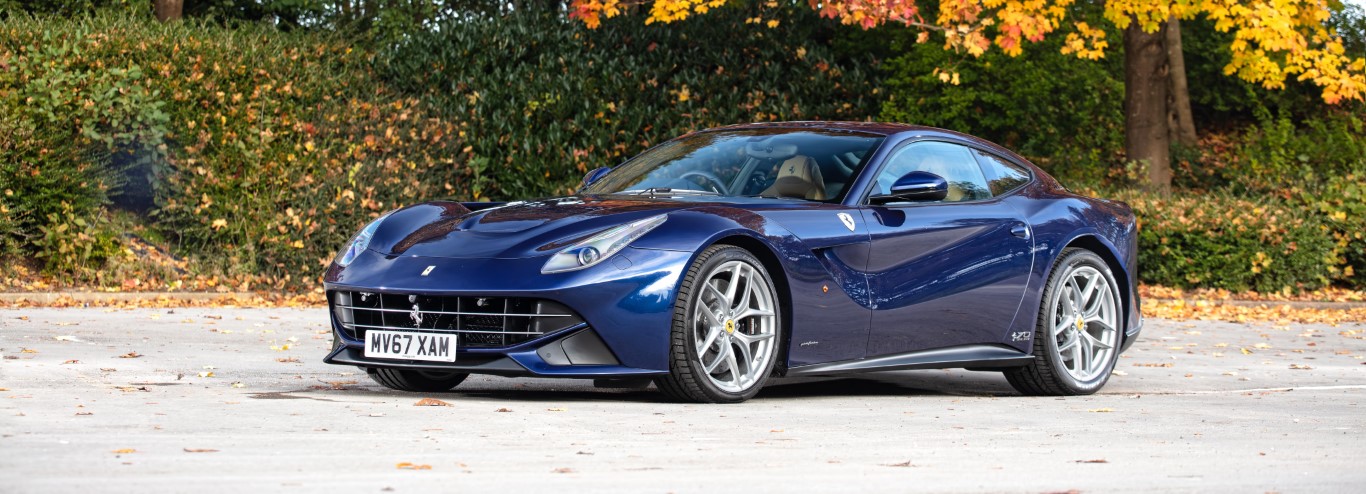
The F12berlinetta represented a quantum leap over its predecessor. Combining a V12 engine pushed to
the limits of naturally aspirated engineering, a functionally beautiful design, and exquisite chassis
dynamics, it redefined expectations for a high-performance GT.
The Heart of the Beast: The F140 FC V12 Engine
The center of the entire F12berlinetta experience is its engine, a masterpiece of engineering. The
powerplant, code-named F140 FC, is a naturally aspirated 6,262 cc (6.3-liter) V12 with cylinder banks at
65°. It produces an impressive 740 cv (730 hp) at 8,250 rpm and 690 Nm of torque at 6,000 rpm, with a
maximum rev limit that reaches a staggering 8,700 rpm. The specific output of 118 cv per liter was a record
for an engine of this type at the time, a testament to the level of optimization achieved by Ferrari
engineers.
This engine was not just an exercise in brute force, but also in efficiency and usability. Thanks to
innovations like a multi-spark ignition system and a drastic reduction in internal friction, it was 30% more
fuel-efficient than that of the 599 GTB Fiorano. Furthermore, 80% of the maximum torque was available at
just 2,500 rpm, ensuring vigorous and immediate acceleration across any rev range. Recognition of its
excellence came in 2013 when the F12's V12 engine won the "International Engine of the Year" award in the
prestigious "Best Performance" and "Best Engine Above 4.0 Liters" categories. This set of characteristics
solidified the F12 as the pinnacle of naturally aspirated V12 engine technology, a technological milestone
before the industry's inevitable transition to turbocharging and hybridization.
Design and Aerodynamics: The Art of Efficiency
The design of the F12berlinetta was the result of a collaboration between the Ferrari Styling Centre, led by
Flavio Manzoni, and the legendary Pininfarina studio. This partnership resulted in the last
series-production Ferrari V12 designed jointly with Pininfarina, marking the end of an iconic era. The
philosophy behind the design was the total integration of form and function, where aesthetic beauty was a
direct consequence of aerodynamic efficiency.
The most notable innovation was the "Aero Bridge". This is an air channel that begins on the hood,
passes through the sides, and flows along the car's flanks. This ingenious solution creates downforce
(downward force that presses the car against the ground) without the need for aggressive aerodynamic
appendages, like large rear wings, preserving the elegant silhouette of a classic GT.
Active aerodynamics also played a crucial role. Brake cooling ducts open automatically only when the
brakes reach high temperatures, remaining closed the rest of the time to reduce drag. The result of all this
work was a drag coefficient (Cd) of just 0.299 and the generation of 123 kg of downforce at 200 km/h, double
what the 599 GTB Fiorano could produce. The F12 demonstrated a paradigm shift at Ferrari: aerodynamics was
no longer just a functional component, but an intrinsic and beautiful part of the design.
Structure and Dynamics: Lightness and Precision
The foundation of the F12berlinetta is an advanced aluminum space frame developed in partnership with
Scaglietti, utilizing 12 different aluminum alloys. This construction resulted in a 20% increase in
torsional rigidity and a 70 kg reduction in weight compared to the 599. The car was shorter, lower, and
narrower than its predecessor, with the engine and seats positioned lower to optimize the center of gravity.
The dry weight was stated at 1,525 kg, with a curb weight of 1,630 kg. The weight distribution was
ideal for a front-engine car, with 46% at the front and 54% at the rear, contributing to agile and balanced
handling. Power was sent to the rear wheels via a 7-speed dual-clutch F1 transmission, which featured
shorter gear ratios to fully exploit the engine's power. The package was managed by state-of-the-art
electronic systems, including carbon-ceramic brakes (CCM3), magnetorheological suspension (SCM-E), an
electronic differential (E-diff 3), and F1-Trac traction control.
Performance and Reception
The performance figures of the F12berlinetta were impressive: acceleration from 0 to 100 km/h in 3.1
seconds, 0 to 200 km/h in 8.5 seconds, and a top speed exceeding 340 km/h. However, what captivated critics
most was its duality. The F12 was, at the same time, a viscerally fast supercar and a surprisingly
comfortable and usable everyday Grand Tourer.
Jeremy Clarkson, on the Top Gear program, perfectly captured this essence. He praised the car's
stunning beauty and the majestic sound of the engine, but also noted, with his characteristic irony, that
the car would be "even better if it had... a little less power" for public roads. This comment, although a
compliment to the car's overwhelming performance, highlighted the wild nature of the F12 and, unknowingly,
anticipated the need for the engineering solutions that would be implemented in its future track-focused
version.
Production and Sales
The Ferrari F12berlinetta was produced between 2012 and 2017. The brand never officially announced
the total number of units manufactured, but the industry estimate is that around 5,000 examples were
produced globally.