The Mission to Surpass a Legend
Presented to the world at the 1995 Geneva Motor Show, the Ferrari F50 carried the weight of a monumental heritage and an ambitious mission. It was not only the successor to the legendary F40, an icon that redefined the supercar concept in the 80s, but also the vehicle chosen to celebrate Ferrari's 50th anniversary as a car manufacturer. The directive from the company's then-president, Luca di Montezemolo, was unequivocal: to create the absolute pinnacle of automotive technology, a car that transferred the knowledge and soul of Formula 1 to a limited-production supercar, destined for a select group of clients.
This mission marked a profound philosophical shift compared to its predecessor. While the F40 was the ultimate expression of brute force, with its twin-turbo V8 engine and a minimalist approach, the F50 pursued a different path. The goal was not just to be fast, but to replicate the driving experience of a Formula 1 car as faithfully as possible in a street-legal vehicle. To achieve this, Ferrari abandoned the turbo in favor of a high-revving naturally aspirated V12 engine and built the car around a state-of-the-art chassis, derived directly from the most demanding tracks in the world. The F50 was conceived from the start to be a purist's machine, making no concessions to luxury, comfort, or ease of driving—an uncompromising testament to racing engineering.
Interestingly, the launch in 1995 anticipated the actual date of Ferrari's anniversary by two years, which would occur in 1997, the year the production of the last F50 was completed. This chronological anomaly reveals that the "anniversary" narrative was as much a celebration as it was an astute marketing tool. The true motivation for the 1995 launch seems to have been strategic: the car's development cycle was finished, the supercar market was heating up after an early-decade crisis, and Ferrari felt the need to introduce its new technological philosophy. The F50 was not just a commemorative gift; it was a calculated move to reaffirm Maranello's technological leadership in the post-F40 era, establishing a new paradigm for what a top-tier supercar could be.
Genesis and Design (1995-1997)
Pininfarina's Stroke: Function Over Form
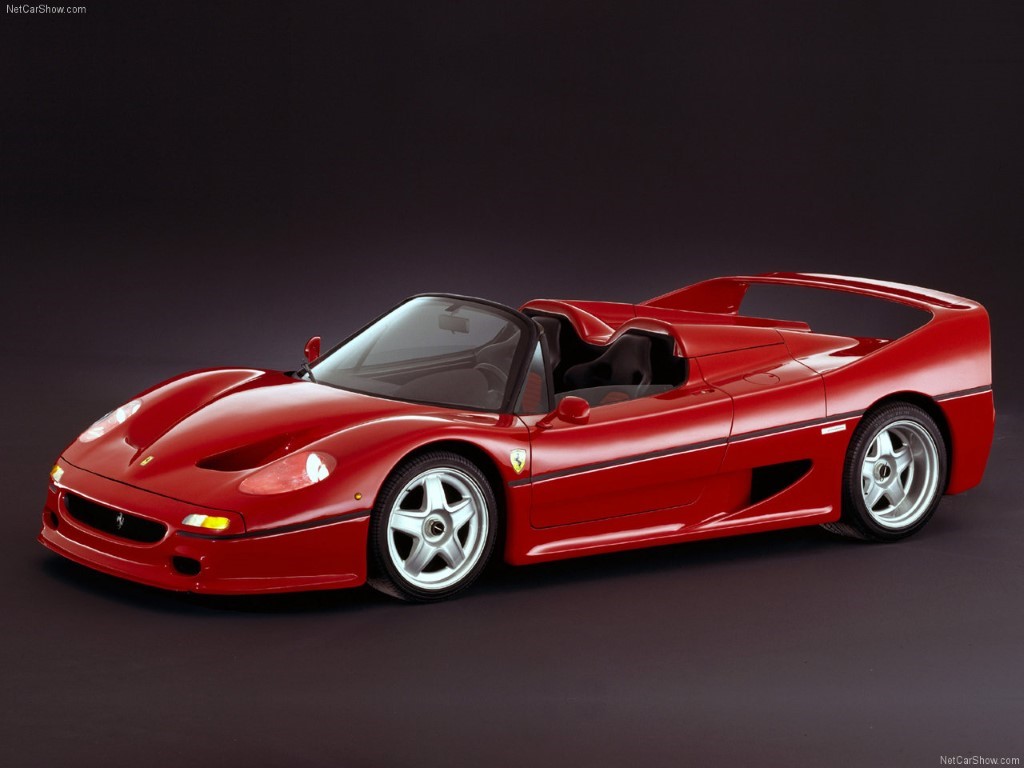
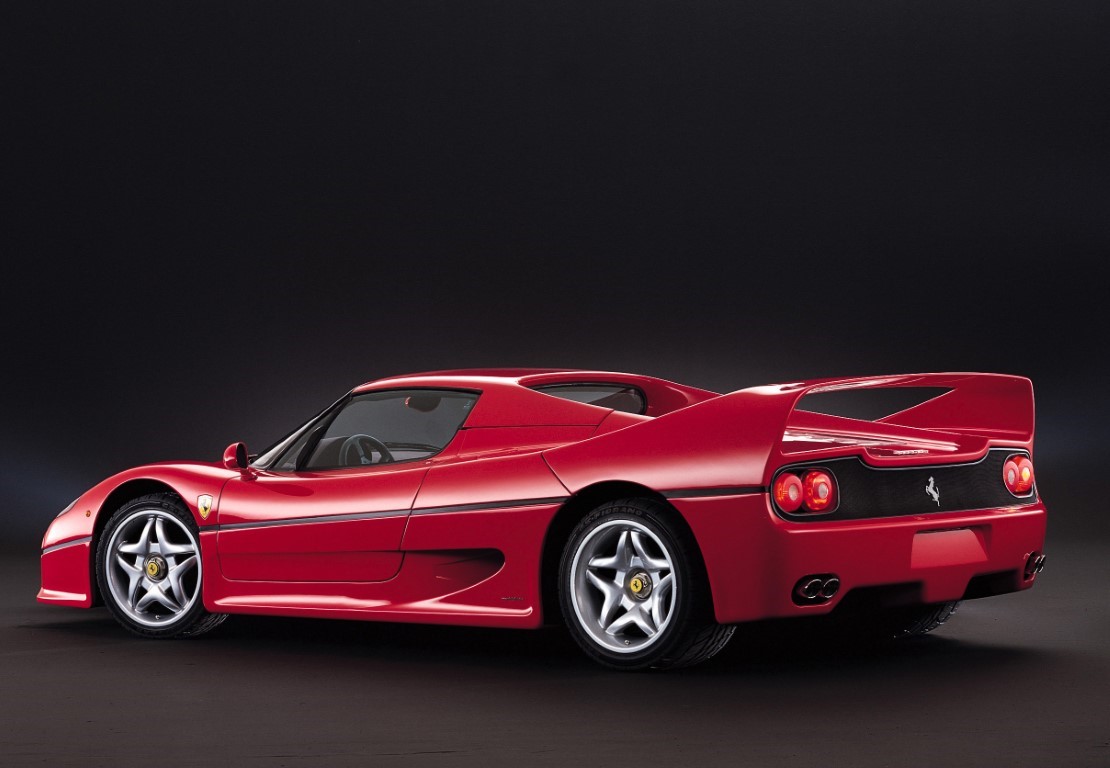
The design of the F50, conceived by the duo Lorenzo Ramaciotti and Pietro Camardella at the Pininfarina studio, was a deliberate break with the past. Heavily inspired by the 1989 Ferrari Mythos concept car and the aesthetics of Formula 1 cars of the time, the F50 abandoned the straight and angular lines of the F40 in favor of a more fluid, organic, and rounded look. Every curve and every opening in the bodywork was dictated by aerodynamic function, following the philosophy that form must follow function. The front end sought to emulate the nose of an F1 single-seater, with two large air vents on the hood for the radiators, while the rear was dominated by a wing even more radical than that of the F40, perfectly integrated into the bodywork to generate significant downforce.
This functional approach resulted in a design that, at the time, was met with divided opinions. Many considered it less pure or beautiful than the F40, with some critics going so far as to classify it as one of Pininfarina's least inspired works for Ferrari. However, this visual shift was not accidental. Ferrari and Pininfarina were visually communicating the car's philosophical transition: from the turbo brutality of the F40 to the aerodynamic sophistication and high-revving soul of F1. Over time, as enthusiasts began to understand the F50's deep connection to racing engineering, its design, once seen as controversial, came to be widely appreciated for its functional purity and clear purpose.
Advanced Aerodynamics
The shape of the F50 was sculpted through more than 2,000 hours of wind tunnel testing, a colossal effort to ensure stability and performance at extreme speeds. The result was a car with a drag coefficient (Cd) of 0.372, a respectable number for a vehicle with such a high need for cooling and downforce generation. At 300 km/h, the aerodynamic work generated a total of 310 kg of downforce, with 120 kg over the front axle and 190 kg over the rear, pressing the car against the asphalt and ensuring remarkable stability.
Barchetta Configuration
Reinforcing its connection with motorsport, the F50 was designed as a "barchetta," a two-seater roadster with a targa top configuration. The car came with a removable hardtop that, somewhat impractically, was delivered to the customer in a separate large box, as there was no compartment to store it in the vehicle. A small canvas soft top was provided for emergencies, but the intention was clear: the purest experience of the F50 was open-air, with the sound of the V12 engine enveloping the occupants, replicating the sensation of an F1 car. This design choice, although criticized for its lack of practicality, was a central element of the car's philosophy.
Production and Exclusivity
Ferrari adopted a production strategy for the F50 aimed at preventing the rampant speculation that plagued the F40. Luca di Montezemolo announced that only 349 units would be manufactured, stating that this number was "one less than they estimated they could sell." This tactic not only guaranteed the model's exclusivity but also positioned it as a "cultural monument," an object of desire for collectors. Production took place between 1995 and July 1997, with the chassis numbered in the continuous sequence of Ferrari's street cars. To further control the market, Ferrari implemented an installment purchase system for the first clients, making immediate resale for profit difficult.
The overwhelming majority of the cars were painted in Ferrari's traditional color, but the rarity of the other available colors today contributes significantly to the collector value of those examples.
Ferrari F50 Production by Color
| Color | Original Name | Units Produced |
|---|---|---|
| Red | Rosso Corsa | 302 |
| Yellow | Giallo Modena | 31 |
| Dark Red | Rosso Barchetta | 8 |
| Silver | Argento Nurburgring | 4 |
| Black | Nero Daytona | 4 |
The Heart of a Single-Seater - Engine and Transmission
Formula 1 Origin
The beating heart of the F50 is undoubtedly its engine: a 4.7-liter V12 (4698.50 cc) with a 65° angle between the cylinder banks, longitudinally mounted in the mid-rear of the car. Designated Tipo F130B, this engine was not just "inspired" by Formula 1; it was directly derived from the 3.5-liter V12 that powered the Ferrari 641 F1 car in the 1990 season, driven by legends like Alain Prost and Nigel Mansell. This lineage gave the F50 an authenticity and racing pedigree that few street cars in history can claim.
The transition from an engine designed to last only a few hundred kilometers at maximum revs to one that required durability and drivability on public roads was a monumental engineering challenge. Ferrari's solution was ingenious: before reaching the F50, a version of this engine block was used to power the Ferrari 333 SP racing prototype, which competed with great success in the IMSA championship in the United States starting in 1994. The endurance races of the 333 SP served as a brutal proving ground, allowing engineers to develop and validate the engine's robustness under extreme conditions, closer to the demands of a street car than an F1 Grand Prix. Thus, the F50's engine represents a unique convergence of three worlds: cutting-edge F1 technology, the endurance of prototype racing, and street car engineering.
Adaptation for the Streets
To make the F1 engine viable for the F50, several modifications were implemented. The displacement was increased from 3.5 to 4.7 liters, and the maximum rotation was reduced from the stratospheric ~13,000 rpm to a more manageable 8,500 rpm, with the ignition cut-off occurring at 8,640 rpm. Internal components, such as pistons and the crankshaft, were reinforced to ensure durability. Despite the alterations, the essential architecture was maintained, including the nodular cast iron block, a robust material, and the cylinder head with 5 valves per cylinder (three intake and two exhaust), totaling 60 valves. The use of exotic materials was extensive: the connecting rods were made of forged titanium, the valve covers and the oil and water pump housings were magnesium, and the intake manifold was made of carbon fiber-reinforced polymer. All this effort resulted in a remarkably light engine, weighing only 198 kg.
Performance and Technology
The final result was an engineering masterpiece that produced 520 cv (382 kW or 513 hp) at 8,500 rpm and 471 Nm (48 kgfm) of torque at 6,500 rpm. To optimize the delivery of power and torque across the entire rev range, the engine was equipped with advanced technologies for the time. A variable-length intake system, controlled by a butterfly valve inside the carbon fiber manifold, and a variable exhaust system, with bypass valves, were managed by the Bosch Motronic 2.7 electronic control unit. At low revs, the ducts were longer to favor torque; at high revs, they shortened to maximize power, making the engine surprisingly tractable given its origins.
The Last Manual Gearbox
All this power was sent to the rear wheels through a 6-speed manual transmission, operated by a shifter positioned in Ferrari's iconic chrome gated box. The F50 holds a special place in history as the last special series supercar ("halo car") from Ferrari to be equipped with a manual transmission. Its successor, the Enzo, would adopt the F1-style automated transmission with paddle shifters on the steering wheel, making the F50 a milestone for purists and one of the last examples of a fully analog driving era.
The Structure of an F1 - Chassis, Suspension and Aerodynamics
Carbon Monocoque Chassis
The F50 represented a quantum technological leap over its predecessor. While the F40 used a tubular steel chassis with composite panels, the F50 was built around a full carbon fiber monocoque. Manufactured by Cytec Aerospace, the chassis utilized cutting-edge materials such as pre-impregnated carbon fiber, epoxy resin, and a Nomex honeycomb core, a sandwich construction technique derived directly from Formula 1. This advanced structure weighed just 102 kg and provided phenomenal torsional rigidity of 34,570 Nm per degree, guaranteeing an extremely stable and responsive platform.
Engine as a Structural Component
Taking the F1 philosophy to the extreme, Ferrari engineers eliminated the rear subframes. The V12 engine and gearbox were bolted directly to the rear of the carbon monocoque, becoming structural members of the car. The rear suspension, in turn, was mounted directly to the transmission casing. This approach, common in race cars but radical for a street vehicle, maximized structural rigidity and reduced weight. However, this engineering choice had a direct and defining consequence: all vibrations, noises, and the mechanical pulsation of the engine were transmitted unfiltered into the cabin and the driver's seat. In any other car, this would be considered a defect, a flaw in refinement. In the F50, however, this vibration is not a defect, but rather the most authentic proof of its purpose. It is the car "speaking" to the driver, providing unparalleled tactile feedback on the behavior of the powertrain and chassis. The vibration becomes a feature, the embodiment of the F50's racing soul.
Competition Suspension
The F50's suspension was another piece of technology taken straight off the Formula 1 grid. At both the front and rear, the car used an unequal-length double wishbone (double A-arm) system actuated by push-rods. This layout allowed for more precise control of the suspension geometry and reduced unsprung mass. The system was complemented by Bilstein gas monotube shock absorbers, which were electronically controlled and adapted to road conditions and driving style, offering a compromise between control and (a minimum of) comfort.
The Pure Driving Experience
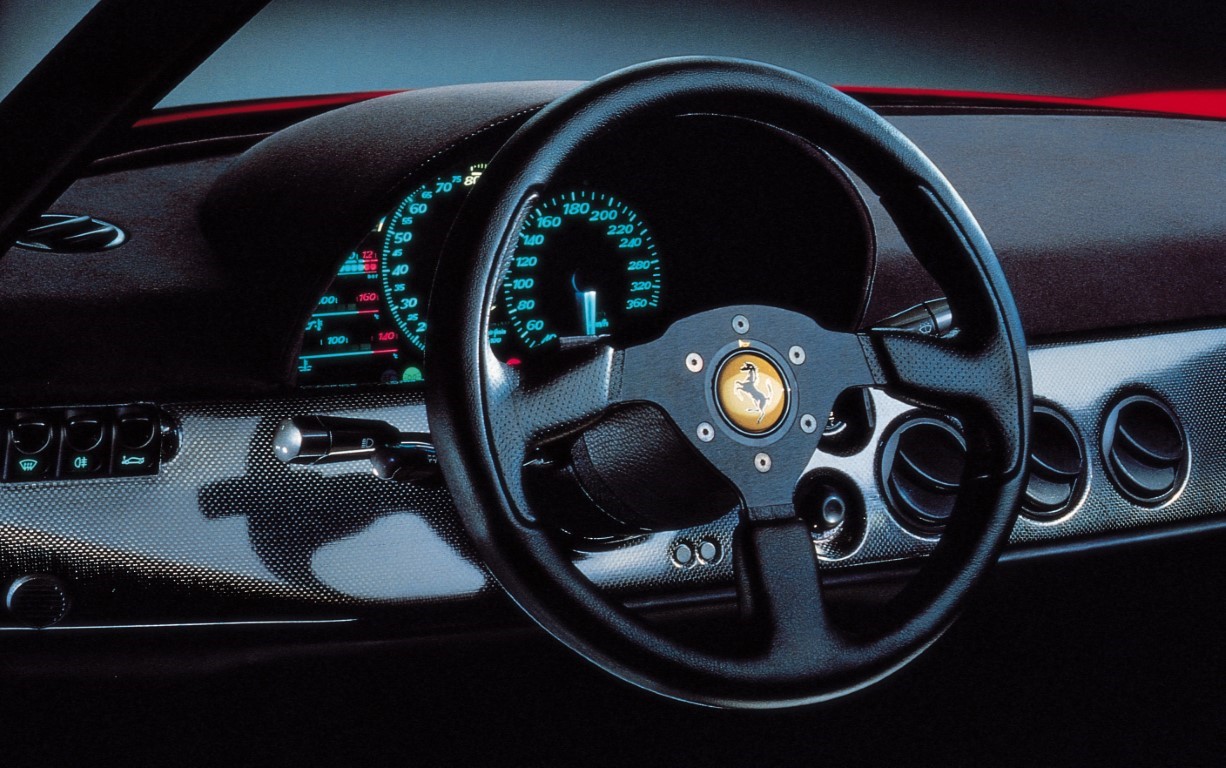
In a decision that seems almost unthinkable today, Ferrari opted for an extreme purist approach, eliminating any kind of driver assistance. The F50 was designed without power steering, without power brakes, and without an anti-lock braking system (ABS). The goal was to maximize the sensory and mechanical connection between the driver, the car, and the road. Driving an F50 is a visceral and physical experience: the steering wheel is heavy at low speeds, the brake pedal requires firm pressure and precise modulation, and every action by the driver has a direct and immediate consequence. It is a machine that demands respect, skill, and total concentration, but rewards the driver with a level of involvement and purity that has become virtually extinct in modern supercars.
The Lost Prototype - The Story of the Ferrari F50 GT
The Goal: Dominate the GT1 Category
Following the successful lineage of the F40 LM and the 333 SP, Ferrari planned to take the F50 to the tracks. The result was the Ferrari F50 GT (also known as the F50 GT1), a prototype developed to compete in the burgeoning BPR Global GT Series, which would soon become the FIA GT Championship. The goal was clear: to face and defeat rivals like the McLaren F1 GTR and reaffirm Ferrari's dominance in Grand Touring racing.
A Radical Transformation
Developed in collaboration with chassis specialists Dallara and composite manufacturer ATR, the F50 GT was a very different beast from its street counterpart. The bodywork was extensively modified, with the addition of a fixed roof, a new and aggressive front spoiler, a functional rear diffuser, and a massive fixed rear wing to generate maximum downforce. The weight was drastically reduced to about 860 kg dry, nearly 400 kg less than the street car. The 4.7-liter V12 engine was meticulously tuned to unleash its maximum potential, generating approximately 750 cv at 10,500 rpm, coupled to a 6-speed sequential transmission.
Devastating Performance
Tests conducted at Ferrari's private Fiorano circuit revealed overwhelming performance. The F50 GT was not only fast but incredibly quick, even posting lap times faster than Ferrari's own 333 SP racing prototype, a car built specifically for competition. The 0 to 100 km/h acceleration was estimated at an impressive 2.9 seconds, with a projected top speed of 376 km/h. The car seemed destined for glory.
The End of a Dream
Despite its promising potential, the F50 GT project was abruptly canceled by Ferrari before the car could enter a single race. The primary reason for this decision was a crucial change in the GT1 category homologation rules. Competitors like Porsche and Mercedes-Benz exploited a loophole in the regulations to create so-called "homologation specials" — cars that were, in essence, thinly disguised racing prototypes, of which a minimum number of street versions were produced solely to comply with the rules. The Porsche 911 GT1, for example, was a mid-engined car that shared little with the street 911. Ferrari realized that the F50 GT, being derived from a genuine street car, would be at a fundamental disadvantage against these purpose-built machines.
However, an even larger strategic factor was at play. The cancellation of the project coincided with a crucial moment in the history of Scuderia Ferrari in Formula 1: the arrival of Michael Schumacher in 1996 and the beginning of a massive team restructuring aimed at winning back the world championship, a title that had eluded Maranello for years. Competing at the highest level on two fronts (F1 and GT1) would require colossal financial and engineering resources. Ferrari faced a choice: divide its efforts and risk mediocre performance in both categories, or focus all its power on a single objective. The decision was made: Formula 1 was the absolute priority. The F50 GT program was sacrificed for the dream of returning to the top of F1, a gamble that, as history proved, was highly successful.
The Fate of the Prototypes
Only three F50 GT chassis were fully completed, carrying serial numbers 001, 002, and 003. Ferrari reportedly produced six chassis in total, but the three unfinished ones were destroyed to prevent the technology from falling into the hands of rivals. The three complete cars were sold to extremely loyal and selected clients, under the strict condition that they never be used in official competitions, instantly transforming them into legends and some of the rarest and most desirable cars in the world.
Legacy and Position in History
The Shadow of the F40
Initially, the F50 lived in the long shadow of its predecessor. To many enthusiasts and the press at the time, the car was seen as a timid evolution, if not a disappointment, compared to the cultural impact and brutality of the F40. Although technically far more advanced, its straight-line performance gains were marginal. The 0 to 100 km/h acceleration was 3.9 seconds for the F50 versus 4.1 seconds for the F40, and the top speed was 325 km/h versus 324 km/h. Furthermore, the power delivery of the naturally aspirated V12 was linear and progressive, contrasting sharply with the sudden and dramatic torque explosion of the F40's twin-turbo V8, a characteristic many fans adored and missed in the F50.
The Bridge to the Enzo
Over time, the F50's role in Ferrari's supercar lineage became clearer. It served as a crucial technological and philosophical bridge between the purely analog era of the F40 and the digital era of its successor, the Enzo Ferrari. Launched in 2002, the Enzo deepened the use of F1 technology but with a different focus: it introduced active aerodynamics, carbon-ceramic brakes, and, decisively, an automated F1 transmission with paddle shifters on the steering wheel, retiring the manual gearbox for good in the brand's top-tier models. The F50, with its carbon chassis and F1-derived engine, anticipated this direction, but did so while keeping one foot firmly planted in the tradition of analog driving.
Reevaluation and Rise to Icon
The perception of the F50 has changed drastically in recent decades. As supercars have progressively become more complex, heavier, more powerful, and computer-mediated, the qualities once seen as disadvantages in the F50 — the naturally aspirated high-revving V12 engine, the gated manual shifter, the total absence of electronic aids, and the uncompromising F1 chassis — have become its greatest assets. Today, the F50 is celebrated by enthusiasts and collectors as perhaps the purest and most extreme analog supercar experience ever created. It represents a pinnacle of mechanical involvement that is unreplicable in the current automotive landscape. Its market value has skyrocketed, reflecting its newly acquired status as an icon and one of the most important and desirable cars ever produced in Maranello.
The following table contextualizes the F50 among its predecessors and successors, highlighting its unique position as a turning point in the history of Ferrari supercars.
Ferrari Supercar Comparison: F40 vs. F50 vs. Enzo
| Characteristic | Ferrari F40 (1987-1992) | Ferrari F50 (1995-1997) | Ferrari Enzo (2002-2004) |
|---|---|---|---|
| Launch Year | 1987 | 1995 | 2002 |
| Engine | 2.9L Twin-Turbo V8 | 4.7L Naturally Aspirated V12 | 6.0L Naturally Aspirated V12 |
| Power | 478 cv @ 7000 rpm | 520 cv @ 8500 rpm | 660 cv @ 7800 rpm |
| Torque | 577 Nm @ 4000 rpm | 471 Nm @ 6500 rpm | 657 Nm @ 5500 rpm |
| Transmission | 5-speed Manual | 6-speed Manual | 6-speed Automated F1 |
| Chassis | Steel tubular with composites | Carbon fiber monocoque | Carbon fiber monocoque |
| Electronic Aids | None | None | ABS, Traction Control (ASR) |
| Weight (dry) | 1100 kg | 1230 kg | 1255 kg |
| 0-100 km/h | 4.1 s | 3.9 s | 3.6 s |
| Top Speed | 324 km/h | 325 km/h | 350 km/h |
| Units Produced | 1,315 | 349 | 400 |
The Bridge Between Two Eras
The Ferrari F50 is much more than the mere successor to the F40 or the precursor to the Enzo. It was an audacious experiment, an uncompromising statement by Ferrari about its ability to translate the pure essence and complexity of a 90s Formula 1 car into a vehicle that could be registered and driven on public roads. Initially misunderstood for its function-dictated design and a performance that, on paper, did not represent a quantum leap over its predecessor, its true value and brilliance have been recognized over time.
The enduring legacy of the F50 is that of representing the pinnacle of the analog driving experience. In an automotive world inexorably moving toward automation, electronic assistance, and sensory isolation, the F50 stands as a monument to mechanical connection. It is a machine that demands skill, courage, and respect, but rewards the driver with a level of feedback and involvement that has become increasingly rare and precious. It is not just a car to celebrate Ferrari's 50th anniversary; it is a tribute to racing engineering in its purest form and the perfect bridge between the brute force era of the F40 and the era of digital sophistication initiated by the Enzo.