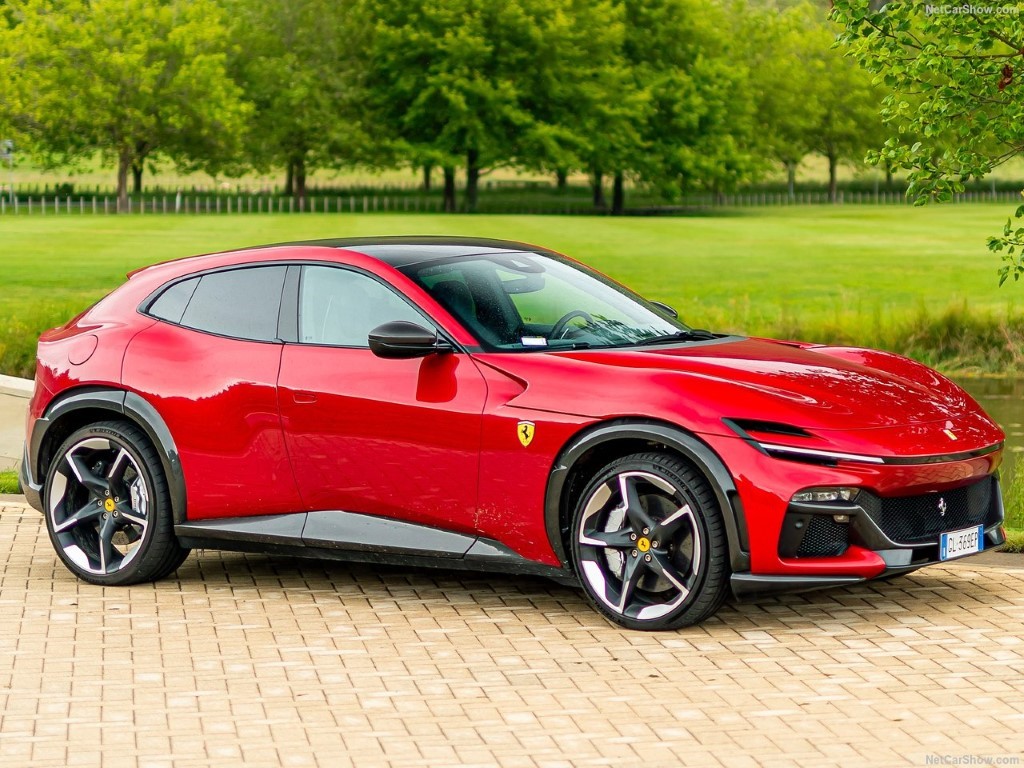
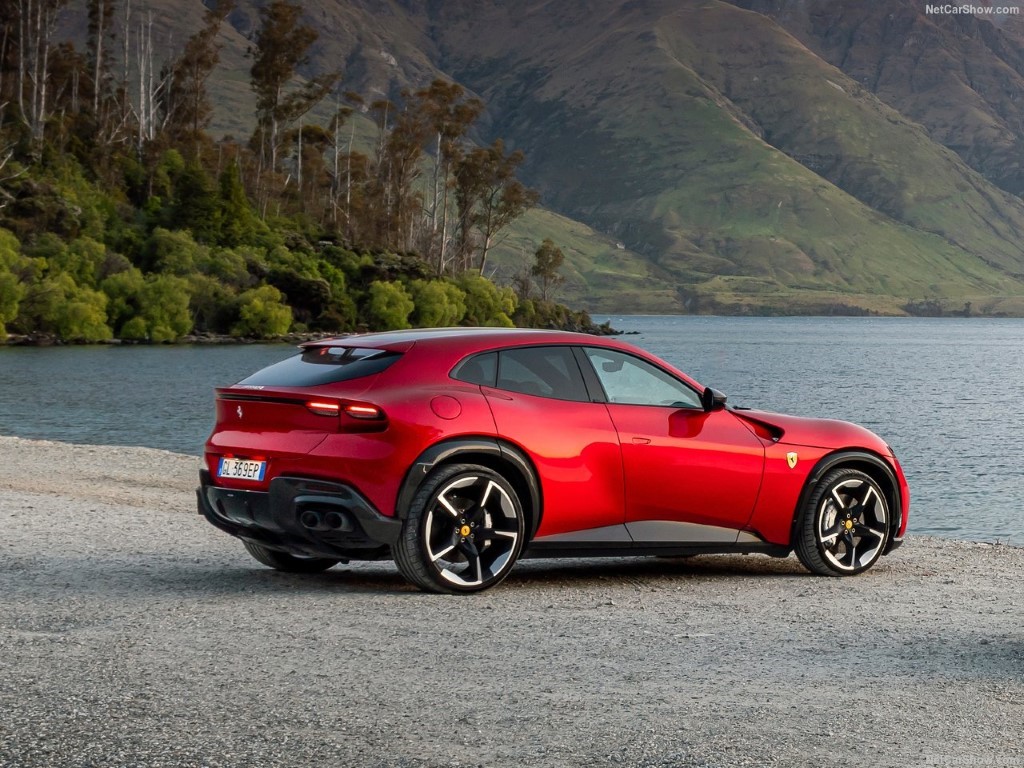
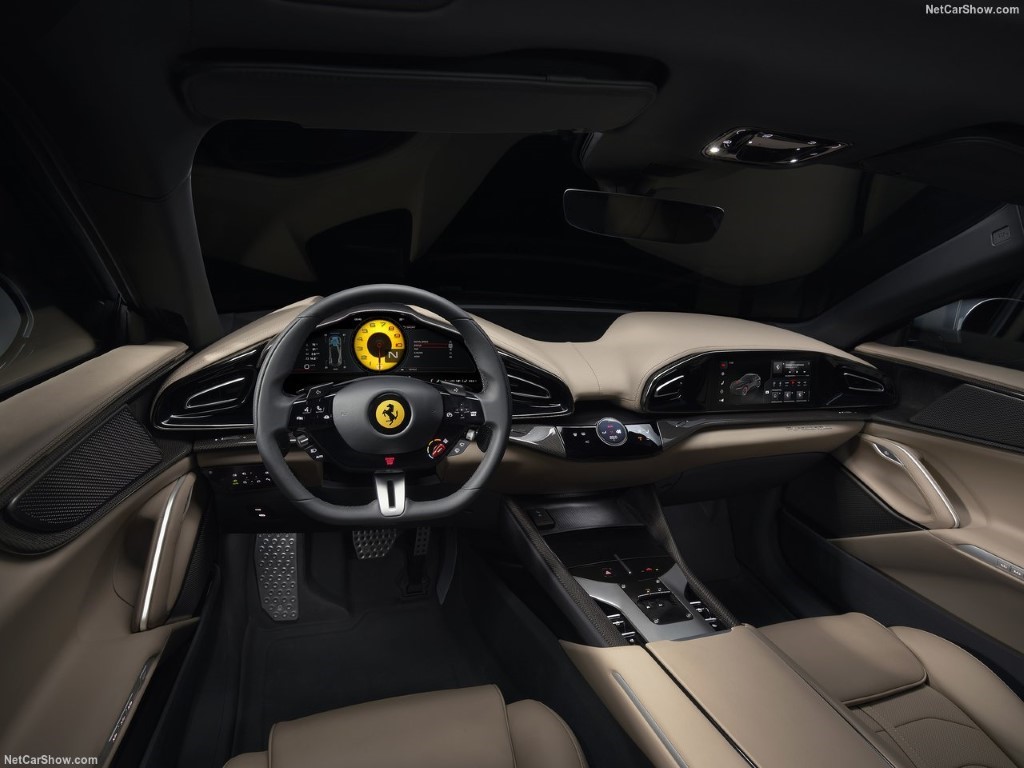
The Heart of the Beast: Naturally Aspirated V12 Engine (F140IA)
At the center of the Purosangue beats an engine that is the purest expression of Ferrari heritage: the
F140IA, a 6.5-liter (6,496 cc) V12 with a 65° angle between cylinder banks, naturally aspirated and
featuring a dry-sump system. Derived from the power unit of the 812 Superfast, this engine was deeply
revised with new camshafts and a modified crankshaft to suit the unique requirements of the Purosangue
chassis.
It delivers a power output of 725 cv (533 kW) at 7,750 rpm and a torque of 716 Nm (73.1 kgfm) at 6,250 rpm,
with the rev limit set at an impressive 8,250 rpm. A notable feature is that 80% of the maximum torque is
already available at just 2,100 rpm, providing a vigorous response at low speeds without sacrificing the
linear and increasing power delivery at high revs, a signature of Maranello's V12s. The choice to maintain a
naturally aspirated V12 engine, in a market dominated by twin-turbo V8s, is deliberate. It is an apparent
contradiction: Ferrari's most "practical" car uses the least "practical" engine in terms of fuel consumption
and emissions. This decision reveals that the absolute priority was not efficiency, but ensuring that the
driving experience — the sound, the throttle response, and the power delivery — was unquestionably
"Ferrari," validating the car as a true "Thoroughbred."
Structure and Dynamics: Chassis, Transmission, and Traction
The Purosangue is built on an entirely new chassis that combines aluminum, steel, and carbon fiber to
maximize torsional rigidity and minimize weight. The carbon fiber roof is a standard item, an engineering
solution to lower the vehicle's center of gravity. The car's dry weight is 2,033 kg.
The mechanical architecture is that of an authentic supercar. The engine is positioned in a mid-front
location, while the 8-speed dual-clutch gearbox is mounted on the rear axle in a layout known as transaxle.
This configuration, typical of the brand's GTs, allows for a nearly perfect weight distribution of 49% at
the front and 51% at the rear, fundamental for agility and dynamic balance.
The all-wheel-drive system, called 4RM-S evo, is equally sophisticated. The rear axle is driven by the main
gearbox, while the front axle receives torque from a separate "Power Transfer Unit" (PTU) coupled directly
to the front of the V12 engine. This PTU has two gears and operates only in the first four gears of the main
transmission, making the Purosangue behave predominantly as a rear-wheel-drive car at higher speeds,
preserving the brand's characteristic driving feel.
The Technological Revolution: Active Suspension and Dynamic Controls
The most innovative technology of the Purosangue is undoubtedly its suspension system. The model marks the
world debut of Ferrari Active Suspension Technology (F.A.S.T.), developed in partnership with the Canadian
company Multimatic. Each of the four shock absorbers is equipped with a 48V electric actuator that can
actively apply force to control body and wheel movement with unprecedented speed and precision.
This system is so effective that it completely eliminates the need for traditional anti-roll bars, standard
components in virtually every other production car. It actively controls body roll in corners, dive during
braking, and squat during acceleration, keeping the car surprisingly flat and stable. The combination of the
transaxle layout, 4RM-S traction, and F.A.S.T. suspension is the engineering "trinity" that allows Ferrari
to fulfill its promise. Without this suspension, the Purosangue would be a car dynamically compromised by
its height and weight; with it, it becomes an engineering feat that defies physics.
Other cutting-edge electronic systems include the ABS 'evo' 2.0, which uses sensors to estimate grip and
optimize braking on any surface, and a four-wheel steering system (4WS) inherited from the 812 Competizione
to maximize agility. For the first time in a Ferrari, there is also a Hill Descent Control (HDC), a nod to
the vehicle's greater versatility.
Technical Specifications Table
| Feature |
Specification |
| Engine |
V12 - 65°, naturally aspirated |
| Displacement |
6,496 cc |
| Maximum Power |
725 cv (533 kW) @ 7,750 rpm |
| Maximum Torque |
716 Nm (73.1 kgfm) @ 6,250 rpm |
| Transmission |
Dual-clutch, 8 speeds |
| Traction |
All-wheel drive (4RM-S evo) |
| Top Speed |
> 310 km/h |
| 0-100 km/h Acceleration |
3.3 seconds |
| 0-200 km/h Acceleration |
10.6 seconds |
| Length |
4,973 mm |
| Width |
2,028 mm |
| Height |
1,589 mm |
| Wheelbase |
3,018 mm |
| Dry Weight |
2,033 kg |
| Weight Distribution |
49% Front / 51% Rear |
| Trunk Capacity |
473 liters |
| Fuel Tank |
100 liters |
| Combined Consumption (WLTP) |
17.3 L/100 km (approx. 5.8 km/L) |