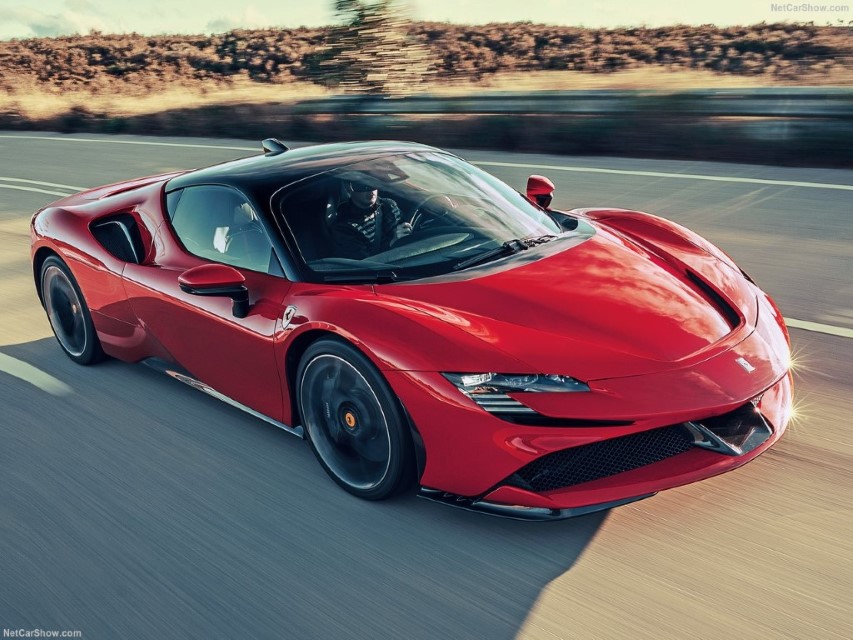
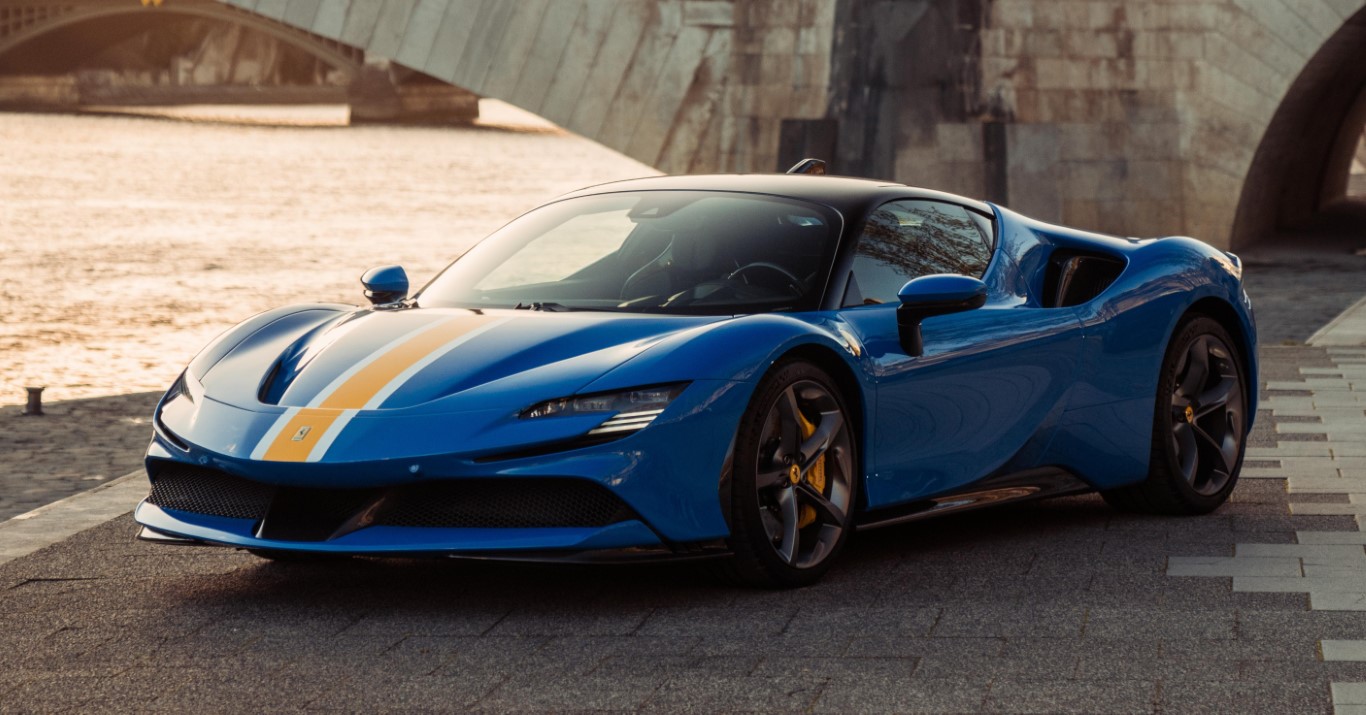
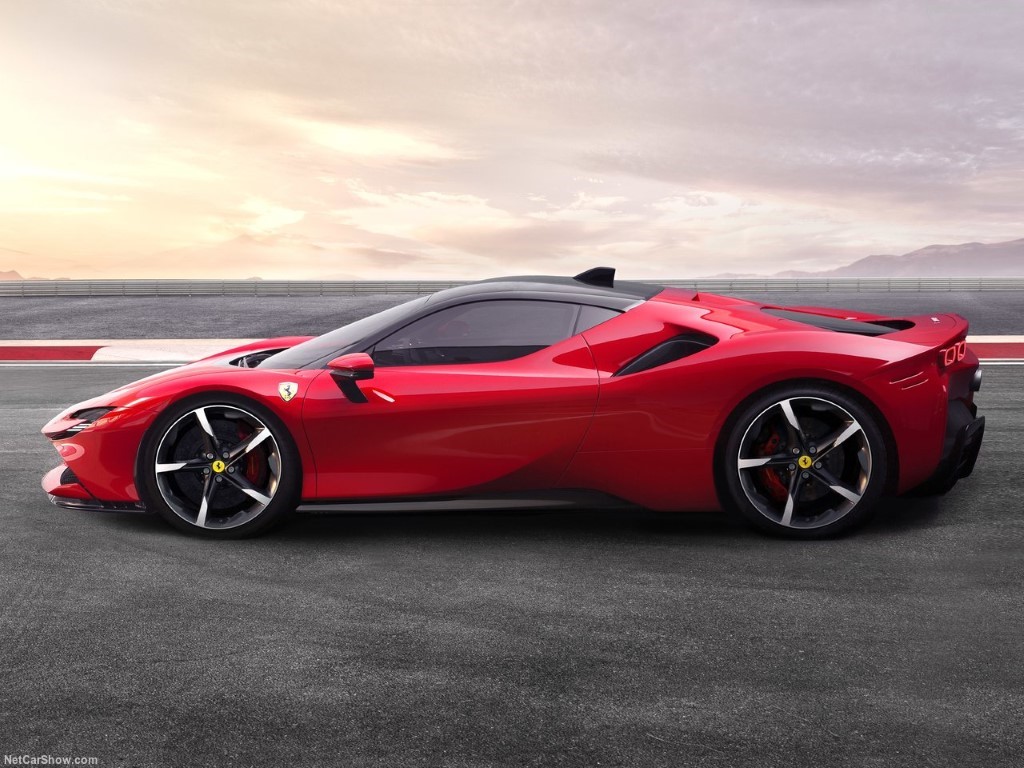
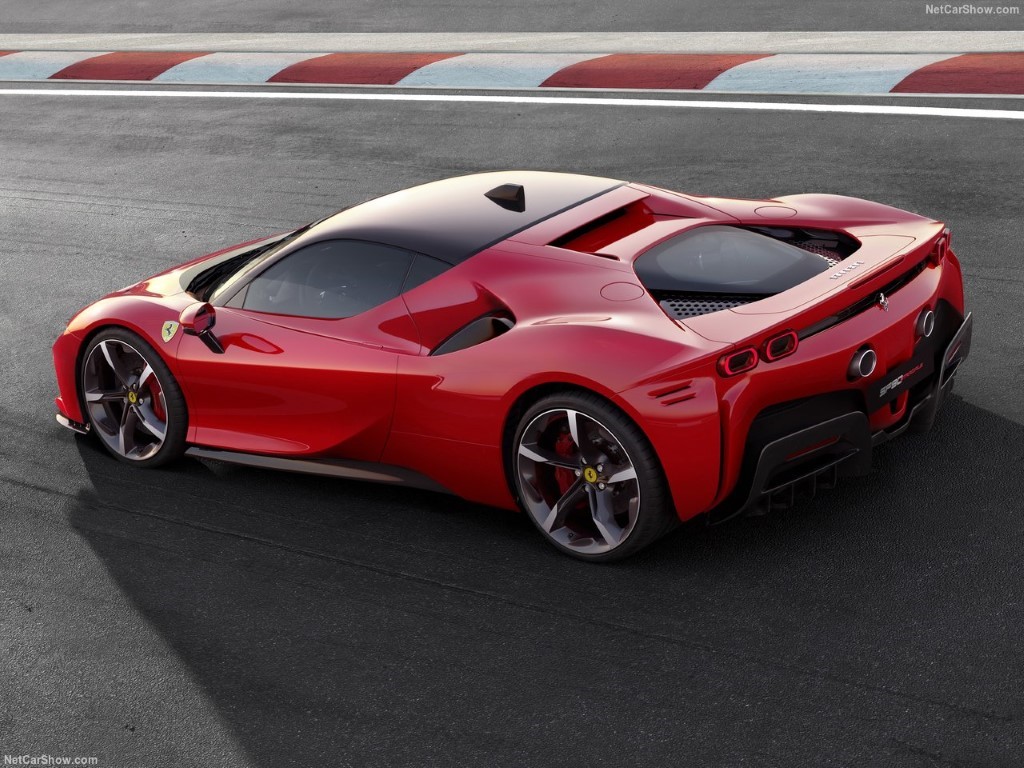
The SF90's propulsion system is an engineering masterpiece that harmoniously integrates a V8
combustion engine with three electric motors, creating one of the most complex and powerful powertrains ever
put into a street car.
The Combustion Engine: The Apex of the Ferrari V8
At the center of the SF90 is an evolution of Ferrari's award-winning F154 engine. It is a 4.0-liter
(3990 cm³) V8 with two turbochargers, mounted in a mid-rear longitudinal position. On its own, this
combustion engine generates an impressive 780 cv (769 hp) at 7,500 rpm and 800 Nm (81.6 kgfm) of torque at
6,000 rpm, making it the most powerful V8 ever produced by Ferrari for a road car up to that point.
To achieve these numbers, Maranello's engineers completely redesigned the intake and exhaust systems.
The cylinder heads were narrowed, new high-pressure fuel injectors (350 bar) were installed, and the entire
engine assembly was mounted 50 mm lower in the chassis to optimize the center of gravity. The exhaust
manifold is made of Inconel, a highly heat-resistant and very light nickel-chromium superalloy, a material
derived directly from Formula 1.
The Electrical System: Power and Intelligence
Complementing the V8, the SF90 has three electric motors that together add 220 cv (162 kW) to the
system. The distribution is as follows:
- Two motors on the front axle: One for each wheel, allowing all-wheel drive
and torque vectoring.
- One motor on the rear axle: Positioned between the V8 engine and the
gearbox. This motor is known as MGUK (Motor Generator Unit, Kinetic), a name and technology inherited
directly from Formula 1, which assists in power delivery and energy recovery.
Power for these motors is supplied by a high-performance lithium-ion battery with a capacity of 7.9
kWh. This battery allows the SF90 to have a pure electric range of up to 25 km, with a maximum speed of 135
km/h using only the electric motors.
Combined Performance and Transmission
The synergy between the combustion engine and the three electric motors results in a total combined
output of 1000 cv (986 hp). The combined torque of the system is 800 Nm, with the V8 engine being the main
contributor.
All this power is managed by a new 8-speed dual-clutch gearbox (F1 DCT) developed by Magna. This
transmission is 10 kg lighter and more compact than the previous 7-speed used in other Ferrari models. One
of its most notable features is the absence of a dedicated reverse gear.
This absence is not a flaw, but rather the result of causal integration engineering. The decision to
use two electric motors on the front axle was not just to add power or create all-wheel drive; it was a
choice that generated a cascade of benefits. By delegating the reverse gear function to the front electric
motors, engineers were able to eliminate the heavy and complex reverse mechanism from the main gearbox. This
resulted in a lighter and more compact transmission, which in turn allowed the entire powertrain assembly to
be mounted lower in the chassis, contributing to a lower center of gravity and thereby improving the
vehicle's dynamics. Electric all-wheel drive, therefore, is not just a performance system, but a key piece
in a chain of engineering decisions that optimizes the car's weight, layout, and agility in an integrated
way.
Driving Modes (eManettino) and Vehicle Dynamics
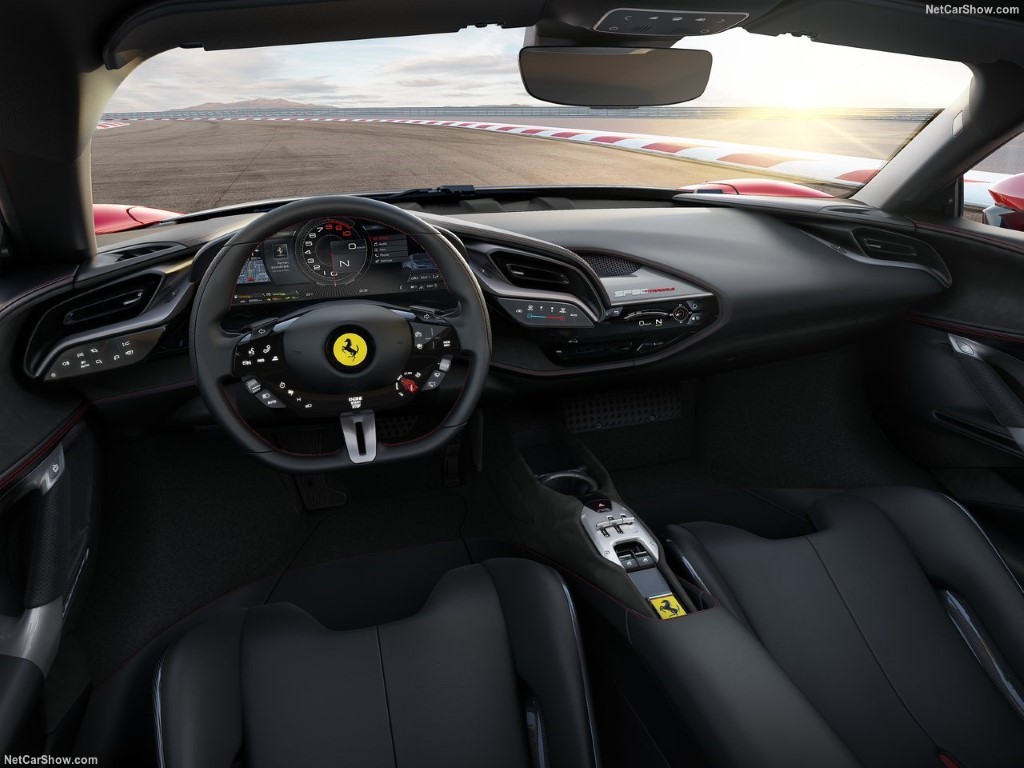
To manage the complexity of the hybrid powertrain, Ferrari introduced the eManettino, an additional
selector on the steering wheel with four driving modes:
- eDrive: 100% electric mode. The V8 engine remains off, and the car operates
with front-wheel drive, ideal for quiet urban use.
- Hybrid: The car's default mode. The control logic autonomously decides when
to use the combustion engine, the electric motors, or a combination of both to optimize efficiency.
- Performance: Keeps the V8 engine always on. The priority here is charging
the battery, ensuring that maximum power is always available instantly.
- Qualify: Unleashes the full 1000 cv potential. All motors work at their
maximum capacity to deliver absolute performance, ideal for fast laps on a circuit.
Vehicle dynamics are enhanced by the on-demand all-wheel drive (e4WD). The front motors enable the
RAC-e (electronic rotational axis control / Regulator of Cornering Angle, Electric) system, which performs
torque vectoring precisely, independently controlling the power sent to the inner and outer wheel in a
corner. This drastically improves traction coming out of corners and makes the car incredibly agile. The
entire system is managed by the eSSC (electronic Side Slip Control), which monitors and adjusts the
vehicle's stability in real time.