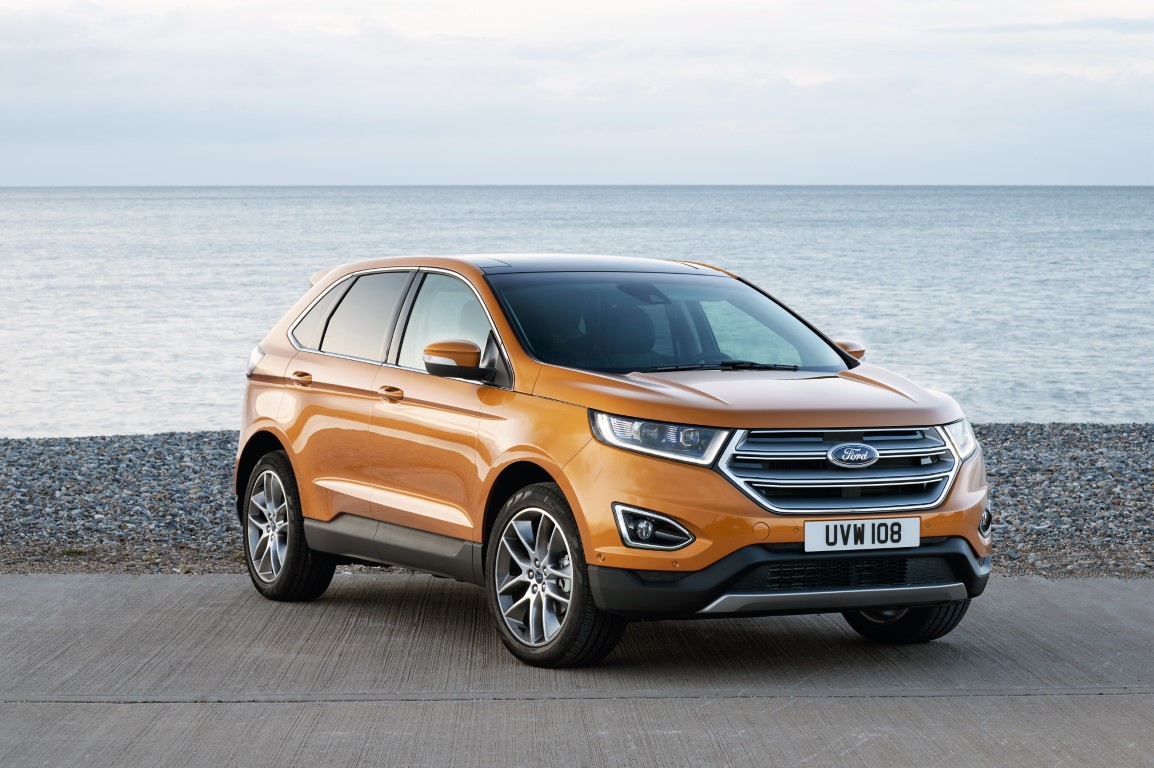
Launched in 2015, the second generation of the Ford Edge was built on the global CD4 platform, the
same one used by the Ford Fusion sedan and the Lincoln Nautilus. This platform change was crucial, as it
allowed the vehicle to be marketed for the first time in the European market and the Asia-Pacific region
with greater competitiveness, offering a more rigid structure and greater acoustic insulation.
Design, Structure, and New Features
The design of the second generation adopted more sculpted and athletic lines. The front now featured
an integrated hexagonal grille, and the rear received a horizontal LED light bar that connected the
taillights, conferring a technological and modern look. The wheelbase was expanded to 112.2 inches (2,850
mm), resulting in a direct gain in knee room for rear passengers and greater cargo capacity.
Ford introduced unprecedented technologies in the 2015 model, such as adaptive steering, which
changes the steering ratio depending on speed to facilitate parking maneuvers and increase stability on
highways. Furthermore, passive safety was reinforced with the introduction of inflatable rear seat belts, an
innovation aimed at protecting children and the elderly in frontal collisions.
Engine and Transmission Configurations (2015–2018)
At the launch of the second generation, the Edge offered three gasoline engine options in North
America, all initially mated to a six-speed automatic transmission:
- 2.0L EcoBoost I4 (Twin-Scroll): Became the standard engine, now equipped
with a twin-scroll turbocharger for faster responses and 245 hp.
- 3.5L Duratec V6: Maintained as a 280 hp naturally aspirated option for
consumers who preferred the linear power delivery of six-cylinder engines.
- 2.7L EcoBoost V6 Biturbo (Sport Version): This performance engine, built
with the same block material as Ford's diesel engines (compacted graphite iron), delivered 315 hp and a
massive 475 Nm (350 lb-ft) of torque, positioning the Edge Sport on a higher level of sportiness.
In Europe, the model was launched with 2.0L TDCi diesel options of 180 hp (single turbo) and 210 hp
(biturbo), frequently combined with standard intelligent AWD to compete in the premium segment against
rivals like the Audi Q5 and BMW X3.
The 2019 Facelift and the Ford Performance Era (Edge ST)
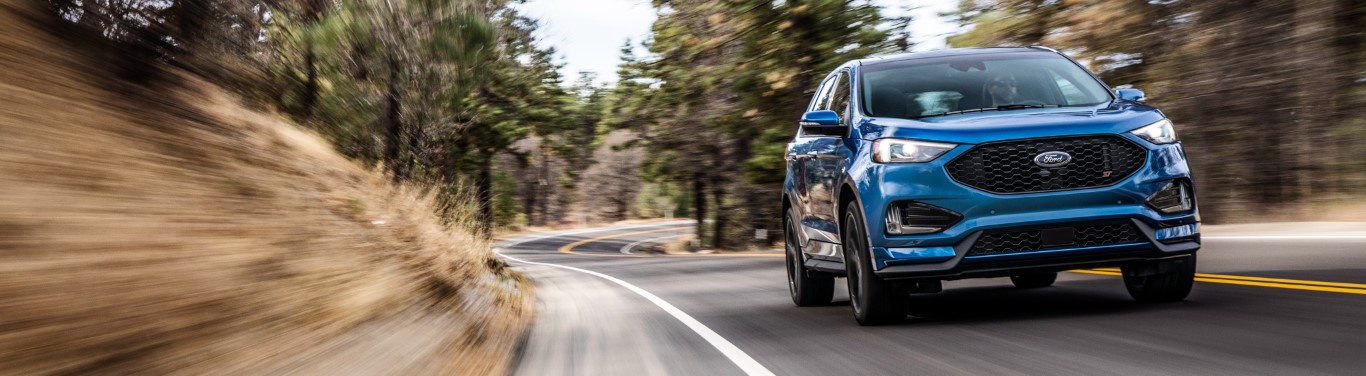
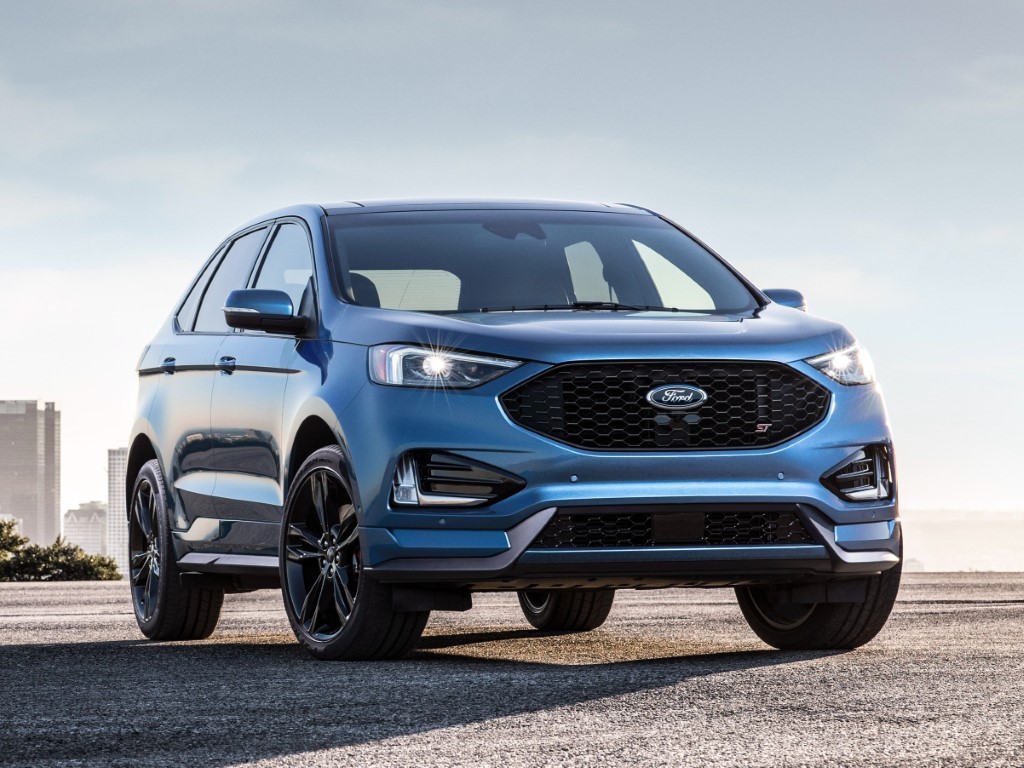
The mid-cycle renewal of the second generation, presented in 2018 for the 2019 model year, brought
the most radical change in the vehicle's identity. Ford discontinued the Sport version and replaced it with
the Edge ST, the first SUV developed by the Ford Performance division. The 2.7L V6 Biturbo engine was
recalibrated to produce 335 hp and 515 Nm (380 lb-ft) of torque, accompanied by a track-tuned suspension and
high-performance brakes.
Technically, the entire 2019 lineup received a new eight-speed automatic transmission (8F35),
operated by a rotary selector (E-Shifter) on the center console, replacing the traditional lever. The
naturally aspirated 3.5L V6 engine was removed from the catalog in most markets, consolidating the total
transition to EcoBoost technology.
| Attribute |
Pre-facelift (2015-2018) |
Post-facelift (2019-2024) |
| Gearbox |
6-speed Automatic |
8-speed Automatic |
| Gear Selector |
Physical lever |
Electronic rotary selector |
| Top Trim |
Sport (315 hp) |
ST (335 hp) |
| Standard Safety |
Airbags and ABS |
Co-Pilot360 Package |
Final Updates and Lineup Simplification (2021–2024)
In the final years of the second generation's life in North America, Ford focused on keeping the
model technologically relevant. In 2021, the Edge received a massive update to the infotainment system,
adopting a 12-inch vertical screen with the SYNC 4A system on all versions. This system brought wireless
connectivity for Apple CarPlay and Android Auto, as well as remote over-the-air updates via the cloud.
In 2022, as part of a production rationalization strategy, Ford made all-wheel drive (AWD) standard
on all Edge models sold in the US and Canada, eliminating the front-wheel-drive variants. Production
officially ended at the Oakville plant in Canada on April 26, 2024, so that the factory could be converted
for the production of next-generation electric vehicles.