1st Generation
(2000 - 2005)
Technical specifications, versions, and history for the Ford Excursion.
Select a generation to see available versions
(2000 - 2005)
The Ford Excursion represents a unique chapter in the history of the global automotive industry, being the pinnacle of an era where scale and raw capability were the main development pillars in the North American market. Launched in 1999 as a 2000 model, this vehicle was not just a response by the Ford Motor Company to General Motors' dominance in the large SUV segment, but an engineering statement that redefined the limits of what a mass-produced passenger vehicle could be. This report exhaustively analyzes the trajectory of the Excursion, from its technical foundation in the Super Duty line to its chronological evolution, engines, and the lasting impact it maintains as a collector's item and heavy-duty work tool.
In the late 1990s, the United States experienced unprecedented economic expansion, accompanied by historically low fuel prices. This scenario fostered a growing demand for increasingly larger and more capable sport utility vehicles (SUVs). Ford already had the Expedition, based on the F-150 pickup, but it was not enough to compete directly with the 2500 series (three-quarter-ton) versions of the Chevrolet Suburban and GMC Yukon XL. To fill this gap, Ford decided to use the platform of its most robust pickup line, the F-250 Super Duty, to create what would become the largest SUV in the world.
The development of the project, internally identified by the code UW137, focused on offering a towing and payload capacity that no conventional SUV could reach, while maintaining luxury and interior space for up to nine passengers. By being classified as a heavy-duty vehicle (Class 2), with a Gross Vehicle Weight Rating (GVWR) of over 8,500 pounds, the Excursion managed a technical exemption from CAFE (Corporate Average Fuel Economy) fuel economy regulations and official EPA consumption ratings at the time, which allowed Ford to equip it with massive displacement engines without suffering direct regulatory penalties.
The foundation of the Ford Excursion is the chassis of the F-250 Super Duty pickup, but with structural modifications that make it unique. The C-channel steel frame was adapted to support the closed body of an SUV, which required changes to the body mounts and rear geometry to accommodate the 44-gallon fuel tank and the specific rear suspension.
The dimensions of the Excursion were so vast that the vehicle became the subject of public debate regarding urban infrastructure. At nearly 5.8 meters long, it significantly surpassed its direct competitors, offering interior space that allowed the vehicle to be configured as a true high-capacity limousine.
| Critical Dimension | Imperial Measurement | Metric Measurement |
|---|---|---|
| Overall Length | 226.7 in | 5,758 mm |
| Wheelbase | 137.1 in | 3,482 mm |
| Width (without mirrors) | 79.9 - 80.0 in | 2,029 - 2,032 mm |
| Height (4WD) | 80.2 - 80.4 in | 2,037 - 2,042 mm |
| Height (2WD) | 77.2 in | 1,961 mm |
| Curb Weight (Diesel) | 7,700 lb | 3,493 kg |
| Curb Weight (Gasoline) | 7,200 lb | 3,266 kg |
Consolidated data from multiple technical references.
This monumental stature brought practical challenges. Reports from the time indicated that the Excursion was too tall to enter many standard residential garages and difficult to maneuver in dense urban centers. However, for the rural public and those who needed to transport large families and heavy trailers simultaneously, these dimensions were its greatest virtue.
Unlike modern SUVs that use independent suspensions to prioritize comfort, the Excursion retained the robustness of solid axles. The front suspension on 4WD models used a solid axle with leaf springs, an engineering choice that prioritized durability and load-bearing capacity over ride smoothness. 2WD models used the Twin I-Beam system, traditional for Ford rear-wheel-drive pickups, offering slightly better articulation for paved road use.
Ford applied leaf springs with slightly softer compression rates than those of the F-250 pickup, attempting to balance payload capacity with the need for a less "bouncy" ride for passengers. Even so, the dynamic behavior was that of a heavy truck, requiring driver attention due to the considerable mass and high center of gravity.
The heart of the Ford Excursion was its engine range, designed to move a vehicle that, empty, already weighed over three tons. During its six years of production, the model was equipped with four distinct engines, each with specific performance and maintenance characteristics.
Triton engines were the basis of the gasoline lineup, using Ford's modular architecture with single overhead camshafts (SOHC) and two valves per cylinder.
Diesel engines were largely responsible for the Excursion's reputation of "invincibility" and are, to this day, the most sought after in the used market.
| Engine | Displacement | Type | Power (hp) | Torque (lb-ft) | Transmission |
|---|---|---|---|---|---|
| Triton V8 | 5.4L | Gasoline SOHC 2V | 255 | 350 | 4-Speed 4R100 |
| Triton V10 | 6.8L | Gasoline SOHC 2V | 310 | 425 | 4-Speed 4R100 |
| Power Stroke V8 | 7.3L | Turbodiesel OHV | 250 | 525 | 4-Speed 4R100 |
| Power Stroke V8 | 6.0L | Turbodiesel OHV | 325 | 560 | 5-Speed 5R110W |
Summary of technical specifications by engine.
To manage the massive torque, Ford used heavy-duty automatic transmissions. The four-speed 4R100 unit was standard for most engines until 2003. With the introduction of the 6.0L diesel engine, Ford launched the five-speed 5R110W "TorqShift" transmission, which featured an advanced electronic control system and a Tow/Haul mode that adjusted shift points and engine braking for steep descents.
The four-wheel-drive systems were part-time, with an NV273 transfer case electronically engaged by a button on the dashboard (Electronic Shift-on-the-Fly) or, in more basic versions, by a manual lever. The 10.5-inch Sterling rear differential was common to all models, ensuring that power was reliably distributed to the rear wheels under heavy load.
Unlike other models that go through multiple generations, the Ford Excursion had a single technical generation but received significant incremental updates each model year (MY).
The Excursion debuted in XLT and Limited trims. The XLT model was the standard of comfort, while the Limited brought leather seats, faux wood trim, and polished aluminum wheels. The vehicle was immediately noted for its "Tri-Panel" rear door system, consisting of a full-width upper window that opened upwards and two lower "Dutch" style doors that opened outward.
In 2001, Ford focused on entertainment, introducing an optional rear video system based on VHS tapes, which would later be updated to DVD. In 2002, the instrument panel received improvements, including a digital odometer and the addition of a transmission temperature gauge on all models, reflecting the frequent use of the vehicle for towing. The Limited Ultimate version was introduced as the new top-of-the-line, offering power-adjustable pedals with memory and heated seats.
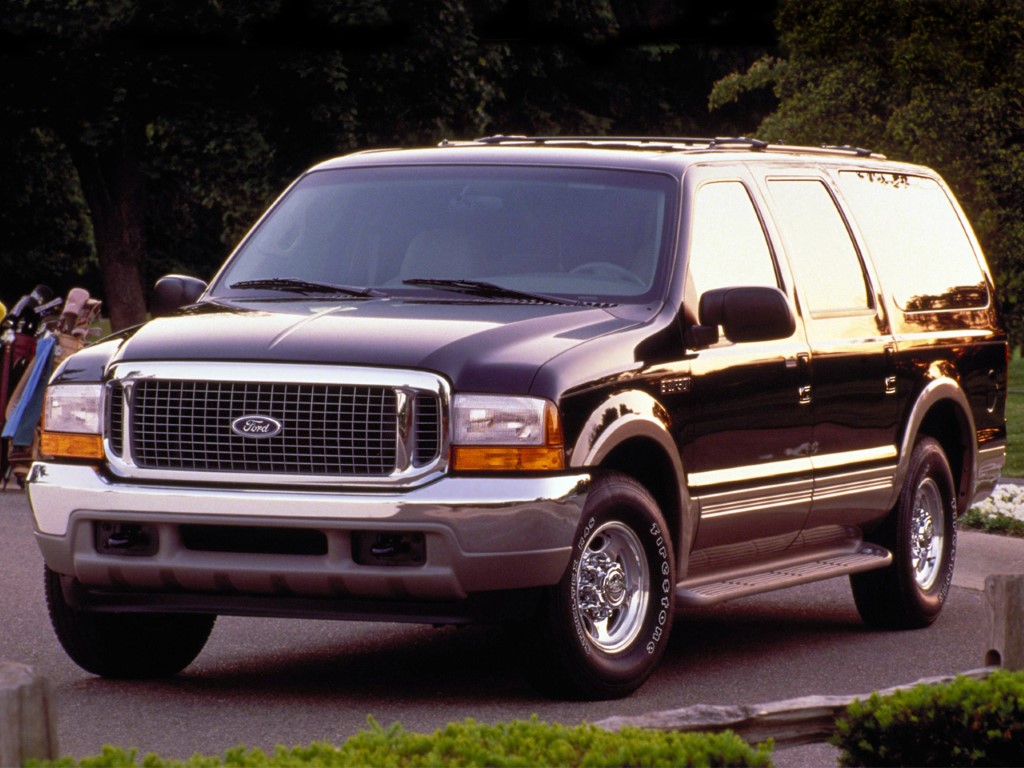
This was the most important year for the Excursion's mechanical evolution. Ford launched the "Eddie Bauer" edition, characterized by two-tone exterior paint (usually with the lower portion in Arizona Beige) and exclusive beige leather interior. Mid-production year, the 7.3L diesel engine was discontinued in favor of the new 6.0L Power Stroke, accompanied by the five-speed TorqShift transmission.
For 2004, the lineup was expanded with the XLS trim level, which became the new entry base, while the XLT moved up to the mid-level. New wheel and color options were added, and the 6.0L diesel engine received software updates to try to mitigate the reliability issues reported in the 2003 models.
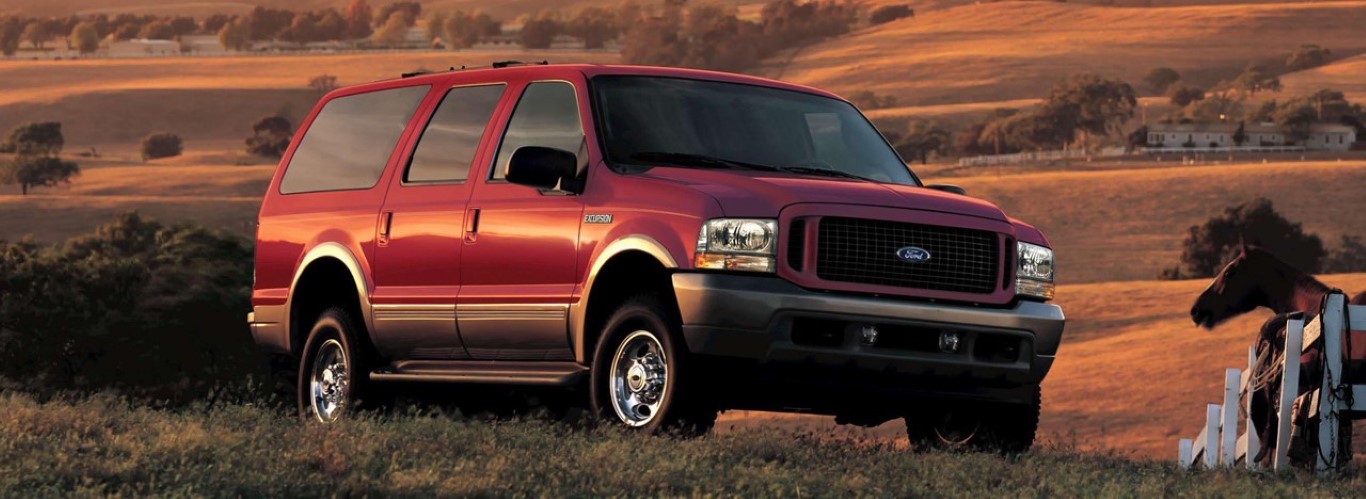
In its final year of production in the United States, the Excursion received its most drastic visual change. The front was completely revamped to align the SUV with the Super Duty pickups of that year. The old "eggcrate" grille was replaced by a more imposing and modern horizontal bar grille. The front bumper was also redesigned, and the headlights gained a new internal arrangement, although they kept their basic shape. Mechanically, the gasoline engines remained with the two-valve-per-cylinder architecture, unlike the F-250 pickup which was already receiving the three-valve engines.
The interior of the Ford Excursion was designed to be a mobile office and a family living room. With three rows of seats, the vehicle could comfortably accommodate up to nine people in the bench seat configuration or seven in the configuration with individual seats (Captain's Chairs) in the second row.
Cargo volume was one of the model's greatest assets. Even with the third row of seats installed, there was still 48 cubic feet of luggage space. With the third row removed and the second folded down, total space reached an impressive 146.4 cubic feet, allowing the transport of large items that would not fit in any other SUV of the time.
| Cargo Configuration | Volume (Cubic Feet) | Volume (Liters - approx.) |
|---|---|---|
| Behind the 3rd Row | 48.0 | 1,359 |
| Behind the 2nd Row (3rd removed) | 100.7 | 2,851 |
| Total Cargo Space (2nd folded) | 146.4 | 4,145 |
Internal volume capacities.
Top versions (Limited and Eddie Bauer) offered a level of sophistication that contrasted with the work-truck origins of the chassis. Owners enjoyed:
Production of the Ford Excursion was concentrated at the Kentucky Truck Plant in Louisville, Kentucky, the same facility responsible for the Super Duty line. Although it started with strong sales, the product's life cycle was cut short due to external pressures.
Initial success in 2000 showed there was an eager market for an extreme-capability SUV. However, the drop in sales starting in 2001 was steep, coinciding with the gradual increase in oil prices and growing environmental awareness in the United States.
| Calendar Year | Total US Sales |
|---|---|
| 1999 | 18,315 |
| 2000 | 50,786 |
| 2001 | 34,710 |
| 2002 | 29,042 |
| 2003 | 26,259 |
| 2004 | 20,010 |
| 2005 | 16,283 |
Total units sold in the American market.
Production officially ended on September 30, 2005. The last Excursion rolled off the assembly line to make way for the expansion of production capacity for the Super Duty pickups, which continued to be Ford's most profitable product. Although the model continued to be sold in Mexico as a 2006 model, its journey as a global Ford product came to an end on that date.
A fascinating curiosity in the history of this model is its "Brazilian version". Ford never officially imported the Excursion to Brazil, but the demand for large SUVs with robust diesel engines led to the emergence of high-quality artisanal conversions.
The company Tropical Cabines, based in Paraná, specialized in converting Ford F-250 pickups into closed SUVs, creating vehicles that were visually and functionally identical to the American Excursion. These conversions involved lengthening the original cabin and integrating a custom rear end, maintaining the robustness of the national pickup chassis.
Perhaps the most unusual creation based on the Brazilian F-250 platform was the Tropiclassic. This vehicle transformed the heavy-duty pickup into a giant luxury sedan. Launched in 2001, the Tropiclassic used components from other Ford vehicles for its finish, such as the taillights and trunk lid from the Ford Focus sedan of the time.
Unlike the American Excursion, the Brazilian versions (Tropivan and Tropiclassic) used the engines available in the national F-250, such as the four-cylinder Cummins B-Series 3.9L and the inline-six MWM 4.2L Sprint, both turbodiesels known for their reliability in the Brazilian market.
The Ford Excursion was one of the most polarizing vehicles of its era. On one hand, it was praised for its unmatched utility; on the other, it was criticized as a symbol of irresponsible excess.
An important safety innovation introduced on the Excursion was the BlockerBeam. Due to its high ride height, there was a risk of the vehicle "riding over" smaller cars in frontal collisions (a phenomenon called underride). The BlockerBeam was a transverse steel bar mounted under the front frame, designed to engage the impact structure of smaller vehicles, deploying their airbags and crumple zones instead of simply driving over them. At the rear, the standard Class IV trailer hitch served a similar purpose of protection in rear impacts.
The launch of the Excursion sparked protests from environmental groups. The Sierra Club awarded Ford the "Exxon Valdez" award for creating the vehicle, arguing that it was a step backward in energy efficiency efforts. In response, Ford highlighted that the vehicle was 90% recyclable and that its pollutant emissions (not to be confused with fuel consumption) were low for a vehicle of its size, complying with the LEV (Low Emission Vehicle) standards of the time.
Decades after the end of its production, the Ford Excursion is experiencing a renaissance in popularity. What was once seen as a "dinosaur" is now valued as an irreplaceable engineering tool.
Well-preserved examples of the Excursion, especially those equipped with the 7.3L Power Stroke engine, have become high-value items. It is not uncommon to find low-mileage units selling at auctions for prices higher than their original factory sticker price. In 2021, a sales record hit the $100,000 mark for a 2003 Limited 7.3L 4x4 model.
The Excursion's persistence in the used market is due to the fact that modern full-size SUVs (like the new Ford Expedition or Chevrolet Suburban 1500) have migrated to half-ton chassis with independent rear suspension. While more comfortable, they do not possess the same gross weight support capacity and durability in severe off-road or continuous towing conditions that the Excursion's Super Duty chassis offers.
The Ford Excursion remains a monument to a specific era of the industry, where raw mechanical capability knew no bounds. It was designed for a customer who accepted no compromises: someone who needed to carry nine people and still tow a five-ton boat through mountain passes.
Its evolution, though short, demonstrated Ford's skill in adapting a heavy-duty work platform (Super Duty) for the family luxury market. The transition between the 7.3L and 6.0L diesel engines marked the pinnacle of compression-ignition technology at the time, while the 2005 facelift gave the model a visual closure befitting its grandeur.
In Brazil, the legacy of the Excursion through Tropical Cabines illustrates the inventiveness of the national market in seeking solutions for transportation needs that major automakers did not directly meet. Whether as an icon of American excess or as an indispensable work tool, the Ford Excursion secured its place in the annals of automotive history as the last and greatest of its lineage, a giant that is unlikely to see a direct successor with the same build philosophy.