1st Generation
(2009 - 2012)
Technical specifications, versions, and history for the Ford Flex.
Select a generation to see available versions
(2009 - 2012)
(2013 - 2019)
The trajectory of the Ford Flex in the North American automotive industry represents one of the most experimental and audacious periods of the Ford Motor Company at the beginning of the 21st century. Launched as an indirect successor to both the Ford Freestar minivan and the Ford Taurus X crossover, the Flex was designed to capture an audience that desired the utility of a seven-passenger vehicle but rejected the social stigma associated with traditional minivans. This report details the genesis, technical development, powertrain variations, mid-life updates, and the context of the discontinuation of one of the most distinctive vehicles on Ford's D4 platform.
The development of the Ford Flex dates back to the 2005 Chicago Auto Show, where Ford presented the Fairlane Concept. Named after Henry Ford's historic estate and a classic model of the brand, the Fairlane concept was not just a styling exercise, but a statement of intent about the future of "people movers". The design, led by Peter Horbury, featured an extremely "boxy" silhouette and flat roof, evoking the Woodie wagons of the 1940s and 1950s, but with a modern and minimalist execution.
The original concept was built on the CD3 platform (shared with the Ford Fusion of the time), but for series production, Ford decided to migrate the project to the full-size D4 platform. This decision was strategic to ensure the vehicle had the necessary dimensions to accommodate three rows of seats with real comfort for adults and competitive towing capacity. The production design retained almost 90% of the concept's aesthetics, with the exception of the "suicide" rear doors (rear-hinged), which were replaced by conventional doors to facilitate manufacturing and increase structural safety.
The mechanical basis of the Ford Flex is the D4 platform, a variant of the D3 architecture originally developed by Volvo (P2 Platform). The D4 platform was specifically tuned for vehicles with longer wheelbases and higher gross weight, also serving as the basis for the Ford Explorer (2011-2019) and the Lincoln MKT.
This architecture provided the Flex with a much more refined ride than body-on-frame SUVs. The front suspension used a MacPherson strut system with L-shaped lower control arms and a stabilizer bar, while the rear was an independent multilink suspension, which ensured a lower center of gravity and less body roll in corners compared to the Ford Explorer.
The Flex's structure was optimized to maximize internal volume. With a wheelbase of almost 3 meters, the vehicle offered superior space utilization compared to many larger SUVs.
| Dimensional Attribute | Specification (Imperial/Metric System) |
|---|---|
| Wheelbase | 117.9 in (2,995 mm) |
| Overall Length | 201.8 in (5,126 mm) |
| Width (without mirrors) | 75.9 in (1,928 mm) |
| Height | 68.0 in (1,727 mm) |
| Curb Weight (FWD) | 4,468 lb (2,026 kg) |
| Curb Weight (AWD) | 4,640 lb (2,104 kg) |
| Maximum Towing Capacity | 4,500 lb (2,041 kg) |
The torsional rigidity of the D4 platform allowed the Flex to offer a quiet environment, focusing on acoustic insulation (NVH - Noise, Vibration, and Harshness), positioning it as a premium crossover within the Ford lineup.
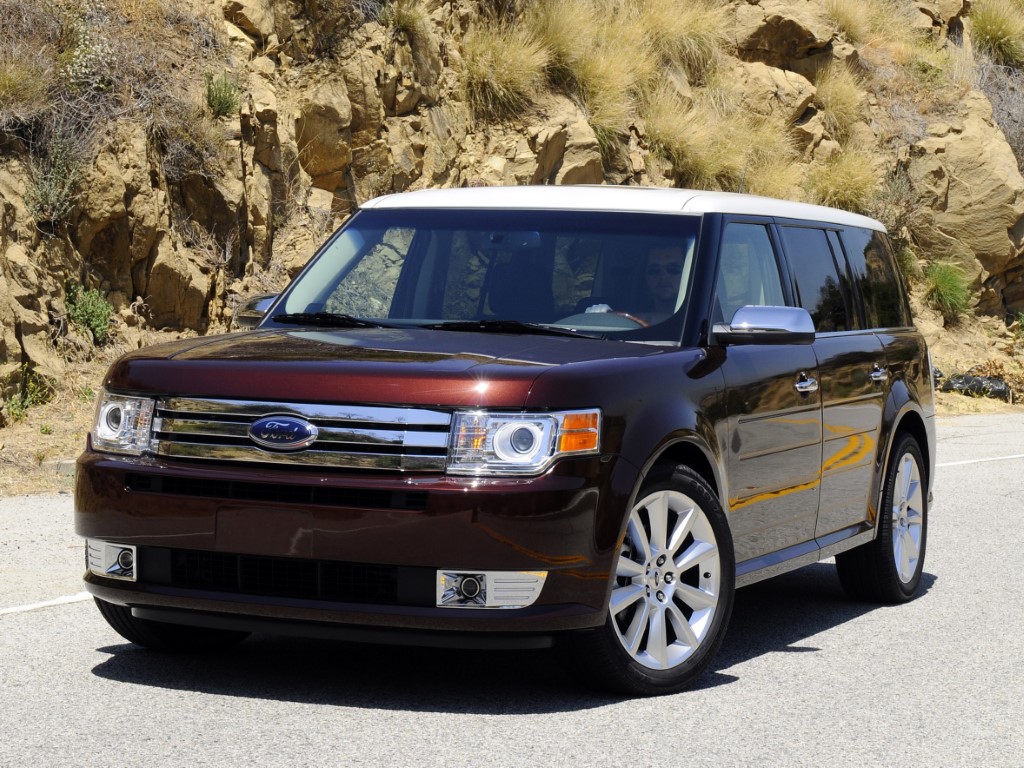
The Ford Flex began production on June 3, 2008, arriving at dealerships as a 2009 model year. At launch, it was available in three trim levels: SE, SEL, and Limited. The SE model focused on value, the SEL offered a balance between luxury and price, and the Limited brought the pinnacle of available technology, including 19-inch wheels and a superior interior finish.
In its early years, the Flex was powered exclusively by the naturally aspirated 3.5-liter Duratec V6 engine. This engine was mated to a 6F50 six-speed automatic transmission, developed in collaboration with General Motors.
| Engine Specification (2009) | Details |
|---|---|
| Engine Type | 3.5L V6 Duratec 35 |
| Aspiration | Natural |
| Power | 262 hp @ 6,250 rpm |
| Torque | 248 lb-ft @ 4,500 rpm |
| Transmission | 6-speed Automatic |
Front-wheel drive (FWD) was standard, with intelligent all-wheel drive (AWD) available as an option on SEL and Limited trims. The AWD system was capable of transferring up to 100% of torque to the front or rear axle depending on the traction needs detected by the AdvanceTrac sensors.
A major milestone in the history of the Flex was the introduction of the EcoBoost engine in 2010. This new family of engines used direct fuel injection and twin turbochargers to offer the power of a V8 with the (theoretical) fuel consumption of a V6.
Available only with all-wheel drive (AWD) on the SEL and Limited trims, the Flex EcoBoost delivered 355 horsepower and 350 lb-ft of torque, transforming the family "box" into one of the fastest vehicles in its category, capable of reaching 0 to 60 mph in about 6 seconds. To handle the extra torque, Ford equipped these versions with the 6F55 transmission, a beefed-up version of the six-speed gearbox.
To maintain interest in the model before the major facelift, Ford introduced targeted updates and new luxury versions.
The Ford Flex Titanium (2011)
In 2011, the Titanium trim level was introduced as the new top-of-the-line, partially replacing the Limited in terms of aesthetic exclusivity. The focus of the Titanium was a more "aggressive" and modern look, characterized by:
This model helped solidify the Flex's image as a "hip" and urban vehicle, further distancing it from the image of a basic utility vehicle.
The SEL Appearance Package
An appearance package was also made available for the SEL version, which included gloss black rearview mirrors, body-colored door handles, and exclusive wheels, allowing buyers of mid-range versions to have a look similar to the Limited.
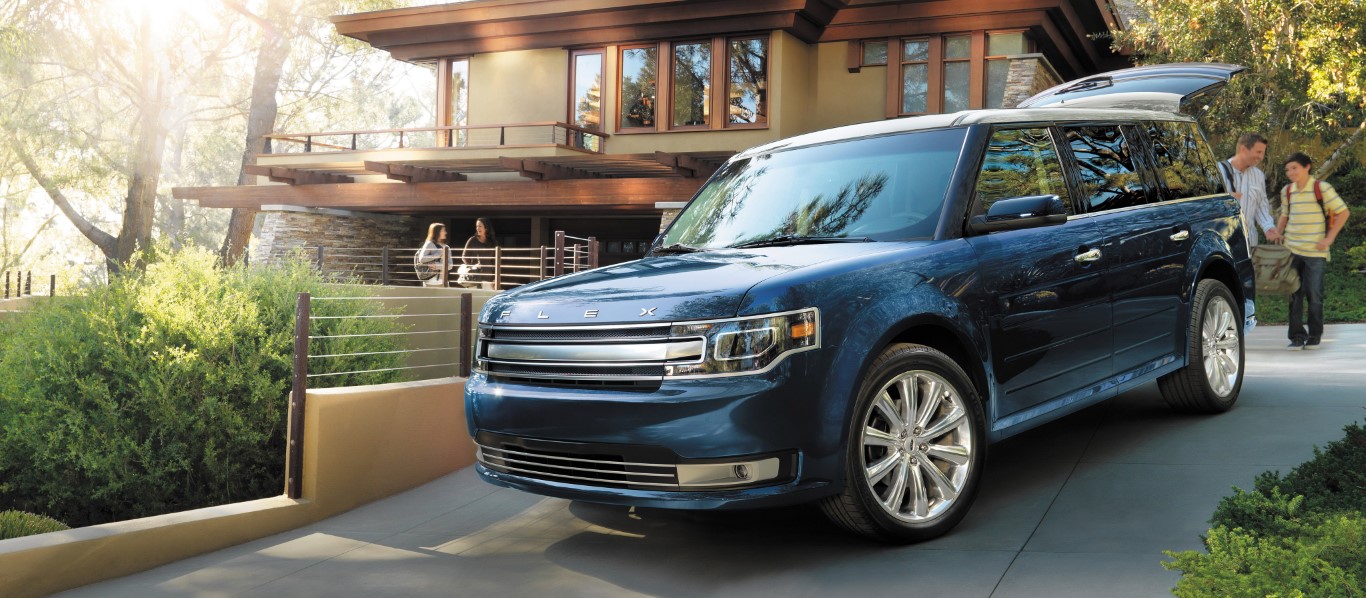
The year 2013 marked the most significant update in the history of the Ford Flex. More than just an aesthetic change, the model received deep mechanical updates and a new technology package.
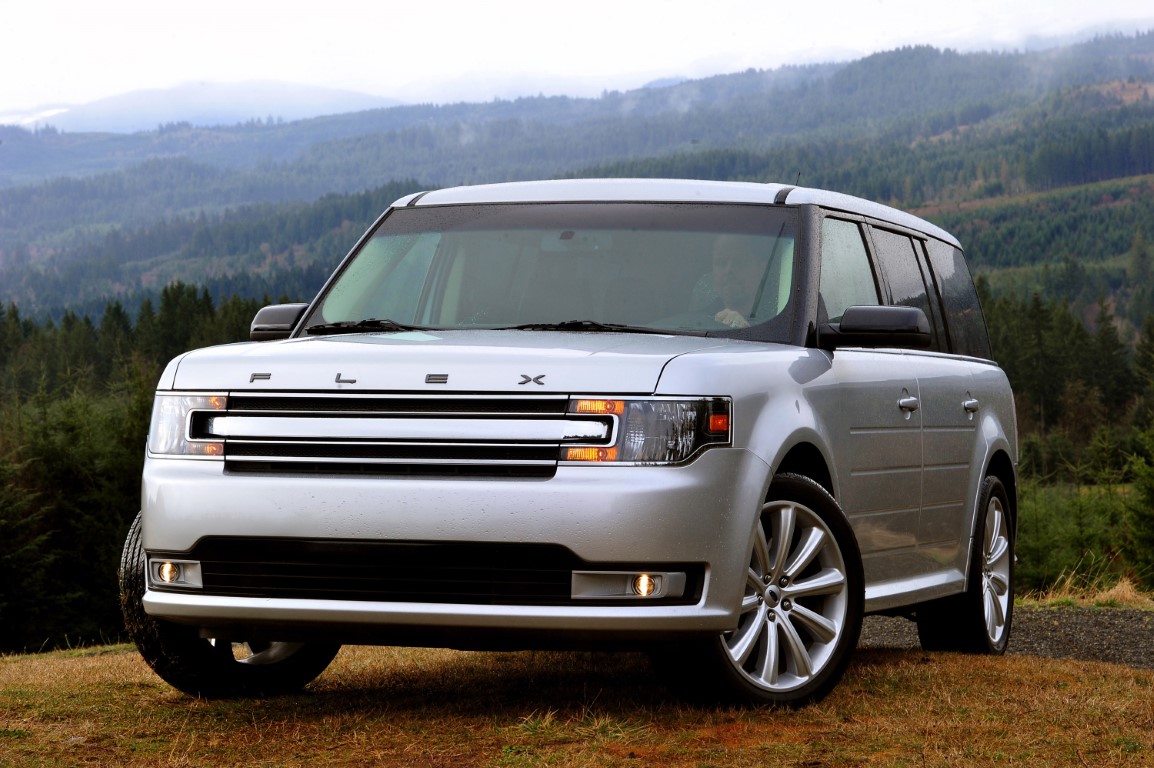
The most visible change occurred at the front. Ford removed the traditional blue oval logo from the front grille. In its place, the word "FLEX" was applied in chrome letters on the edge of the hood, a bold decision that aimed to treat the Flex almost like a sub-brand within Ford.
Ford revised both V6 engines for the 2013 model year, focusing on efficiency and greater torque delivery through the adoption of twin independent variable camshaft timing (Ti-VCT) on the naturally aspirated engine.
| Engine (2013-2019 Facelift) | Power | Torque | Change vs 2012 |
|---|---|---|---|
| 3.5L V6 Ti-VCT (Naturally Aspirated) | 287 hp | 254 lb-ft | +25 hp / +6 lb-ft |
| 3.5L V6 EcoBoost (Turbo) | 365 hp | 350 lb-ft | +10 hp / Stable |
The naturally aspirated engine, in particular, became much more competitive, reducing the feeling of being underpowered that occurred in loaded vehicles. In addition, the hydraulic power steering was replaced by an electric power-assisted steering (EPAS) system, which slightly improved fuel economy and allowed the inclusion of parking assistance systems.
The facelift also brought suspension improvements, with shock absorbers recalibrated to offer a smoother ride without sacrificing body control. The front brake rotors were enlarged to improve heat dissipation and braking power, a response to the increased engine power.
The interior of the Ford Flex was always its strongest point. Seating six or seven passengers, the interior design prioritized long-distance comfort and cargo versatility.
The Flex offered a second row of seats that could be configured as a three-person bench or two captain's chairs. One of the differentiators was the generous legroom in the second row, surpassing even larger SUVs of the time.
| Cargo Configuration | Volume (Cubic Feet) |
|---|---|
| Behind 3rd Row | 20.0 cu. ft. |
| Behind 2nd Row (3rd folded) | 43.2 cu. ft. |
| Max Cargo (All folded) | 83.2 cu. ft. |
The third row of seats featured the optional PowerFold system, which allowed the seats to be folded or reversed (tailgate mode) with the push of a button, facilitating the use of the trunk for outdoor recreation.
The technological evolution of the Flex followed Ford's software cycles, going through three distinct phases:
The Flex was known for features unusual in its category:
Starting in 2013, the Flex received a suite of safety technologies that kept it competitive until the end of its life. The package included:
The Ford Flex was produced exclusively at the Oakville Assembly Complex in Ontario, Canada. Unlike the Ford Explorer, which was a massive sales success, the Flex was always a niche vehicle, attracting a loyal but limited audience.
Although Ford expected to sell around 100,000 units per year at the beginning of the project, the reality of the market was different. Sales peaked in 2009 and remained stable at around 20,000 to 30,000 units annually for most of its lifespan.
| Calendar Year | Units Sold (USA) |
|---|---|
| 2008 | 14,457 |
| 2009 | 38,717 |
| 2010 | 34,227 |
| 2011 | 27,608 |
| 2012 | 30,236 |
| 2013 | 25,953 |
| 2014 | 23,822 |
| 2015 | 19,570 |
| 2016 | 22,588 |
| 2017 | 22,389 |
| 2018 | 20,308 |
| 2019 | 24,484 |
| 2020 | 4,848 (Final inventory) |
| Cumulative Total | ~309,207 |
Total Flex production slightly exceeded 300,000 units over 11 years of manufacturing. In Canada, the model was less popular, selling about 2,000 to 3,000 units annually in its later years.
Below, we detail the minor changes that occurred in each model year to keep the Flex up to date.
Although designed primarily for the US and Canadian market, the Ford Flex had a strategic international presence, being exported to Mexico and the Middle East.
In the Middle East, the Flex was positioned as a luxury family vehicle for desert transport and long intercity trips. Specifications were generally similar to the American model, but with reinforced air conditioning calibrations to handle the extreme climate. In countries like the United Arab Emirates and Oman, the model was sold until 2019, maintaining the 290 hp 3.5L V6 and the 365 hp EcoBoost. In Mexico, the Flex served as a more stylish alternative to the Ford Explorer, although in lower volumes.
Ford officially announced the end of Flex production in October 2019. The last vehicle rolled off the Oakville assembly line in November 2019.
Several factors contributed to the retirement of the Flex after a single 11-year generation:
Despite never having been a sales champion, the Ford Flex left a legacy of originality. It proved that it was possible to create a seven-seater crossover with a polarizing design that won over an extremely loyal audience. Flex owners often praise the quiet ride, excellent outward visibility (provided by the large windows and flat roof), and ease of entry and exit compared to taller SUVs.
In the used market, the Flex remains a popular choice for families looking for versatility without the look of a minivan, especially versions equipped with the EcoBoost engine, which are considered "sleepers" (cars that look slow but are very fast).
The Ford Flex represented a unique moment in the history of the Ford Motor Company. It was the result of a time when the brand was willing to risk unconventional designs to differentiate itself from competitors like Toyota and Chevrolet. With its robust platform, powerful engines, and passenger-focused interior, it fulfilled its mission of being an efficient "people mover" for more than a decade.
Although it was discontinued to make way for more profitable and technologically advanced models, the story of the Flex serves as a reminder that functionality doesn't have to be generic. It remains an icon of early 21st-century automotive industrial design, blending retro nostalgia with the modern engineering of the D4 platform.