Ford Maverick

Ford Maverick

Technical specifications, versions, and history for the Ford Maverick.

Ford Maverick Generations

Select a generation to see available versions

Ford Maverick G1

1st Generation

(2022 - 2024)

2.0 Turbo 16V EcoBoost 253 cv
Ford Maverick G1F

1st Generation Facelift

(2025-)

2.0 Turbo 16V EcoBoost 241 cv

Technical Data and History: Ford Maverick

Ford Maverick: From Automotive Legacy to the Compact Pickup Revolution

The trajectory of the Maverick name within the Ford Motor Company is one of the most fascinating case studies in the global automotive industry. What began in 1969 as an economical response to the invasion of foreign compacts in the United States transformed, after decades of hiatus and redefinitions in international markets, into one of the most successful products of the brand's modern era: a compact pickup with a unibody structure. This transition reflects not only changes in consumer preferences but a profound evolution in platform engineering and Ford's market segmentation strategy.

The Historical Legacy: The Original Maverick (1969–1979)

Before becoming the pickup that defines the current segment, the Ford Maverick was a compact car of enormous relevance. Designed by Tom Tjaarda, the model was launched in North America in 1969 with the goal of offering an affordable and efficient alternative. In the United States, the Maverick filled the space left by the Falcon and competed directly with the Chevrolet Nova and the Dodge Dart. Its production lasted until 1977, during which time it consolidated itself as a robust high-volume vehicle with an iconic design.

In Brazil, the Maverick's story began in 1973. Unlike the American approach of an entry-level vehicle, the Brazilian Maverick was positioned as a prestige car, focused on performance and luxury. Manufactured until 1979, the model became legendary in the country, especially in the GT version equipped with the 302 V8 engine. Although it was not an absolute sales success at the time due to the oil crisis and competition from the Chevrolet Opala, its appreciation as a collectible grew exponentially in the following decades.

First Era Powertrains (Automobile)

The engine options for the original Maverick varied significantly between markets, reflecting the fuel economy or performance needs of each region.

Powertrain Configuration Power (Gross/Net) Usage Context
2.3L I4 Inline 4-cylinder ~99 hp Introduced in Brazil for greater economy
2.8L I6 Inline 6-cylinder 105 hp Base engine in North America
3.0L I6 Inline 6-cylinder 112 hp Willys engine adapted for the Brazilian Maverick
3.3L I6 Inline 6-cylinder 120 hp Intermediate option in the US
4.9L V8 (302) V8 cylinder 197 to 210 hp High-performance versions (GT and Luxury)
The International Era: The Maverick as an SUV (1988–2005)

Between the end of the car's production in the 70s and the launch of the pickup in 2021, the Maverick name was used globally on several sport utility vehicles (SUVs), the result of Ford's strategic partnerships.

In Australia, between 1988 and 1994, the Maverick was essentially a rebadged Nissan Patrol Y60 under the "Button car plan," a government agreement to share models between automakers. In Europe, the name identified the Ford Maverick SUV between 1993 and 1999, which was a version of the Nissan Terrano II manufactured in Spain. This model underwent a significant facelift in 1996, adopting dual circular headlights and a chrome grille inspired by the European Ford Ranger pickup of the time. Finally, between 2001 and 2005, the Ford Escape was sold in Europe and China under the Maverick name, maintaining the utility lineage before the name was put to rest for its biggest transformation.

The Rebirth: The Maverick Pickup (2022–Present Generation)

In June 2021, Ford revealed the Maverick (project code P758) as an all-new compact pickup, based on the C2 unibody platform, shared with the Bronco Sport and the Ford Escape. This architectural choice was fundamental to offering the drivability of an SUV with the practicality of a pickup truck.

First Generation Structure (2022–2024)

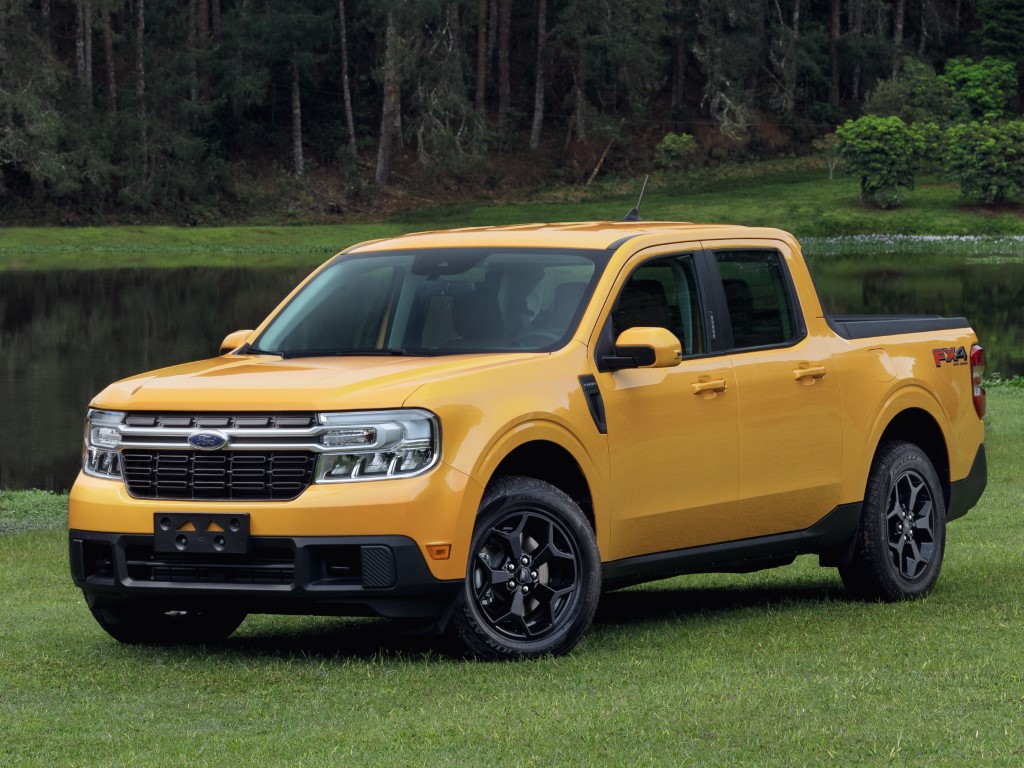
The initial launch established three trim levels in the United States: XL, XLT, and Lariat. In Brazil, the strategy was more restricted, focusing on the top-of-the-line Lariat version with the FX4 package, targeting a leisure and performance consumer.

Attribute Technical Specification (Launch)
Platform Ford C2 (Unibody/Monocoque)
Length 199.7 inches (5,072 mm)
Width 72.6 inches (1,844 mm)
Height 68.7 inches (1,745 mm)
Payload ~680 kg (1,500 lbs)
Maximum Towing 907 kg (2,000 lbs) to 1,814 kg (4,000 lbs)

The Maverick's competitive differentiator was the hybrid propulsion system as standard equipment at the American launch, making it the most efficient pickup on the market at the time.

Powertrain Evolution (2022–2024)

During its first years, the Maverick offered two main engine configurations. The big change occurred in 2024, when the 2.0L EcoBoost engine became standard, and the hybrid system became optional.

Powertrain Power Torque Transmission Drivetrain
2.5L Hybrid 191 hp 21.4 kgfm (M) / 23.9 kgfm (S) eCVT (HF45) Front (FWD)
2.0L EcoBoost 250 hp 38.3 kgfm 8-speed Automatic FWD or AWD

Trim and Package Details (2022–2024)

Each version of the Maverick was designed for a specific usage profile, from basic work to adventurous leisure.

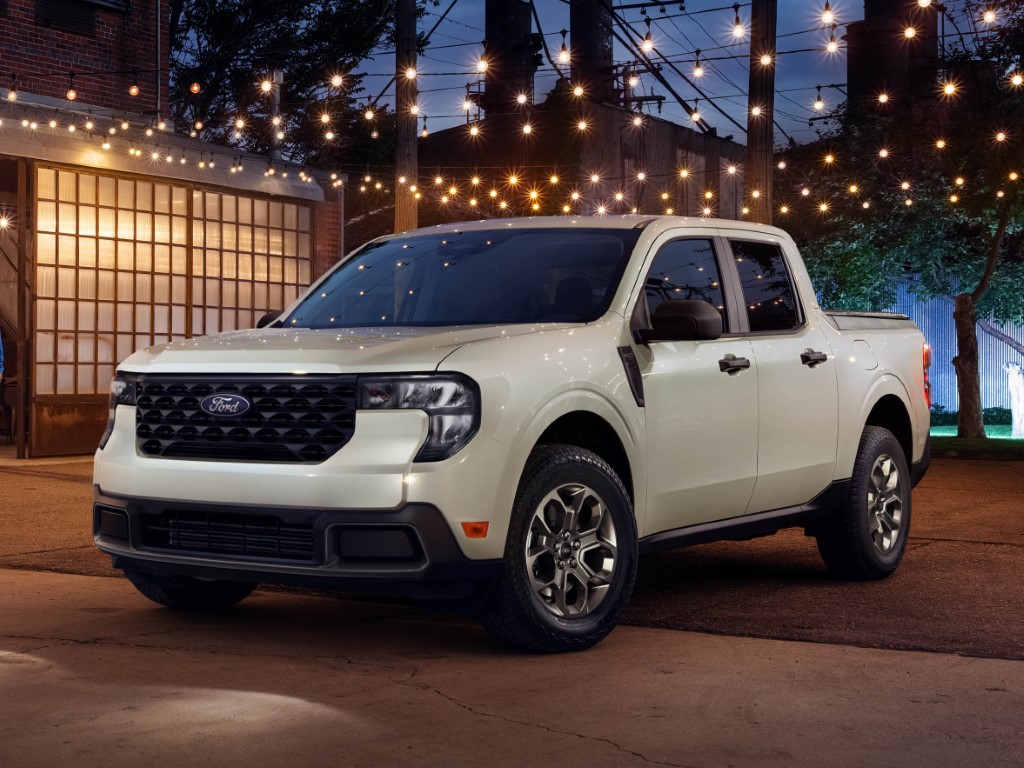
  • XL Version: Focused on fleets and cost-benefit. Came with 17-inch steel wheels, automatic headlights, 8-inch multimedia center with wired Apple CarPlay and Android Auto.
  • XLT Version: Added alloy wheels, power tailgate locks, and the Flexbed system with more tie-down points. It was considered by experts as the best value version.
  • Lariat Version: The top of the line, with synthetic leather seats (ActiveX), power driver's seat, 6.5-inch digital instrument cluster, and optional B&O premium sound.
  • FX4 Package: Available for AWD versions, included off-road suspension, skid plates, and specific driving modes for mud/ruts and sand.
  • Tremor Off-Road Package (2023): Introduced in the second year, brought a 1-inch suspension lift, an advanced all-wheel-drive system with differential lock, and trail control.
The Mid-Life Facelift: The 2025 Maverick

For the 2025 model year, Ford implemented the pickup's first major restyling. This facelift was not just cosmetic, but brought profound technological updates and new mechanical configurations requested by consumers.

Exterior and Interior Changes

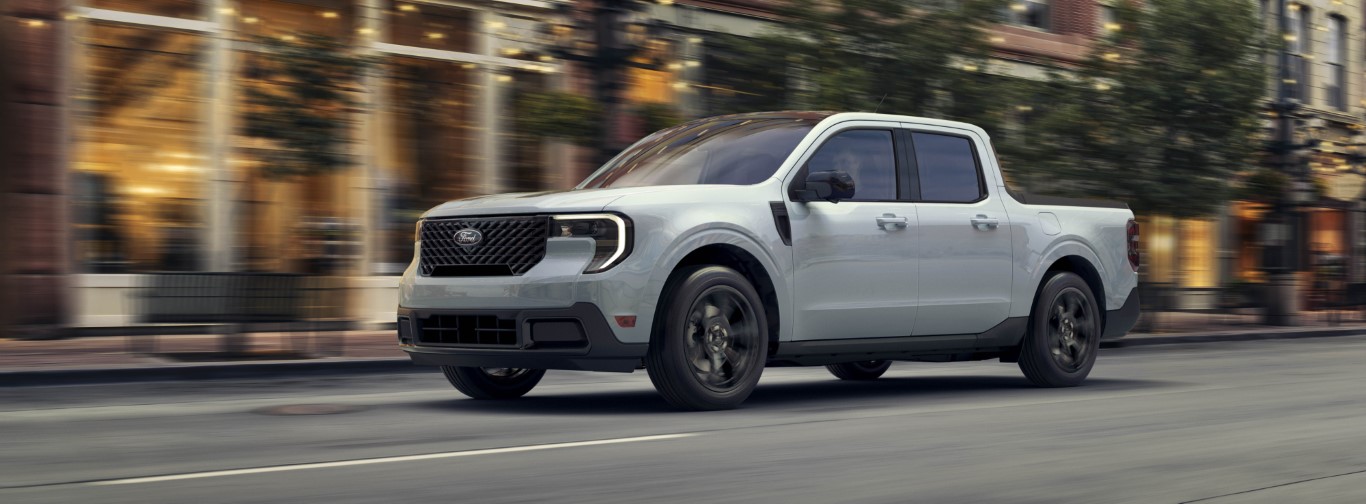
The front look was completely revamped, with sharper and darkened "7"-shaped headlights. Each version now has a distinct front grille to reinforce its personality. Inside, the most striking change was the replacement of the 8-inch screen with a 13.2-inch one, equipped with the SYNC 4 system and 5G connectivity with over-the-air updates.

The AWD Hybrid Revolution

The main mechanical evolution for 2025 was the introduction of all-wheel drive (AWD) for the hybrid engine. Previously, those who wanted four-wheel drive had to choose the 2.0 turbo engine. With this change, the Maverick Hybrid AWD became capable of towing up to 4,000 lbs (1,814 kg) when equipped with the 4K Tow Package, something impossible in previous versions.

New Versions in 2025: Lobo and Tremor as Models

In 2025, Ford reorganized the Maverick lineup, upgrading the Tremor package to a standalone version and launching the all-new Lobo version.

Maverick Lobo: Street Performance

Inspired by "street trucks" and urban tuning culture, the Maverick Lobo focuses on tarmac performance.

  • Chassis: Suspension lowered by 0.5 inches in the front and 0.8 inches in the rear, with sport tuning.
  • Transmission: Uses a 7-speed "Quick Shift" automatic gearbox with paddle shifters.
  • Brakes and Steering: Components inherited from the Ford Focus ST and the European Ford Kuga for greater precision.
  • Lobo Mode: An exclusive driving mode that optimizes torque delivery and stability for closed-circuit driving.

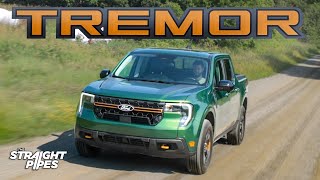
Maverick Tremor: Off-Road Capability

The Tremor consolidated itself as the heavy-duty work and adventure model.

  • Drivetrain: Advanced 4WD system with a twin-clutch rear drive unit.
  • Suspension: Shocks and springs tuned for rugged terrain, offering 9.1 inches of ground clearance.
  • Aesthetics: Honeycomb grille, orange tow hooks, and all-terrain tires.

Year-by-Year Evolutions and Refinements (2022–2026)

Ford demonstrated agility in adjusting the Maverick based on market feedback, resulting in constant annual changes.

Model Year Main Evolutions and Changes
2022 Official launch; Hybrid FWD as standard engine in the US; Lariat FX4 in Brazil.
2023 Introduction of the Tremor Off-Road package and the Black Appearance Package.
2024 2.0 EcoBoost engine becomes standard; Hybrid becomes a paid option (+$1,500).
2025 Visual facelift; 13.2" SYNC 4; Hybrid gains AWD option; Launch of the Lobo version.
2026 Wins MotorTrend "Truck of the Year" award; Removal of wireless charging in some versions; New colors (Orange Fury and Marsh Gray).
Performance in the Brazilian Market

In Brazil, the Maverick followed a path of differentiation. Launched at a time when Ford was repositioning itself as an importer of high value-added products, the pickup found its niche among technology and performance enthusiasts.

The Arrival of the 2025 Lineup in Brazil

The 2025 update arrived in Brazil with a revamp of the versions, discontinuing the old Lariat FX4 to offer more distinct options.

  • Maverick Lariat Black: Positioned as the new entry-level version with a darkened look and 2.0 EcoBoost engine.
  • Maverick Tremor: Officially introduced for the off-road public, offering raised suspension and differential lock.
  • Maverick Hybrid AWD: The great electrified novelty, now with all-wheel drive and Multilink rear suspension, improving dynamic behavior and acceleration (0-100 km/h in 8.0s).

Consumption and Range (Brazil Standard)

Efficiency is one of the Maverick's biggest pillars, especially in the hybrid version, which uses the Atkinson cycle to maximize every drop of fuel.

Version City (Gasoline) Highway (Gasoline) Estimated Range
Hybrid AWD (2025) 15.4 km/l 13.5 km/l ~800 km
EcoBoost AWD (2022) 8.5 km/l 11.4 km/l ~500 km
Tremor (2025) 8.4 km/l 10.7 km/l ~480 km
Production and Sales Volume

The Maverick is produced at the Hermosillo plant in Mexico, one of Ford's most efficient facilities globally. The success was so immediate that, in January 2022, Ford had to temporarily suspend orders due to a backlog that exceeded production capacity.

Production and Sales Numbers in the US and Brazil

Sales volume has shown consistent growth, consolidating the Maverick's dominance in the unibody compact pickup segment.

Year US Sales Brazil Sales Commercial Highlight
2021 13,259 39 Q4 Launch
2022 76,603 1,380 Viral success in the US
2023 91,882 1,654 Launch of the Hybrid in Brazil
2024 118,368 3,538 Hermosillo production reaches peak
2025 155,051 4,052 Best sales year recorded

By September 2024, the Hermosillo plant had already produced 135,224 units for the year, a significant increase to meet global demand. About 60% of Maverick buyers in the United States are new to the Ford brand, indicating that the model is a strategic entry point for the automaker.

Applied Engineering and Technology

The Maverick is not just a "bed attached to an SUV". Its engineering involves specific solutions for durability and utility.

The Flexbed System and Modularity

The 4.5-foot (1.37m) bed was designed under the Flexbed concept. This system allows the owner to create custom dividers using standard dimensional lumber (2x4 or 2x6), thanks to slots molded into the metal structure. Furthermore, the tailgate has an intermediate position that allows carrying 4x8-foot sheets of plywood resting on the wheel wells.

Suspension and Dynamics

There are two main rear suspension configurations:

  • Twist-beam axle with force vectoring springs: Used on FWD (front-wheel drive) versions to save weight and space.
  • Independent Multilink: Used on all AWD versions (EcoBoost, Tremor, and the new 2025 Hybrid). This configuration offers superior body control on winding roads and greater robustness on uneven terrain.

Safety and Co-Pilot360 Assistance

Since launch, the Maverick has been equipped with a robust safety package. In 2025, many of these features became standard on more versions:

  • Autonomous emergency braking with pedestrian detection.
  • Adaptive cruise control with Stop-and-Go function.
  • 360-degree camera and Pro Trailer Backup Assist.
  • Blind spot monitoring that accounts for the trailer's length.
Final Considerations on the Model's Evolution

The Ford Maverick (Pickup) represents the materialization of a utility "downsizing" trend, where consumers seek the advantages of a truck without the fuel costs and maneuvering difficulties of full-size pickups like the F-150 or even the Ranger.

From the legacy of the 70s coupe to the technological pickup of 2025/2026, the evolution was guided by two pillars: affordability and innovation. The model managed to silence critics who doubted the capability of a unibody structure by delivering respectable payload and towing numbers, combined with fuel consumption close to that of a passenger car.

With the expansion into niche versions like the Lobo (street performance) and the Tremor (pure off-road), Ford ensures that the Maverick remains relevant to a diverse range of profiles, from the urban youth who has never owned a pickup truck to the veteran looking for a vehicle that is easier to live with daily. The model's future points towards even deeper electrification and the continuous refinement of its connectivity, maintaining it as the absolute benchmark in its segment.

Technical data based on: • Official manufacturer catalogs • EPA / WLTP documentation when available • Official press releases

Editorial content produced by Gabriel Carvalho. | Última revisão: Dezembro/2025.