
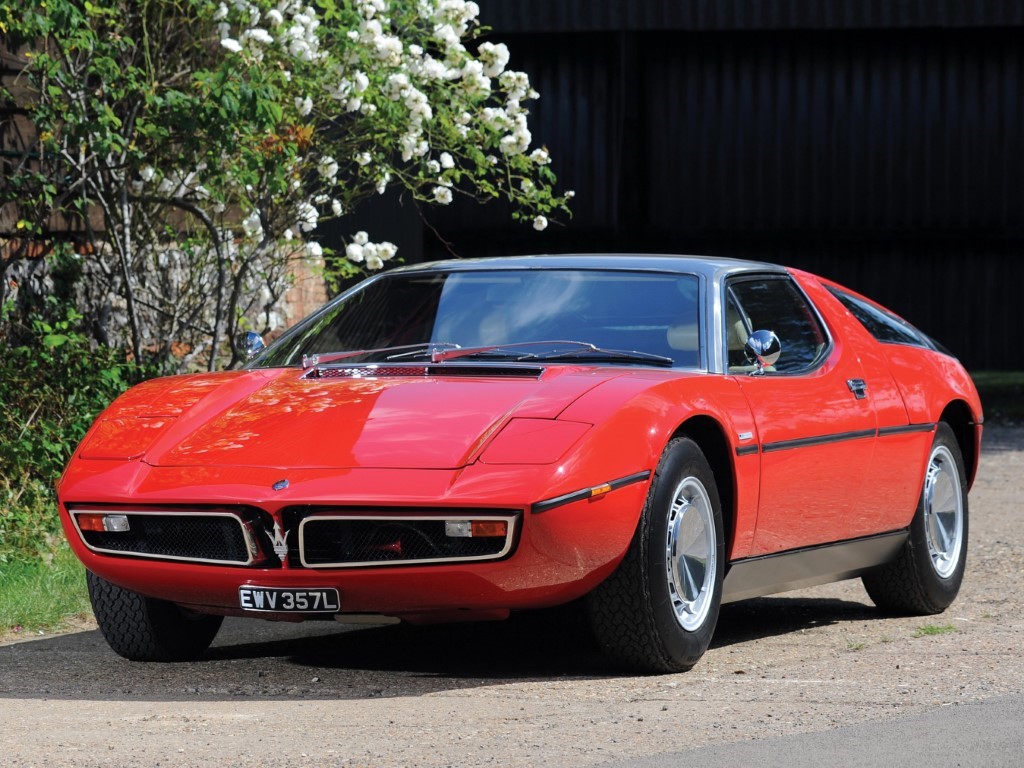
1st Generation
(1972 - 1978)
4.9 V8
330 cv
Technical specifications, versions, and history for the Maserati Bora.
Select a generation to see available versions
(1972 - 1978)
The turn of the decade from the 1960s to the 1970s undeniably represents the most tumultuous and creative period in the history of high-performance sports cars. Until the mid-60s, the hegemony of Italian Grand Tourer (GT) design was defined by an aristocratic and conservative formula: a front-mounted V12 or V8 engine, rear-wheel drive, and an elegant body that prioritized transcontinental comfort over absolute agility on circuits. Maserati, one of the most venerable houses in Modena, was the undisputed master of this format, with icons like the Ghibli and the Mexico dominating the garages of the European elite.
However, the launch of the Lamborghini Miura in 1966 detonated a seismic shift in the industry. By placing the V12 engine transversely behind the driver, Lamborghini not only invented the term "supercar," but instantly rendered the front-engine architecture obsolete for any vehicle aspiring to the title of the fastest car in the world. Ferrari, reluctant to abandon the stability of the front engine for its 12-cylinder road cars, eventually yielded with the 365 GT4 BB. Maserati, in turn, found itself at an existential and financial crossroads.
The development of the Maserati Bora, known internally as Tipo 117, was not just a reactive response to the Miura or the De Tomaso Mangusta; it was the product of an unlikely and technologically fascinating corporate union between Italian artisanal conservatism and French avant-garde futurism. Citroën's acquisition of the controlling stake in Maserati in 1968 provided the capital and, crucially, access to patented hydraulic technologies that would allow Maserati to create something its rivals could not: a mid-engine supercar that was genuinely civilized, usable, and refined.
This report dissects the trajectory of the Maserati Bora from its conception in October 1968 until the cessation of production in 1978. We will analyze the chassis and engine engineering, the controversial integration of Citroën's hydraulic systems, the evolution of the 4.7 and 4.9-liter variants, and the impact of North American regulations on the vehicle's design and performance.
In the late 1960s, Maserati faced chronic financial difficulties, an almost endemic condition among small Italian supercar manufacturers of the time. Engineering new models required capital investments that the Orsi family, owners of the brand, could not sustain alone. In 1968, Citroën, seeking a prestige engine for its own GT project (the future SM), acquired Maserati.
This merger was not just financial; it was a clash of engineering cultures. Citroën, under the technical leadership of engineers who valued radical innovation (hydropneumatic suspensions, variable power steering, directional headlights), collided with Maserati's tradition, led by the pragmatic Giulio Alfieri, who prioritized robust race-derived engines and conventional tubular chassis. The Bora project became the crucible where these two philosophies merged. Alfieri, although initially skeptical of the French complexity, recognized that high-pressure hydraulic technology could solve chronic ergonomic problems in mid-engine cars.
The brief for the Tipo 117 was ambitious. The market was already saturated with fast but flawed mid-engine cars. The Lamborghini Miura was notoriously loud, hot, cramped, and unstable at high speeds due to front aerodynamic lift. The De Tomaso Mangusta suffered from a flexible chassis and treacherous handling at the limit.
Maserati decided that its contender would not seek only top speed or raw acceleration. The Bora was to be a "mid-engine Gran Turismo"—a contradiction in terms for the era. It had to offer:
Development began in October 1968, and a prototype was running by the summer of 1969. After 18 months of intensive testing—a relatively fast gestation period by today's standards, but rigorous for the time—the final car was revealed at the Geneva Motor Show in March 1971, with deliveries starting late that year.
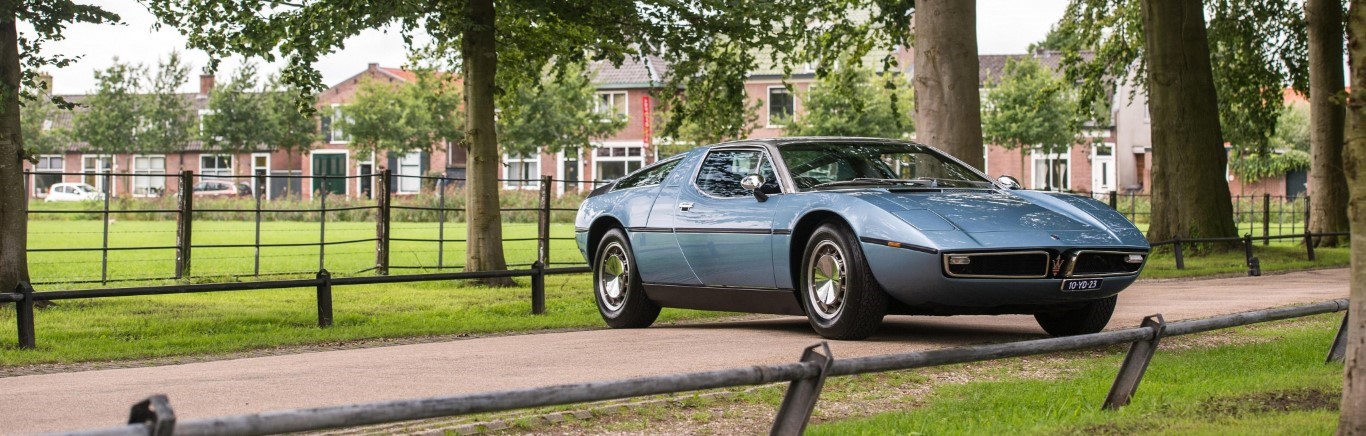
The design of the Bora was entrusted to the newly formed Italdesign, led by the young prodigy Giorgetto Giugiaro. The early 70s marked the stylistic transition from the voluptuous and organic shapes of the 60s to "Wedge" design, characterized by straight lines, flat surfaces, and sharp angles. The Bora was one of the pioneers and, arguably, one of the most balanced examples of this new language.
The profile of the Bora is defined by a continuous line that rises from the low nose to the roof and drops abruptly into a truncated tail (Kamm tail), optimized to reduce aerodynamic drag and increase stability. The total height of the vehicle was only 1,134 mm, slicing through the air efficiently.
Distinctive Stylistic Elements:
It is impossible to discuss the Bora's design without mentioning the Maserati Boomerang, a concept car also designed by Giugiaro and revealed in 1971. Built on the Bora's chassis and mechanics, the Boomerang took the wedge concept to the absolute extreme. Although it never entered production, it served as a styling laboratory and demonstrated the flexibility of the Bora platform, influencing future designs like the Lotus Esprit and the DeLorean DMC-12.
Beneath the futuristic skin designed by Giugiaro, the Bora hid mechanics that traced their roots directly to the golden era of Maserati's sports-prototype racing.
The Bora's engine was an evolution of Maserati's family of aluminum V8 engines, direct descendants of the legendary 450S race car and the ultra-exclusive 5000 GT. Giulio Alfieri chose to mount the engine longitudinally (unlike the Miura's transverse V12 or the Dino's V6), a decision that simplified the gearbox linkage and improved access for maintenance.
The block and cylinder heads were cast in lightweight aluminum alloy, with wet cast-iron cylinder liners. The valvetrain featured double overhead camshafts (DOHC), chain-driven, operating two valves per cylinder. The exhaust valves were sodium-filled to aid in heat dissipation, a vital technology to ensure durability under intense use.
Fueling was handled by four vertical (downdraught) Weber 42 DCNF carburetors. This choice was critical: while horizontal carburetors might have reduced the engine's height, the vertical ones offered better mixture flow and more immediate throttle response, even though they required raising the engine cover.
The Bora was offered with two engine displacements during its lifespan. The transition and coexistence of these engines created a complex matrix of specifications, especially when considering the differences between the European and North American markets.
| Technical Specification | Bora 4.7 (Europe) | Bora 4.9 (USA - Federalized) | Bora 4.9 (Europe - Late Standard) |
|---|---|---|---|
| Engine Code | Tipo AM 107.07 | Tipo AM 107.16 | Tipo AM 107.16 |
| Production Period | 1971 – 1978 | 1973 – 1978 | 1976 – 1978 |
| Displacement | 4,719 cc | 4,930 cc | 4,930 cc |
| Bore x Stroke | 93.9 x 85 mm | 93.9 x 89 mm | 93.9 x 89 mm |
| Compression Ratio | 8.5:1 | 8.5:1 (reduced for emissions) | 8.75:1 |
| Maximum Power | 310 hp @ 6,000 rpm | 300 hp @ 6,000 rpm | 320 - 330 hp @ 5,500 rpm |
| Maximum Torque | 46.9 kgf.m @ 4,200 rpm | 42.9 kgf.m @ 3,500 rpm | 48.1 kgf.m @ 4,000 rpm |
| Top Speed | ~270 km/h (168 mph) | ~265 km/h (estimated) | ~280 km/h (174 mph) |
The introduction of the 4.9-liter engine in the US in 1973 was a compensatory measure. Emissions control equipment (air pumps, exhaust gas recirculation) choked the 4.7 engine, drastically reducing its power. By increasing the piston stroke to 89mm, Maserati recovered the lost torque, maintaining acceptable drivability for the American market, even with the nominal power dropping to 300 hp. In Europe, where such restrictions did not exist, the unfettered 4.9 engine produced up to 330 hp, making it the definitive version in terms of performance from 1976 onwards.
Power was transmitted to the rear wheels via a five-speed ZF manual gearbox (ZF-1 DS-25/2). This transaxle, overhung behind the rear axle, was the same robust unit used in the Ford GT40 and the De Tomaso Pantera. Its durability was legendary, capable of handling torques much higher than those generated by the Maserati V8. The shift pattern was "Dog-leg" (first gear down and to the left), prioritizing the alignment of 2nd and 3rd, and 4th and 5th gears, for fast sporty driving. The rear differential was a limited-slip type, essential for putting the power down on corner exits.
The Bora's chassis represented a technological leap for Maserati. It was a stamped steel monocoque, manufactured in Modena by Officine Padane. However, the true innovation lay in the noise, vibration, and harshness (NVH) management.
Giulio Alfieri designed a rear tubular subframe that supported the engine, transmission, and rear suspension. This subframe was isolated from the main monocoque by four large elastic bushings. This solution effectively decoupled the cabin from high-frequency mechanical vibrations and road noise, creating a remarkably quiet interior environment.
Furthermore, the Bora was the first Maserati road car to feature four-wheel independent suspension, abandoning the rigid rear axle that equipped the Ghibli and the Indy. The setup used unequal-length double wishbones, coil springs, and telescopic shock absorbers on all wheels, plus front and rear anti-roll bars. The result was a car that absorbed bumps with surprising competence, avoiding the punishing harshness typical of supercars of the era.
The most polarizing technical feature of the Maserati Bora was the extensive adoption of Citroën's high-pressure hydraulic system (LHM - Liquide Hydraulique Minéral). Operating at pressures exceeding 2,000 psi, this centralized system powered multiple auxiliary and critical functions, giving the Bora a unique technological "soul."
Unlike conventional braking systems that use a master cylinder and vacuum servo to multiply the force of the driver's foot, the Bora's system used accumulated hydraulic pressure to apply the brakes. The brake pedal did not directly push fluid; instead, it opened a metering valve that released the pressure stored in the accumulator spheres to the brake calipers.
The most innovative application of hydraulics was in the cabin's ergonomics. Due to the monocoque structure and the need for engine insulation, the driver's seat had limited adjustments (only height, operated hydraulically). To compensate for the lack of longitudinal seat adjustment, Maserati created a hydraulically adjustable pedal box.
By flicking a switch on the console, the entire pedal assembly (clutch, brake, and accelerator) moved forward or backward over a travel of approximately 76 mm (3 inches). This allowed the driver to adjust the distance of the pedals without altering their position relative to the steering wheel or the shifter, a brilliant engineering solution that was rarely repeated in the industry.
The LHM system also operated:
The Bora's interior challenged the notion that a supercar had to be spartan. The goal was to create an environment where two occupants could travel hundreds of kilometers without fatigue.
As mentioned, the double glazing separating the cabin from the engine and the thick carpet over the aluminum engine cover transformed the internal acoustics. Air conditioning was standard and, crucially, effective—a rarity in Italian cars of the era. Power windows were also standard.
The seats, designed with a distinct horizontal ribbed pattern, evoked the modern furniture design of the time and were extremely comfortable, described as "lounge chairs" rather than hard racing buckets. The wraparound dashboard featured a full set of Veglia Borletti instruments, although the speedometer (calibrated up to 300 km/h or 200 mph) had its top left portion frequently obscured by the thick-rimmed steering wheel, a typical Italian ergonomic flaw.
The steering column was adjustable for both rake and reach. Combined with the movable pedals and the seat height adjustment, the Bora accommodated drivers of varying statures with an ease that the Lamborghini Countach could never dream of.
Bora production ran from 1971 to 1978, spanning one of the most difficult periods in automotive history, marked by the 1973 Oil Crisis and global recession.
There is a divergence between historical sources regarding the exact number of Boras produced, varying between 524 and 564 units. This discrepancy is common among low-volume Italian manufacturers, where chassis were allocated but not always completed sequentially, or prototypes were re-numbered.
According to the most detailed records accepted by owners' clubs and historians:
| Model | Production Estimate (Consensus) |
|---|---|
| Bora 4.7 L | 289 to 314 units |
| Bora 4.9 L | 235 to 275 units |
| Grand Total | 524 to 564 units |
Approximately half of the total production was destined for the North American market, making the original European specification models (especially the late 4.9Ls) the rarest and most sought after by today's collectors. Production of right-hand drive (RHD) models was minuscule, estimated at only 39 units of the 4.7 model and a "handful" of 4.9 models, making them unicorns in the market.
From 1973/74, US federal regulations (DOT and EPA) forced Maserati to create two distinct "lineages" of the Bora.
Although Maserati built its reputation on the track, the company was officially out of racing during the Bora era. However, the French importer Jean Thépenier saw the platform's potential for endurance and GT racing.
In 1972/73, Thépenier commissioned the development of a racing version to compete in FIA Group 4 and the 24 Hours of Le Mans. The result was the Bora Gr.4 Competizione.
The dream of seeing the Bora at Le Mans died on the desks of FIA bureaucrats. Group 4 rules required the production of 500 identical (or mechanically similar) road units for homologation. By 1973, Maserati had barely produced half that number. The FIA refused homologation, and Maserati, plunged into a financial crisis, could not appeal or build the necessary cars. Only two examples of the Bora Competizione were built (chassis 3000 and 3001). They competed briefly in French national events but could never fulfill their international destiny. Today, they are priceless collector's pieces.
To understand the true value of the Bora, it is necessary to position it against its direct contemporaries.
The Miura is visceral beauty; the Bora is rational beauty. Where the Miura suffered from terrifying front aerodynamic "lift" above 200 km/h, the Bora remained planted and stable. The Countach, which succeeded the Miura, offered unparalleled visual drama, but its cabin was an oven, visibility was zero, and the clutch required herculean strength. The Bora offered 90% of the Lamborghini's performance with levels of comfort that allowed it to be used as a true touring car. The Bora was the car for the gentleman driver; the Lamborghini, for the exhibitionist.
Ferrari's Boxer arrived on the market two years after the Bora. It had the advantage of the 12-cylinder engine (Flat-12), which offered more prestige and smoothness. However, the early Boxer had the engine mounted over the gearbox, raising the center of gravity. The Bora, with its transaxle mounted low and behind the engine, offered handling frequently described by journalists of the time as more neutral and predictable at the limit. Furthermore, the Bora's front trunk was significantly more useful than the Ferrari's.
Both used the same ZF gearbox and had V8 engines, but the similarities stopped there. The Pantera, with its American Ford V8, was more brutal, less refined, and suffered from build quality issues (early rust, overheating). The Bora was built to much higher artisanal standards (and cost much more). The Pantera was a mid-engine muscle car; the Bora was a sophisticated Italian aristocrat.
The 1973 Oil Crisis devastated the supercar market. Citroën went bankrupt in 1974 and was absorbed by Peugeot, which discarded Maserati. The Italian company was put into liquidation in 1975, being saved by the Italian government (GEPI) and by Alejandro de Tomaso.
Under the new management of De Tomaso, the focus shifted to survival through cheaper models (the Biturbo project). The Bora was kept in production in limited numbers until 1978, unified with the 4.9L engine, but without major investments in development. When the line stopped, the Bora had no direct successor. The Merak (basically a "mini-Bora" with a V6 engine) continued until 1983, but Maserati would only return to producing a top-tier mid-engine supercar with the MC12 in 2004, and a mass-produced model with the MC20 in 2020.
Owning a Maserati Bora today requires dedication and a deep understanding of its mechanical idiosyncrasies.
The hydraulic system is the "elephant in the room." The green LHM fluid must be changed regularly. Unlike DOT brake fluid (which absorbs water and corrodes lines), LHM is a hydrophobic mineral oil that protects the system, but the rubber seals and accumulator spheres (the "green bombs") do degrade.
Critical Warning: Never introduce conventional brake fluid into an LHM system. This will cause all rubber seals to swell and disintegrate within hours, requiring a total and extremely expensive rebuild of the system.
The V8 is robust but complex. The chain-driven timing system requires tensioners in perfect condition. A specific reported issue is the locking nut on the left chain tensioner, which can come loose, allowing the tensioner shaft to vibrate and damage the mechanism, generating chain noise and the risk of catastrophic failure.
The value of Boras has risen consistently, although they are still below the stratospheric prices of the Miura. Factors that increase value include:
A notable example of provenance is chassis AM117-366, a 4.9L model delivered to the Aga Khan in Paris, replete with special requests, illustrating the level of clientele the car attracted.
The Maserati Bora remains a fascinating monument to a transitional moment in automotive history. It encapsulates the tension between Italian artisanal engineering and French technological innovation, packaged in one of the purest forms ever designed by Giorgetto Giugiaro.
Although it did not achieve the bedroom-poster fame of the Lamborghini Countach or the production longevity of the Porsche 911, the Bora triumphed in its original goal: to be the mature supercar. It proved that a mid-engine layout did not require masochistic sacrifices of comfort and that extreme speed could coexist with civilized refinement. Today, as collectors seek usability as much as aesthetics, Maserati's "Wind of Trieste" is finally receiving the recognition its sophisticated engineering has always deserved.