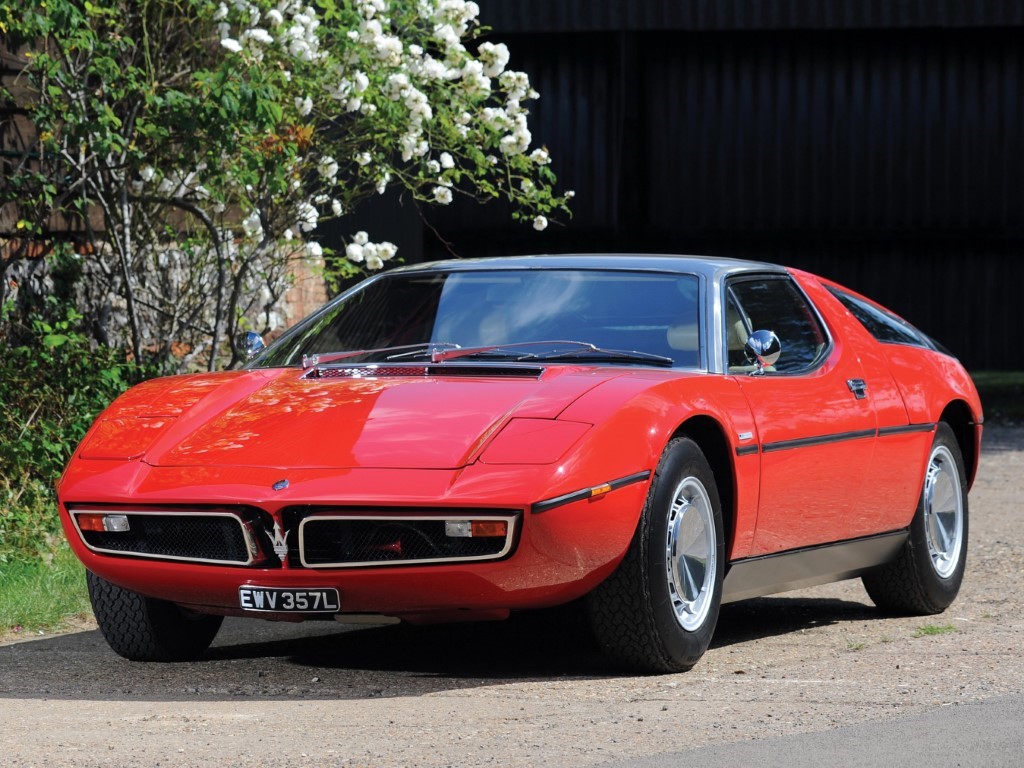
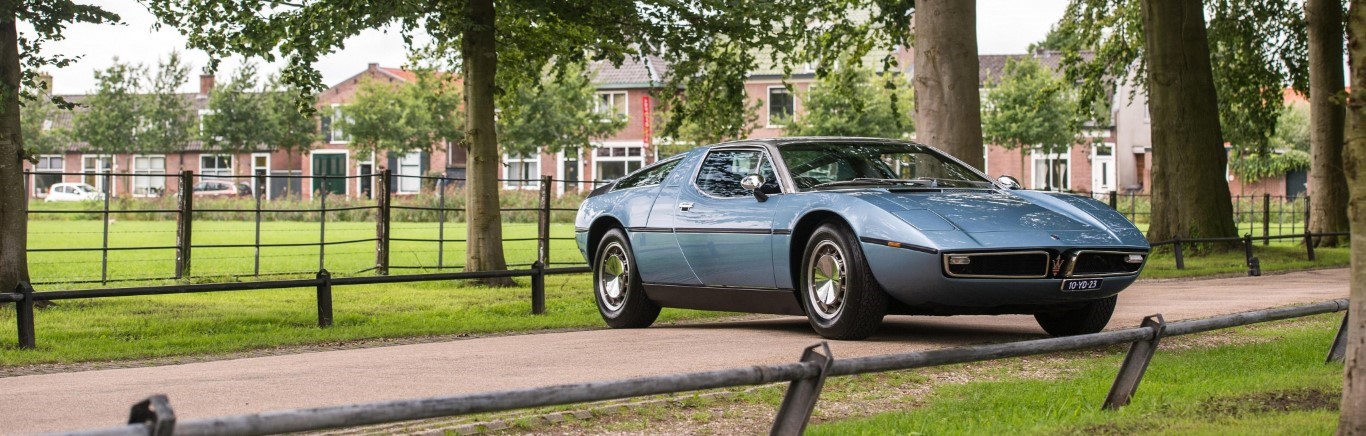
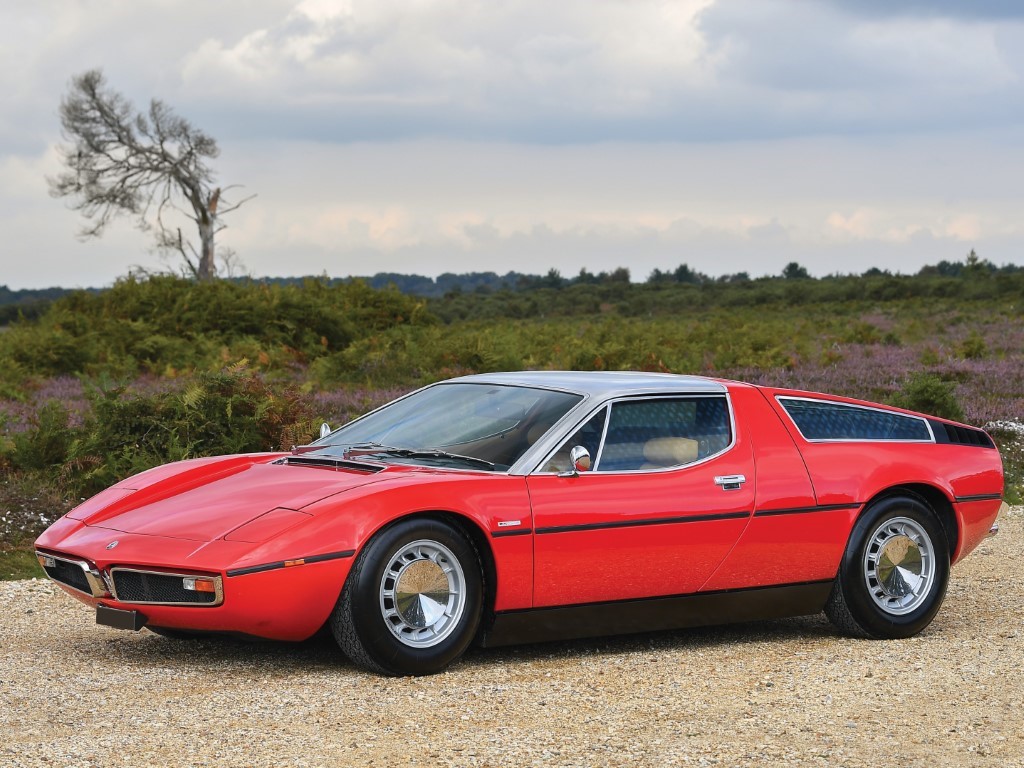
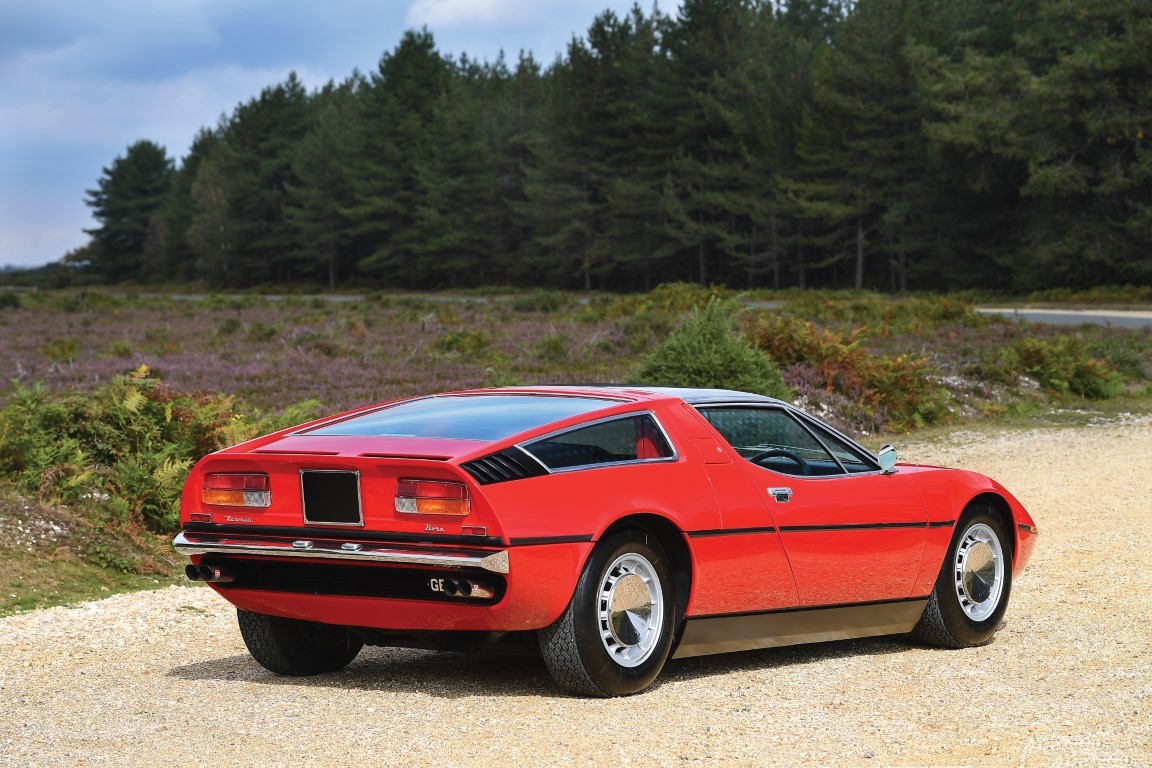
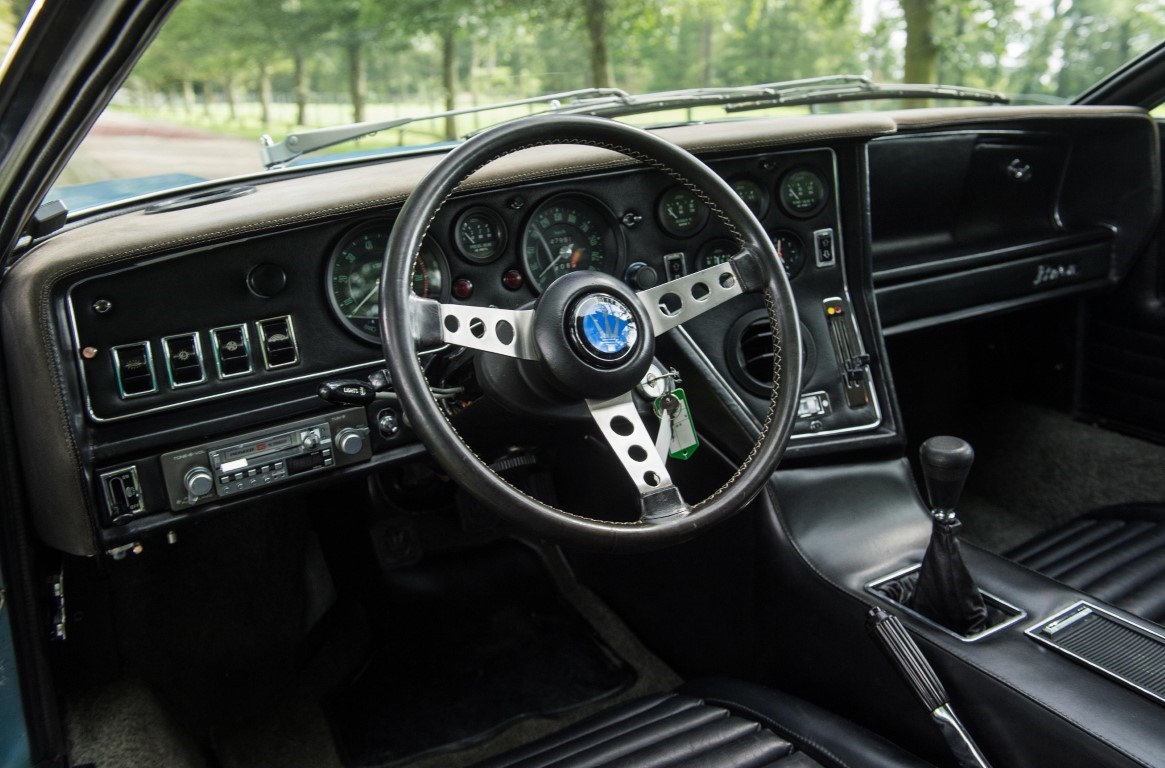
Beneath the futuristic skin designed by Giugiaro, the Bora hid mechanics that traced their roots
directly to the golden era of Maserati's sports-prototype racing.
The V8 Engine: Lineage and Specifications
The Bora's engine was an evolution of Maserati's family of aluminum V8 engines, direct descendants of
the legendary 450S race car and the ultra-exclusive 5000 GT. Giulio Alfieri chose to mount the engine
longitudinally (unlike the Miura's transverse V12 or the Dino's V6), a decision that simplified the gearbox
linkage and improved access for maintenance.
The block and cylinder heads were cast in lightweight aluminum alloy, with wet cast-iron cylinder
liners. The valvetrain featured double overhead camshafts (DOHC), chain-driven, operating two valves per
cylinder. The exhaust valves were sodium-filled to aid in heat dissipation, a vital technology to ensure
durability under intense use.
Fueling was handled by four vertical (downdraught) Weber 42 DCNF carburetors. This choice was
critical: while horizontal carburetors might have reduced the engine's height, the vertical ones offered
better mixture flow and more immediate throttle response, even though they required raising the engine
cover.
Engine Versions and Performance
The Bora was offered with two engine displacements during its lifespan. The transition and
coexistence of these engines created a complex matrix of specifications, especially when considering the
differences between the European and North American markets.
| Technical Specification |
Bora 4.7 (Europe) |
Bora 4.9 (USA - Federalized) |
Bora 4.9 (Europe - Late Standard) |
| Engine Code |
Tipo AM 107.07 |
Tipo AM 107.16 |
Tipo AM 107.16 |
| Production Period |
1971 – 1978 |
1973 – 1978 |
1976 – 1978 |
| Displacement |
4,719 cc |
4,930 cc |
4,930 cc |
| Bore x Stroke |
93.9 x 85 mm |
93.9 x 89 mm |
93.9 x 89 mm |
| Compression Ratio |
8.5:1 |
8.5:1 (reduced for emissions) |
8.75:1 |
| Maximum Power |
310 hp @ 6,000 rpm |
300 hp @ 6,000 rpm |
320 - 330 hp @ 5,500 rpm |
| Maximum Torque |
46.9 kgf.m @ 4,200 rpm |
42.9 kgf.m @ 3,500 rpm |
48.1 kgf.m @ 4,000 rpm |
| Top Speed |
~270 km/h (168 mph) |
~265 km/h (estimated) |
~280 km/h (174 mph) |
The introduction of the 4.9-liter engine in the US in 1973 was a compensatory measure. Emissions control
equipment (air pumps, exhaust gas recirculation) choked the 4.7 engine, drastically reducing its power. By
increasing the piston stroke to 89mm, Maserati recovered the lost torque, maintaining acceptable drivability
for the American market, even with the nominal power dropping to 300 hp. In Europe, where such restrictions
did not exist, the unfettered 4.9 engine produced up to 330 hp, making it the definitive version in terms of
performance from 1976 onwards.
Transmission and Differential
Power was transmitted to the rear wheels via a five-speed ZF manual gearbox (ZF-1 DS-25/2). This
transaxle, overhung behind the rear axle, was the same robust unit used in the Ford GT40 and the De Tomaso
Pantera. Its durability was legendary, capable of handling torques much higher than those generated by the
Maserati V8. The shift pattern was "Dog-leg" (first gear down and to the left), prioritizing the alignment
of 2nd and 3rd, and 4th and 5th gears, for fast sporty driving. The rear differential was a limited-slip
type, essential for putting the power down on corner exits.
Chassis and Suspension: The Quest for Refinement
The Bora's chassis represented a technological leap for Maserati. It was a stamped steel monocoque,
manufactured in Modena by Officine Padane. However, the true innovation lay in the noise, vibration, and
harshness (NVH) management.
Giulio Alfieri designed a rear tubular subframe that supported the engine, transmission, and rear
suspension. This subframe was isolated from the main monocoque by four large elastic bushings. This solution
effectively decoupled the cabin from high-frequency mechanical vibrations and road noise, creating a
remarkably quiet interior environment.
Furthermore, the Bora was the first Maserati road car to feature four-wheel independent suspension,
abandoning the rigid rear axle that equipped the Ghibli and the Indy. The setup used unequal-length double
wishbones, coil springs, and telescopic shock absorbers on all wheels, plus front and rear anti-roll bars.
The result was a car that absorbed bumps with surprising competence, avoiding the punishing harshness
typical of supercars of the era.