The transition from the 3200 GT to the 4200 GT involved a complete reengineering of the weight distribution
and power transmission.
The Transaxle Layout
The most radical change in chassis engineering was the adoption of the Transaxle layout. In the previous
model (3200 GT), the gearbox was coupled directly behind the engine, at the front of the car. In the M138,
the gearbox was moved to the rear axle, forming an integrated unit with the differential.
The front engine and rear gearbox are connected by a rigid torque tube, inside of which the driveshaft spins
at engine speed. This arrangement is expensive and complex, but it offers unparalleled dynamic benefits. It
shifts a significant amount of mass (the transmission) to the rear, counterbalancing the engine's weight.
The result is a near-perfect weight distribution:
- Maserati Coupe: 52% Front / 48% Rear.
- Maserati Spyder: 53% Front / 47% Rear.
This distribution reduces the polar moment of inertia, allowing the car to change direction with more
readiness and maintain a neutral attitude at the limit of grip, avoiding the excessive understeer typical of
heavy front-engine cars.
Gearbox Options: GT vs. Cambiocorsa
Maserati offered two interfaces for the same 6-speed mechanical transmission manufactured by Graziano:
- GT (Manual): The purist version, equipped with a clutch pedal and a traditional shift
lever with a metal gated shifter. Due to the rear location of the gearbox, the lever uses long cables or
linkages to engage the gears. Although it offers total involvement, this version represented a minority
of sales and is extremely rare today.
- Cambiocorsa (Automated Sequential): The standout technology of the time. "Cambiocorsa"
means "Race Gearbox" in Italian. It is not a conventional automatic transmission with a fluid torque
converter that "slips" and smooths shifts. It is the same mechanical gearbox as the GT version, but
robotized. A high-pressure electro-hydraulic system, controlled by a processing unit (TCU), operates the
clutch and gear selection.
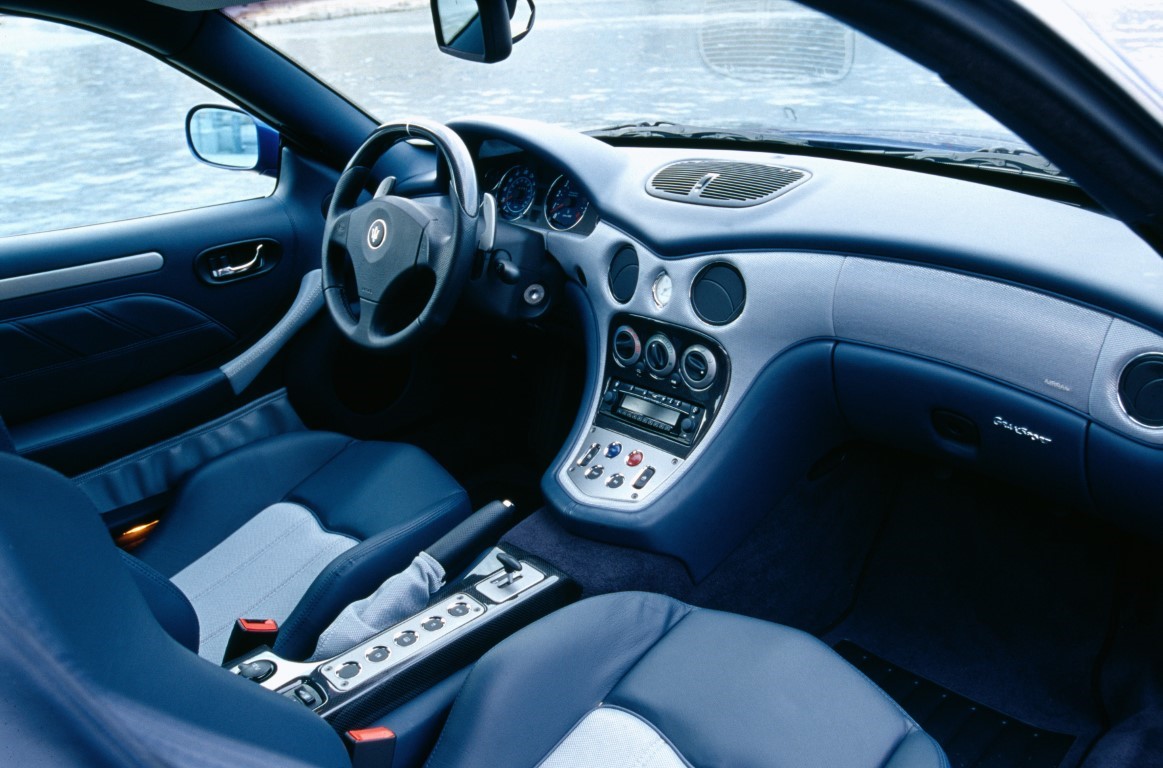
The driver commands shifts via paddles mounted on the steering column (not on the steering wheel, meaning
they remain fixed while the steering wheel turns, a preference derived from F1 so the driver always knows
where the upshift and downshift controls are).
Operating Modes: The system offers "Sport" mode (faster and more aggressive shifts), "Auto" (the computer
decides, simulating an automatic), and "Low Grip" (for snow/ice).
Software Evolution: Throughout production, the control software (nicknamed "SOFAST") was updated. Early
versions (2002-2003) could be a bit jerky in traffic. From 2004/2005 onwards, and especially in the
GranSport, the software became much more refined, smoothing out maneuvers and speeding up shifts under heavy
load.
Skyhook Suspension: Real-Time Adaptation
The aluminum double wishbone suspension on all four wheels ensured correct geometry. However, the
technological innovation lay in the Skyhook adaptive damping system, developed in partnership with
Mannesmann-Sachs.
The Skyhook system uses a network of sensors that monitor the vertical movements of the wheels, the body's
acceleration, and the driver's inputs (steering, braking, throttle). An electronic control unit processes
this data thousands of times per second and adjusts the fluid viscosity inside each shock absorber
individually via electromagnetic valves.
The theoretical concept is to isolate the body from road imperfections, as if the car were suspended by a
"sky-hook," keeping it level while the wheels work. The driver can select between "Normal" mode (focusing on
ride comfort and absorption) and "Sport" (focusing on roll control and precision).