M145
(2010 - 2017)
4.7 V8
460 cv

Technical specifications, versions, and history for the Maserati GranCabrio.
Select a generation to see available versions
(2010 - 2017)

(2018 - 2020)

(2024-)
Select a powertrain to view full technical specifications
The Maserati GranCabrio is not just an isolated model in the timeline of the Modena manufacturer; it represents the culmination of a brand repositioning strategy initiated under Ferrari management and consolidated within the Fiat Chrysler Automobiles (FCA) group. Launched globally at the 2009 Frankfurt Motor Show and entering production in 2010, the GranCabrio — known as the GranTurismo Convertible in the North American market — was designed to fill a critical gap in Maserati's portfolio: the absence of a true four-seater convertible (full four-seater).
Historically, Maserati offered the Spyder model (based on the Coupé 4200 GT), which was strictly a two-seater car with a short wheelbase. The luxury market, however, demanded a vehicle that could transport four adults in comfort, competing directly with high-luxury British and German convertibles. The GranCabrio was the answer to this demand, maintaining the Grand Tourer (GT) philosophy that prioritizes the ability to cross continents at high speed and in absolute comfort, over pure track performance.
This report details the technical and commercial trajectory of this icon, from its conception by Pininfarina, through the golden age of naturally aspirated V8 engines, to the technological rebirth of the second generation with twin-turbo V6 engines and the revolutionary Folgore electric variant.
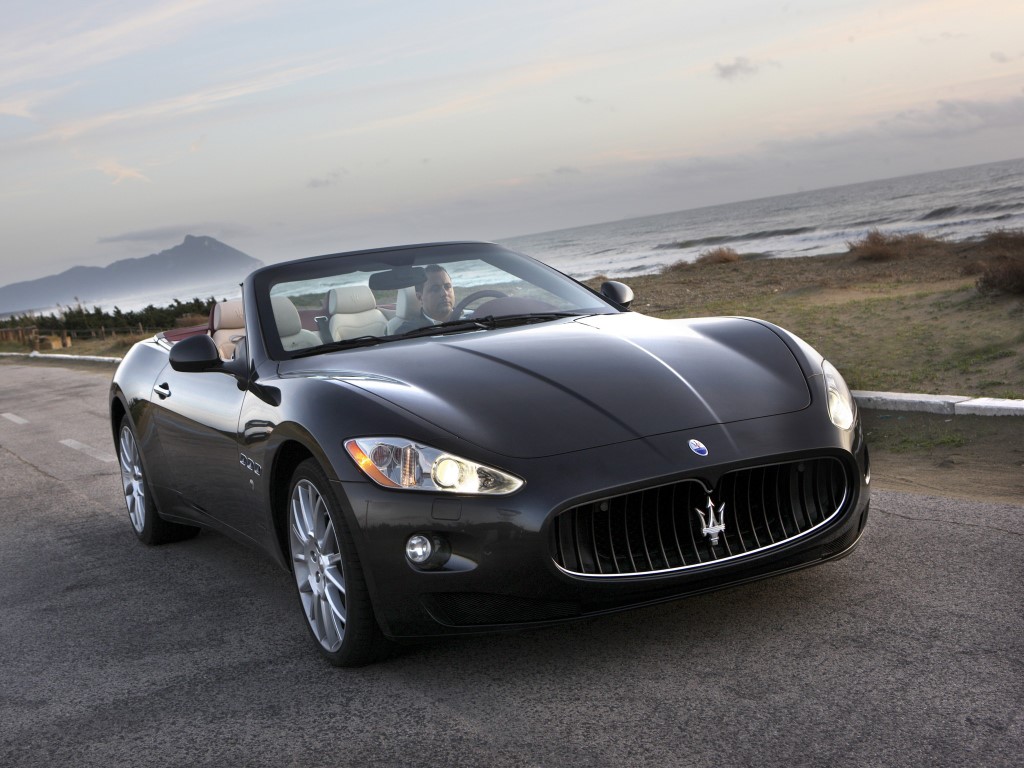
The first generation of the GranCabrio, internally designated by the code M145, is widely celebrated as one of the purest works of automotive design of the 21st century. The project was led by the Pininfarina studio, with creative direction by Jason Castriota and Lowie Vermeersch. The central challenge was to transform the GranTurismo coupe into a convertible without destroying the harmony of the lines or compromising torsional rigidity, a common problem when removing the fixed roof from a monocoque.
The adopted solution was maintaining a long wheelbase of 2,942 mm, the largest in its category at the time. This allowed the designers to create a fluid silhouette, where the canvas roof (soft-top) organically integrated into the rear, avoiding the need for a bulky "hump" to house a retractable hardtop. The choice of the canvas roof was not just aesthetic, but technical: it weighed less and occupied less volume in the trunk when folded down, in addition to keeping the center of gravity lower compared to metal roof mechanisms.
However, the engineering of a convertible of such dimensions required massive structural reinforcements in the floor and sills to prevent chassis torsion in corners. The result was a significant weight increase. The GranCabrio registered a curb weight ranging between 1,880 kg and 1,980 kg, depending on the version, representing an addition of approximately 100 kg compared to the coupe. The weight distribution was meticulously adjusted to mitigate this increase, achieving a balance of 49% on the front axle and 51% on the rear with the roof closed (changing to 48/52 with the roof open), an ideal configuration for rear-wheel drive that favored traction when exiting corners.
The heart of the GranCabrio M145 experience is the V8 engine from the F136 family, developed in technical partnership with Ferrari and produced in Maranello. This powerplant is frequently cited by experts as one of the best-sounding engines in automotive history, a characteristic intentionally designed by Maserati's acoustic engineers.
Unlike the V8s used by Ferrari (which employed a flat-plane crankshaft to reach stratospheric revs), the Maserati version used a cross-plane crankshaft. This configuration balances second-order inertia forces, resulting in smoother operation with fewer vibrations — ideal for a luxury GT — and producing that characteristic deep, low rumble, which transforms into a metallic howl near the 7,500 rpm limiter.
The evolution of this engine in the GranCabrio followed three distinct phases:
A crucial point of technical analysis, often misunderstood, concerns the transmission. The GranTurismo coupe offered, in its sportiest versions, a single-clutch robotized manual gearbox mounted on the rear axle (transaxle), known commercially as "MC Shift". This gearbox was famous for brutal 60-millisecond shifts.
However, for the GranCabrio, Maserati opted almost exclusively for the conventional ZF 6HP26 6-speed automatic transmission with a torque converter. The reason was pragmatic: the convertible customer valued comfort and smoothness at low speeds, something the robotized gearbox could not offer without jerking. To compensate for the loss of sportiness, Maserati developed the MC Auto Shift software.
This software, present in the Sport and MC versions of the GranCabrio, drastically altered the torque converter's behavior. In "Manual-Sport" mode, the ZF gearbox was capable of holding the gear at the rev limiter without automatically shifting up, performed blips (electronic heel-and-toe) on downshifts to match revs, and reduced shift times by up to 50%. Therefore, although marketing used the MC acronym, the underlying mechanics were the reliable ZF gearbox mounted right behind the engine, not the robotized transaxle system.
The longevity of the first generation, which remained in production for almost a decade, required constant updates to keep the model competitive.
The inaugural version focused purely on elegance. It was equipped with the Skyhook active suspension as standard, calibrated to absorb asphalt irregularities. Visually, it distinguished itself with bumpers featuring smaller air intakes and dual oval exhaust tailpipes. Performance was competent but restrained, with 0-100 km/h in the 5.3-second range.
Presented at the 2011 Geneva Motor Show, this version injected visual and dynamic aggressiveness.
The definitive and most extreme version. Inspired by the success of the GranTurismo MC Stradale, the GranCabrio MC brought track aesthetics to the streets.
Maserati used limited series to maintain the model's appeal and celebrate historical milestones. These versions are today the most valued by collectors.
A luxury collaboration with the Italian fashion house Fendi.
Created to celebrate the brand's 100 years (1914-2014), this edition is considered the "holy grail" of GranCabrios.
An analysis of production numbers reveals the GranCabrio's exclusivity compared to its coupe sibling. During its 12-year life cycle (2007-2019 for the complete family), the Modena factory produced a total of 40,520 units of the M145 platform.
Table 1: Production Breakdown (2007–2019)
| Model | Units Produced | % of Total |
|---|---|---|
| GranTurismo (Coupe - All versions) | 28,805 | 71.1% |
| GranCabrio (Convertible - Total) | 11,715 | 28.9% |
| Grand Total | 40,520 | 100% |
Source: Consolidation of official data and end-of-production reports.
Market Insight: With fewer than 12,000 units produced globally over a decade, the GranCabrio maintains an average annual production of about 1,100 cars. This guarantees natural exclusivity. The rarest versions, such as the Centennial Edition and the Fendi, represent minuscule fractions of this total, with production in the tens, which sustains high resale values in the collector's market.
Production officially ended in December 2019, marking the end of the naturally aspirated V8 era in Maserati's GT line. The Viale Ciro Menotti factory then entered a renovation period for the production of the MC20.
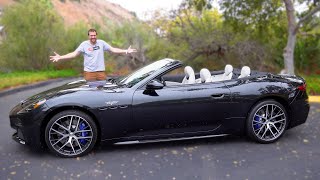
After a four-year hiatus, the GranCabrio returned to the market in 2024. The new generation, although visually evolutionary, represents a total rupture in terms of engineering. The model abandoned the naturally aspirated V8 in favor of more efficient solutions and introduced full electrification.
The new generation uses a multi-energy platform, designed from the ground up to accommodate both combustion and electric powertrains without compromising interior space or design. The structure extensively utilizes aluminum and magnesium to keep the weight down, although the dimensions have grown slightly to improve habitability.
The canvas roof has been technologically enhanced: it now operates at speeds of up to 50 km/h and completes opening in just 14 seconds. Thermal and acoustic insulation has been reinforced, and the neck warmer system has become a standard feature, blowing hot air directly from the base of the headrest to allow top-down driving on cold days.
The main combustion version, named Trofeo, adopts the "Nettuno" twin-turbo V6 engine, which debuted in the MC20 supercar. This engine is a technological showcase for Maserati, incorporating Formula 1-derived systems.
The Folgore variant places Maserati in a unique market position: it is the first fully electric luxury convertible available globally.
Table 2: Technical Comparison of the M189 Generation (2024)
| Characteristic | GranCabrio Trofeo | GranCabrio Folgore |
|---|---|---|
| Engine/Powertrain | 3.0L V6 Twin-Turbo (Nettuno) | 3 Electric Motors (Radial) |
| Maximum Power | 542 hp | 761 hp (818 hp Boost) |
| Maximum Torque | 650 Nm | 1,350 Nm |
| 0-100 km/h | 3.6 s | 2.8 s |
| Top Speed | 316 km/h | 290 km/h |
| Weight (Curb Weight) | ~1,958 kg | ~2,340 kg |
| Range (WLTP) | N/A | 419 - 447 km |
| Traction/Drivetrain | AWD (Mechanical) | AWD (Electric Vectoring) |
Source: Consolidated official technical data
Maserati has a niche presence in Brazil, officially represented by the Via Itália group. The GranCabrio, due to its price and specific configuration, has always been an extremely low-volume vehicle in the country.
The trajectory of the Maserati GranCabrio illustrates the evolution of the automotive luxury concept. The First Generation (2010-2019) secured its place in history as one of the last guardians of the analog experience: a large-displacement naturally aspirated engine, operatic sound, and timeless Pininfarina design. It is a car that appeals to pure emotion and whose collectible value tends to grow as the industry moves away from internal combustion.
The Second Generation (2024-) marks Maserati's adaptation to new times. By offering both the state-of-the-art in combustion (Nettuno V6) and the vanguard of electrification (Folgore) in the same seductive bodywork, the brand proves that it is possible to keep the soul of the Grand Tourer alive, regardless of the energy source. The GranCabrio is no longer just a beautiful Italian car, but has become a high-performance technological showcase.
Images of the Maserati GranCabrio