Design and Structural Engineering
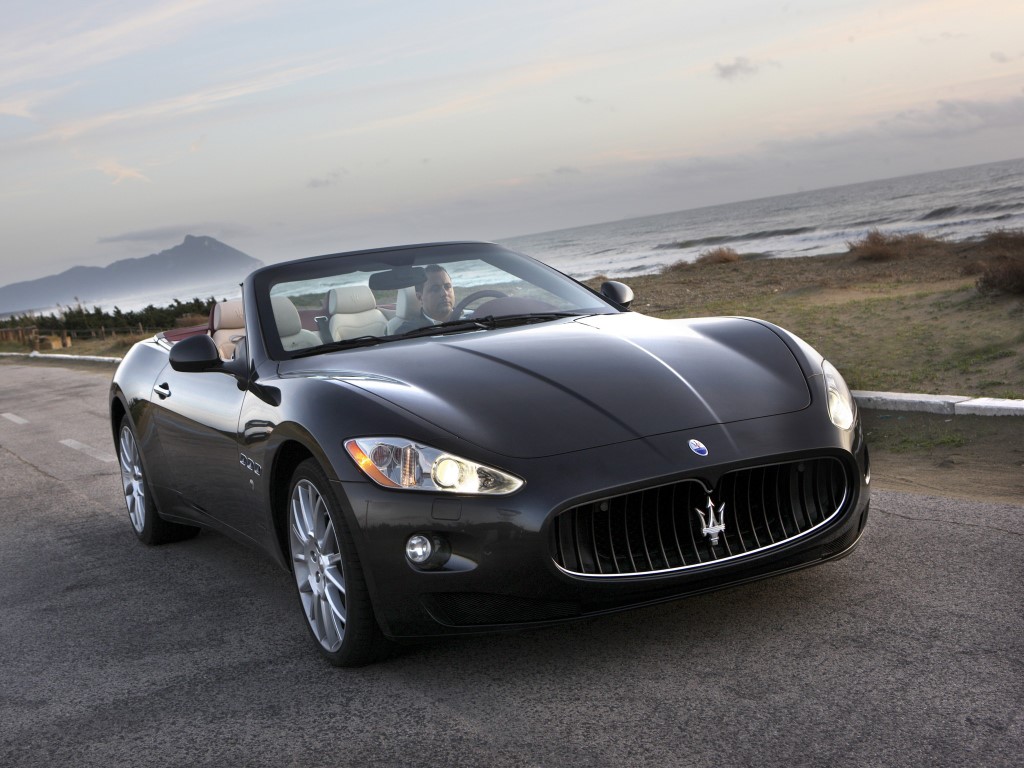
The first generation of the GranCabrio, internally designated by the code M145, is widely celebrated
as one of the purest works of automotive design of the 21st century. The project was led by the Pininfarina
studio, with creative direction by Jason Castriota and Lowie Vermeersch. The central challenge was to
transform the GranTurismo coupe into a convertible without destroying the harmony of the lines or
compromising torsional rigidity, a common problem when removing the fixed roof from a monocoque.
The adopted solution was maintaining a long wheelbase of 2,942 mm, the largest in its category at the time.
This allowed the designers to create a fluid silhouette, where the canvas roof (soft-top) organically
integrated into the rear, avoiding the need for a bulky "hump" to house a retractable hardtop. The choice of
the canvas roof was not just aesthetic, but technical: it weighed less and occupied less volume in the trunk
when folded down, in addition to keeping the center of gravity lower compared to metal roof mechanisms.
However, the engineering of a convertible of such dimensions required massive structural reinforcements in
the floor and sills to prevent chassis torsion in corners. The result was a significant weight increase. The
GranCabrio registered a curb weight ranging between 1,880 kg and 1,980 kg, depending on the version,
representing an addition of approximately 100 kg compared to the coupe. The weight distribution was
meticulously adjusted to mitigate this increase, achieving a balance of 49% on the front axle and 51% on the
rear with the roof closed (changing to 48/52 with the roof open), an ideal configuration for rear-wheel
drive that favored traction when exiting corners.
Powertrain: The F136 V8 Architecture
The heart of the GranCabrio M145 experience is the V8 engine from the F136 family, developed in technical
partnership with Ferrari and produced in Maranello. This powerplant is frequently cited by experts as one of
the best-sounding engines in automotive history, a characteristic intentionally designed by Maserati's
acoustic engineers.
Unlike the V8s used by Ferrari (which employed a flat-plane crankshaft to reach stratospheric revs), the
Maserati version used a cross-plane crankshaft. This configuration balances second-order inertia forces,
resulting in smoother operation with fewer vibrations — ideal for a luxury GT — and producing that
characteristic deep, low rumble, which transforms into a metallic howl near the 7,500 rpm limiter.
The evolution of this engine in the GranCabrio followed three distinct phases:
- Initial Phase (4.7L V8): Launched with 440 hp (324 kW) and 490 Nm of
torque.
- Sport Phase (Revised 4.7L V8): Introduced with the Sport version, power
rose to 450 hp (331 kW) and 510 Nm, thanks to improvements in ECU mapping and a reduction in internal
friction.
- Final Phase (Naturally Aspirated 4.7L V8): In the latest iterations (Sport
and MC from 2012/2013 onwards), the engine reached its peak with 460 hp (338 kW) at 7,000 rpm and 520 Nm
of torque at 4,750 rpm.
Transmission: The Myth of the "MC Shift" in the Convertible
A crucial point of technical analysis, often misunderstood, concerns the transmission. The
GranTurismo coupe offered, in its sportiest versions, a single-clutch robotized manual gearbox mounted on
the rear axle (transaxle), known commercially as "MC Shift". This gearbox was famous for brutal
60-millisecond shifts.
However, for the GranCabrio, Maserati opted almost exclusively for the conventional ZF 6HP26 6-speed
automatic transmission with a torque converter. The reason was pragmatic: the convertible customer valued
comfort and smoothness at low speeds, something the robotized gearbox could not offer without jerking. To
compensate for the loss of sportiness, Maserati developed the MC Auto Shift software.
This software, present in the Sport and MC versions of the GranCabrio, drastically altered the torque
converter's behavior. In "Manual-Sport" mode, the ZF gearbox was capable of holding the gear at the rev
limiter without automatically shifting up, performed blips (electronic heel-and-toe) on downshifts to match
revs, and reduced shift times by up to 50%. Therefore, although marketing used the MC acronym, the
underlying mechanics were the reliable ZF gearbox mounted right behind the engine, not the robotized
transaxle system.