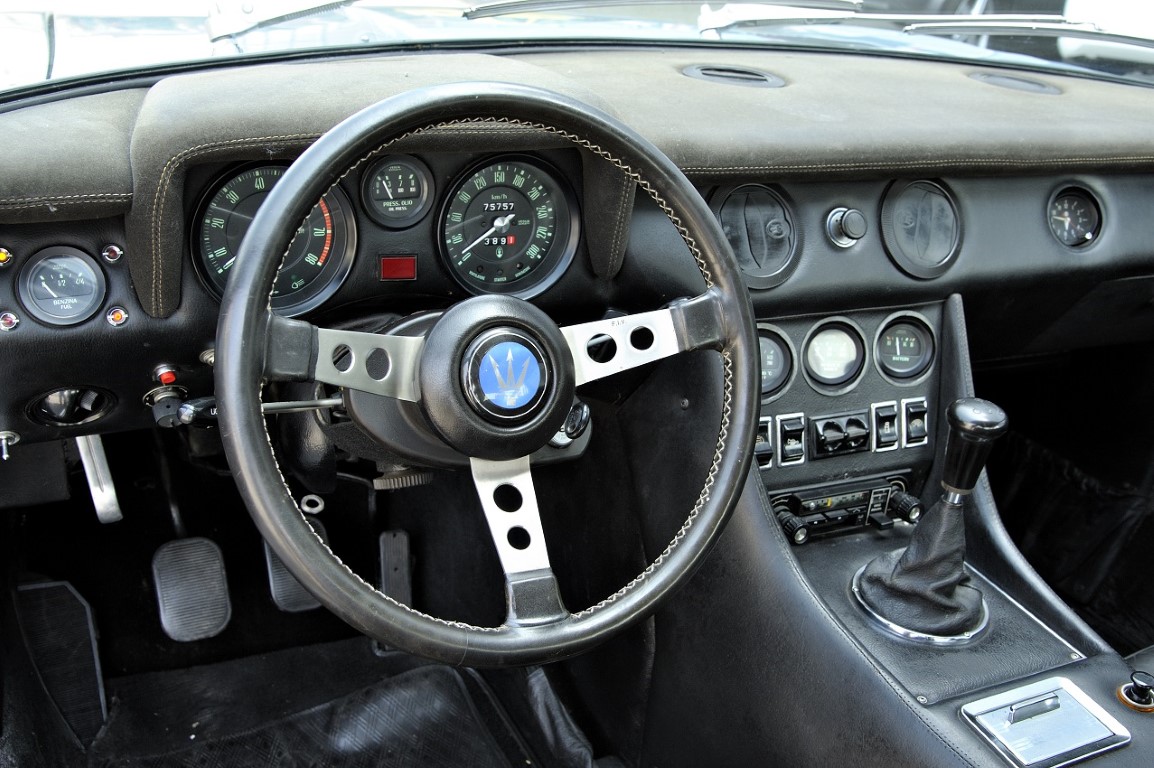
The heart of the Maserati Indy was always the 90-degree V8 engine with double overhead camshafts, a
power unit that had its roots in the brand's racing engines, specifically the 450S model. Throughout its
commercial life, the Indy went through three main stages of engine evolution, each focused on increasing
volumetric capacity and torque to compensate for the vehicle's considerable weight, which hovered around
1,680 kg.
The Initial 4.2-Liter Version (1969-1975)
The first generation of the engine used the 4,136 cc block, which had already proven its competence
in previous models like the Quattroporte I. With a bore and stroke of 88 mm x 85 mm, this engine was fed by
four twin-choke Weber 42 DCNF carburetors, which replaced the smaller carburetors used on the Mexico model.
This setup produced 260 horsepower at 5,500 rpm, allowing the Indy to reach a top speed of 250 km/h and an
acceleration from 0 to 100 km/h in approximately 7.7 to 8.2 seconds. The compression ratio was kept at
8.5:1, ensuring that the engine ran smoothly in a variety of road conditions.
The 4.7-Liter Upgrade (1970-1975)
Introduced at the Turin Motor Show in October 1970, the 4.7-liter engine was a direct response to
customer demand for more power. By enlarging the cylinder bore to 93.9 mm, the total displacement rose to
4,719 cc. This version increased power to 290 horsepower at 5,200 rpm, raising the top speed to around 260
km/h and reducing the 0 to 100 km/h acceleration time to the 7-second range. Besides the larger engine, this
version featured the Bosch electronic ignition system, improving starting reliability and fuel combustion
efficiency compared to traditional coil systems.
The Definitive 4.9-Liter Version (1972-1975)
The final evolution of the powertrain occurred in 1972 with the introduction of the 4,930 cc block.
This engine was essentially an adaptation of the unit used in the Ghibli SS, but with a fundamental
technical difference: while the Ghibli used a dry-sump lubrication system, the Indy maintained the wet-sump
system. The displacement increase was achieved by lengthening the piston stroke to 89 mm. The result was an
output of 320 horsepower at 5,500 rpm and a robust torque of 480 Nm at 4,000 rpm. With this engine, the Indy
could reach up to 280 km/h, consolidating its position as one of the fastest family vehicles of its decade.
Technical Comparison of Maserati Indy Engines
| Technical Specification |
Indy 4.2 |
Indy 4.7 |
Indy 4.9 |
| Displacement (cc) |
4,136 cc |
4,719 cc |
4,930 cc |
| Power (hp) |
260 hp @ 5,500 rpm |
290 hp @ 5,200 rpm |
320 hp @ 5,500 rpm |
| Torque (Nm) |
362 Nm @ 3,800 rpm |
382 Nm @ 3,800 rpm |
480 Nm @ 4,000 rpm |
| Top Speed |
250 km/h |
260 km/h |
265-280 km/h |
| Acceleration 0-100 km/h |
~7.7 s |
~7.0 s |
~6.8 s |