

Introduction and Historical Context
The Automotive Landscape of the Early 1970s
To understand the genesis of the Maserati Merak, it is imperative to analyze the turbulent and innovative supercar industry landscape in the late 1960s and early 1970s. This period was marked by a paradigm shift, where the mid-rear engine configuration, pioneered in road cars by the Lamborghini Miura, began to become the standard for high-performance vehicles. Ferrari, initially reluctant, embraced the format with the Dino, while Lamborghini continued to push the boundaries with the Countach and the Urraco.
Maserati, one of Modena's most traditional brands, found itself in a phase of profound transition. In January 1968, the French giant Citroën acquired a controlling stake in the Italian company. This unusual merger between France's pragmatic and futuristic engineering and Italy's artisanal passion resulted in an era of unprecedented technical creativity, but also logistical complexity.
Citroën's goal was clear: to use Maserati's expertise in high-performance engines for its own GT, the Citroën SM, and simultaneously modernize Maserati's lineup, which still relied heavily on front-engine designs like the Ghibli and the Mexico. The first entirely new fruit of this union for the trident brand was the Maserati Bora, launched in 1971, a mid-engine V8 supercar designed by Giorgetto Giugiaro.
The Need for a "Junior Supercar"
While the Bora competed at the top of the pyramid against the Ferrari Boxer and the Lamborghini Countach, there was an emerging and lucrative market segment just below: the "junior supercars" or mid-engine 2+2s. Porsche dominated this sector with the 911, offering sports performance with a level of daily practicality. Ferrari responded with the Dino 308 GT4 and Lamborghini with the Urraco. Maserati needed an answer.
The AM122 project, which would be named Merak (the name of a star in the Ursa Major constellation), was born from this strategic need. The directive was to create a vehicle that was visually impactful and technically advanced, but significantly cheaper to produce and buy than the Bora. To achieve this, Maserati decided to leverage the Bora's monocoque structure, but replace the large and expensive V8 engine with a more compact V6 unit — the same one that had been developed for the Citroën SM.
Launch and Impact of the Crisis
The Maserati Merak was presented to the world at the Paris Motor Show in October 1972, more than a year after its "older brother", the Bora. The initial reception was positive, praising Giugiaro's clean aesthetics and the intelligence of the shared platform. However, the timing of the launch proved challenging. Shortly after the car arrived on the market, the world was hit by the 1973 Oil Crisis.
Fuel prices skyrocketed and the demand for cars with large V8 and V12 engines collapsed practically overnight. Paradoxically, what was born as Maserati's "entry-level model" became its lifeline. With a 3.0-liter engine that was more efficient than the V8s of the time, the Merak managed to maintain a sales volume that sustained the factory during the lean years, vastly surpassing the Bora's production and becoming one of the brand's best-selling models of that decade.
Engineering and Technical Specifications
The Merak's engineering is a fascinating case study on how to adapt existing components to create a new and distinct product. The fusion of Italian and French technologies defines the mechanical identity of this vehicle.
The Type C.114 V6 Engine
The heart of the Merak is the 90-degree V6 engine, known internally as Type C.114. The history of this engine is complex: it was designed by Giulio Alfieri, Maserati's chief engineer, commissioned by Citroën for the SM model.
Unusual Architecture: Most V6 engines use a 60-degree angle between the cylinder banks to ensure a natural balance of vibrations. The Merak's engine, however, has a 90-degree angle. The reason for this is pragmatic: this engine was developed by cutting two cylinders from Maserati's existing V8 (used in the Indy and the Bora). This allowed Maserati to use the same machining tooling, drastically reducing capital costs.
Detailed Specifications:
- Displacement: For use in the Merak, the displacement was increased from 2.7 liters (from the SM) to 3.0 liters (2,965 cc).
- Dimensions: The cylinder bore was enlarged to 91.6 mm, maintaining the 75 mm stroke.
- Valve Train: The engine is entirely made of light alloy, with double overhead camshafts (quad-cam) driven by chains.
- Fuel Feed: The air-fuel mixture was supplied by three twin-choke Weber carburetors, specifically the 42 DCNF model.
- Power: In its initial configuration, the engine delivered 190 cv (187 hp) at 6,000 rpm and 255 Nm of torque at 4,000 rpm.
The choice of this engine wasn't just economical; its longitudinal compactness was the key factor that allowed Maserati to add two small rear seats, creating the 2+2 configuration that differentiated the Merak from the Bora.
Citroën's Hydraulic Influence
During the initial production phase (1972-1975), the Merak deeply incorporated the hydropneumatic technology of its parent company. Unlike conventional systems, the Merak used a centralized high-pressure system, fed by an engine-driven pump and utilizing the green LHM (Liquide Hydraulique Minéral) fluid.
This system controlled three main functions:
- Braking System: The brakes were hydraulically assisted, providing immense stopping power with very little effort on the pedal. The system was known for its immediate, almost binary response, which required the driver to get used to it. The rear brakes were mounted "inboard" (next to the differential) to reduce unsprung mass.
- Pop-up Headlights: The lifting of the pop-up headlights was operated hydraulically, unlike the electric motors used by most competitors.
- Clutch: Perhaps the most exotic feature was the hydraulic assistance on the clutch, which made it extremely light, but complex to maintain.
The reliability of this system became a point of contention. Leaks in the pump or the accumulator spheres could leave the car without power brakes. The complexity scared off mechanics unfamiliar with French engineering, creating a reputation for difficult maintenance that endures to this day.
Chassis and Suspension
Structurally, the Merak shared the Bora's steel monocoque up to the B-pillar. From there back, however, there was a crucial difference. While the Bora used a complex structure to support the heavy V8, the Merak utilized a simplified tubular subframe to accommodate the V6 engine and transmission.
This solution not only reduced costs, but also made maintenance easier, allowing the powertrain assembly to be removed more easily. Furthermore, the tubular subframe helped isolate the cabin from engine vibrations and noise, contributing to the car's "Gran Turismo" character.
The suspension was independent on all four wheels, with double wishbones and coil springs, offering a praiseworthy balance between ride comfort and body control. The wheels were Campagnolo light alloy, initially 15 inches.
Design: Giugiaro's Signature
The design of the Maserati Merak is widely considered one of Giorgetto Giugiaro's masterpieces during his time at Italdesign. The challenge was to transform the Bora's design into a 2+2 car without losing its sporty aggressiveness, while simultaneously reducing production costs.
Frontal Differentiation
Although the survival cell and doors were identical to those of the Bora, the front of the Merak received a distinct treatment. Giugiaro replaced the complex front grille of the Bora with two thin chrome bumpers that "floated" on the front, giving the car a lighter and more classic appearance. The front hood retained the radiator air vent, but the overall aesthetic was less brutalist than its V8 sibling.
The Innovation of the "Flying Buttresses"
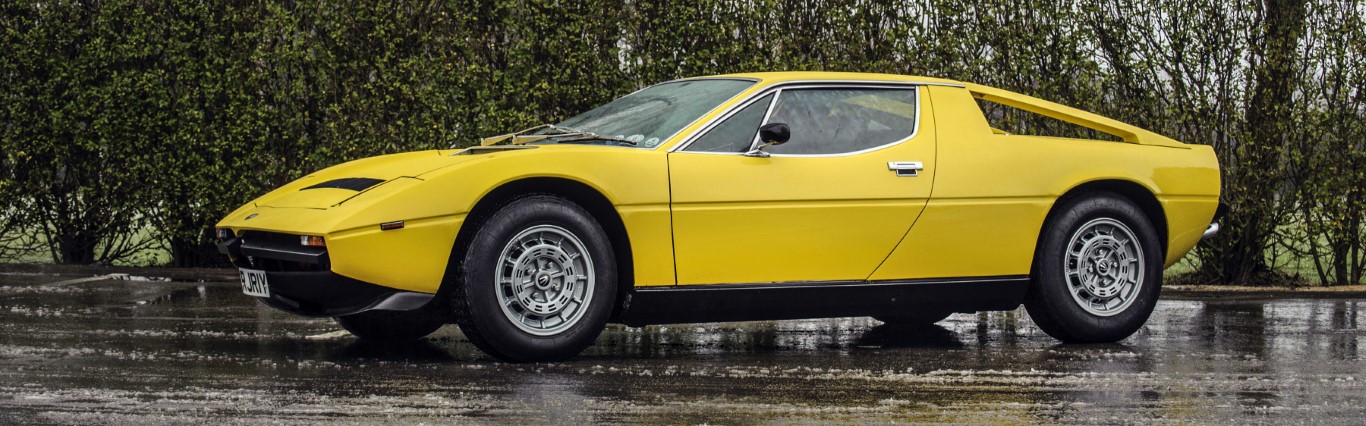
The most iconic feature of the Merak lies in its rear section. On the Bora, the V8 engine was covered by a large fastback glass structure, creating a closed and visually heavy cabin. For the Merak, Giugiaro cut the roof abruptly right behind the seats, installing a vertical rear window.
To maintain the fluid silhouette of a sports coupe and disguise the abrupt cut of the cabin, Giugiaro designed two open "flying buttresses" that extended from the roof to the rear of the car. This brilliant solution served multiple purposes:
- Aesthetics: It maintained the side profile identical to the Bora, preserving the wedge line.
- Visibility: The absence of glass over the engine and the opening in the arches significantly improved rear visibility.
- Cost and Weight: It eliminated the need for complex and expensive glass, reducing the total weight of the vehicle.
- Mechanical Access: The engine sat under a flat and accessible cover between the arches, making maintenance easier.
Interiors: An Evolution in Three Acts
The interior of the Merak underwent radical changes throughout its lifespan, reflecting the transition from Citroën management to De Tomaso. We can categorize the interiors into three distinct phases:
- Phase 1: The Citroën Dashboard (1972-1975): The early models, especially left-hand drive (LHD) ones, inherited the complete dashboard of the Citroën SM. This futuristic design featured oval instruments, a curved center console, and Citroën's famous single-spoke steering wheel. It was ergonomic and avant-garde, but many purists considered it not very "Italian".
- Phase 2: The Transition and RHD Models: Interestingly, right-hand drive (RHD) models never used the SM dashboard due to incompatibilities in the steering column. From the beginning, these cars used the Bora dashboard, which was more traditional and sporty, with a three-spoke steering wheel. This created a curious disparity where the British models were considered more aesthetically "authentic" from launch.
- Phase 3: The De Tomaso Era (Post-1976): With the departure of Citroën, the SM dashboard was abandoned. The Merak SS introduced a new dashboard, sometimes called the "square dashboard" or modified Bora style, with round instruments (Veglia or Jaeger) and a four-spoke steering wheel, later returning to the classic three-spoke steering wheel in the final models.
The Merak Versions and their Evolution
The production of the Merak lasted from 1972 to 1983 and can be divided into three main variants, each with distinct performance and trim characteristics.
Maserati Merak (1972–1975) - The First Generation
The original model, often referred to simply as "Merak", was the most influenced by Citroën.
- Engine: 3.0L V6 with 190 cv.
- Identification: Chrome bumpers, no aggressive front spoiler, and a body-colored strip of material between the pop-up headlights on the hood.
- Performance: Top speed was approximately 240 km/h. The 0 to 100 km/h time was around 9 to 9.7 seconds, which was criticized by the press of the time as being slow for a supercar, losing out to rivals like Ferrari.
- Production: 830 units were manufactured, of which about 630 retained the SM-style dashboard.
Maserati Merak SS (1975–1983) - The Sporty Refinement
In response to criticisms about its modest performance, Maserati launched the SS version (Type AM122/A) at the 1975 Geneva Motor Show. This version represented a significant leap in performance and the gradual transition away from Citroën technology.
- Mechanical Improvements: The engine received larger carburetors (Weber 44 DCNF instead of 42s), a cylinder head with larger valves, and an increased compression ratio to 9.0:1. Visually, the SS engine can be identified by the six-bolt valve cover, in contrast to the five bolts of the previous model.
- Weight Reduction: An extensive weight-saving program reduced total mass by about 50 kg, dropping the dry weight to 1,370 kg.
- Power: Power rose to 220 cv at 6,500 rpm (some sources cite 208 cv depending on US emissions standards), drastically improving throttle response.
- Visual Identification: The SS is distinguished by the black grille between the pop-up headlights (previously body-colored), matte black bumpers and trim details instead of chrome, and a lower front spoiler to improve stability at high speeds.
- Interior: The SM dashboard was replaced by a more conventional driver-oriented design, aligning with the Bora's style.
- Production: 787 units were produced.
Maserati Merak 2000 GT (1977–1983) - The Tax Response
In 1976, Italy introduced a draconian tax law to combat fuel consumption and ostentation, applying a VAT (Value Added Tax) of 38% or 39% on vehicles with engines above 2,000 cc, while cars below this limit paid only 19%.
In order not to lose the domestic market, Alejandro de Tomaso ordered the creation of the Merak 2000 GT (Type AM122/D).
- Engine: Displacement was reduced to 1,999 cc (2.0L). This was achieved by reducing the cylinder bore to 80 mm and the stroke to 66.3 mm.
- Power: Despite the drastic reduction in size, the engine produced 170 cv (or 159 cv SAE) at 7,000 rpm, an impressive specific power output for the era.
- Economy: The car was marketed with a focus on fuel economy, promising averages of up to 10 km/l, something unheard of for the brand.
- Visual Identification: The 2000 GT is easily recognizable by the thick black side stripes (swage lines) that run along the car's profile and by the matte black bumpers. It was predominantly available in two colors: light metallic blue and gold.
- Production: Only 200 units were manufactured, almost all sold in Italy, making it a rarity outside its home country.
Production Analysis and Rarity
The total production of the Maserati Merak is a topic of some historical debate, but the most widely accepted figures indicate a total of approximately 1,817 to 1,830 units over 11 years. The table below details production by version and steering configuration.
| Version | Production Period | Total Units | Specific Notes |
|---|---|---|---|
| Merak (1st Generation) | 1972 – 1975 | 830 | Includes approx. 91 units with right-hand drive (RHD). |
| Merak SS | 1975 – 1983 | 787 | Includes approx. 140 units with right-hand drive (RHD). |
| Merak 2000 GT | 1977 – 1983 | 200 | Exclusive to the Italian market, almost all LHD. |
| Grand Total | 1972 – 1983 | ~1,817 |
It is important to note that, although the Merak outsold its larger brother, the Bora (which had only 564 units produced), by more than three to one, it remains an extremely rare car by modern standards and even in comparison with the Porsche 911 of the same era.
Market Comparison: Merak vs. Competition
The Merak did not exist in a vacuum; it fought in a fiercely competitive segment known as "junior supercars". Its main adversaries were the Ferrari Dino 308 GT4 and the Lamborghini Urraco.
Merak vs. Ferrari Dino 308 GT4
Powertrain: The Ferrari used a transverse 3.0-liter V8 engine, which produced significantly more power (about 250-255 cv in Europe) than the Merak's V6. This translated into superior straight-line performance, with the Ferrari reaching 0-100 km/h in the 7-second range.
Styling: Bertone's design for the Ferrari 308 GT4 (known as the "wedge") was controversial and often considered less elegant than Giugiaro's fluid lines on the Merak. The Merak frequently won in elegance contests and in the visual preference of buyers at the time.
Space: Both were 2+2s, but the Ferrari's transverse engine layout allowed for slightly better use of cabin space. However, the Merak offered a decent front trunk and the clever use of the rear seats as a luggage shelf.
Merak vs. Lamborghini Urraco
Reliability: The Urraco, especially in its early P250 versions, suffered from catastrophic reliability issues, including timing belt failures (a novelty at the time). The Merak's V6 engine, derived from the SM and using timing chains, proved to be more robust in the long run, despite the hydraulic idiosyncrasies of the rest of the car.
Performance: In period tests, such as the September 1975 Road & Track magazine comparison, the Merak was praised for being more refined and quieter at cruising speed than the Urraco, which was seen as rawer and more temperamental. The Merak pulled ahead of the Lamborghini in terms of perceived quality, but behind the Ferrari in pure sporty performance.
Driving Dynamics
The Merak was frequently described as the "Gran Turismo" of the group. While the Ferrari encouraged aggressive driving on the edge, the Merak shone on long-distance trips and fast winding roads. The car's "sweet spot" was identified by owners and journalists as between 110 and 140 km/h (70-90 mph), where the engine, steering, and chassis fell into perfect harmony, offering a fluid and engaging experience.
The steering, light and precise (especially in versions without the excessive assistance of the Citroën system), combined with the excellent visibility provided by the open rear arches, made the Merak a much easier car to live with in urban traffic than its mid-engine rivals, which suffered from massive blind spots.
The De Tomaso Transition and the End of the Citroën Era
The Merak's history is inextricably linked to corporate politics. In 1975, Citroën declared bankruptcy and was absorbed by Peugeot, forming PSA. Maserati was placed into liquidation and saved by the Italian government and Alejandro de Tomaso.
This change had a profound impact on the Merak's engineering starting in 1976. De Tomaso was a pragmatic industrialist who despised unnecessary complexity. Under his order, Maserati engineers began to systematically remove the French components from the car:
- The hydraulic clutch was replaced by a conventional mechanical system.
- The brakes, although retaining hydraulic actuation, were simplified in their operation and maintenance.
- Interior trim components were standardized with parts used in other De Tomaso and new-era Maserati models, such as the Kyalami.
This "de-Frenchification" made the final models (SS and 2000 GT) mechanically simpler and, ironically, cheaper to maintain today than the early examples, although purist collectors now value the technological uniqueness of the Citroën era.
Ownership Guide: Maintenance and Curious Details
For the modern enthusiast or collector, the Merak presents unique challenges and rewards. Its maintenance requires specific knowledge.
The Sodium-Filled Valves Problem
A known critical flaw in the C.114 engine is the sodium-filled exhaust valves. Designed to dissipate heat in high-performance engines, these valves tend to corrode over time and with humidity. The valve stem can break, causing the valve head to drop into the cylinder, resulting in catastrophic engine destruction. Preventive replacement with solid stainless steel valves is considered mandatory for any new owner.
The Hydraulic System
Leaks in the high-pressure pump or actuators are common in cars that have been sitting idle. The system requires the strict use of LHM fluid (green) and never conventional brake fluid, which would destroy the rubber seals. A common symptom of problems is the frequent "clicking" of the pressure regulator or a delay in the headlights popping up.
Peculiar Details
The Merak is full of idiosyncrasies that delight fans:
- Dual Horns: The car came equipped with two selectable horn systems: a "polite" electric horn for the city and a "loud" compressed air horn for the highway, a typically Italian feature of the time.
- Jewelry Compartment: Unlike the Bora, which had hydraulic adjustments even for the pedals, the Merak SS featured a small secret compartment in the front trunk area, often referred to as a "jewelry box" or a place to store valuables.
- Spare Tire (US Version): In models destined for the USA, the requirement for a full-size spare tire forced Maserati to create a "bulge" in the engine cover to accommodate the wheel, in addition to lowering the exhaust, which detracted from Giugiaro's clean aesthetics.
- Oil Pressure Indicator: A notorious peculiarity is the oil pressure gauge that frequently reads zero or triggers the warning light at idle, even when the pressure is correct. The factory itself even instructed dealers that if the needle moved minimally, the engine was fine, as it was a characteristic of the instrument and not a mechanical failure.
Conclusion
The Maserati Merak has traveled a long journey from being seen as the Bora's "poor brother" to being recognized as a legitimate and desirable classic. It represents a unique moment in automotive history, where Citroën's technological ambition met Maserati's sporting soul.
While the Bora is the brutal and unattainable supercar, the Merak is the usable hero. Its survival through the oil crisis and corporate turbulence proved the brilliance of its basic concept: an exotic, visually stunning car, but with rationalized mechanics. With only about 1,817 units produced, it offers exclusivity, a pure analog driving experience (especially in the SS version), and one of the most beautiful designs of the 1970s, immortalized by its floating rear buttresses. For the collector seeking the essence of the Italian "Gran Turismo" with a touch of French eccentricity, the Merak remains an incomparable choice.