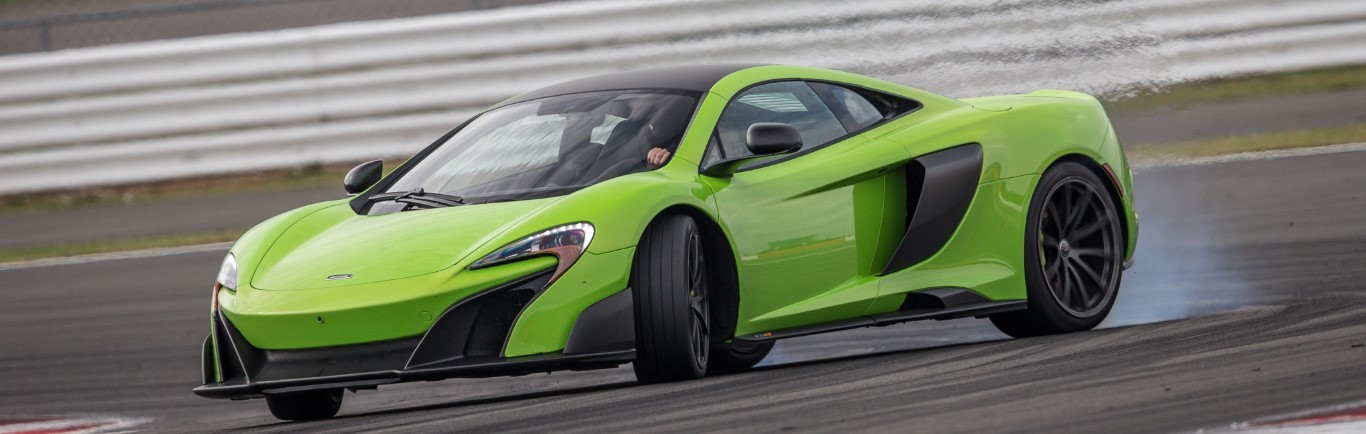
1st Generation
(2014 - 2017)
Technical specifications, versions, and history for the Mclaren 675LT.
Select a generation to see available versions
(2014 - 2017)
Select a powertrain to view full technical specifications
The history of the McLaren 675LT transcends the launch of a simple sports car; it represents a crucial moment in McLaren Automotive's engineering philosophy. Launched at the 2015 Geneva Motor Show, the 675LT marked the rebirth of the "Longtail" designation, a revered nomenclature that had remained dormant for almost two decades. This report meticulously dissects the genesis, mechanical engineering, advanced aerodynamics, and market impact of this model which, according to experts, redefined the segment of track-focused supercars.
To understand the depth of the 675LT project, it is imperative to revisit its roots. The term "Longtail" originated during the 1997 racing season, when McLaren was forced to evolve its legendary F1 GTR to compete against new dedicated prototypes, such as the Porsche 911 GT1 and the Mercedes CLK GTR. The result was the F1 GTR "Longtail", a car lengthened at the front and rear to maximize downforce and reduce aerodynamic drag.
That 1997 car wasn't just a faster version; it was a complete re-engineering focused on aerodynamic efficiency and an obsessive reduction of weight. When McLaren decided to resurrect this name for the 675LT, the expectation created was not just marketing, but a technical promise: the car would need to be significantly lighter, faster, and more engaging than the model it was based on, the 650S.
The 675LT was positioned at the top of McLaren's "Super Series", the brand's mid-range, above the 650S and below the P1 hypercar. However, the crucial distinction of the 675LT was its shift in focus. While the 650S was designed to be an everyday usable supercar with great comfort, the 675LT was developed with a singular focus: driver interaction and circuit performance. Production was strictly limited to ensure exclusivity, with only 500 units of the Coupe and 500 units of the Spider initially planned, all sold out quickly, validating the demand for a more visceral machine.
The central pillar of the 675LT's development was weight reduction. McLaren set an ambitious goal of shedding 100 kg compared to the 650S, a Herculean task considering that the 650S already utilized a carbon fiber chassis and was light by class standards.
The foundation of the vehicle is the famous carbon fiber MonoCell structure, which weighs only 75 kg. This central "tub" offers exceptional torsional rigidity, which allowed engineers to remove weight from other areas without compromising structural integrity or safety. The inherent stiffness of the carbon is such that, even in the convertible version (Spider), no heavy additional structural reinforcements were necessary, a significant technical differentiator compared to aluminum or steel competitors.
To achieve the target of 1,230 kg (dry weight of the Coupe), the engineering team examined every component of the vehicle:
| Component | Material / Alteration | Weight Savings / Impact |
|---|---|---|
| Bodywork | Carbon Fiber | The extensive use of carbon in the body panels (bumpers, rear fenders, rear deck) contributed significantly to the overall weight reduction. |
| Glass | Thinner glass | The windshield is 1.0 mm thinner than standard, and the rear bulkhead glass is 0.5 mm thinner, reducing weight in a high area of the car, which helps lower the center of gravity. |
| Engine Cover | Polycarbonate | Instead of heavy glass, the engine cover is made of lightweight polycarbonate with louvers for ventilation. |
| Exhaust System | Titanium | A full titanium exhaust system replaces the stainless steel one, saving 1.1 kg and drastically altering the acoustic resonance. |
| Suspension | Derived from the P1 | Suspension arms and uprights inherited from the P1 saved 13.7 kg of unsprung mass. |
| Wheels | Ultra-light Forged Alloy | The wheels are the lightest ever offered by McLaren at the time, reducing rotational inertia. |
| Wheel Bolts | Titanium | Even the wheel bolts were made of titanium to save precious grams. |
This meticulous approach resulted in a car with a power-to-weight ratio of 549 PS per tonne, a figure that places the 675LT into hypercar territory.
Although visually similar to the 650S engine, the 675LT's power unit underwent modifications so extensive that it received a new identification code: M838TL. McLaren claims that about 50% of the engine components are new or redesigned specifically for this model.
The engine is a 3.8-liter (3,799 cc) twin-turbo V8 with a flat-plane crankshaft, a characteristic that allows the engine to rev more freely and reach higher RPMs.
The main criticism of modern turbo engines is the delay in response (turbo lag). To combat this in the 675LT, the engineers implemented low-inertia internal components:
The 7-speed dual-clutch transmission (SSG - Seamless Shift Gearbox) manufactured by Graziano was recalibrated to offer shifts twice as fast as in the 650S.
In "Track" mode, McLaren introduced a technology called "Ignition Cut". During upshifts, the system momentarily cuts the spark from the spark plugs, interrupting engine torque for a fraction of a second. This allows the gearbox to engage the next gear instantly and creates an explosive "crack" sound in the exhaust, as unburned fuel is ignited in the hot exhaust system. This not only improves performance but adds a visceral auditory theater to the driving experience.
The 675LT's aerodynamics are not just aimed at reducing drag to reach top speeds in a straight line, but rather at generating downforce to increase cornering speed. The aerodynamic package generates 40% more downforce than the 650S, transforming the vehicle's stability at high speeds.
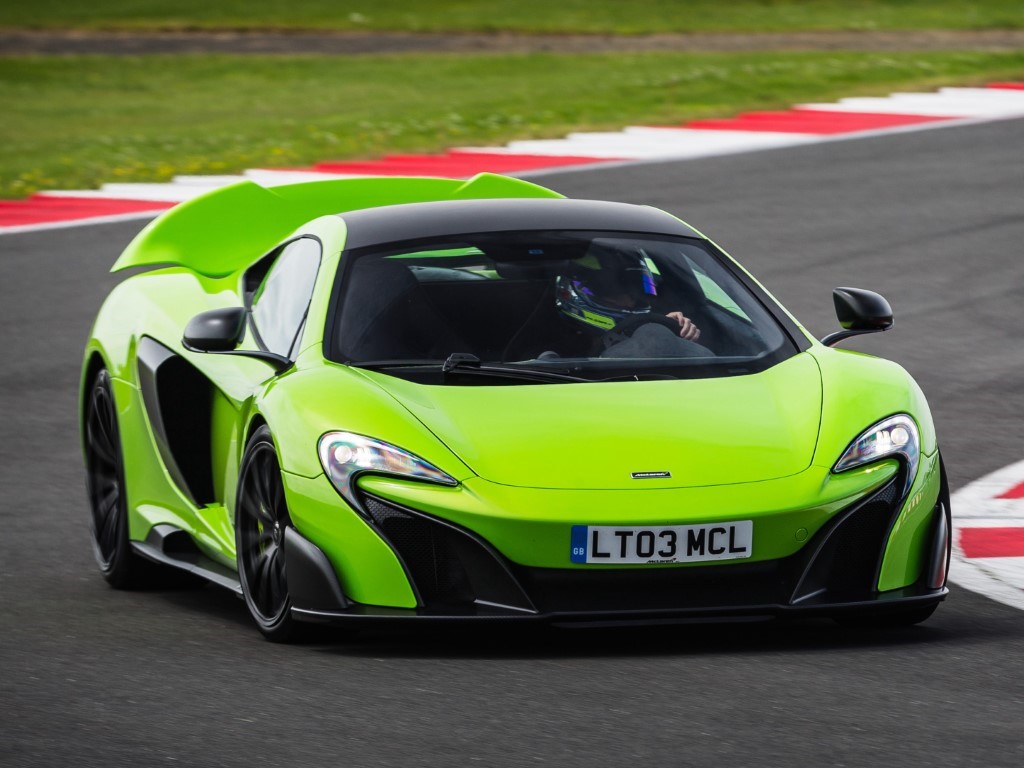
The most distinct visual characteristic is the "Longtail" Airbrake at the rear. This active wing is 50% larger than the one on the 650S, extending across the entire width of the rear. Despite the increased size, it is lighter due to its carbon fiber construction.
The operation of the Airbrake is complex and adapts to three main scenarios:
At the front, a prominent carbon fiber splitter channels air underneath the car and to the sides. Vertical plates at the ends of the front bumper (end-plates) generate vortices that clean up the turbulent airflow generated by the spinning front wheels.
At the rear, an aggressive diffuser works in conjunction with the car's flat underbody to accelerate the air passing underneath the vehicle, creating a low-pressure zone that "sucks" the car against the ground.
Despite the "Longtail" name, the car's physical growth is subtle in terms of overall length, but significant in terms of width and stance.
The suspension of the 675LT represents a significant departure from the 650S setup, moving closer to the technology used in the P1 hypercar.
The 675LT utilizes the ProActive Chassis Control suspension system, which eliminates traditional mechanical anti-roll bars in favor of an interconnected hydraulic system. However, the hardware has been radically altered:
McLaren retained hydraulic assistance for the steering, instead of adopting the electric assistance common in the industry. The 675LT's steering rack has a faster ratio than the 650S, making the front of the car incredibly incisive. The retention of hydraulic assistance is widely praised for providing superior tactile "feedback", allowing the driver to feel the texture of the asphalt and the level of grip available from the front tires.
The car came from the factory with Pirelli P-Zero Trofeo R tires, street-legal semi-slick compounds developed specifically to maximize dry track grip. The braking system uses massive carbon ceramic solid discs (CCM) (394 mm at the front, 380 mm at the rear), bitten by six-piston calipers at the front and four at the rear, ensuring immense stopping power and resistance to thermal fade.
The 675LT's lifecycle saw the launch of two main body styles and two ultra-limited special editions.
The original version presented in Geneva.
Launched a year later, in response to overwhelming customer demand.
Based on the Spider, this edition was created by the McLaren Special Operations (MSO) division.
The final and most extreme evolution of the platform.
To understand the magnitude of the 675LT's engineering, we present a direct comparative table with the base 650S model:
| Characteristic | McLaren 650S | McLaren 675LT | Difference Analysis |
|---|---|---|---|
| Power | 650 PS (641 bhp) | 675 PS (666 bhp) | +25 PS, but with more aggressive delivery. |
| Torque | 678 Nm | 700 Nm | Torque increase and improvement in the delivery curve. |
| Dry Weight | ~1,330 kg | 1,230 kg | -100 kg. A massive reduction that affects acceleration, braking, and cornering. |
| 0-200 km/h | 8.4 s | 7.9 s | 0.5s faster is an eternity in supercar performance. |
| Aerodynamics | Standard | Longtail (+40% Downforce) | The 675LT sticks to the ground more at high speeds. |
| Exhaust | Steel | Titanium | Lighter, louder, and heat resistant. |
| Suspension | ProActive Chassis | Derived from P1 | Much stiffer springs and wider front track. |
| Interior | Comfort/Leather | Track/Alcantara | Removal of carpets and acoustic insulation to save weight. |
Engineering Insight: The simple reading of the 0-100 km/h numbers (3.0s vs 2.9s) hides the true difference. The limitation at low speeds is tire traction. The 675LT's true advantage reveals itself above 100 km/h, where superior aerodynamics and power-to-weight ratio allow it to quickly pull away from the 650S.
The interior of the 675LT is an exercise in functional minimalism.
On the center console, the driver finds the ADP, which controls the car's character:
McLaren offered a vibrant and historic color palette for the launch of the 675LT. The colors helped define the aggressive personality of the car.
In addition to these, the MSO division allowed painting the car in practically any desired color for an extra cost.
Being a high-performance supercar, maintenance is rigorous, but the 675LT is considered mechanically robust, benefiting from the maturity of the platform that started with the 12C.
The McLaren 675LT ended its production in 2017, but its impact endures. It established the formula for all future "LT" models from the brand (like the 600LT and the 765LT): reduced weight, active aerodynamics, and total focus on driver involvement.
For many collectors and automotive journalists, the 675LT remains McLaren's modern "sweet spot". It combines the compact size and communicative hydraulic steering of the older generation with performance that even today, years after its launch, is capable of humbling much newer supercars. With only 1,000 main units produced (500 Coupe + 500 Spider), it secured its place in history as one of the great analog-digitals of its era.
The combination of exclusivity, the purity of hydraulic steering (a technology that is disappearing), and the brutality of the M838TL engine make the 675LT not just a chapter in McLaren's history, but an entire volume dedicated to the pursuit of dynamic perfection.
Images of the Mclaren 675LT