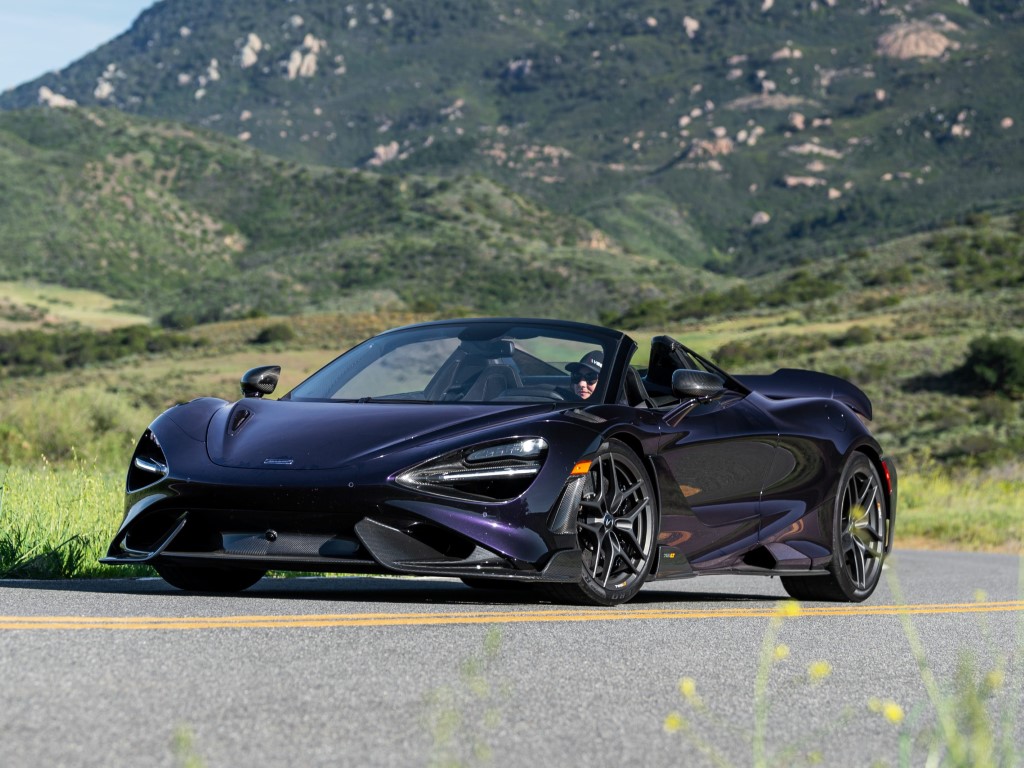
The Longtail Lineage
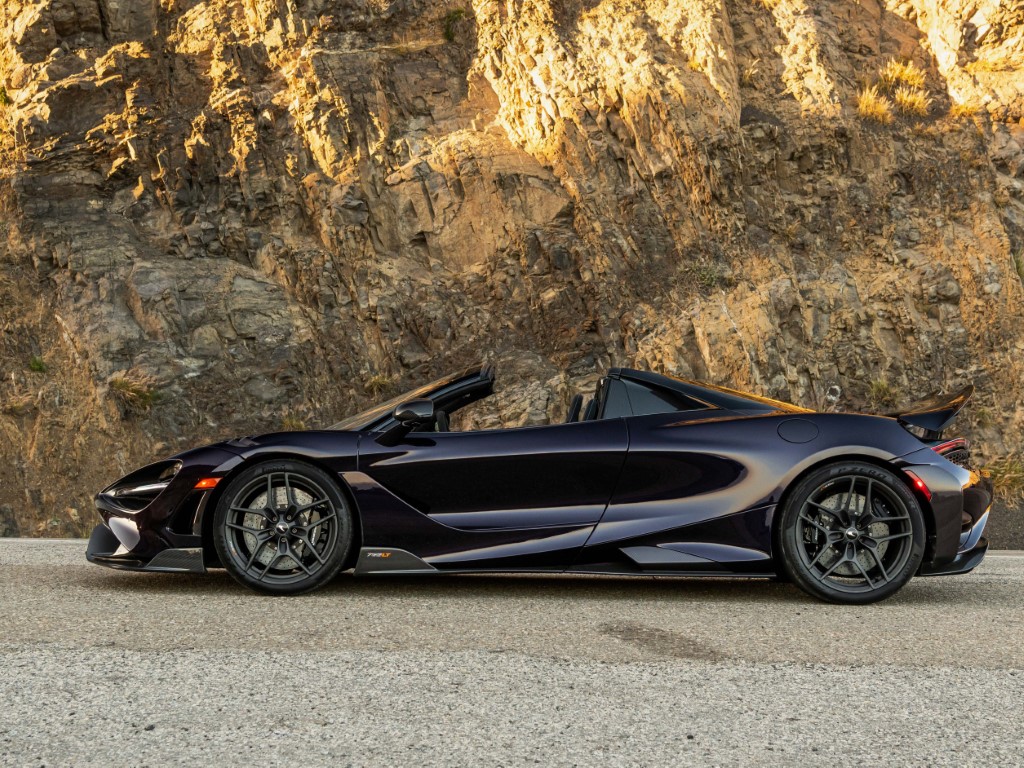
In the pantheon of high-performance automotive engineering, few designations carry as much historical and technical weight as the "LT" acronym within McLaren Automotive. Meaning "Longtail", this suffix is not merely a marketing strategy, but rather an indicative of a radical engineering philosophy focused on aerodynamics, obsessive weight reduction, and pure driving dynamics. The McLaren 765LT and its convertible counterpart, the 765LT Spider, represent the apex of the British manufacturer's "Super Series", serving as the final and most extreme chapter of the platform introduced by the acclaimed 720S.
To understand the magnitude of the 765LT project, it is imperative to contextualize it within the historical lineage that spawned it. The story begins not on the roads, but on the Le Mans racing tracks in the 1990s. The original McLaren F1 GTR dominated GT racing, but faced increasing competition from special homologation prototypes, such as the Porsche 911 GT1 and the Mercedes-Benz CLK GTR. In response, McLaren radically modified the F1 GTR's bodywork for the 1997 season, lengthening the rear section to reduce aerodynamic drag and increase downforce. This car, the F1 GTR "Longtail", became an instant legend, establishing the blueprint for all future LT models: lighter, longer, and unconditionally focused on performance.
McLaren revived the name in 2015 with the 675LT, based on the 650S, and followed with the 600LT, based on the 570S. When the 765LT was announced in March 2020, it had the responsibility of succeeding the venerated 675LT and raising the bar set by the 720S, a car that many critics already considered almost unbeatable in its segment. The 765LT was not designed to be just a faster version of the 720S; it was conceived as a "distilled" machine, where comfort was sacrificed in the name of tactile communication and surgical precision.
With a production strictly limited to 765 numbered units for the coupe and, subsequently, 765 units for the Spider, the model embodies exclusivity as much as technical excellence. This report exhaustively details the engineering, design, and market impact of these two models, exploring every facet that makes them milestones in the history of internal combustion supercars.
Development Philosophy and Subtractive Engineering
The development of the 765LT was guided by an ethos of "subtractive engineering". While most model updates involve adding technology and features, creating a Longtail involves the meticulous removal of excess. The Woking team operated under a strict mandate for mass reduction, aiming for significant weight savings compared to the donor model, the 720S.
The Obsession with Lightweighting
Weight reduction in the 765LT is systemic, not isolated. McLaren managed to shave off 80 kg (176 lbs) compared to the 720S, achieving a minimum dry weight of just 1,229 kg for the coupe. This achievement is notable considering that the 720S was already a class leader in terms of lightweight construction due to its carbon fiber chassis.
To achieve this goal, the engineers examined every subcomponent of the vehicle:
- Glass and Polycarbonate: The windshield is thinner than standard. In the coupe, the rear side windows and the C-pillar window were replaced by lightweight polycarbonate, a motorsport-derived material that offers impact resistance at a fraction of the weight of glass.
- Titanium: The exhaust system was completely redesigned in titanium. Besides acoustic properties, this material allowed for a 40% weight savings over a comparable steel system. The attention to detail extends even to the wheel bolts, which are also made of titanium to reduce unsprung rotational mass.
- Carbon Fiber: The use of carbon fiber was drastically expanded. Exterior panels that were aluminum on the 720S, such as the front bumper, rear bumper, front floor, side skirts, and diffuser, are made of carbon fiber composite on the 765LT. Many of these components are produced at the McLaren Composites Technology Centre (MCTC) in Yorkshire, ensuring precision and optimized weave quality.
- Removal of Comfort Items: In its purest specification, the 765LT came without an air conditioning system and without an audio system, saving vital kilograms. Although McLaren offered the reinstallation of these systems as a "No Cost Option", the default configuration reflects the vehicle's track focus.
- Microscopic Details: Weight reduction went down to the level of replacing door storage pockets with elastic nets, saving a mere 800 grams, and simplifying the center console.
This holistic approach resulted in a class-leading power-to-weight ratio, fundamental to the vehicle's dynamic performance. Lightness does not only benefit straight-line acceleration, but it reduces inertia in corners, improves braking response, and decreases wear on tires and suspension components.
Functional Aerodynamics and Design
The design of the 765LT is purely functional. The aggressive aesthetics are a direct byproduct of aerodynamic and cooling needs. The car is physically longer than the 720S, justifying the "Longtail" name. The overall length increased by 57 mm, with 48 mm added to the front splitter and 9 mm to the active rear wing.
| Dimension | Change vs. 720S | Main Function |
|---|---|---|
| Overall Length | +57 mm | Increased aerodynamic stability and downforce |
| Ride Height (Front) | -5 mm | Increased ground effect and aggressive "rake" |
| Front Track | +6 mm | Greater front mechanical grip |
| Rear Wing | +20% Area | Greater downforce, aerodynamic braking, DRS |
The aerodynamic package generates 25% more downforce than the 720S. The extended front splitter acts like a blade, separating the high-pressure airflow going to the radiators from the low-pressure flow passing underneath the car. Small vertical blades on the edges of the front bumper guide turbulent air away from the front wheels, while the extended "door blades" help extract dirty air from the wheel wells.
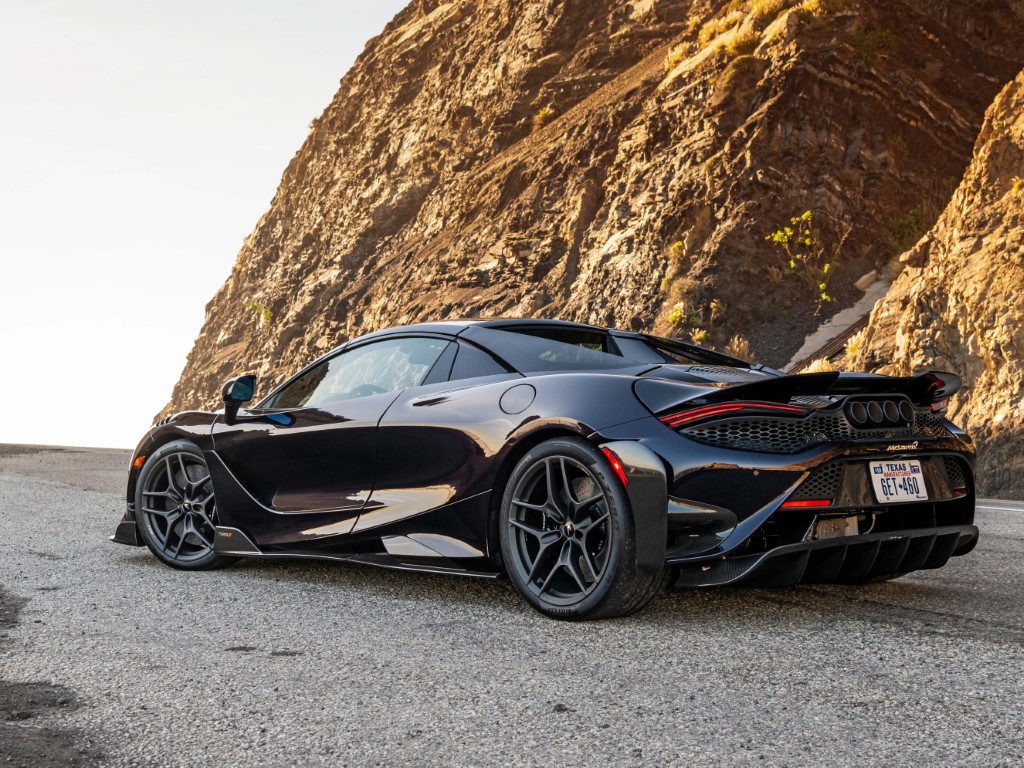
At the rear, the diffuser is larger and more aggressive, accelerating the air exiting from beneath the flat floor to create suction. The active rear wing features three main positions:
- Driver Downforce: Default position to generate stability in high-speed corners.
- DRS (Drag Reduction System): Reduces the angle of attack on straights to maximize top speed.
- High Speed Braking (Airbrake): The wing raises completely in less than half a second during heavy braking, increasing drag and shifting the center of pressure backwards to stabilize the rear axle.
Technical Analysis: The Powertrain
The beating heart of the 765LT is the M840T engine, a 4.0-liter twin-turbo V8. Although it shares the basic architecture with the 720S engine, the modifications implemented for the LT version are extensive, aiming not just for more power, but for a more visceral delivery and immediate response.
M840T Engine Specifications and Modifications
The 765LT's M840T engine produces 765 PS (755 hp) at 7,500 rpm and 800 Nm (590 lb-ft) of torque at 5,500 rpm. To achieve these numbers with reliability under track use, McLaren incorporated hardware derived from the McLaren Senna hypercar.
- Internal Components: The engine uses reinforced forged aluminum pistons to withstand higher combustion pressures. A three-layer head gasket, also sourced from the Senna, ensures sealing under extreme loads.
- Valvetrain: Diamond-Like Carbon (DLC) coated cam followers are employed to reduce internal friction and improve throttle response.
- Fuel System: A higher-flow fuel pump and a revised injection system ensure the air-fuel mixture is precise even at high RPMs.
- Thermal Management: Due to the power increase and the focus on track use, cooling was enhanced to handle the higher heat rejection from the block and turbochargers.
The turbochargers are low-inertia twin-scroll units, electrically actuated to minimize lag. The ECU (Engine Control Unit) calibration was adjusted to maximize the area under the torque curve, providing relentless acceleration from low revs to the limiter.
SSG Transmission and Gear Ratios
The 7-speed dual-clutch transmission (SSG) received special attention. Unlike many manufacturers who solely pursue faster shift times, McLaren altered the physical gear ratios. The 765LT's gears are optimized for acceleration, resulting in 15% quicker in-gear response than the 720S. This means that, at any speed, the 765LT is readier to pounce when the driver demands power.
The gearshift logic was also refined. The "Limit Downshift" feature allows the driver to request a downshift even when the engine speed is too high for the lower gear. Instead of rejecting the command, the software "remembers" the request and executes the shift at the exact millisecond the engine speed drops to a safe level, allowing the driver to focus on braking and corner entry without having to repeatedly pull the paddle.
The Acoustics of Titanium
The quad-exit exhaust system is a visual and auditory signature of the 765LT. Built entirely from titanium, it weighs just 10.9 kg, representing a 40% weight saving over the standard stainless steel system. The four high-mounted central exits are not merely aesthetic; they allow for a shorter and more direct exhaust path, reducing backpressure. The generated sound is described as sharper and more mechanical at high RPMs, contributing to the "ferocious" sensory experience that distinguishes the LT from the 720S.
Vehicle Dynamics: Chassis and Suspension
Power is useless without control, and it is in the chassis dynamics that the 765LT truly separates itself from its peers. The foundation is McLaren's famous carbon fiber monocoque, known as the MonoCage II in the coupe and MonoCage II-S in the Spider. This structure offers exceptional torsional rigidity, allowing the suspension to do its job with pinpoint precision.
Optimized ProActive Chassis Control II (PCC II)
The 765LT utilizes the second generation of McLaren's interconnected hydraulic suspension system. This system eliminates traditional mechanical anti-roll bars, replacing them with a hydraulic network that connects the left and right, and front and rear dampers. This allows for the decoupling of roll stiffness (in corners) from heave stiffness (in straight lines), offering the "holy grail" of flat cornering without excessive harshness over single-wheel bumps.
For the 765LT, the PCC II hardware and software were aggressively recalibrated:
- Geometry: The front of the car was lowered by 5 mm, increasing the aerodynamic angle of attack (rake). The front track is 6 mm wider, increasing lateral stability.
- Springs: The car uses lightweight main springs combined with "helper springs". This dual-spring setup is common in race cars and serves to keep the main spring under tension even when the suspension is in full extension (rebound), ensuring constant tire contact with the ground, especially when attacking curbs on a circuit.
- Stiffness: Roll stiffness was significantly increased, making the car flatter and more responsive, but sacrificing some ride comfort compared to the 720S.
Steering and Feedback
McLaren remains steadfast in the use of electro-hydraulic power steering, resisting the industry trend of moving to fully electric systems (EPAS). In the 765LT, the steering ratio is quicker and the steering torsion bar is stiffer. This results in crystalline feedback, where the driver can feel the texture of the tarmac and the grip level of the front tires through the steering wheel, a characteristic frequently cited as the high point of the McLaren driving experience.
The McLaren 765LT Spider: Engineering Without Compromise
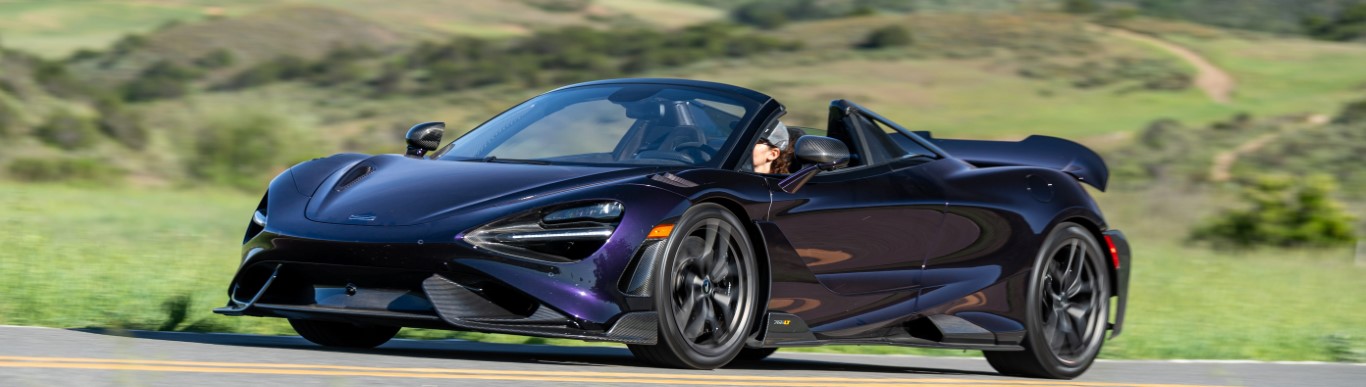
Launched in July 2021, the 765LT Spider brought the coupe's performance to the convertible world. The engineering challenge in creating a Spider version of a track-focused car is mitigating the weight gain and the loss of structural rigidity inherent to the removal of the fixed roof.
The MonoCage II-S Chassis
Thanks to the intrinsic strength of the carbon "tub", the 765LT Spider did not require heavy structural reinforcements in the sills or the floorpan, something common in aluminum or steel convertibles. The MonoCage II-S structure differs from the coupe version only in the upper rear section, which was designed to accommodate the roof mechanism and provide rollover protection. Carbon fiber supports are bonded to the chassis for this purpose, maintaining integrity without adding excessive mass.
The result is a weight increase of just 49 kg over the coupe, attributed almost entirely to the retractable roof mechanism and the window operation. With a DIN weight of 1,388 kg, the 765LT Spider is 80 kg lighter than the 720S Spider and about 100 kg lighter than its direct competitors.
Retractable Hard Top (RHT) Mechanism
The roof is a single piece of carbon fiber operated electrically. The mechanism uses eight electric motors to ensure fast and quiet operation.
- Speed: The opening or closing cycle takes just 11 seconds.
- Operation on the Move: The roof can be operated at speeds up to 50 km/h.
- Noise: The system is designed to be discreet, emitting a maximum of 50 dBA during operation, with a peak of 60 dBA only at the moment the latches lock.
A distinctive feature of the Spider is the independently operated rear glass window. It can be lowered even with the roof closed, allowing the sound of the V8 engine and the titanium exhaust to flood the cabin without the full wind turbulence, creating a unique auditory experience.
Performance: Data and Comparative Analysis
The 765LT's performance numbers are world-class, putting it in direct competition with much more expensive hypercars. The combination of high power, low weight, and advanced aerodynamics results in staggering acceleration and braking metrics.
Acceleration and Speed
Rear-wheel drive typically limits initial acceleration (0-100 km/h) due to tire grip, but the launch control calibration and the Pirelli Trofeo R tires allow the 765LT to defy this physics.
| Metric | 765LT Coupe | 765LT Spider | Observations |
|---|---|---|---|
| 0-100 km/h | 2.8 s | 2.8 s | Identical thanks to traction and electronics |
| 0-200 km/h | 7.0 s | 7.2 s | The Spider's weight difference appears slightly here |
| 0-300 km/h | ~18.0 s | N/A | Estimate based on independent tests |
| 1/4 Mile | 9.9 s | 10.0 s | Officially sub-10 seconds |
| Top Speed | 330 km/h | 330 km/h | Aerodynamically and gear limited |
Independent tests frequently record even faster times. On prepped drag strip surfaces, owners and journalists have recorded quarter-mile times in the 9.3 to 9.4-second range, demonstrating that McLaren tends to be conservative in its official numbers.
Braking
The braking system is derived directly from the McLaren Senna, utilizing carbon ceramic discs (CCM-R) that undergo a months-long manufacturing process to ensure superior structural integrity and heat dissipation.
- 100-0 km/h: 29.5 meters.
- 200-0 km/h: 108 meters (Coupe) and 113 meters (Spider).
The increased braking distance in the Spider from 200 km/h (5 meters more) is a direct physical consequence of the 49 kg of additional mass that needs to be decelerated.
Tires and Ground Contact
The 765LT's performance depends critically on its tires. McLaren collaborated with Pirelli to develop a specific ("MC spec") version of the P Zero Trofeo R tire.
This tire is classified as a "semi-slick" or R-Compound. Its structure and compound are optimized for dry tracks, offering massive lateral grip that allows the car to generate high G-forces in corners.
Safety Warning: Pirelli themselves and McLaren warn that the Trofeo R is not recommended for very wet track conditions or heavy rain, due to the risk of hydroplaning. For daily use in varied climates, owners often opt for the Pirelli P Zero (standard) or Michelin Pilot Sport 4S, which offer better wet performance in exchange for slightly less ultimate dry track grip.
Interior and Driver Interface
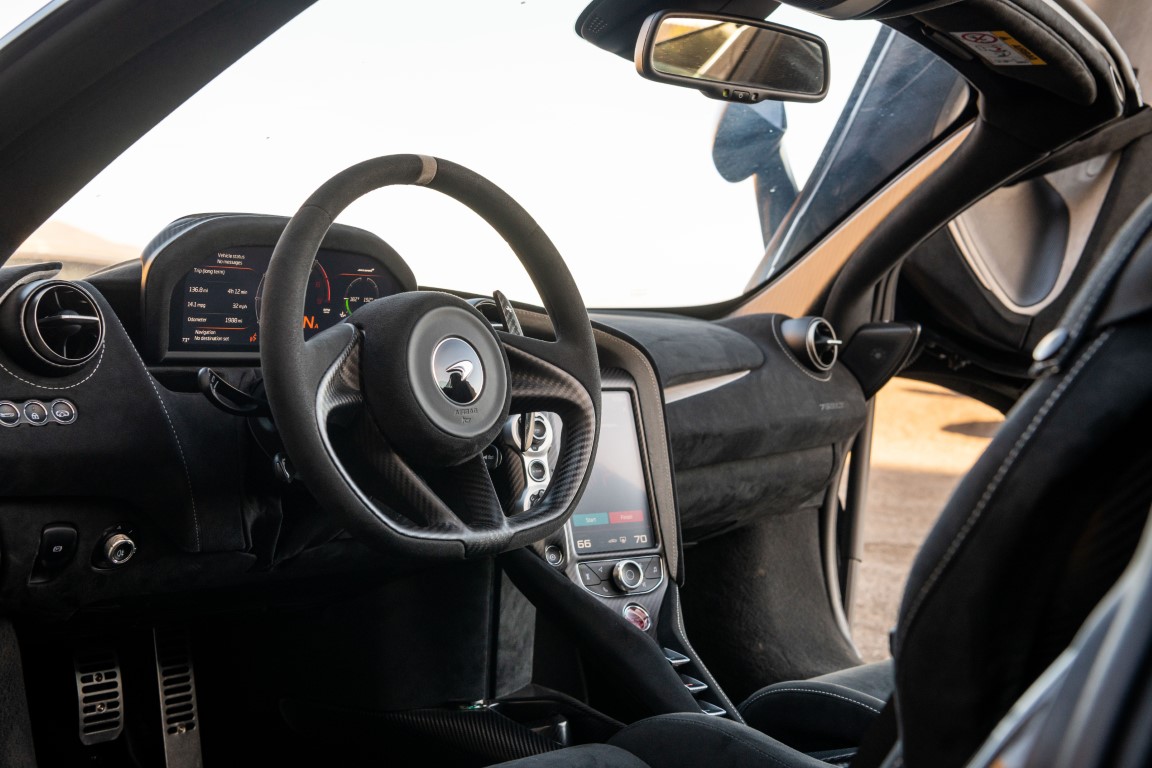
The interior of the 765LT is a study in functional minimalism. The goal is to remove distractions and connect the driver to the machine.
- Materials: Alcantara is omnipresent, covering the steering wheel, dashboard, and doors. It is lighter than leather and offers better grip. Exposed carbon fiber is visible on the floorpan (carpets are removed to save weight) and the central tunnel, which features a panel thickness of just 0.8 mm.
- Seats: Seat choice is critical to the car's experience and weight.
- Standard: Carbon fiber sports seats (adjustable).
- P1 Seats: More aggressive carbon shells, derived from the McLaren P1.
- Senna Seats (Super-Lightweight): Optional, built with an innovative hollow double-shell technology. They weigh just 3.35 kg each and offer extreme lateral support for track use.
Personalization and McLaren Special Operations (MSO)
Given the exclusive nature and high price tag of the 765LT, most units undergo some level of customization through the MSO division. This allows clients to create "One of One" vehicles.
Defined MSO Packs
McLaren offered structured packages to facilitate the specification of track-focused cars:
| Package | Content and Details |
|---|---|
| MSO Clubsport Pack | Includes the Super-Lightweight (Senna) seats, track brake upgrade (Senna discs and special pads), McLaren Track Telemetry (MTT), and satin visual carbon fiber details. |
| MSO Clubsport Pro Pack | Everything from the pack above, plus a titanium harness bar behind the seats and MSO six-point seat harnesses (in black, red, blue, or orange). Transforms the car into a competition-ready track tool. |
| Black Pack | Replaces exterior components (diffuser, splitter, skirts) with a Gloss Black finish instead of exposed carbon fiber or Dark Palladium. |
| Stealth Pack | Blacked-out/smoked finish on the exhaust tips and rear wing mechanisms, for a more discreet and sinister look. |
In addition to these packs, MSO offers bespoke paintworks (such as the "Strata" effect that blends colors), tinted carbon fiber, and custom-tailored interiors.
Production, Market, and Legacy
Production of the 765LT was limited to 765 Coupe units and 765 Spider units for the global market. This programmed scarcity is fundamental to the model's value proposition.
- Sales: The entire Coupe allocation was sold out even before the first deliveries began. The Spider followed a similar trajectory, with high demand from collectors who missed out on the coupe opportunity.
- Price: Base pricing in the US hovered around $358,000 (Coupe) and $382,500 (Spider), but with MSO options, the final price frequently surpassed $450,000 or $500,000.
The Successor: 750S vs 765LT
With the subsequent launch of the McLaren 750S, discussion arose regarding the relevance of the 765LT. The 750S is effectively an updated version of the 720S that incorporates many of the 765LT's technologies (lightweight pistons, shorter gear ratios), but with a more compliant suspension and a focus on daily drivability.
The distinction remains clear: the 750S is the brand's definitive road-going supercar, while the 765LT remains the hardcore track machine, with more aggressive aerodynamics, less sound insulation, and a "rawer", more collectible nature.
Competitor Comparison
The 765LT operates in a rarefied segment of "Supercar Track Specials".
- Ferrari 488 Pista / F8 Tributo: The 765LT is frequently compared to the 488 Pista. While the Ferrari offers an emotive engine experience, the 765LT is generally considered faster in a straight line and more surgical in its chassis dynamics. The F8 Tributo is less track-focused than the LT.
- Lamborghini Huracán STO: The STO focuses on aural emotion (naturally aspirated V10) and extreme aerodynamics, but the 765LT boasts a significant torque and acceleration advantage due to turbocharging, alongside a more sophisticated carbon chassis (the Huracán uses an aluminum/carbon hybrid chassis).
- Porsche 911 GT2 RS: A formidable rival in lap times, but with a completely different rear-engine philosophy.
Conclusion
The McLaren 765LT and 765LT Spider represent the end of an era. As the last "Longtail" models of the Super Series to be launched before the industry's (and McLaren's own, with the Artura) full transition to hybridization, they stand as monuments to internal combustion engineering.
They deliver on the promise of the LT badge spectacularly. They are not merely fast cars; they are intense sensory experiences, designed to reward the skilled driver with visceral feedback, sound, and speed. The obsessive weight reduction, functional aerodynamics, and limited production ensure that, even decades into the future, the 765LT will be revered not just as an improved version of the 720S, but as one of the purest and most focused supercars ever produced in Woking. For the enthusiast seeking the ultimate connection between man and machine, without the filtering of heavy hybrid systems, the 765LT remains an absolute benchmark.