
1st Generation
(1996 - 1997)
3.2 L V6
192 cv
Technical specifications, versions, and history for the Acura SLX.
Select a generation to see available versions
(1996 - 1997)
(1998 - 1999)
Select a powertrain to view full technical specifications
In the 1990s, the United States automotive market went through a profound transition with the rapid rise of sport utility vehicles, commonly called SUVs. High-end consumers began to seek vehicles that combined robustness and a high driving position with the sophistication and prestige of luxury brands. To respond quickly to this demand without bearing the immense cost and development time of an entirely new platform, Honda resorted to a strategic badge engineering agreement with the manufacturer Isuzu. From this agreement, the Acura SLX was born, the pioneering sport utility vehicle marketed by an imported luxury brand in the United States.
The presence of the Acura SLX in the market was made possible by a commercial exchange program established in 1993 between Honda and Isuzu. Under the agreement, Honda provided passenger cars for Isuzu to sell under its brand in Japan, while Isuzu reciprocated by providing trucks and SUVs for Honda to market in North America. The Acura SLX was, in reality, a slightly modified and more luxurious version of the second generation of the Isuzu Bighorn, widely known in the United States as the Isuzu Trooper, a model built on the DJ5 code chassis.
The vehicle was entirely manufactured by Isuzu Motors at the Fujisawa plant, located in Kanagawa, Japan, and subsequently exported to the United States with the emblems of the Acura luxury division. Unlike other global restylings of the Trooper, the SLX was an exclusive model for the North American market, not even being sold in neighboring countries like Canada or Mexico. Acura's promotional strategy tried to highlight the model's versatility with striking slogans, defining the SLX as the most civilized way to leave civilization and describing it as a vehicle designed for drivers with a strong sense of adventure.
The original Isuzu Trooper stands out as one of the most rebadged models in global automotive history, having been marketed under more than a dozen different names by various brands. Among the best-known derived versions were the Chevrolet Trooper in Latin America, the Holden Jackaroo and Holden Monterey in Australia and New Zealand, the Honda Horizon in the Japanese market, the Opel Monterey in continental Europe, the Vauxhall Monterey in the United Kingdom, the Subaru Bighorn, and even a sporty-looking version developed by Holden's special division, dubbed the HSV Jackaroo.
The Acura SLX remained in the lineup for four model years, from 1996 to 1999, undergoing gradual equipment improvements and a profound mechanical and visual mid-cycle restyling.
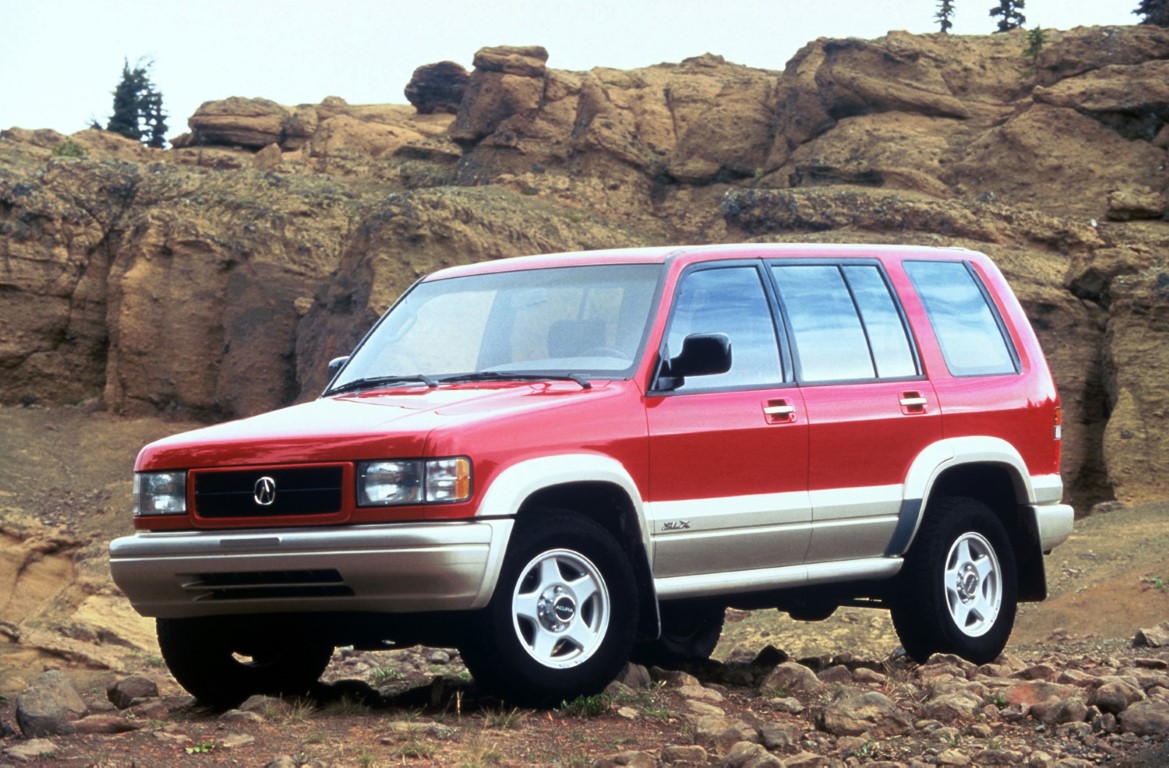
The utility vehicle debuted in late 1995, already as a 1996 model, with a six-door station wagon-style body, consisting of four side passenger doors and 70/30 split rear doors with hinges on the outer pillars. This rear opening configuration facilitated access to the ample luggage compartment in tight garages and eliminated the weight of a single tailgate. At launch, the vehicle was available in two trim configurations: the base version, called Standard, and the top-of-the-line Premium version.
The Standard version featured gray cloth seats, while the Premium added exclusive design alloy wheels, heated gray leather seats with power adjustments for the driver and front passenger, a power panoramic sunroof, and a limited-slip rear differential. Both versions came standard with anti-lock brakes (ABS), air conditioning, cruise control, dual front airbags, a six-speaker sound system, and steel skid plates under the chassis for off-road use.
For the 1997 model year, Acura promoted interior and convenience refinements. An in-dash CD player became standard equipment on both versions, and front fog lights became standard on the base model. The Premium version received a factory-installed digital display in the overhead console, dubbed a multi-meter, which added an electronic compass, altimeter, outside thermometer, and barometer.
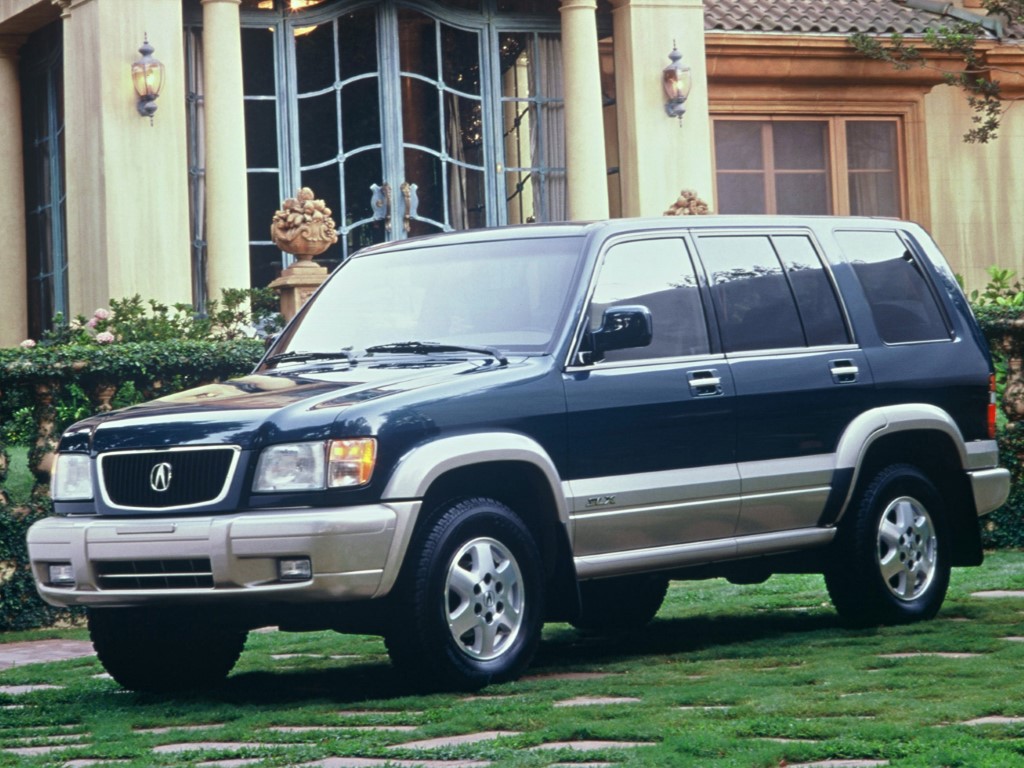
The 1998 model year marked the SLX's mid-cycle restyling, bringing significant aesthetic updates to try to stem falling sales. The front exterior design was completely renewed, abandoning the integrated rectangular headlight assembly and adopting a prominent trapezoidal grille, taller headlights, and more robust integrated bumpers that increased visual aggressiveness. The rear remained unchanged, receiving only minor bumper tweaks.
Internally, the instrument panel was completely redesigned to display the operation of the new on-demand all-wheel-drive system. Keyless remote door locking started being offered as an option. To simplify the product offering, Acura discontinued the Premium version and concentrated sales on a single highly equipped version, which already came standard with all the old luxury features of the Premium version.
In its final year on the market, the 1999 model received only a practical improvement to the standard equipment list, which was the inclusion of an immobilizer alarm system with a coded anti-theft key. With no price changes or new mechanical options, the SLX was discontinued at the end of 1999 to make way for the Acura MDX, a utility vehicle developed entirely on a unibody platform by Honda itself.
Unlike modern SUVs built on passenger car platforms, the Acura SLX utilized a box-section ladder frame chassis made of high-strength steel, which gave the model excellent torsional rigidity on rough terrain. The front suspension used double overlapping "A" arms with torsion bars, while the rear suspension adopted a solid axle with multiple links and coil springs. The entire spring and shock absorber calibration was geared toward prioritizing ride comfort and smoothness on asphalt, reducing noise and vibration in the cabin, although this engineering choice caused the vehicle to bounce excessively when passing over very bumpy roads.
The braking system featured four-wheel ventilated disc brakes with hydraulic assist and an integrated four-channel ABS system. The factory tires were mixed-use in size 216/80 R16, mounted on 16-inch alloy wheels, a setup sized to balance traction capacity on dirt roads with acoustic comfort on highways.
Throughout its history, the Acura SLX featured two V6 engines, both gasoline-powered and developed by Isuzu.
The initial models came equipped with the 3.2-liter, 24-valve single overhead camshaft (SOHC) engine, which generated a maximum output of 190 horsepower at 5,600 rpm and 188 lb-ft of torque at 4,000 rpm. This aluminum block featured integrated cast-iron cylinder liners and a sequential multi-point electronic fuel injection system.
The engine was mounted longitudinally in the front engine bay to concentrate weight near the center of the vehicle, improving mass distribution and dynamic stability. The transmission was exclusively an electronically controlled four-speed automatic, with no manual gearbox option in the Acura lineup. To improve drivability, the transmission offered two distinct operating programs activated by buttons on the console: power mode, which stretched the gears to higher rpm to prioritize rapid acceleration, and winter mode, which started the vehicle in third gear to prevent the wheels from spinning on slippery surfaces.
With the 1998 restyling, Acura introduced a 3.5-liter engine with dual overhead camshafts (DOHC) and four valves per cylinder arranged at a narrow 19-degree angle, allowing for straighter intake ports and a compact wedge-shaped combustion chamber. This engine generated 215 horsepower at 5,400 rpm and raised the torque to 230 lb-ft at just 3,000 rpm, guaranteeing much more power at low revs.
Among its advances, the variable induction system operated by an electronic control module stood out. At engine speeds below 3,600 rpm, air passed through long runners in the intake manifold to take advantage of the air pulsation effect and increase torque. Above 3,600 rpm, an electronic actuator opened internal butterfly valves, directing airflow through a short, direct path to maximize oxygen intake and generate more power at high speeds.
The block also adopted a deep-skirt crankcase and structural reinforcements to reduce vibrations, as well as valve covers made of lightweight magnesium. Ignition was direct via individual 33,000-volt coils installed over the spark plugs, and the stainless steel exhaust featured two fast-acting catalytic converters. Under full acceleration, the central control module temporarily deactivated the air conditioning compressor to prioritize performance.
The great mechanical evolution of the Acura SLX in the 1998 lineup was the replacement of the old part-time four-wheel drive system, which required the driver to physically engage a floor lever, with the modern intelligent on-demand traction system, named Torque on Demand. Controlled by a dedicated electronic unit, the TOD system utilized an oil-bathed multi-disc clutch located inside the transfer case, constantly monitoring axle rotational speed, acceleration, and engine load parameters.
The driver could switch between driving modes simply using dashboard selectors:
The table below compiles all technical, mechanical, and dimensional specifications of the Acura SLX across its two production phases in the North American market.
| Technical Attribute | Phase 1: 1996 and 1997 Model Years | Phase 2: 1998 and 1999 Model Years |
|---|---|---|
| Engine Code | Isuzu 6VD1 | Isuzu 6VE1 |
| Cylinder Head Configuration | 75° V6, SOHC, 24 valves | 75° V6, DOHC, 24 valves |
| Displacement | 3,165 cc (3.2 Liters) | 3,494 cc (3.5 Liters) |
| Bore x Stroke | N/A | 93.4 mm x 85.0 mm |
| Maximum Power | 190 hp @ 5,600 rpm | 215 hp @ 5,400 rpm |
| Maximum Torque | 188 lb-ft @ 4,000 rpm | 230 lb-ft @ 3,000 rpm |
| Transmission | 4-speed automatic with torque converter | 4-speed automatic with PCM and active torque reduction |
| Rear Differential Ratio | 4.3:1 | 4.3:1 with clutch-type limited slip |
| Overall Length | 183.5 inches (4,661 mm) | 187.8 inches (4,770 mm) |
| Overall Width | 72.4 inches (1,839 mm) | 72.2 inches (1,834 mm) |
| Overall Height | 72.2 inches (1,834 mm) | 72.2 inches (1,834 mm) |
| Wheelbase | 108.7 inches (2,761 mm) | 108.7 inches (2,761 mm) |
| Trunk/Cargo Capacity | Minimum: 1,465 liters / Maximum: 2,550 liters | Minimum: 1,465 liters / Maximum: 2,550 liters |
| Curb Weight | 4,315 lbs (1,957 kg) | ~4,400 lbs (~1,995 kg) |
| Tank Capacity | 22.5 gallons (85 Liters) | 22.5 gallons (85 Liters) |
Despite Acura's heavy investment in advertising, the SLX recorded very low sales throughout its commercial trajectory, totaling just 6,590 units sold in the United States. As a basis for comparison, its successor, the Acura MDX, sold 40,950 units in its first model year alone, surpassing the SLX's four-year cumulative volume in just three months of sales in early 2001.
The following table presents the Manufacturer's Suggested Retail Prices (MSRP) for each year, destination charges, and the units sold annually in the North American market.
| Calendar Year | Units Sold | Base MSRP | Destination Charge | Equipment and Sales Highlights |
|---|---|---|---|---|
| 1996 | 2,566 | $33,900 | $420 | Model debut with 3.2L engine; Premium version offered for an additional $4,100. |
| 1997 | 1,299 | $35,300 | $435 | Standard CD Player; inclusion of a roof-mounted multi-meter on the Premium version. |
| 1998 | 1,634 | $36,300 | $435 | Front restyling; 3.5L DOHC engine; adoption of the TOD system; single standard Premium version. |
| 1999 | 694 | $36,300 | $455 | Anti-theft alarm with immobilizer added as standard. |
| 2000 | 198 | N/A | N/A | End of sales and physical liquidation of remaining dealership inventory. |
The vehicle came from the factory with a basic warranty of 4 years or 50,000 miles (about 80,000 kilometers). In the current used market, the SLX is considered extremely durable and easy to maintain for independent mechanics, receiving from owners an average reliability rating of 4.2 out of 5 and an overall quality rating of 4.1 out of 5. According to statistical data from the RepairPal platform, the estimated average annual preventive maintenance cost of the Acura SLX is very low for the category, hovering around $278.
However, in the event of more serious mechanical breakdowns or the need for specific replacement components, owners may face high costs due to the rarity of parts in the market. The complete replacement of a V6 engine cylinder head can cost between $4,596 and $5,538; replacing the power steering gear box ranges from $2,904 to $3,054; replacing an ABS wheel speed sensor falls between $685 and $750; replacing the coolant temperature sensor ranges from $461 to $528; and a simple full engine coolant flush with system cleaning is quoted between $395 and $430.
The determining factor in the Acura SLX's sales failure was a severe reputation crisis that began in 1996. During dynamic stability and emergency evasive maneuver testing conducted by the renowned product testing magazine Consumer Reports, the 1995-1996 Isuzu Trooper and the 1996 Acura SLX exhibited dynamic behavior deemed dangerous. The avoidance maneuver simulated a common situation on American roads, such as quickly dodging an obstacle in the lane (like a child or a wild animal) and immediately returning to the original driving lane.
In the publication's dynamic tests, the cars exhibited severe lateral roll. Over 33 passes made at different speeds, the magazine's engineers recorded that the vehicles' outside wheels lost contact with the ground at speeds starting at 33 miles per hour (about 53 km/h), reaching a critical 45-degree tilt that required the intervention of safety outriggers to prevent an actual rollover. Consequently, the institution assigned both models the extremely rare and dreaded 'Not Acceptable' rating in its October 1996 issue, emblazoning the magazine cover with a photo of a Trooper leaning on two wheels with the word 'UNSAFE' highlighted.
The release of this rating had a massive negative impact on the model's image, driving buyers away from dealerships almost immediately. Isuzu vehemently refuted the magazine's testing methodology and filed a defamation lawsuit against the publisher, Consumers Union. The lawsuit dragged through the courts, and the jury concluded that while there was bias on both sides and some published statements showed a 'reckless disregard' for the truth, the market damage to the Trooper and the SLX was already irreversible.
Acura and Isuzu spokespeople publicly defended that the vehicle strictly met all federal government safety requirements. The US government's highway safety agency (NHTSA) was petitioned by the consumer association to force a mandatory recall, but after conducting its own track tests and reviewing the real-world crash database, the government agency refused to open an official investigation or order a recall, issuing an official statement asserting there was no real evidence of a manufacturing defect or unusual driving danger. Although the rear suspension was slightly modified in subsequent lineups to lower the center of gravity and calm the public, the rollover suspicion tarnished the Acura SLX's image until the end of its production in 1999.
Even with a short life cycle marred by safety controversies, the SLX provided valuable market data for Acura to understand the evolution of luxury SUVs. Practical experience showed that high-end sport utility vehicle buyers wanted the high seating position and space versatility, but were unwilling to give up the smooth ride comfort, cabin silence, and cornering stability typical of luxury passenger cars, something difficult to achieve on a heavy truck-based body-on-frame architecture.
From this learning, the brand designed the SLX's direct replacement, the Acura MDX, launched in the North American market in late 2000 as a 2001 model. Developed internally from the Honda Odyssey minivan unibody platform, the MDX featured refined dynamics for asphalt use, four-wheel independent suspension, and excellent interior space utilization. This change proved extremely correct, turning the MDX into an immediate sales success and ushering in a new era of modern crossovers that dictate the direction of today's luxury market.
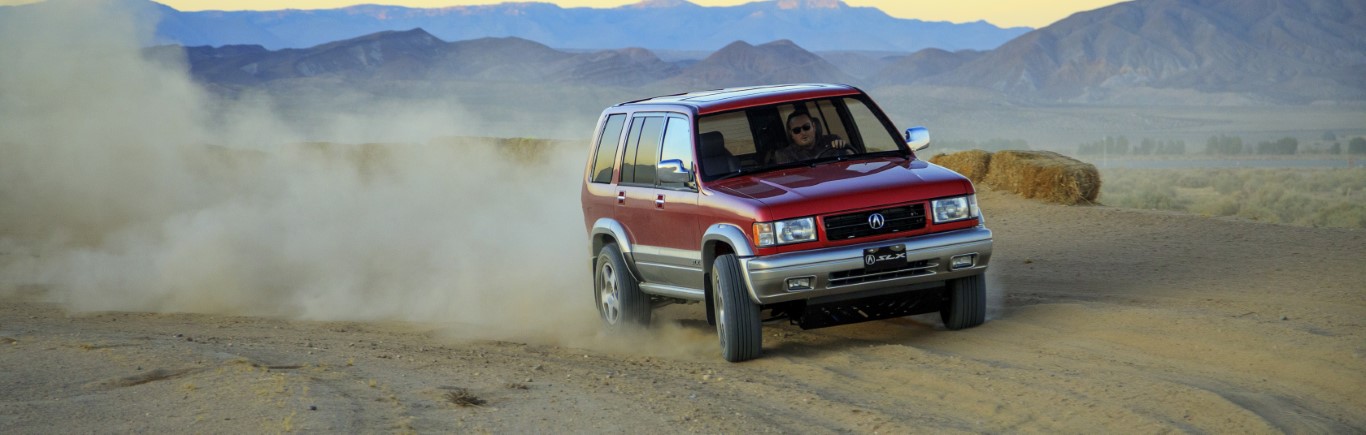
In late 2019, to celebrate the historic milestone of over one million vehicles equipped with the SH-AWD intelligent traction system sold in North America, Acura built a special vehicle honoring its first sport utility vehicle. The project consisted of extensive restoration and modernization work on an original 1997 Acura SLX, presented to the public at the Radwood classic car culture automotive event in California.
The original powertrain was completely removed to make way for the brand's modern technology. Engineers installed a 2.0-liter turbocharged four-cylinder engine with dual overhead cams and VTEC valve control under the hood, mated to a modern 10-speed automatic transmission, a mechanical setup inherited directly from the Acura RDX crossover.
With electronic calibration rework and new intake and exhaust manifolds, power was raised to an estimated 350 horsepower and torque to 340 lb-ft, offering vastly superior performance to the original powertrain. The entire undercarriage received the physical adaptation of the fourth-generation SH-AWD permanent all-wheel-drive system, with a modified multi-link rear suspension.
Visually, Acura kept the classic square lines of the 1997 bodywork, applying the modern factory Performance Red Pearl paint to the body and keeping the bumpers and side trims in a champagne silver tone, identical to the period standards. The SUV received custom 17-inch Fifteen52 Tarmac alloy wheels wrapped in 245/65 R17 Yokohama Geolander A/T all-terrain tires.
The interior was fully restored, featuring dark gray leather seats stitched in the classic Milano lineup style, a leather-wrapped steering wheel with integrated paddle shifters for manual gear changes, dark wood trim accents on the doors and console, as well as custom woven floor mats. This project served to creatively demonstrate how the original utility vehicle could have been refined had Acura had its modern dynamic traction technologies available in the 1990s.
Images of the Acura SLX