Origins and Strategic Positioning
The Honda Vigor was originally born in the Japanese market in September 1981 as a premium sedan derived directly from the Honda Accord. The manufacturer's proposal was to establish a faster, more refined model with a sporty character to compete with consolidated rivals in Japan, such as the Toyota Chaser and the Nissan Laurel.
Sold exclusively through the Honda Verno dealership network, the Vigor offered a level of equipment far superior to that of the standard Accord. This strategic positioning helped prepare the Japanese market to accept even larger Honda luxury vehicles, which culminated in the development of the Honda Legend in 1985. In North America, the model was introduced only in its third generation, in June 1991, under the Acura luxury division. It was strategically positioned between the compact Integra and the luxury Legend sedan.
First Generation (SZ/AD - 1981–1985)
The first generation of the Vigor shared its basic platform with the second-generation Accord. The car was offered in four-door sedan and three-door hatchback configurations, both equipped solely with 1.8-liter four-cylinder engines.
The great differentiator of the Vigor compared to its competitors at the time was the extensive list of standard items. Features such as automatic air conditioning with thermostatic control, cruise control, power windows with one-touch down for the driver, and power steering were standard, whereas on the Accord they were only available as options. In addition, it featured the "Electronic Navigator", a complete trip computer for measuring fuel consumption, range, and travel time.
Honda also provided advanced technological items for the time, including a digital instrument panel, four-wheel anti-lock brakes (ABS), and the pioneering "Electro Gyrocator", recognized as the world's first automated automotive navigation system.
Mechanically, the first-generation Vigor utilized a five-speed manual transmission or a four-speed automatic transmission with a direct-coupling (lockup) torque converter. The engines used the SOHC system with three valves per cylinder and Honda's CVCC-II clean combustion technology. The hatchback version was discontinued in 1984 to make way for the Honda Integra, leaving only the sedan until the end of the generation in 1985.
Consumption and Power Specifications (First Generation)
| Engine Model / Fuel System | Power | Average Consumption (Japanese 10-Mode Standard) | Consumption at Constant 60 km/h |
|---|---|---|---|
| EK1 1.8L (CVCC-II Carburetor) | 110 PS (108 hp) | 13.6 km/L | 23 km/L |
| ES3 1.8L (PGM-FI Electronic Injection) | 130 PS (128 hp) | 13.2 km/L | 22 km/L |
Trim Levels (First Generation)
| Body Style | Initial Versions (Carburetor) | Versions with Electronic Injection (PGM-FI) | Transition Versions (1985) |
|---|---|---|---|
| 4-door Sedan | VXR, VX, VL | VTL-i, VT-i | MG, ME, ME-R |
| 3-door Hatchback | TXL, TX, TU | TT-i | MX-T, ME-T |
Second Generation (CA1-CA2-CA3 - 1985–1989)
Introduced to the market on June 4, 1985, the second generation of the Vigor was sold solely as a four-door sedan. To highlight the model's sporty appeal, Honda adopted hidden (pop-up) headlights, inspired by the Prelude coupe and the Integra hatchback. Visually, the Vigor featured an exclusive grille and integrated horizontal taillights, distancing itself from the more conservative design of the Accord.
The car's engineering evolved with the adoption of an independent double-wishbone suspension on both axles. Although the cost of this design was higher than that of common systems, it guaranteed stability and precision in corners.
The Vigor featured standard front sway bars, while top configurations added a rear sway bar. The braking system featured four-wheel discs (with dual-piston calipers on the top 2.0-Si version) or front discs and rear drums on the entry-level versions, with the ABS system as an option. The wheels were 13-inch steel with hubcaps or 14-inch alloy on the most equipped configurations.
The engine lineup was restructured with three main options: the base 1.8 A18A engine, the mid-range 1.8 B18A engine with dual carburetors, and the powerful 2.0 B20A with dual overhead camshafts (DOHC) and PGM-FI electronic injection. In May 1987, Honda launched the "2.0 Si Exclusive" version, which incorporated power-folding exterior mirrors. In September 1988, the "MXL Super Stage" version received the electronic automatic transmission shift-lock system.
Engine Technical Specifications (Second Generation)
| Engine Model | Displacement | Cylinder Head / Valves | Fuel System | Estimated Power |
|---|---|---|---|---|
| A18A | 1.8L | SOHC 12v | Single Carburetor | 100 hp |
| B18A | 1.8L | DOHC 16v | Dual Carburetors | 115 hp |
| B20A | 2.0L | DOHC 16v | PGM-FI Electronic Injection | 120 hp (137 hp in Japan) |
Third Generation (CB5/CC2 and CC3 - 1989–1995)
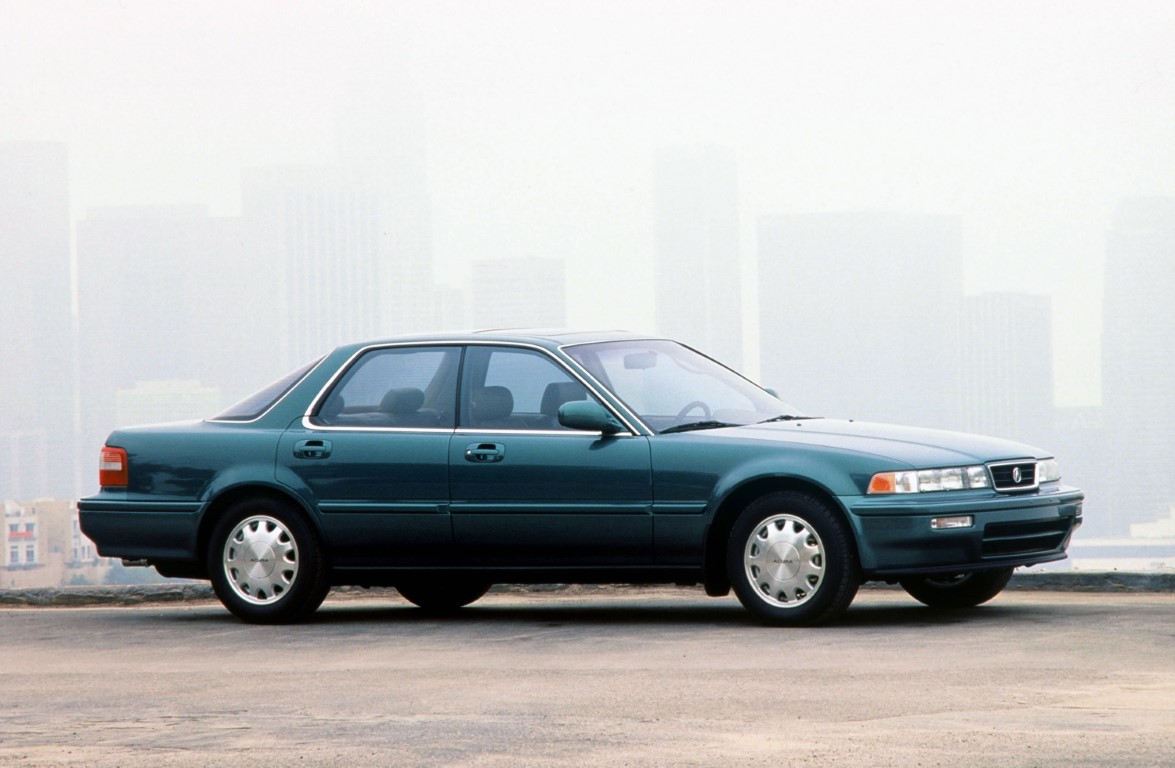
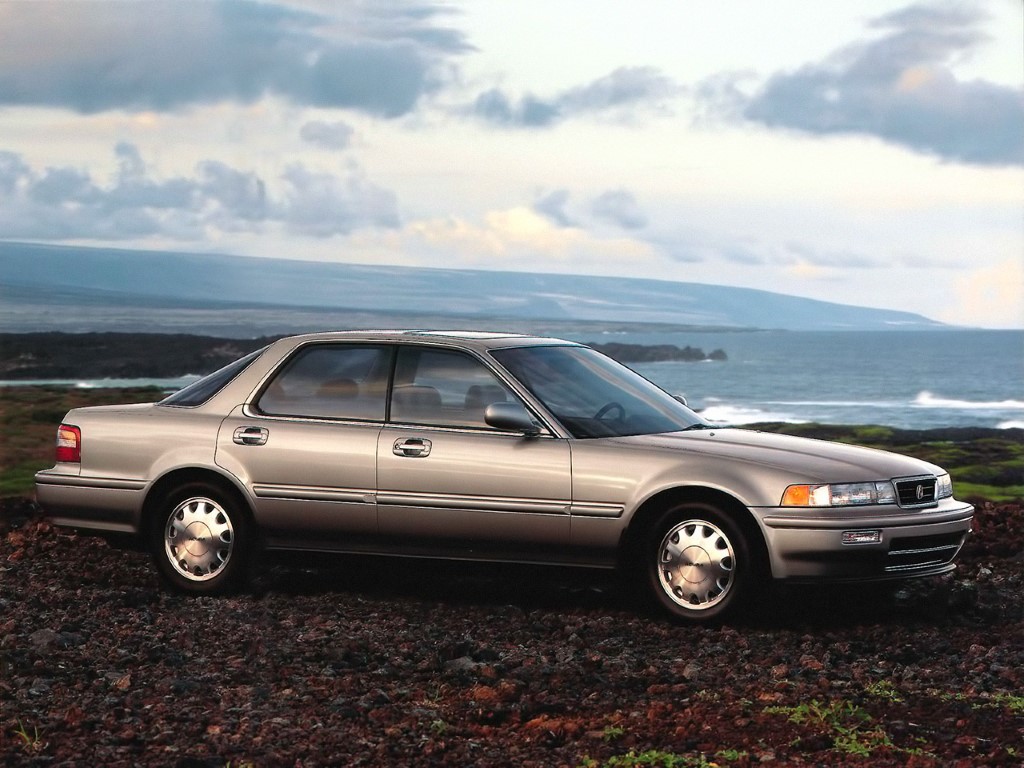
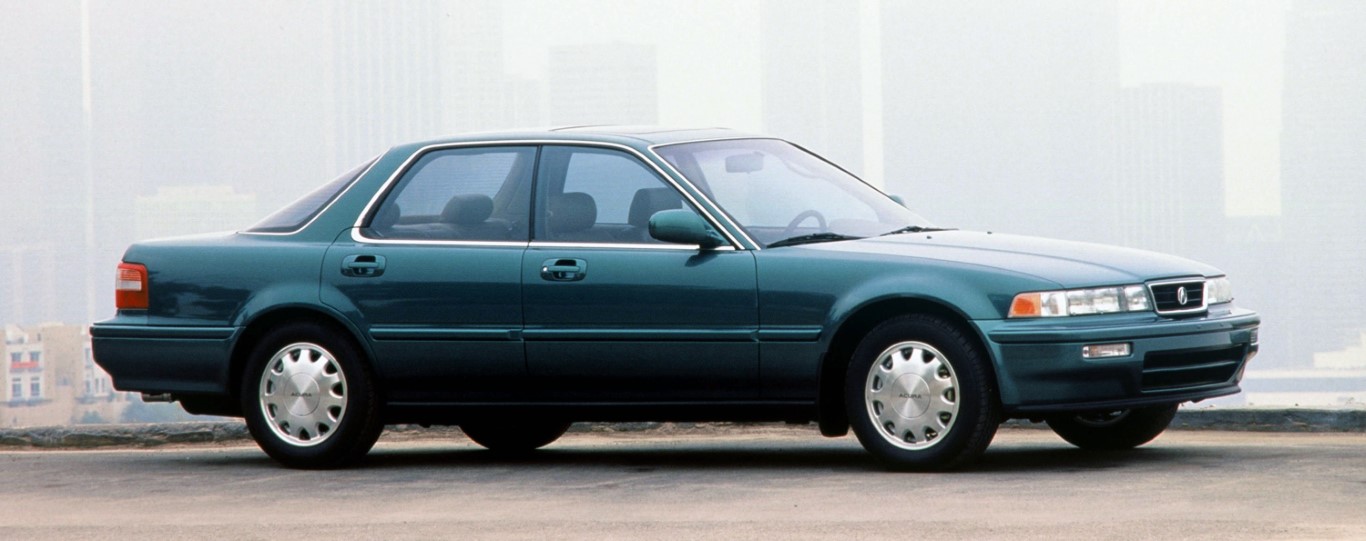
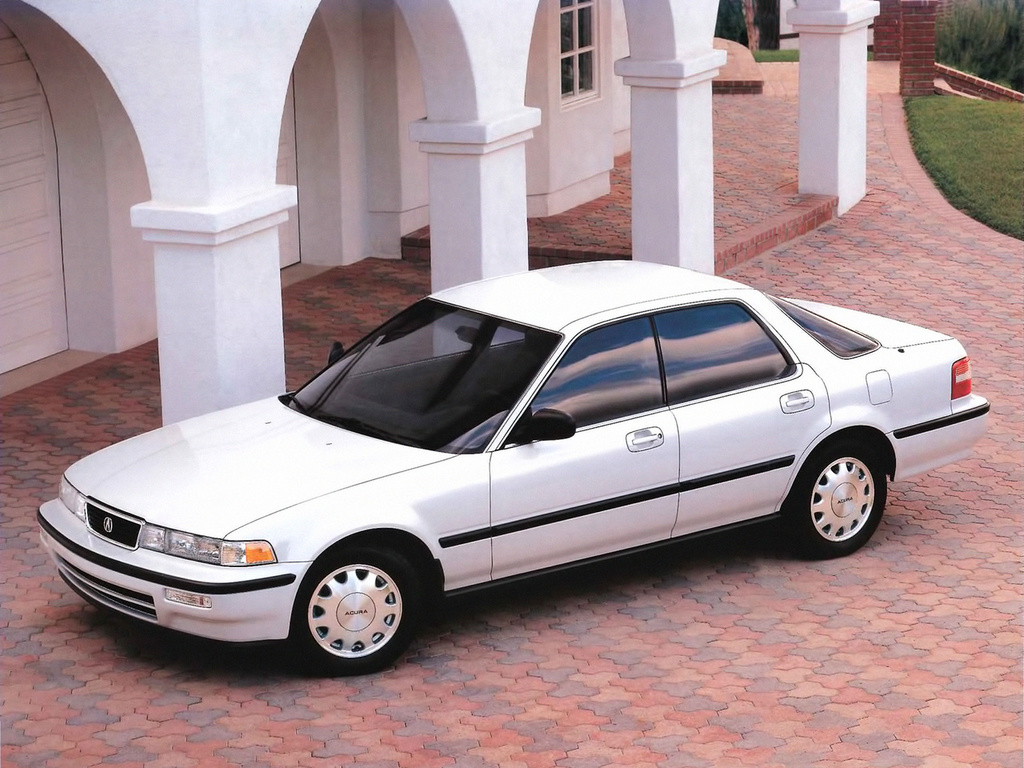
Launched in Japan in 1989 and imported to North America starting in mid-1991 as the Acura Vigor, the third generation completely abandoned the Accord's chassis and body panels. The sedan began utilizing an exclusive platform shared with the new Honda Inspire and the second generation of the Legend. The bodywork adopted a built-in "B" pillar (hardtop) style, providing fluid and clean lines.
The Engineering of the Longitudinal Five-Cylinder Engine
The Acura Vigor stood out for its use of an unprecedented inline five-cylinder engine, dubbed the G-Series. This engine was installed longitudinally (lengthwise) in the engine bay, which was a highly unusual arrangement for a front-wheel-drive automobile.
The justification for this mounting choice was not space for a four-wheel-drive system, but rather compliance with Japan's strict tax zoning laws. If the five-cylinder engine had been positioned transversely, the car's width would have increased to the point of exceeding the 1.70-meter limit stipulated by the Japanese government for compact cars, which would have generated heavy taxes for the buyer. The longitudinal mounting allowed the Japanese bodywork to remain narrow.
To make front-wheel drive feasible with the longitudinal engine, Honda adopted complex engineering solutions:
- The transmission was positioned right behind the engine.
- A secondary driveshaft took the power back to the front, connecting to a limited-slip differential installed asymmetrically.
- The right-side drive half-shaft passed through an armored tube that traversed the engine's oil pan, just below the center cylinder.
- The five-cylinder engine was tilted 35 degrees to the right, making it possible to design an extremely low, elegant, and aerodynamic hood line.
This set-back assembly resulted in a weight distribution of 60% in the front and 40% in the rear, considered by engineers as the ideal proportion to ensure stability and drivability in a front-wheel-drive automobile.
For export as an Acura, the car was modified. Because the United States did not tax vehicles by width, the manufacturer widened the bodywork and adopted bumpers designed to withstand impacts of up to 5 mph (8 km/h), increasing the overall length of the car.
Dimensions Comparison (JDM Honda Vigor vs. Acura Vigor)
| Dimension | Japanese Version (CB5 Chassis - Compact) | American Version (CC2/CC3 Chassis - Mid-size) |
|---|---|---|
| Length | 4,690 mm | 4,836 mm |
| Width | 1,695 mm | 1,781 mm |
| Height | 1,355 mm | 1,369 mm (1992) / 1,321 mm (1993–1994) |
| Wheelbase | 2,805 mm | 2,804 mm |
| Curb Weight | — | 1,429 kg (LS manual) to 1,485 kg (GS automatic) |
Engines and Fuel (Third Generation)
The third generation offered two distinct inline five-cylinder engines, both equipped with an aluminum alloy block and cylinder head and cast-iron cylinder liners:
- G20A (2.0L): Available only in the Japanese market to keep the car in the lower tax bracket, developing 158 hp. It was calibrated to run on regular low-octane gasoline.
- G25A1 (2.5L): Standard engine of the Acura Vigor in North America, generating 176 hp at 6,300 rpm and 170 lb-ft of torque at 3,900 rpm with fuel cutoff at 7,100 rpm. The cylinder head utilized a single overhead camshaft (SOHC), four valves per cylinder, and a dual-stage variable intake manifold to ensure power at low revs. In Japan and the United States, this engine required the use of premium high-octane gasoline.
Acura Trim Levels and Equipment Structure
In the North American market, the Acura Vigor was offered in two distinct configurations, which shared the same mechanical and safety setup.
LS Trim (Entry-level)
Equipped as standard with an extensive list of technology and comfort features:
- 15-inch alloy wheels with 205/60 R15 All Season tires.
- Driver's safety airbag integrated into the steering wheel.
- Four-wheel disc brakes with a diameter of 282 mm in the front (ventilated) and 260 mm in the rear (solid), assisted by 3-channel ABS.
- Progressive, speed-sensitive rack-and-pinion power steering.
- Air conditioning, power windows, locks, and mirrors.
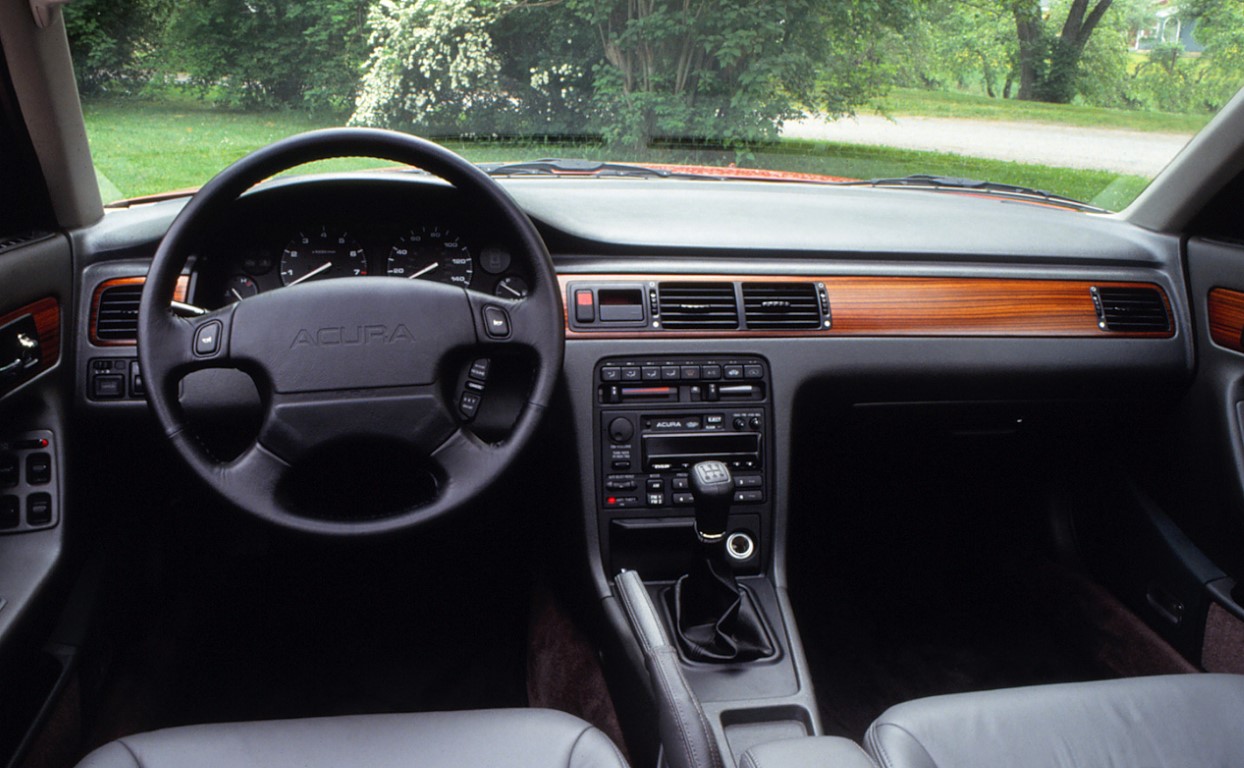
- High-quality velour (moquette) interior upholstery, dashboard and doors with real wood trim designed not to splinter.
- Acura Music System audio with cassette player, Dolby, and integrated anti-theft system.
GS Trim (Premium Sporty)
Added features focused on sophistication:
- Seats and doors upholstered in genuine leather.
- Driver's seat with four-way power adjustments.
- Power glass sunroof with sunshade.
- Body-colored exterior mirrors.
- Premium audio system with Digital Signal Processor (DSP), capable of emulating the acoustics of concert halls or cathedrals, pre-wired for a six-disc CD changer mounted in the trunk.
Color and Trim Options (Acura Vigor)
| Exterior Color (3-Coat Paint) | LS Interior Trim (Moquette Fabric) | GS Interior Trim (Genuine Leather) |
|---|---|---|
| Granada Black Pearl | — | Cognac / Gray |
| Frost White | Gray | Black |
| Cassis Red Pearl | Gray | Gray |
| Buckingham Blue Pearl | Gray | Cognac |
| Regal Plum Pearl | — | Cognac |
| Rosewood Brown Metallic | — | Black |
Annual Evolution and Updates of the Acura Vigor
Instead of undertaking profound aesthetic restyling, the brand focused on addressing the criticisms of the automotive press and North American consumers, who considered the car's suspension excessively stiff and the rear space too tight compared to the rival Lexus ES 300.
1992 Model Year
Official introduction of the model. The initial suspension tuning focused on sporty driving, utilizing soft springs paired with gas-pressurized shock absorbers featuring specially designed, extremely firm compression and rebound valving (HPV system in the front and Showa's NSV in the rear).
Although it provided excellent body control and cornering grip, the ride was deemed too rigid for a luxury vehicle. Additionally, the longitudinal engine pushed the cabin backward, limiting rear legroom to a scant 76.9 cm (30.3 inches).
1993 Model Year
Minor convenience tweaks were introduced:
- Addition of an illuminated vanity mirror for the front passenger.
- Adoption of body-colored side protective moldings on the top GS trim (which were previously black).
1994 Model Year
Application of mechanical changes for comfort and safety:
- Passenger-side safety airbag becomes standard equipment on all versions.
- In-dash CD player becomes standard equipment on the GS trim.
- Suspension and Steering Revision: In direct response to the comfort of the Lexus ES, Acura softened the spring and shock absorber calibration and redesigned the steering rack to better isolate the driver from asphalt imperfections.
- Rear Space Expansion: The front seatbacks were scooped out and redesigned to give slightly more knee room for rear-seat passengers.
Production Data, Sales, and Technological Legacy
Sales History
The Acura Vigor had a short and discreet commercial life in North America. Honda believed that the American market would readily absorb a smaller sedan with sharp, driver-focused dynamic behavior, along the lines of the BMW 3 Series. However, entry-level luxury consumers preferred the soft ride, interior space, and 185 hp V6 engine of the Lexus ES 300.
With sales well below expectations and no public reaction even after the improvements applied to the 1994 lineup, Acura Vigor production was definitively ended on May 13, 1994, being replaced by the Acura TL. In total over its trajectory in North America, the model failed to break the 45,000 units sold barrier.
Annual Sales Volume (Acura Vigor in North America)
| Calendar Year | Units Sold | Period Price Range (MSRP) |
|---|---|---|
| 1991 | 11,324 | $23,590 (Model Introduction) |
| 1992 | 13,846 | $23,665 to $28,000 |
| 1993 | 10,016 | $24,265 to $27,500 |
| 1994 | 8,469 | $26,350 to $29,100 |
| 1995 | 253 | — (Clearance of residual inventory) |
| Cumulative Total | 43,908 | — |
(Note: Some sources point to partial net sales records of approximately 32,584 units in the United States, reflecting just how rare the sedan has become in today's market).
Fate and Technological Legacy
After Vigor production ended in May 1991 in Japan (continuing until 1995 under the Honda name) and in 1994 in the United States, Acura restructured its sedan catalog. The direct successor was the Acura TL (known in the Japanese market as the Honda Saber and Honda Inspire), launched in 1995.
The first generation of the TL inherited the longitudinally mounted five-cylinder engine in the entry-level "2.5 TL" version, keeping the exotic characteristics of the Vigor project alive. However, the new model corrected the flaws of its predecessor by adopting a wider and more spacious bodywork, in addition to offering the Legend's V6 engine in the top-of-the-line "3.2 TL" version to fully meet the performance demands of the North American market.
Thanks to this practical learning, the TL lineup took off in sales and became one of the greatest historical successes of the Acura brand in the following decades. The Vigor remains in history as a notable example of mechanical boldness and constructive excellence from the golden era of Japanese engineering.