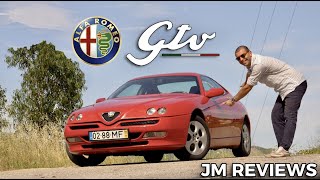
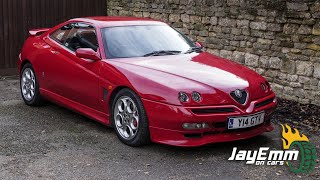
Series 1
(1995 - 1998)
3.0 L V6 24V
220 cv

Technical specifications, versions, and history for the Alfa Romeo GTV.
Select a generation to see available versions
(1995 - 1998)

(1998 - 2003)

(2003 - 2005)
In the late 1980s, Alfa Romeo was undergoing a crucial transition after being acquired by the Fiat Group in 1986. Under the leadership of then-Fiat CEO Vittorio Ghidella, the development project for the Type 916 model began. The goal for the new chassis was clear: to re-establish the Italian brand's purely sporty image in the coupe market. This joint effort resulted in the parallel development of two models: the Alfa Romeo GTV (Gran Turismo Veloce), a coupe with a 2+2 seating configuration, and its two-seater convertible sibling, the Spider.
Both models were designed by stylist Enrico Fumia, from the renowned Pininfarina studio. Initial sketches began in September 1987, and the full-scale clay model was approved in July 1988. Although the car's exterior remained faithful to Fumia's design, the initial interior design was rejected by the Fiat board. Consequently, the Alfa Romeo Centro Stile, under the leadership of designer Walter de Silva, took responsibility for finalizing the cabin's aesthetic details and refining the exterior finishing elements. Many of the model's final lines were directly inspired by the Alfa Romeo Proteo concept car, presented at the 1991 Geneva Motor Show, from which it inherited the iconic low front end with embedded dual round headlights.
After years of testing and production line adjustments, the final GTV model was officially presented at the Paris Motor Show in October 1994, with global sales beginning shortly after the Geneva Motor Show in March 1995.
The Alfa Romeo GTV utilized a heavily modified version of the Fiat Group's "Tipo Due" (Type 2) front-wheel-drive platform as its base. Although it shared the McPherson front suspension components and basic transmission with the 1992 Alfa Romeo 155 sedan, the model's dynamic behavior was transformed by the introduction of an innovative independent multilink rear suspension.
This rear system was designed by engineer Gianclaudio Travaglio under the supervision of chief engineer Bruno Cena. The decision to adopt such refined engineering came from the new Fiat Auto CEO, Paolo Cantarella, who in 1990 demanded a "no-compromise" design after testing the original prototypes. The suspension was mounted on a lightweight aluminum alloy subframe fixed directly to the car's steel chassis.
The great innovation of this geometry was the passive steering effect of the rear wheels. Thanks to the design of the quadrilateral arms and the programmed deformation of the mounting bushings, the rear wheels slightly altered their toe-in/toe-out according to lateral force in corners:
This solution eliminated the chronic tendency toward understeer (front-end push) common in front-wheel-drive platforms of the time, causing the GTV chassis to respond agilely and precisely, simulating the dynamic balance of rear-wheel-drive sports cars.
Throughout its ten years of active commercialization, the Alfa Romeo GTV went through three distinct phases of stylistic and technical updating to remain modern and in compliance with European emission legislation.
The first Phase 1 models were characterized by a clean and purist look, sporting the front shield ("Scudetto") integrated into the hood in black plastic without a chrome frame, and side skirts that circled the car's base painted in matte black. The instrument panel adopted classic analog gauges deeply recessed in individual cylinders aimed directly at the driver's view.
In mid-1996, a technical transition known as Phase 1b began. The GTV model began to offer the 3.0 V6 24-valve engine. To handle the power increase and the resized Brembo brakes with 305 mm discs and four-piston red calipers, the car began to be equipped with 16-inch "Teledial" style alloy wheels (five circular holes). Internally, the finish was improved with pleated leather seats from the MOMO brand in red, white, or tan, with coordinated door linings and carpets. The center console replaced the round ventilation knobs with rectangular selectors and introduced a three-spoke sports steering wheel.
Presented in May 1998, Phase 2 focused on modernizing the cabin and aesthetic refinements. The car's exterior adopted the front shield with a polished chrome frame, and the side skirts began to be painted the same color as the bodywork.
The cabin received an entirely redesigned center console with a silver finish imitating satin aluminum, plus new gauges and climate controls. Alfa Romeo made available the internal styling packages "Red Style" (red-centered dashboard with red or black seats) and "Blue Style" (seats, dashboard, and carpets entirely in coordinated blue or white). Mechanically, the powerplants were adapted to meet Euro 2 environmental standards (CF2 electronic management series). The 3.0 V6 24V engine gained a new six-speed manual transmission. In the year 2000, to optimize operating costs, the Fiat Group transferred final assembly of the GTV from its old Arese plant in Milan to Pininfarina's specialized facilities in San Giorgio Canavese.
Phase 3 was the most radical update applied to the model, also designed directly by the Pininfarina studio. The vehicle's front end was restyled to incorporate the new Alfa Romeo visual standard, adopting a much larger and deeper central chrome shield that extended to the lower part of the bumper, which forced the license plate to be offset to the left side.
Internally, seats with a slightly lowered base were installed, and the center console received a slight button repositioning. The aging Twin Spark four-cylinder engine was replaced by the modern JTS engine with direct fuel injection. At the top of the range, the 3.0 V6 24V engine was discontinued to make way for the 240 PS 3.2 V6 powerplant. Series production of the model ended in late 2004, although remaining stock units continued to be sold until mid-2006.
The inline four-cylinder engines that equipped the Alfa Romeo GTV were built at the Pratola Serra plant, while the V6 six-cylinder engines were machined at the iconic Arese plant.
The "Twin Spark" ignition system used two different-sized spark plugs per cylinder in asymmetrical positions. This system generated an extremely uniform fuel burn through four individual static coils operating on the wasted spark principle. The 2.0 Twin Spark engine featured two internal balancer shafts driven by a belt to neutralize second-order engine vibrations, ensuring smooth and quiet operation similar to larger displacement engines. Conversely, the 1.8 Twin Spark engine did without these shafts to reduce internal moving mass and favor quick throttle response.
The 2.0 JTS (Jet Thrust Stoichiometric) powerplant, which debuted in Phase 3, abandoned Twin Spark technology and adopted a single conventional spark plug per cylinder combined with a direct fuel injection system at high pressure directly into the combustion chamber, which significantly optimized fuel consumption and raised torque available at low revs.
The legendary 60-degree V6 engine, designed by Giuseppe Busso, featured a cast aluminum block, liquid cooling, and polished, chrome-plated intake ducts at the front of the engine.
The 2.0 V6 Turbo (TB) engine was custom-designed for the Italian market to bypass the severe 38% taxation on cars equipped with engines larger than 2.0 liters. Alfa Romeo engineers reduced the cylinder bore of the V6 block and installed a Garrett T25 turbocharger with an intercooler, managing to extract an excellent 200 PS of power and visceral responses through an electronic temporary turbo boost (overboost) system.
The 3.0 and 3.2 24-valve engines featured double overhead camshafts (DOHC) driven by a reinforced timing belt and displayed dynamic behavior characterized by linear torque and a striking metallic sound at high revs.
Below are the official technical performance and fuel economy specifications for each powertrain that equipped the Alfa Romeo GTV:
| Engine | Phase | Engine Code | Maximum Power | Maximum Torque | Acceleration (0–100 km/h) | Top Speed | Average Consumption (L/100 km) |
|---|---|---|---|---|---|---|---|
| 1.8 TS 16V | Phase 2 | AR 32201 | 144 cv @ 6,500 rpm | 169 Nm @ 3,500 rpm | 9.2 s | 210 km/h | 8.9 L |
| 2.0 TS 16V (Euro 1) | Phase 1 | AR 16201 | 150 cv @ 6,200 rpm | 186 Nm @ 4,000 rpm | 8.4 s | 215 km/h | 9.2 L |
| 2.0 TS 16V (Euro 2) | Phase 2 | AR 32301 | 155 cv @ 6,400 rpm | 187 Nm @ 3,500 rpm | 8.4 s | 216 km/h | 9.2 L |
| 2.0 TS 16V (Euro 3) | Phase 2 | AR 32310 | 150 cv @ 6,300 rpm | 181 Nm @ 3,800 rpm | 8.5 s | 215 km/h | 9.2 L |
| 2.0 JTS 16V | Phase 3 | 937A1000 | 165 cv @ 6,400 rpm | 206 Nm @ 3,250 rpm | 8.4 s | 220 km/h | 9.2 L |
| 2.0 V6 Turbo | Ph 1 / Ph 2 | AR 16202 | 200 cv @ 6,000 rpm | 271 Nm @ 2,400 rpm | 7.4 s | 235 km/h | 10.8 L |
| 3.0 V6 12V | Phase 1 | AR 16101 | 192 cv @ 5,600 rpm | 260 Nm @ 4,400 rpm | 7.3 s | 225 km/h | 11.0 L |
| 3.0 V6 24V (Euro 2) | Ph 1b / Ph 2 | AR 16102 | 220 cv @ 6,300 rpm | 270 Nm @ 5,000 rpm | 6.7 s | 240 km/h | 11.7 L |
| 3.0 V6 24V (Euro 3) | Phase 2 | AR 16105 | 218 cv @ 6,300 rpm | 265 Nm @ 5,000 rpm | 6.8 s | 238 km/h | 11.7 L |
| 3.2 V6 24V | Phase 3 | 936A6000 | 240 cv @ 6,200 rpm | 289 Nm @ 4,800 rpm | 6.3 s | 255 km/h | 13.2 L |
To celebrate the one-make racing championship conceived by the brand in 1999 under the supervision of driver Andrea de Adamich at the Varano circuit — in which drivers received advanced driving instruction aboard GTV racing cars with prepared 230 PS V6 engines, without catalytic converters, and about 200 kg lighter —, Alfa Romeo launched the GTV Cup on the street market in 2001.
This street series was globally limited to just 419 units and featured striking aesthetic modifications inspired by the track. Externally, the car adopted side skirts with extractors behind the front fenders, side skirts, a pronounced rear spoiler supplied by the German company Zender, and exclusive 17-inch wheels with a titanium grey finish. The interior featured center consoles painted in metallic titanium, black leather sports seats with light-gray textured fabric, factory-installed upgraded Brembo brakes, and an individual numbered control plaque.
The model was manufactured with two engine options and distinct steering configurations:
| Cup Powertrain | Steering Position / Market | Body Color | Specific Details | Units Produced |
|---|---|---|---|---|
| 3.0 V6 24V | Right (RHD) / UK | Alfa Red (Rosso Alfa 130) | 6-speed gearbox, standard Brembo brakes | 155 |
| 3.0 V6 24V | Left (LHD) / General Europe | Alfa Red (Rosso Alfa 130) | 6-speed gearbox, standard Brembo brakes | 25 |
| 2.0 Twin Spark | Left (LHD) / Europe and Italy | Metallic Light Grey (Grigio Chiaro) | Brembo brakes added at the factory | 239 |
The history of the GTV's importation into the Brazilian automotive market was tied to the import reopening policy promoted by the national government in 1990. After nearly twenty years of commercial closure, the landing of the luxurious Alfa Romeo 164 sedan marked the official return of the Italian brand's operations in the country.
Subsequently, in the mid-1990s, both Fiat's official importer and small independent importers began bringing limited batches of the GTV and Spider Type 916 sports models to the Brazilian market. Although sales volumes were small due to the importation cost, the model enjoyed excellent acceptance among classic sports car enthusiasts, with almost absolute preference for versions with Twin Spark engines and 24-valve V6s.
The importance of the South American market to Alfa Romeo motivated the creation of an official export catalog exclusive to the Brazilian market in the mid-1990s, identified under code 163.628.0.0 – Spider 3.0 V6 12V Lusso Brasile. Between 1995 and 1996, the Italian factory produced exactly 238 units of this specific convertible configuration aimed at meeting Brazilian environmental compliance and fuel standards, making this model one of the rarest classic export versions of the Type 916 project.
Listed below are the total audited and corrected production numbers for the Alfa Romeo GTV (Coupe) and the Spider (Convertible), classified according to specific powertrain and production cycle phases, evidencing the general volume of each industrial catalog over the years:
TOTAL PRODUCED GTV (COUPE): 42,935 units
TOTAL PRODUCED SPIDER (ROADSTER): 38,893 units
The Alfa Romeo GTV (Type 916) represents one of the most inspired engineering and styling projects in the modern history of the Italian manufacturer. Despite the initial challenges in adapting the front-wheel-drive chassis to a level worthy of high-standard sports cars, the inclusion of the advanced multilink rear suspension with passive steering, conceived under Paolo Cantarella's demanding parameters and executed with precision by Gianclaudio Travaglio, gave the GTV exceptional cornering dynamics.
The visual evolution promoted by the three distinct phases kept the model's aggressive aesthetic attractive throughout ten years of continuous production, while the refined Twin Spark, JTS, and the celebrated Busso V6 engines delivered performance worthy of Alfa Romeo's rich sporting heritage. Currently, rare special editions like the GTV Cup and the specific export examples for the Brazilian market are highly revered in the global automotive collecting community, confirming the Type 916's timeless legacy as a true work of art on wheels from the Italian industry.