Series 1
(2008 - 2013)
1.4 L I4 16V Turbo
170 cv

Technical specifications, versions, and history for the Alfa Romeo MiTo.
Select a generation to see available versions
(2008 - 2013)

(2013 - 2016)

(2016 - 2018)
Alfa Romeo's debut in the premium compact segment occurred in 2008 with the launch of the Alfa Romeo MiTo, known internally as the Tipo 955. The model was developed with the mission of attracting younger consumers and expanding the Italian manufacturer's sales volume, positioning itself as a stylish and sophisticated alternative to the MINI Cooper. During the project's gestation phase, the vehicle was codenamed "Junior". In 2007, the brand promoted a European contest to choose the definitive name for the new arrival. The winning name from the popular vote was "Furiosa", but the manufacturer's board opted to christen the hatchback MiTo. This name is a combination of the first letters of the cities of Milan (Milano), where the style was designed, and Turin (Torino), the site of its manufacture. Coincidentally, the word "mito" means "legend" in Italian.
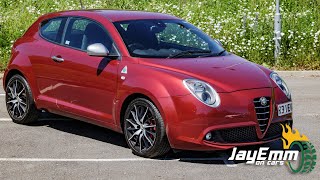
The model's design, signed by designer Juan Manuel Diaz at the Alfa Romeo Centro Stile, drew strong inspiration from the fluid lines of the limited-run Alfa Romeo 8C Competizione supercar. This visual heritage manifested in the rounded shape of the front headlights, the doors that dispensed with frames for the side windows, and the circular LED-illuminated taillights. The compact exhibited a sporty and muscular stance, with dimensions totaling 4,063 mm in length, 1,721 mm in width, 1,446 mm in height, and a 2,511 mm wheelbase. The trunk offered an initial volumetric capacity of 250 liters.
The MiTo was structured on the SCCS (Small Common Components and Systems) platform, a modular architecture shared with the Fiat Grande Punto and the Opel Corsa D. However, to deliver the agile behavior demanded by Alfa Romeo customers, engineering applied profound modifications to the assembly. The front and rear tracks were widened by 10 mm and the ride height was lowered compared to the Punto. The suspension used the traditional McPherson architecture at the front and a torsion beam at the rear, but received firmer coil springs and special shock absorbers equipped with internal rebound springs to contain body roll in corners. The vehicle's aerodynamic drag coefficient was optimized to 0.29.
The model's major dynamic innovation was the debut of the "Alfa DNA" system, a selector that allowed the driver to adjust the vehicle's operating parameters in three different modes: Dynamic, Normal (later renamed Natural), and All-Weather. This device altered the throttle response curve, the level of electric steering assistance, the actuation of the stability control (VDC), and transmission behavior. In Dynamic mode, the engine activated a turbo overboost function, delivering the maximum available torque. In All-Weather mode, the electronics prioritized active safety and traction control on extremely low-grip surfaces, such as wet asphalt or snow.
Integrated into this dynamic apparatus, the front axle featured the Q2 electronic differential. When the DNA selector was in the sports position, the system monitored grip loss and applied braking force to the inner wheel during hard cornering, transferring engine torque to the outer wheel with more traction. This significantly improved cornering speed and reduced understeer without the need for a heavy mechanical differential. The steering system also featured Dynamic Steering Torque (DST), which interacted with the stability control to send subtle steering pulses to the steering wheel, guiding the driver to make the correct trajectory correction in loss-of-control situations. In versions equipped with more powerful engines, Alfa Romeo made available an active suspension with electronic shock absorbers developed in partnership with Magneti Marelli, capable of reading road conditions via five accelerometers.
The model's braking proved quite efficient, requiring only 34 meters to bring the vehicle to a complete stop from a speed of 100 km/h, thanks to the use of four generously sized disc brakes. Regarding passive safety, the compact offered seven airbags as standard, active front headrests to avoid whiplash in rear-end collisions, and a body constructed with high-strength steels. This design earned the MiTo the maximum five-star rating in Euro NCAP crash tests in 2008, registering 36 points for adult occupant protection.
The MiTo reached the European market with engines inherited from Fiat but underwent crucial mechanical refinements within its first year. In September 2009, the compact adopted gasoline powertrains with the innovative MultiAir valve actuation system. This technology eliminates the conventional physical intake camshaft, utilizing an electro-hydraulic control system operated by solenoids to freely regulate the timing and lift of the intake valves per cycle. Fuel burn became much cleaner, generating significant gains in torque and power efficiency, while drastically reducing emissions of nitrogen oxides (NOx) and particulate matter.
In 2010, Alfa Romeo introduced the TCT (Twin Clutch Transmission) six-speed dry dual-clutch automated gearbox, capable of handling up to 350 Nm of torque. In 2011, the range gained the 875 cc two-cylinder turbocharged TwinAir engine, focused on ecological and urban mobility.
Presented in late 2013 for the 2014 model year, the first facelift focused on aesthetic and connectivity changes. On the outside, the MiTo received a new chrome trim surrounding the front grille (in the same style adopted by the Giulietta model), front headlights with darkened internal lenses, and a new metallic grey paint option.
Inside, the cabin was renewed with new fabric patterns for the seats and three unprecedented trim options for the dashboard. The main technological advancement was the installation of Continental's Uconnect multimedia center, equipped with a 5-inch color touchscreen, auxiliary connections, Bluetooth, and an integrated TomTom navigation system. All available engines were updated to meet Euro 5+ emission parameters.
The second MiTo facelift was displayed at the 2016 Geneva Motor Show and aimed to align the model's design with the new visual language introduced by the Giulia sedan. The front of the compact hatch received a remodeled bumper with black honeycomb-pattern lower grilles, the Alfa Romeo front shield began to feature a darkened surround, and the brand's classic colored emblem was replaced by a modernized visual version. The trunk lid received the brand's new logo and redesigned lettering for the car's name.
The manufacturer simplified the model's trim levels, offering it in MiTo, Super, and Veloce configurations. The old top-of-the-line "Quadrifoglio Verde" variant was discontinued, being replaced directly by the Veloce version, which featured an aggressive look and finish focused on performance. The powerplants were recalibrated to comply with Euro 6 emission rules.
The Alfa Romeo MiTo offered a variety of gasoline, diesel, liquefied petroleum gas (LPG), and compressed natural gas (CNG/NGV) engine options throughout its production cycle. The tables below gather the detailed specifications for each powertrain marketed from 2008 to 2018.
| Engine Identification | Block and Head Type | Displacement | Maximum Power | Maximum Torque | Transmission | Top Speed | 0–100 km/h | Period |
|---|---|---|---|---|---|---|---|---|
| 0.9 TwinAir 85 | I2 Turbo, SOHC 8V | 875 cc | 85 hp @ 5,500 rpm | 145 Nm @ 2,000 rpm | 6-speed Manual | 174 km/h | 12.5 s | 2011–2012 |
| 0.9 TwinAir 105 | I2 Turbo, SOHC 8V | 875 cc | 105 hp @ 5,750 rpm | 145 Nm @ 2,000 rpm | 6-speed Manual | 184 km/h | 11.4 s | 2013–2018 |
| 1.4 MPI 78 | I4 Naturally Aspirated, SOHC 8V | 1,368 cc | 78 hp @ 6,000 rpm | 120 Nm @ 4,750 rpm | 5 or 6-speed Manual | 165 km/h | 12.3 s | 2008–2018 |
| 1.4 MPI 95 | I4 Naturally Aspirated, DOHC 16V | 1,368 cc | 95 hp @ 6,000 rpm | 129 Nm @ 4,750 rpm | 6-speed Manual | 180 km/h | 11.2 s | 2008–2018 |
| 1.4 MPI MultiAir 105 | I4 Naturally Aspirated, SOHC 16V | 1,368 cc | 105 hp @ 6,500 rpm | 130 Nm @ 4,000 rpm | 6-speed Manual | 187 km/h | 10.7 s | 2009–2018 |
| 1.4 TB 120 | I4 Turbo, DOHC 16V | 1,368 cc | 120 hp @ 5,000 rpm | 206 Nm @ 1,750 rpm | 5-speed Manual | 195 km/h | 8.8 s | 2008–2009 |
| 1.4 TB 155 | I4 Turbo, DOHC 16V | 1,368 cc | 155 hp @ 5,500 rpm | 230 Nm @ 3,000 rpm | 6-speed Manual | 215 km/h | 8.0 s | 2009–2018 |
| 1.4 TB MultiAir 135 | I4 Turbo, SOHC 16V | 1,368 cc | 135 hp @ 5,250 rpm | 206 Nm @ 1,750 rpm | 5-speed Manual | 207 km/h | 8.4 s | 2009–2018 |
| 1.4 TB MultiAir 135 TCT | I4 Turbo, SOHC 16V | 1,368 cc | 135 hp @ 5,250 rpm | 230 Nm @ 1,750 rpm | 6-speed TCT | 207 km/h | 8.2 s | 2010–2018 |
| 1.4 TB MultiAir 170 (QV) | I4 Turbo, SOHC 16V | 1,368 cc | 170 hp @ 5,500 rpm | 250 Nm @ 2,500 rpm | 6-speed Manual | 219 km/h | 7.5 s | 2009–2018 |
| 1.4 TB MultiAir 170 TCT | I4 Turbo, SOHC 16V | 1,368 cc | 170 hp @ 5,500 rpm | 250 Nm @ 2,500 rpm | 6-speed TCT | 219 km/h | 7.3 s | 2014–2018 |
| Engine Identification | Block and Head Type | Displacement | Maximum Power | Maximum Torque | Transmission | Top Speed | 0–100 km/h | Period |
|---|---|---|---|---|---|---|---|---|
| 1.3 JTDm 90 | I4 Turbo-Diesel, DOHC 16V | 1,248 cc | 90 hp @ 4,000 rpm | 200 Nm @ 1,750 rpm | 6-speed Manual | 178 km/h | 11.8 s | 2008–2009 |
| 1.3 JTDm 95 | I4 Turbo-Diesel, DOHC 16V | 1,248 cc | 95 hp @ 4,000 rpm | 200 Nm @ 1,500 rpm | 5-speed Manual | 180 km/h | 11.6 s | 2009–2018 |
| 1.3 JTDm 85 (UK) | I4 Turbo-Diesel, DOHC 16V | 1,248 cc | 85 hp @ 3,500 rpm | 200 Nm @ 1,500 rpm | 5-speed Manual | 174 km/h | 12.9 s | 2011–2018 |
| 1.6 JTDm 120 | I4 Turbo-Diesel, DOHC 16V | 1,598 cc | 120 hp @ 3,750 rpm | 320 Nm @ 1,750 rpm | 6-speed Manual | 198 km/h | 9.7 s | 2008–2018 |
| 1.4 Turbo GPL (LPG) | I4 Turbo-LPG, DOHC 16V | 1,368 cc | 120 hp @ 5,000 rpm | 206 Nm @ 1,750 rpm | 5-speed Manual | 198 km/h | 8.8 s | 2009–2016 |
| 1.4 Natural Power (CNG) | I4 Turbo-CNG, SOHC 16V | 1,368 cc | 120 hp @ 5,000 rpm | 206 Nm @ 1,750 rpm | 6-speed Manual | —— | —— | 2012–2016 |
(Note: The 78 hp 1.4 MPI engine received updates throughout its life cycle, varying the number of valves in the cylinder head and injection electronic maps to optimize CO₂ emission data).
Alfa Romeo took advantage of the MiTo's visual appeal and urban agility to launch exclusive, low-run series, coveted by brand collectors.
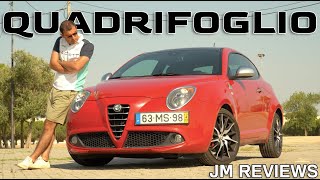
Launched in 2009, the Quadrifoglio Verde version was equipped with the 170 hp 1.4 TB MultiAir engine. It featured active suspension with continuously variable stiffness, resized Brembo brake system, and exclusive 17 or 18-inch alloy wheels.
Inside, the cabin received darkened sports trim, a steering wheel with green stitching, and structured Sabelt sports seats with a carbon fiber shell. With the line's remodeling in 2016, this top-of-the-line mechanical configuration was renamed MiTo Veloce.
Strictly limited series of 100 units produced to serve as official courtesy vehicles for the Maserati dealership and authorized service network in Europe. The vehicles came in the exclusive Maserati Ocean Blue shade and were equipped with the 170 hp 1.4 MultiAir engine.
The interior finish was refined, with seats upholstered in tan Frau leather, dual-zone digital air conditioning, GPS navigator with European maps, and metallic door sill guards with the inscription "Alfa Romeo for Maserati".
This commemorative edition celebrated the 46th anniversary of the Registro Italiano Alfa Romeo, with production limited to just 46 numbered units, destined exclusively for club members. Painted in Cattivo Black or Etna Black, the units featured darkened 17-inch forged alloy wheels in an identical style to those of the 8C Competizione supercar, red brake calipers, and premium leather interior in black or burgundy colors.
The factory 1.4 Turbo engine received special tuning to raise power from 155 hp to 170 hp, in addition to incorporating a silver plaque on the center console with the owner's name engraved at the factory.
Commemorative series produced in a limited run of 200 units to honor Alfa Romeo's role as the official safety car of the FIM Superbike World Championship.
The vehicle adopted a two-tone paint job (Solid Black with Alfa Red roof or Alfa Red with Black roof), sporty side decals, rear spoiler, and 18-inch alloy wheels that housed red Brembo brake calipers. Inside, it came with Sabelt sports seats upholstered in Alcantara with red stitching and a carbon fiber backrest.
Revealed as a functional prototype at the 2009 Geneva Motor Show, the Gran Turismo Alleggerita (GTA) project represented the pinnacle of performance conceived for the model. Under the hood, the concept carried the 1,750 cc (1.75 liter) four-cylinder aluminum engine, endowed with direct fuel injection and continuously variable intake and exhaust valve timing.
This unit generated a power output of 240 hp. The vehicle's total weight was reduced through the use of carbon fiber components in the rear wing, roof panel, and mirror caps, while aluminum was utilized in the suspensions and braking system. The car featured lowered active suspension by 20 mm and reduced-weight 19-inch alloy wheels. For economic feasibility reasons stemming from the global financial crisis, Alfa Romeo opted not to produce the model in mass.
Two test prototypes were built with hydrogen fuel cell technology to participate in environmental experimentation programs in Europe.
The electric powertrain utilized a fuel cell supplied by Nuvera, associated with compact lithium-ion batteries and 700 bar pressure hydrogen storage cylinders, delivering a range of up to 450 km.
Although the MiTo offered good handling and striking design, owners and mechanics reported recurrent failures in specific components throughout the model's ten years on the market. The 78 hp 1.4 naturally aspirated engine proved to be the most robust and durable in the portfolio, while units equipped with the modern MultiAir head required meticulous maintenance to avoid serious failures.
The Alfa Romeo MiTo accumulated a total production of 293,428 units over its commercial trajectory. All units destined for global markets were assembled at the Mirafiori plant, located in Turin. The table below details the annual volume of vehicles produced at the plant and the respective consolidated sales on the European continent.
| Calendar Year | Production (Mirafiori Plant) | European Market Sales |
|---|---|---|
| 2008 | 24,759 | 13,282 |
| 2009 | 65,342 | 62,122 |
| 2010 | 53,091 | 51,994 |
| 2011 | 41,077 | 40,425 |
| 2012 | 24,857 | 25,173 |
| 2013 | 19,655 | 17,884 |
| 2014 | 16,894 | 16,950 |
| 2015 | 13,909 | 13,839 |
| 2016 | 14,644 | 12,944 |
| 2017 | 10,906 | 11,367 |
| 2018 | 8,274 | 9,198 |
| Cumulative Total | 293,408 | 275,178 |
(Note: The total production officially released by the manufacturer for the car's full life cycle is 293,428 units. The consolidated sum of the annual tables from internal Mirafiori records registers 293,408 assembled vehicles).
The MiTo achieved excellent commercial acceptance in the first years following its launch, surpassing the mark of 62,000 units sold in Europe in 2009. This strong initial demand helped Alfa Romeo maintain market relevance at a time when the mid-size 147 model was losing appeal and the 159 sedan was suffering from falling sales volumes. However, starting in 2012, sales began a continuous decline trajectory. The absence of a practical five-door body revealed itself as a crucial hurdle, as consumption profiles in the B-segment migrated heavily toward more versatile vehicles or compact sport utility vehicles (crossovers).
In 2017, annual demand had plummeted to just 11,367 units in Europe. Faced with such low volumes and the need to reorganize its assembly lines to make more profitable crossovers viable, FCA definitively ended MiTo manufacturing in mid-2018. The draining of remaining dealership stock extended into 2020. The segment occupied by the compact remained without direct representation in the Alfa Romeo lineup until 2024, when the manufacturer launched the Junior model, a compact SUV that caters to the public that previously consumed the brand's compact hatchbacks.
The Alfa Romeo MiTo fulfilled an important strategic mission for the Arese brand. From a market point of view, it allowed the manufacturer to participate in a segment in which it had never competed, attracting a new generation of drivers and keeping the Mirafiori plant active during the global financial crisis of the late 2000s.
Technically, the MiTo served as the group's main laboratory for new mechanical technologies, debuting MultiAir technology and combining it with advanced electronic vehicle dynamics systems, such as the DNA selector and the Q2 electronic differential, which dictated the handling standard for future Alfa Romeo models. Although its cycle ended due to the irreversible shift in consumer preference toward SUVs and five-door cars, the model established itself as a future classic, valued for its Italian design and sharp dynamic behavior.