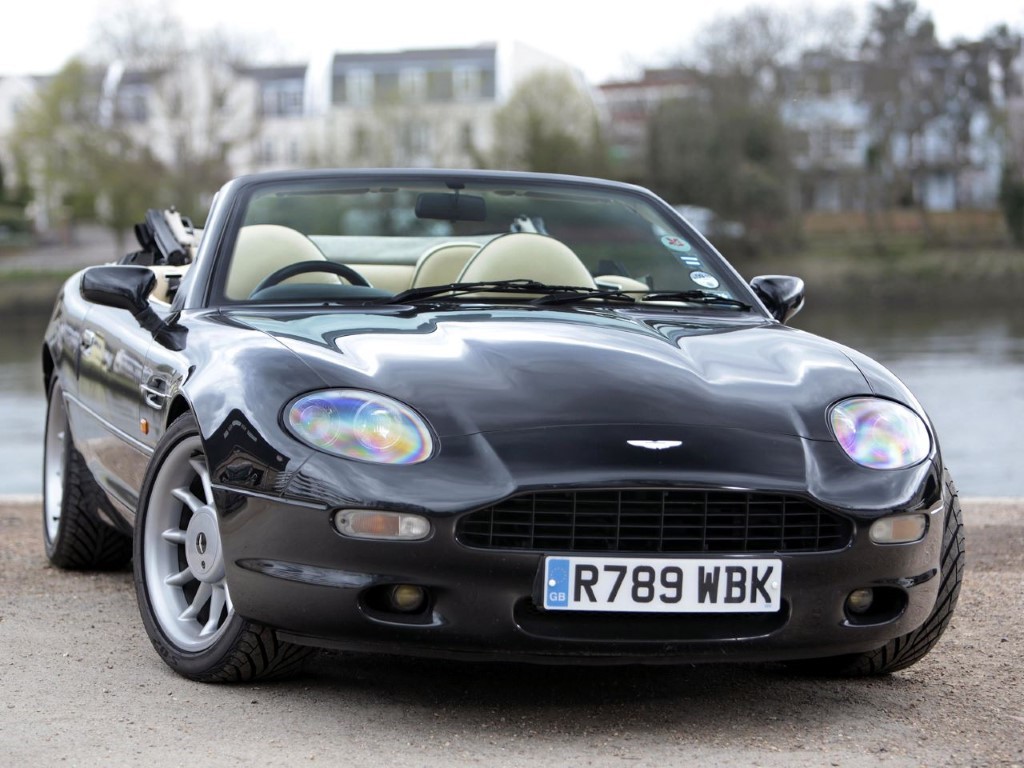
1st Generation
(1997-2000)
3.2 Supercharged
340 cv

The pinnacle of British sophistication in a convertible designed to cross continents with unrivaled style.
Select a generation to see available versions
(1997-2000)
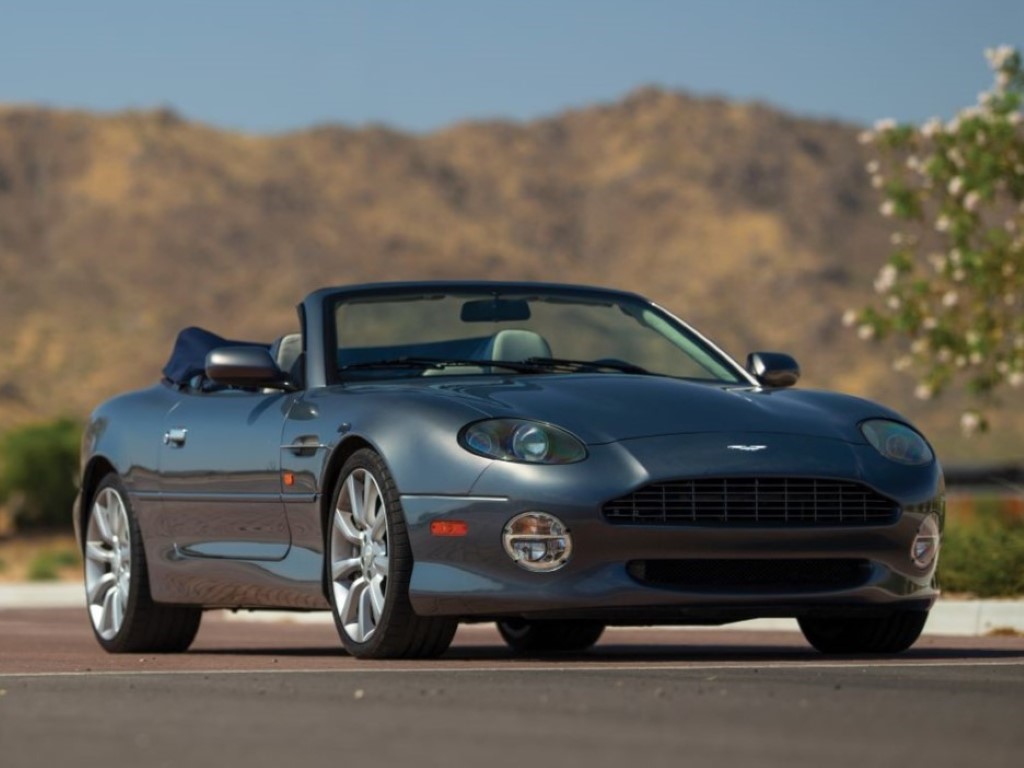
(2000-2003)
The history of Aston Martin is often characterized by cycles of financial turbulence followed by extraordinary products that rescue the brand from obscurity. However, no model exemplifies this narrative as viscerally as the Aston Martin DB7. Launched at a time when the company's annual production numbered in the mere tens, the DB7 was not just a new model; it was the catalyst that transformed Aston Martin from a niche artisanal operation into a global manufacturer of luxury sports cars. Within this lineage, the DB7 Volante (the brand's traditional designation for convertibles) played a fundamentally strategic role, especially in reclaiming the North American market, vital for the company's sustainability under the aegis of the Ford Motor Company.
In the early 1990s, Aston Martin faced an existential crisis. The production of the Virage V8 models, hand-built at the historic Newport Pagnell factory, was expensive and slow, resulting in prohibitive prices that severely limited sales volume. Ford, which had acquired the brand in 1987, urgently needed a product that could be manufactured in more significant volumes — hundreds or thousands, instead of tens — to justify the investment and guarantee the brand's future.
The solution to this impasse did not emerge internally, but rather through an external collaboration with Tom Walkinshaw Racing (TWR). The genesis of the DB7 is intrinsically linked to a canceled project from Jaguar, another brand in Ford's portfolio at the time. Jaguar had spent years developing a successor to the E-Type, codenamed XJ41 (Coupe) and XJ42 (Convertible). This project, designed to be the new "F-Type", became excessively heavy, complex, and expensive, leading Ford to cancel it in 1990 in favor of what would become the XK8.
Tom Walkinshaw, the visionary owner of TWR, saw an opportunity in the abandoned work of the XJ41. He proposed to Aston Martin a re-engineered version of that concept, adapted to use the Jaguar XJS platform — a proven, albeit aging, mechanical base that would allow for a drastic reduction in development costs. Designer Ian Callum, then working for TWR, was tasked with restyling the bodywork so that it exuded Aston Martin's DNA, moving away from the Jaguar aesthetic. The project received the code NPX (Newport Pagnell Experimental) and was greenlit by Ford, marking the beginning of a new era.
The development of the DB7 was a brilliant exercise in pragmatism. By utilizing the Jaguar XJS platform, Aston Martin was able to bring a car to market in record time and with a budget that was a fraction of what a "clean sheet" design would require. However, this imposed significant challenges, especially for the future Volante variant.
The XJS chassis dated back to the mid-1970s. While competent, its adaptation for a modern GT required extensive work. The DB7's bodywork was built using a semi-structural steel monocoque, with the hood, front fenders, and trunk lid manufactured from composite materials (Resin Transfer Moulding - RTM) to save weight and allow for complex curves in the design.
For the Volante version, the removal of the hardtop — an essential component for structural integrity in monocoques — required substantial reinforcements. The engineering team had to add steel beams in the door sills, transverse reinforcements in the floorpan, and a more robust windshield structure. The goal was to maintain the torsional rigidity necessary for precise dynamic behavior, avoiding the "scuttle shake" common in convertibles of the era. Technical reports indicate that, despite these efforts, the Volante's chassis still exhibited some flexibility compared to the Coupe, a characteristic that would be mitigated, but never entirely eliminated, throughout the model's life.
Ian Callum's design for the DB7 is widely considered a masterpiece. He managed to disguise the proportions inherited from the XJS with fluid and organic lines that defined a timeless elegance. For the Volante, Callum designed a beltline that rose smoothly towards the rear, giving the car a muscular stance even with the top down.
A frequently discussed design point on the Volante was the roof storage. Due to the space constraints imposed by the XJS fuel tank and rear suspension, it was not possible to create a compartment where the top would hide completely under a flush tonneau cover. Instead, the top, when folded, sat visibly "stacked" at the rear, covered by a leather or vinyl cover that had to be manually secured. Although it was a less elegant solution than that of its German rivals (such as the Mercedes SL), it became a distinctive feature of the model, harkening back to classic British convertibles.
The first generation of the DB7 Volante, equipped with the six-cylinder engine, represented Aston Martin's official return to large volumes and, crucially, to the United States market.
While the DB7 Coupe was unveiled in 1993, the Volante version made its world debut only in January 1996, at the Detroit and Los Angeles Auto Shows. The choice of these locations was deliberate: North America was the primary target market for the convertible. Aston Martin had practically abandoned the US in previous years due to a lack of competitive products, and the Volante was the spearhead for the brand's renaissance in the region.
The engine that powered this generation was a 3.2-liter (3,228 cc) inline-six unit. Although based on the Jaguar AJ6 block, the engine was so extensively modified by TWR that Aston Martin considered it a distinct unit.
On the road, the DB7 i6 Volante was praised for its ride comfort and the linear power delivery of the supercharged engine. It was not a hardcore sports car; it was a Grand Tourer (GT) capable of covering long distances with style. Critics pointed out the high weight (almost 1,900 kg) and the steering which, although precise, did not transmit as much feedback as a Porsche 911. However, the aesthetics and exclusivity of the Aston Martin brand compensated for any dynamic shortcomings against technically superior rivals.
Production of the i6 Volante model took place at the Bloxham factory, Oxfordshire, a modern facility adapted specifically for the DB7.
| Parameter | Detail |
|---|---|
| Production Period | October 1996 – Mid 1999 |
| Total Produced | 879 Units |
| Chassis Range | Starting at SCFAA311-TK 201001 |
| Primary Market | United States of America |
The production of 879 units in less than three years was a resounding success by Aston Martin's standards, validating Ford's strategy and paving the way for something even more ambitious.
In 1999, the supercar landscape was changing. Ferrari had launched the 550 Maranello, and Jaguar was preparing to launch more powerful versions of the XK8. The DB7's six-cylinder engine, although competent, lacked the acoustic prestige and raw power needed to compete at the top of the food chain. Aston Martin's answer was the DB7 Vantage.
The introduction of the Vantage model marked the transition of the DB7 from a "baby Aston" to a true supercar. It was also the first time a mass-produced Aston Martin was equipped with a V12 engine, setting a precedent that lasts to this day.
The new heart of the DB7 Vantage was a naturally aspirated 6.0-liter (5,935 cc) V12. Developed in partnership with Ford Research and Cosworth, this engine was technically the union of two Ford Duratec V6 blocks, but with specific casting, cylinder heads, and internal components developed by Cosworth for Aston Martin.
The Vantage Volante was not just an engine swap; it was a near-complete re-engineering of the car.
The Vantage Volante proved to be even more popular than its predecessor, consolidating Aston Martin as a manufacturer of V12 GTs.
| Parameter | Detail |
|---|---|
| Production Period | 1999 – 2003 |
| Total Produced | 1,786 Units |
| Chassis Range | Starting at SCFAB322-XK 400001 up to 404297 |
| Note | Production more than doubled compared to the i6 Volante |
Throughout the life of the DB7 Volante, Aston Martin launched several special editions to maintain interest in the model and celebrate partnerships or historical events. These versions are highly sought after by collectors today due to their rarity and unique specifications.
This edition was created to celebrate British elegance in partnership with the luxury house Alfred Dunhill.
An ultra-exclusive edition commissioned for the famous "Christmas Book" of the American luxury department store Neiman Marcus.
Commissioned by the largest Aston Martin dealership group in the UK, Stratstone.
Created to commemorate Queen Elizabeth II's Golden Jubilee.
A rare series commissioned by the Lancaster Group.
The "Run-out model", celebrating the end of DB7 production and its 10th anniversary.
| Characteristic | DB7 Volante (i6) | DB7 Vantage Volante (V12) |
|---|---|---|
| Production Years | Oct 1996 – 1999 | 1999 – 2003 |
| Total Produced | 879 Units | 1,786 Units |
| Engine | 3.2L I6 Supercharged | 6.0L V12 Naturally Aspirated |
| Power | 335 hp @ 5,500 rpm | 420 hp @ 6,000 rpm |
| Torque | 368 lb-ft @ 3,000 rpm | 400 lb-ft @ 5,000 rpm |
| 0-100 km/h | ~5.7 seconds | ~5.1 seconds |
| Top Speed | 165 mph (265 km/h) | 165 mph (limited on Volante) |
| Auto Transmission | 4-spd GM 4L80-E | 5-spd ZF 5HP30 (Touchtronic) |
| Manual Transmission | 5-spd Getrag 290 | 6-spd Tremec T-56 |
| Chassis (Start) | SCFAA311-TK 201001 | SCFAB322-XK 400001 |
Note on Total Production: The combined number of 2,665 Volante units represents a significant portion (about 38%) of the total 7,000 DB7s produced. This volume was crucial to amortize the costs of the Bloxham factory and validate Ford's business model for the brand.
The Aston Martin DB7 Volante ended its production in December 2003, paving the way for the DB9 and the new era of the Gaydon factory. However, its impact endures.
In summary, the DB7 Volante was the right car at the right time. It combined timeless British beauty with the industrial pragmatics necessary to survive in the modern world, leaving a legacy of elegance and power that defined Aston Martin for the 21st century.